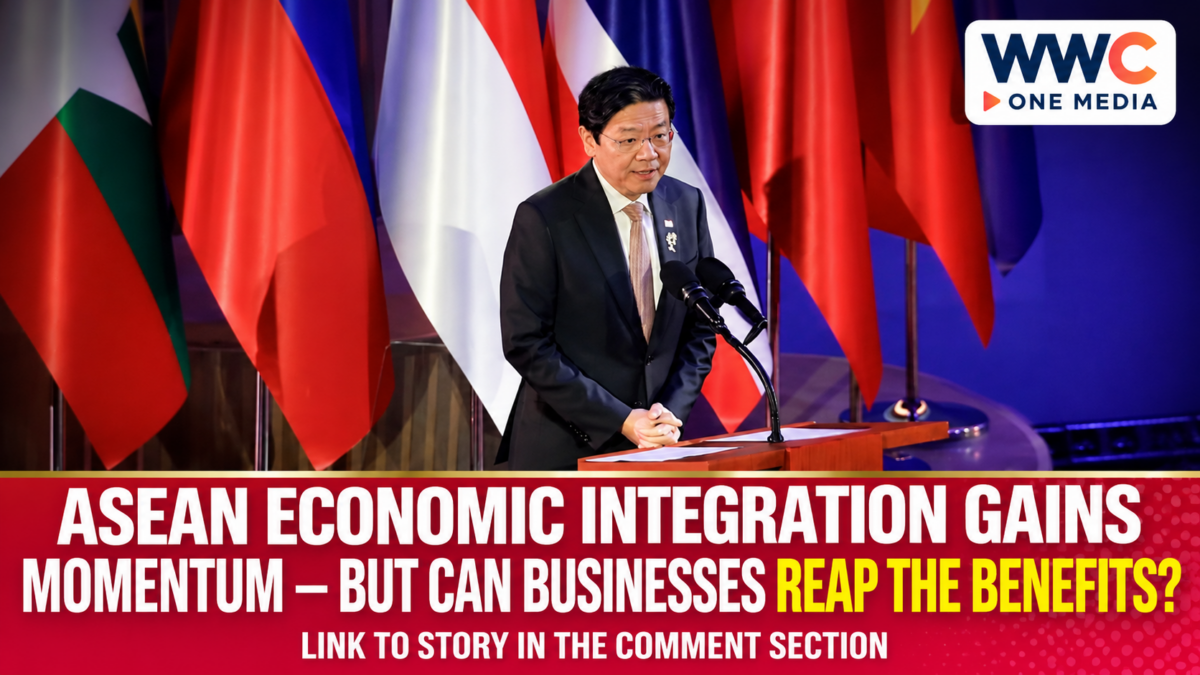
MANILA, Philippines — Singapore Prime Minister Lawrence Wong outlined a deeper regional market as a central priority for his country’s 2027 ASEAN chairmanship during the bloc’s summit closing ceremony in Manila on Nov. 17, 2026. His agenda puts financial connections, digital systems and energy cooperation at the centre of the next phase of ASEAN economic integration.
The important question for Philippine firms is not whether Southeast Asia can announce another ambitious economic vision. It is whether governments can make cross-border transactions, investment and trade easier in ways that businesses can actually use.
ASEAN economic integration moves from ambition to implementation
Wong’s closing remarks identified a more seamless regional market as an objective, alongside wider economic partnerships outside Southeast Asia. His stated theme for Singapore’s chairmanship is “Deeper Integration, Wider Partnerships.”
This is not the same as announcing an immediate single market. ASEAN members retain their own domestic rules, institutions and economic priorities. Making it easier for a company to operate in several countries requires practical coordination beyond a summit declaration.
For example, a Philippine manufacturer can benefit from a regional customer base only when its products can move reliably, comply with relevant requirements and reach buyers at a competitive delivered cost. An online services company needs compatible payment, data and identity systems as well as demand for what it sells.
The distinction between regional ambitions and concrete results matters. WWC’s earlier examination of ASEAN’s shifting supply chains explored why access to a larger production network does not automatically translate into higher-value activity for every member economy.
Digital rules could matter as much as tariffs
A significant outcome highlighted in Wong’s Nov. 17 speech was the signing of the ASEAN Digital Economy Framework Agreement, or DEFA. Singapore Deputy Prime Minister Gan Kim Yong described the agreement in a Nov. 18 public dialogue as a flexible framework intended to accommodate different levels of digital readiness among ASEAN members.
Gan explained that the framework allows members to pursue initial initiatives together while leaving room for others to participate as their capabilities develop. He said the agreement provides a 180-day period related to ratification and implementation, making national follow-through important.
For businesses, compatibility can be as consequential as a lower tariff. A supplier that cannot exchange documents efficiently, receive a payment securely or meet another market’s digital requirements still faces costs that can weaken its ability to compete.
These potential benefits are not yet universal entitlements or operational guarantees. WWC has separately examined the ASEAN digital pact signed in Manila and why the detailed implementation process matters to Filipino enterprises.
Regional trade still depends on the basics
Wong also cited the upgraded ASEAN Trade in Goods Agreement and the ASEAN-China Free Trade Agreement 3.0 among the milestones of the Philippine chairmanship. Their inclusion signals that integration is not limited to software platforms or emerging technologies.
Physical trade still depends on efficient customs procedures, dependable transport, clear product requirements and businesses that can meet orders consistently. Easier regional trade can improve access to suppliers and customers, but it does not remove competition between producers based in different countries.
For Philippine exporters, that means regional cooperation must be paired with domestic improvements. Reliable electricity, logistics, skilled staff and predictable compliance processes determine whether an enterprise can turn new commercial possibilities into signed orders.
Those gains would also be uneven. A larger business with established overseas customers may be able to adapt quickly, while a small enterprise could first need training, certification, financing or a trustworthy logistics partner.
The growth opportunity is real, but doubling is not assured
The public debate about the scale of ASEAN’s future economy should not be confused with a firm forecast or a contractual result of integration. Wong’s Nov. 17 official address set out an economic direction; it did not provide a dated, quantified guarantee that deeper integration would double regional output.
There is a useful historical distinction. In an official speech delivered in October 2022, Wong, then deputy prime minister, described a roughly US$3-trillion ASEAN economy and discussed the possibility of its size doubling or even quadrupling over the following two decades. That was a long-range expectation voiced in a different economic period, not a verified November 2026 forecast.
Changes in nominal economic size can reflect several forces, including inflation, exchange rates and growth in actual production. A headline about a bigger economy therefore does not, by itself, establish that workers will earn more or that every member country will benefit proportionately.
Readers looking at near-term performance can also consult WWC’s analysis of competing ASEAN growth projections, which explains why forecasts covering different geographic groups should not be treated as interchangeable.
What this could mean for Philippine businesses
Analysis: The strongest opportunity for the Philippines may come from lowering the practical cost of participating in regional commerce, rather than relying on the headline size of the ASEAN economy.
A Philippine exporter that faces fewer document-related delays could use working capital more efficiently. A technology services provider with more interoperable digital systems could potentially reach customers in neighbouring markets. A factory with reliable connections to regional suppliers could become a more attractive part of a multinational production network.
None of these benefits is automatic. Stronger competition could also put pressure on firms that cannot match rivals’ prices, delivery standards or technical capabilities. Smaller businesses may need support to understand regulatory requirements and manage international transactions.
The appropriate test is measurable: fewer delays, lower transaction friction, more accessible markets and sustained customer relationships. Policy progress should ultimately be evaluated against those outcomes rather than against the number of agreements signed.
What happens next
Singapore’s 2027 chairmanship will provide an opportunity to move the commitments announced in Manila into practical cooperation. Gan’s Nov. 18 remarks make the DEFA ratification and implementation process one clear item to monitor, while Wong’s agenda places finance, energy and external partnerships on the wider regional work programme.
For Philippine companies, useful indicators will include published implementing rules, functioning cross-border systems, customs improvements and evidence that smaller enterprises can participate. Until those changes occur, the most defensible conclusion is that ASEAN has an agenda for deeper integration, not a guaranteed doubling of prosperity.