A Singapore District Court has dismissed a passenger’s negligence claim against a private-hire driver after a chicken crossing the road triggered sudden braking on Holland Road. In its judgment published on Nov. 18, 2026, the court found that the driver’s response was reasonable in the circumstances, although the claimant has filed an appeal to the High Court.
The decision in Chen Qianyun Yvonne v Tan Teng Kiat [2026] SGDC 363 examines a practical question for road users: when an unexpected hazard forces a driver to brake sharply, does the resulting injury automatically make that driver legally responsible?
The court’s answer was no. It assessed the sequence of events, the available reaction time and the need to avoid a collision rather than treating the force of the braking as proof of negligence.
Singapore chicken case began with a sudden road hazard
The incident happened on Feb. 19, 2024, while Yvonne Chen Qianyun was travelling as a fare-paying passenger in a private-hire vehicle driven by Tan Teng Kiat.
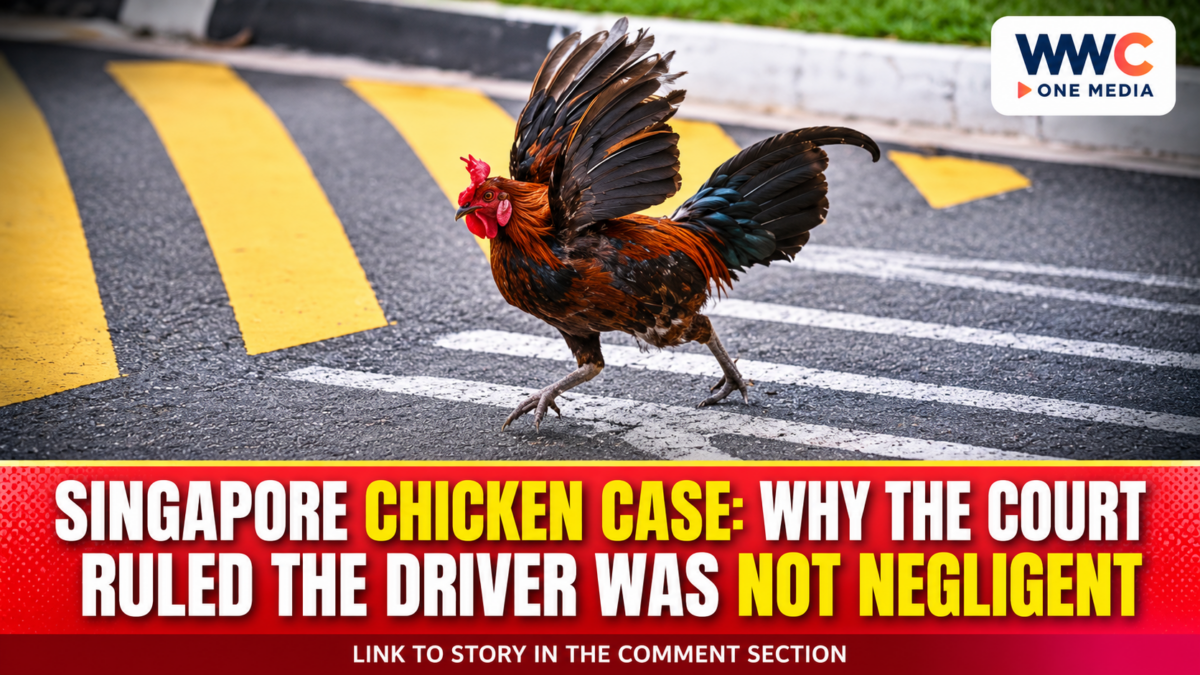
As the vehicle travelled along Holland Road, a chicken entered the path of the vehicle ahead. That vehicle braked, prompting Tan to apply his own brakes to avoid hitting it.
The two parties differed over how the animal entered the road. Chen described it as a jungle fowl that was already on the road, while Tan said it flew across the path.
The judge considered that difference immaterial to the central issue. The important point was that the animal caused the vehicle ahead to brake, creating a sudden situation for the vehicles behind.
Chen claimed that the braking caused her personal injuries. She argued that Tan had failed to maintain a sufficient following distance or, alternatively, that the force of his braking went beyond what was reasonably necessary.
What the court examined about following distance
The judgment considered Rule 67 of Singapore’s Highway Code, which sets out guidance on the distance drivers should leave between their vehicles and the vehicles ahead.
The rule states that drivers should allow at least one car length for every 16km/h of speed so they can adjust their speed and stop within the available space.
Tan’s evidence was that he had been travelling at about 50km/h and was approximately 10 metres behind the vehicle in front. Chen later testified that the gap was about four to five metres.
The judge observed that, using the Highway Code guidance and Tan’s stated speed, a following distance of about three car lengths would have been appropriate. However, the court did not make a final factual finding on whether Tan had maintained an adequate distance.
That distinction matters. The claim could not succeed simply by establishing that the distance might have been insufficient. The court also had to assess whether the driver’s response to the sudden hazard fell below the required standard of care.
Why emergency braking did not amount to negligence
The court found that Tan had applied an emergency or hard brake. It considered the sequence of events too sudden to expect the vehicles to slow down through ordinary, gentle braking.
The judge reasoned that a driver faced with a vehicle ahead braking suddenly because of an unexpected animal crossing may reasonably need to react in the same way to prevent a collision.
The court also considered whether Tan’s braking exceeded what was necessary. It concluded that the claimant had not established that either her primary argument about following distance or her alternative argument about the manner of braking demonstrated a breach of the required standard of care.
This was not a finding that sudden braking can never be negligent. The decision turned on the specific circumstances and the evidence presented in this case.
For drivers, the practical lesson is that road safety involves responding to hazards as they develop. Maintaining a safe distance remains important, but a sudden emergency can require an immediate response that differs from normal driving conditions.
The S$15,000 costs order and the appeal
The District Court dismissed Chen’s claim and ordered her to pay Tan costs fixed at S$15,000, together with any applicable goods and services tax and reasonable disbursements to be fixed if the parties could not agree.
The judgment also states that Chen filed an appeal to the General Division of the High Court. This means the District Court decision should not be presented as the final outcome of the entire dispute.
The trial before the District Judge dealt with responsibility for the incident. The judge expressly noted that the issue of causation of Chen’s alleged injuries was not before the court in that trial.
That is an important legal distinction: the court decided whether the driver was negligent in the circumstances, not every question that could arise in a separate assessment of injury or damages.
What this means for Singapore road users
The ruling illustrates how negligence cases are assessed through evidence rather than the outcome alone. An injury occurring during a vehicle manoeuvre does not automatically establish that the driver breached a duty of care.
The decision also shows why following-distance rules and emergency responses must be considered together. A driver should leave enough room to react, but courts may also recognise that an unexpected event can leave very little time to choose how to brake.
WWC has previously covered a Singapore motorist sentenced after a collision involving a motorcyclist, a separate case involving criminal driving liability. The distinction between criminal proceedings and civil negligence claims is important: the legal questions and standards are not interchangeable.
Other road incidents have also raised questions about how responsibility is established. In a Singapore cyclist collision case involving a falling shop panel, the court considered evidence about the condition of the premises and the circumstances of the accident. Meanwhile, a recent Singapore road collision involving a motorcyclist illustrates why an ongoing investigation should not be confused with a final finding of responsibility.
Together, these cases show that liability depends on the particular facts, the applicable legal duty and the evidence presented.
What happens next
The next significant development is the appeal filed by Chen to the General Division of the High Court. The District Court judgment does not state the appeal hearing date or its eventual outcome.
Until the appeal is decided, the November 18 judgment remains the District Court’s decision on the negligence issue. Any further conclusion about the dispute should be based on the High Court’s eventual ruling or other official court records.
Frequently asked questions
1. Why did the Singapore court dismiss the passenger’s claim?
The District Court found that the driver’s emergency braking was reasonable in response to a sudden hazard and that the claimant had not established a breach of the required standard of care.
2. How much was the claimant ordered to pay?
The court fixed costs at S$15,000, plus any applicable goods and services tax and reasonable disbursements to be fixed if not agreed.
3. When did the chicken incident happen?
The incident occurred on Feb. 19, 2024, while the claimant was travelling in a private-hire vehicle along Holland Road.
4. Did the court decide whether the passenger’s injuries were caused by the braking?
No. The trial dealt with responsibility for the incident. The judge noted that the issue of causation of the claimant’s alleged injuries was not before the court.
5. Is the case completely over?
Not based on the published District Court judgment. The judge recorded that the claimant had filed an appeal to the General Division of the High Court. The appeal outcome was not included in the judgment.