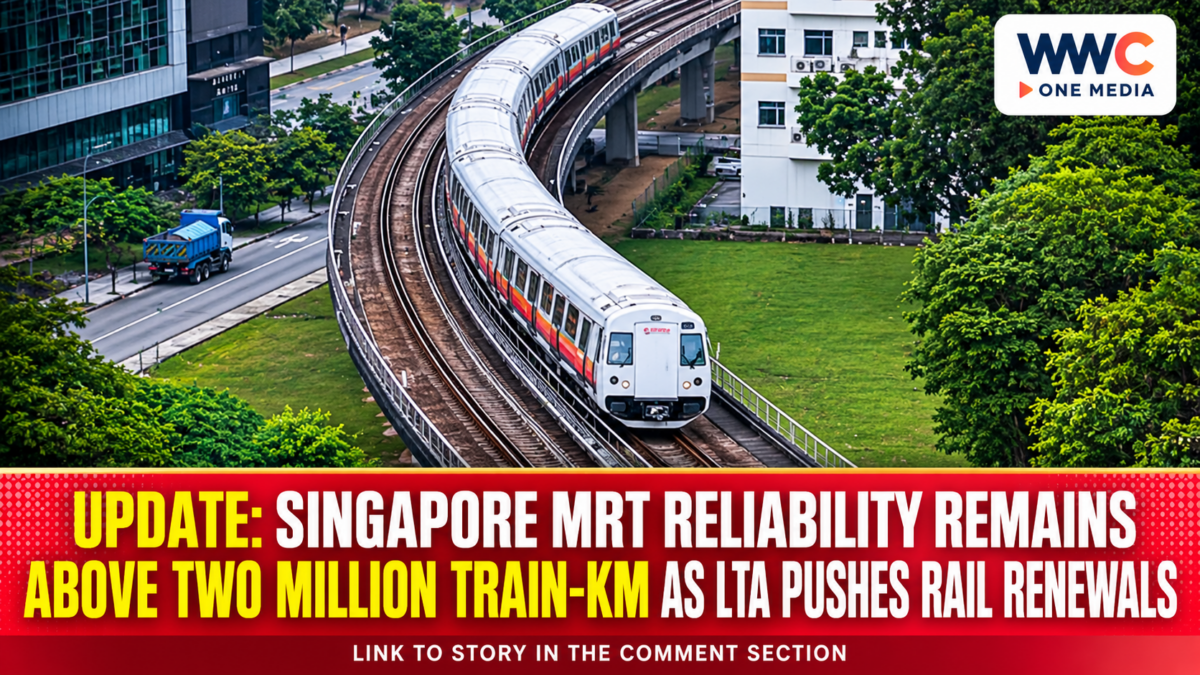
Recommended placement: Update the existing September MRT reliability article rather than publish a new standalone report.
Singapore’s transport authorities are moving from short-term disruption response towards a longer programme of rail maintenance, system renewal and workforce development. In October 2026, Transport Minister Jeffrey Siow said the MRT network was on track to record more than two million mean kilometres between failures for six consecutive months, with performance crossing three million train-km.
The minister also highlighted the North East Line’s year without a disruption at the time of his remarks. The figures underline the importance of looking beyond individual monthly movements: sustaining rail performance requires maintenance, replacement of ageing equipment and faster recovery when faults occur.
Rail reliability is becoming a long-term maintenance challenge
The Ministry of Transport’s October remarks placed greater emphasis on maintaining the system as the network grows and its assets age.
Mean Kilometres Between Failure, or MKBF, measures the average distance trains travel before a delay lasting more than five minutes. It is useful for tracking the frequency of qualifying failures, but it does not independently describe every aspect of the passenger experience.
The ministry’s position is that a large and complex rail system will still experience occasional equipment faults. Its operational priority is to minimise these incidents while preserving passenger safety.
Bukit Panjang LRT offers a case study in infrastructure renewal
The Bukit Panjang LRT renewal programme shows how sustained engineering work can change the performance of an existing system.
LTA said the programme began in 2018 and has involved replacing the train fleet, upgrading signalling and power systems, and improving the Operations Control Centre. The renewed fleet and signalling system have entered service, while the remaining power-rail replacement was scheduled for completion by the end of 2026.
The authority reported that BPLRT’s MKBF increased from 53,000 car-km in 2017 to about 443,000 car-km.
That is a substantial improvement, but the programme also illustrates why reliability cannot be treated as a one-time achievement. Infrastructure renewal requires continued monitoring, engineering work and investment.
Taskforce recommendations target the systems behind disruptions
In February 2026, LTA, SMRT and SBS Transit announced that they would progressively implement recommendations from the Rail Reliability Taskforce.
The work includes strengthening power supply, improving procedures for signalling faults, making train-rescue operations more efficient and improving spare-parts management.
The organisations also plan to standardise condition monitoring and share asset-performance data across operators. These measures are intended to identify faults earlier and improve maintenance planning.
Some renewal work may require longer engineering hours or planned service adjustments. LTA has said alternative transport arrangements will be considered where needed to reduce inconvenience.
What commuters should watch
The next stage of Singapore’s rail reliability effort is not simply about achieving a high MKBF figure. It is about maintaining dependable service while replacing ageing systems and expanding the network.
For commuters, the most useful picture comes from several indicators together: how often significant failures occur, how much scheduled service is delivered, whether trains arrive on time and how quickly operators restore normal service after an incident.
The September WWC report on Singapore’s MRT reliability should be updated with the official October report’s complete tables once the underlying LTA document is available. Until then, the October ministerial remarks and BPLRT renewal figures provide verified context, but should not be presented as a substitute for the complete monthly dataset.