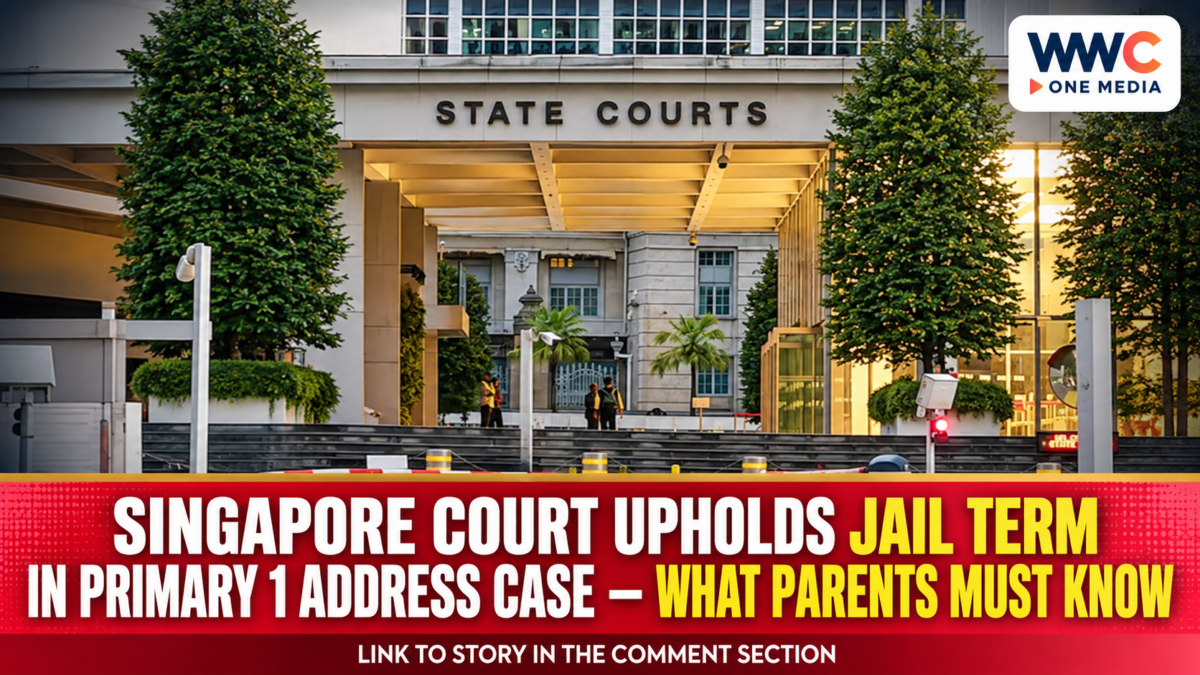
Singapore’s High Court has upheld a one-week jail sentence for a mother who admitted giving false residential information to secure and retain her daughter’s place at a primary school. The April 22, 2026 decision sets out why misleading a school and falsifying an official change-of-address record can cause harm beyond an individual family’s admission outcome.
The ruling matters because Singapore’s Primary 1 registration system uses residential distance as one basis for priority admission. The court’s reasoning shows that a false declaration can affect school resources, the reliability of public records and confidence in the fairness of a system that allocates limited places.
The judgment, JEH v Public Prosecutor [2026] SGHC 113, concerns a separate case from the parents charged in November 2026. It should not be treated as a decision on those newer allegations.
Singapore Primary 1: How the address became central
The High Court judgment describes a mother who owned a flat but had leased it to six tenants from January 2023 to December 2024. She and her daughter primarily lived at her partner’s apartment.
In June 2023, shortly before the Primary 1 registration exercise began, she reported that her residential address had changed back to the rented-out flat. The address was within one kilometre of the school, allowing her daughter to obtain priority admission through the home-school distance category.
The child began attending the school in January 2024.
The issue surfaced after the mother later informed the school of a change to an address outside the two-kilometre radius. The school began checking where the child actually lived. Its representatives visited the flat and encountered tenants rather than the mother and daughter.
The judgment records that the mother subsequently made repeated false statements to the school’s vice-principal about the family’s residence. She also gave false information when reporting a change of address to a registration officer.
Why the High Court rejected the appeal
The mother had pleaded guilty to an amalgamated charge of giving false information to a public servant and a separate charge under the National Registration Regulations involving a false change-of-residence report.
The District Court imposed one week’s imprisonment for each offence, with the sentences to run concurrently. She appealed, seeking to replace the custodial sentence with a fine.
Chief Justice Sundaresh Menon dismissed the appeal.
The High Court found that the conduct caused appreciable harm. School employees had to spend time checking the address, conducting visits, holding meetings and exchanging correspondence to establish the facts.
The court also considered the broader effect of false declarations on the Primary 1 admissions framework. Places allocated through distance-based priority are limited. A child admitted through inaccurate information may affect the opportunity available to another eligible applicant.
The judgment therefore treated the case as more than a private disagreement between a parent and a school. It involved the use of public resources and the integrity of a public admissions process.
The 30-month residence condition
The case also illustrates why parents must understand the conditions attached to distance-based priority admission.
In the judgment, the court noted that the child was required to reside at the declared flat for at least 30 months from the start of the 2023 registration exercise. The period would have ended on Jan. 4, 2026.
Singapore’s Ministry of Education also sets out conditions for alternative childcare arrangements. Its registration guidance requires parents using an approved caregiver’s address to make a declaration and obtain approval before registering through that address.
The ministry’s declaration warns that false information is a criminal offence under Section 182 of the Penal Code 1871, punishable by imprisonment of up to two years, a fine or both. It also states that a child may be transferred to another school if false information is provided.
Parents should therefore distinguish between a residential address, an approved caregiver arrangement and a temporary stay. These are not automatically interchangeable for registration purposes.
What the decision says about harm and punishment
The High Court’s reasoning focused on the actual consequences of the conduct, including the time and resources spent by school staff investigating the address.
It also considered the seriousness and persistence of the false statements. The judgment described a course of conduct involving repeated attempts to maintain the appearance that the family lived at the flat.
The court did not establish that every inaccurate address declaration automatically warrants imprisonment. Its decision assessed the specific facts, the harm caused and the offender’s culpability.
That distinction is important for parents. A sentencing outcome in one case should not be treated as a fixed penalty for every registration mistake. The facts, charges, plea and court findings matter.
For wider context, WWC previously examined Singapore’s changes to Primary 1 places for families without school ties. The registration framework also sits within a broader debate about school choice and family expectations, explored in our report on parents stepping away from Singapore’s education arms race.
Why fairness matters beyond one school
Primary 1 admission is an important transition for families, but it is also an allocation process. When a school has more applicants than available places, eligibility rules determine who receives priority.
That makes accurate information essential. If families could gain an advantage by declaring addresses where they do not genuinely live, the distance-based system would become harder to administer fairly.
The issue also connects with the pressure families feel when choosing schools. WWC has examined the cost and anxiety surrounding Singapore’s tuition culture. Those pressures help explain why school access receives close attention, but they do not change the obligations attached to official registration declarations.
The High Court ruling sends a clear message about the seriousness of deliberately misleading public institutions. It does not remove the need for fair treatment of every individual case, but it confirms that the consequences can extend beyond the applicant.
What happens next
The High Court judgment is a completed appeal decision in the case of JEH. It does not determine the outcome of any separate proceedings involving other parents.
Parents preparing for a future Primary 1 exercise should check the latest Ministry of Education registration instructions, use the correct residential information and secure approval before relying on an alternative caregiver address.
Any family uncertain about its eligibility should seek clarification from the ministry before submitting a declaration. Correcting a misunderstanding early is safer than allowing inaccurate information to become part of an official registration.
Frequently asked questions
1. Can a parent be jailed for giving a false address during Singapore Primary 1 registration?
A parent may face criminal consequences for giving false information. In JEH v Public Prosecutor [2026] SGHC 113, the High Court upheld concurrent one-week jail terms for offences involving false information to a public servant and a false change-of-address report.
2. What is the 30-month residence requirement?
For the case discussed in the judgment, the child had to reside at the declared address for at least 30 months from the start of the registration exercise. Parents should check the rules that apply to the specific registration year.
3. Can parents use a grandparent’s or caregiver’s address?
Singapore’s MOE provides a formal Declaration of Alternative Child-care Arrangements process for eligible cases. Parents must follow the ministry’s requirements and receive the necessary approval before using the caregiver’s address.
4. Can a child be transferred if false information is discovered?
MOE’s registration declaration states that a child may be removed from the posted school and enrolled in another school as determined by the ministry if false information is provided.
5. Does the High Court ruling decide the November 2026 parents’ case?
No. The judgment concerns a separate appellant and earlier proceedings. It does not establish the guilt or sentence of any other parents facing separate charges.