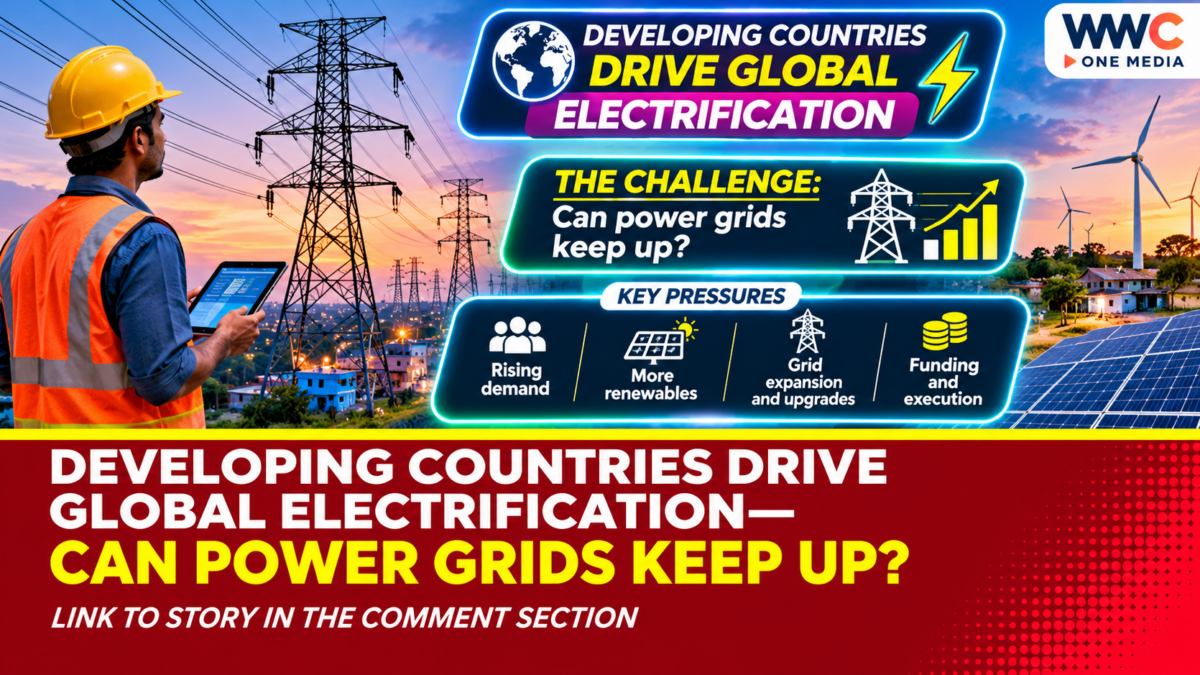
MANILA, Philippines — Nov. 19, 2026. Developing countries are becoming central to global electrification, with emerging and developing economies accounting for 80% of worldwide electricity-demand growth in 2025, the International Energy Agency’s latest assessments show.
The shift is reshaping energy investment, transport and industrial development, but it also raises an increasingly urgent question: can electricity networks expand quickly enough to deliver reliable and affordable power?
For the Philippines and its Southeast Asian neighbours, the challenge is particularly significant. Electrification offers opportunities to reduce dependence on imported fuels, yet the benefits depend on power generation, transmission, consumer affordability and the reliability of electricity services.
Global Electrification Is Changing the Energy Landscape
Electricity is becoming more important across industries, households and transportation.
The IEA’s September 2026 electrification assessment found that electricity demand increased by more than 3% annually between 2015 and 2025, roughly twice the pace of overall energy-demand growth.
Electricity represented approximately 23% of total final energy consumption in 2025, reflecting growing demand for cooling, appliances, digital infrastructure and electrified transportation.
The latest figures also reveal where much of the expansion is taking place.
Emerging and developing economies generated 80% of global electricity-demand growth in 2025. China alone accounted for 58% of the worldwide increase, underscoring its considerable influence on global trends.
These numbers require an important distinction.
Higher electricity demand is not automatically evidence that more households have gained electricity access or that fossil fuels have been replaced. Consumption can also rise because existing customers use more appliances, factories expand production or new digital facilities require substantial power.
The significance of electrification lies in how electricity increasingly replaces direct fuel consumption across economic activities.
Why Developing Economies Have an Advantage—and a Challenge
Developing markets can benefit from introducing modern electric technologies as infrastructure expands.
Electric vehicles, industrial equipment and electric cooking technologies can offer efficiency advantages over conventional fuel-powered alternatives. Their attractiveness, however, depends on purchase prices, electricity tariffs and access to financing.
The IEA estimates that electric vehicles can be two to four times more energy-efficient than comparable internal-combustion vehicles.
This advantage creates opportunities for economies seeking to reduce exposure to imported petroleum.
WWC ONE MEDIA previously examined how electric vehicles and solar power are increasing competition for fossil fuels, a related transition that illustrates why reduced fuel consumption does not mean oil and coal will disappear immediately.
There are also substantial obstacles.
Electric equipment often requires higher initial spending, while electricity networks need significant capital investment.
For lower-income households and smaller businesses, even technologies that could reduce operating expenses may remain financially inaccessible.
That makes affordable financing, clear regulation and dependable infrastructure essential to capturing electrification’s potential.
Southeast Asia Is Already Undergoing an Electricity Transformation
Southeast Asia provides a particularly useful example of how electrification is reshaping developing economies.
The IEA’s Nov. 9, 2026 regional assessment found that electricity’s share of total final energy consumption increased from 12% in 2000 to 25% in 2025.
That proportion is already above the global average of approximately 23%.
Much of the region’s growth has come from buildings, particularly appliances and cooling systems, while industrial expansion and digital infrastructure are creating additional demand.
However, the region’s electricity supply continues to rely heavily on fossil fuels.
Coal currently accounts for almost half of regional electricity generation, while natural gas represents nearly one-quarter.
This creates a policy challenge: expanding electric transport and industry will not automatically produce the largest possible emissions reductions unless electricity generation also becomes cleaner.
For the Philippines, island communities introduce another consideration.
WWC’s earlier report on the Philippines–Indonesia–Vietnam initiative to expand island solar power and battery storage illustrates why remote electricity systems need solutions suited to local conditions.
Solar generation can reduce dependence on diesel, but dependable service also requires adequate storage, maintenance and system planning.
The Electricity Access Gap Remains Enormous
Despite the rapid expansion of electricity consumption, universal access remains unfinished.
The 2026 edition of the international Tracking SDG 7 assessment estimated that 655 million people worldwide still lacked electricity access.
More than 560 million were in sub-Saharan Africa.
This demonstrates why electricity-demand growth and electricity access must be evaluated separately.
A country can experience rapid industrial electrification while some communities remain disconnected from reliable power.
Nevertheless, distributed solar technology is widening the available options.
An October 2026 World Bank assessment found that the number of people using off-grid solar products had increased from 118 million to 149 million over the previous two years.
It also identified off-grid solar as the least-cost electricity-access solution for at least 398 million people currently without power.
However, equipment affordability remains a significant barrier.
For governments, the challenge is not simply installing additional generation capacity. It is ensuring that electricity reaches households and businesses at prices they can afford.
Why Power Grids Could Determine the Winners
The expansion of electrification introduces new pressures on electricity transmission and distribution.
Higher consumption from factories, cooling systems, electric vehicles and data centres can create costly infrastructure requirements.
The IEA emphasises that generation capacity, grid development and electricity-system flexibility must advance together.
Otherwise, investment in electric technology could move faster than the infrastructure required to support it.
The issue also extends to who pays for network expansion.
WWC ONE MEDIA has examined the debate over electricity-grid costs associated with large data centres, highlighting how new electricity users can raise difficult questions about infrastructure financing and consumer protection.
For developing economies, similar economic principles apply even when regulatory arrangements differ.
Analysis: Governments that coordinate generation investments, network expansion and affordable financing could be better positioned to capture the economic benefits of electrification.
Those that fail to address grid bottlenecks may face higher costs, delayed connections or less reliable supply.
What Happens Next?
The next phase of global electrification will be judged by results rather than investment announcements alone.
The IEA’s High Electrification Scenario projects electricity’s share of final energy consumption could reach 35% by 2035, compared with approximately 23% in 2025.
That is a scenario illustrating accelerated adoption, not a guaranteed forecast.
Achieving higher electrification levels would require additional infrastructure investment, affordable technology and substantial changes in how electricity is generated and consumed.
For the Philippines, the most meaningful indicators will include reliable electricity supply, grid capacity, renewable generation, electricity prices and the availability of practical electric alternatives.
Developing economies have become major drivers of electricity-demand growth. The unresolved question is whether that momentum will translate into secure, affordable power across entire societies.