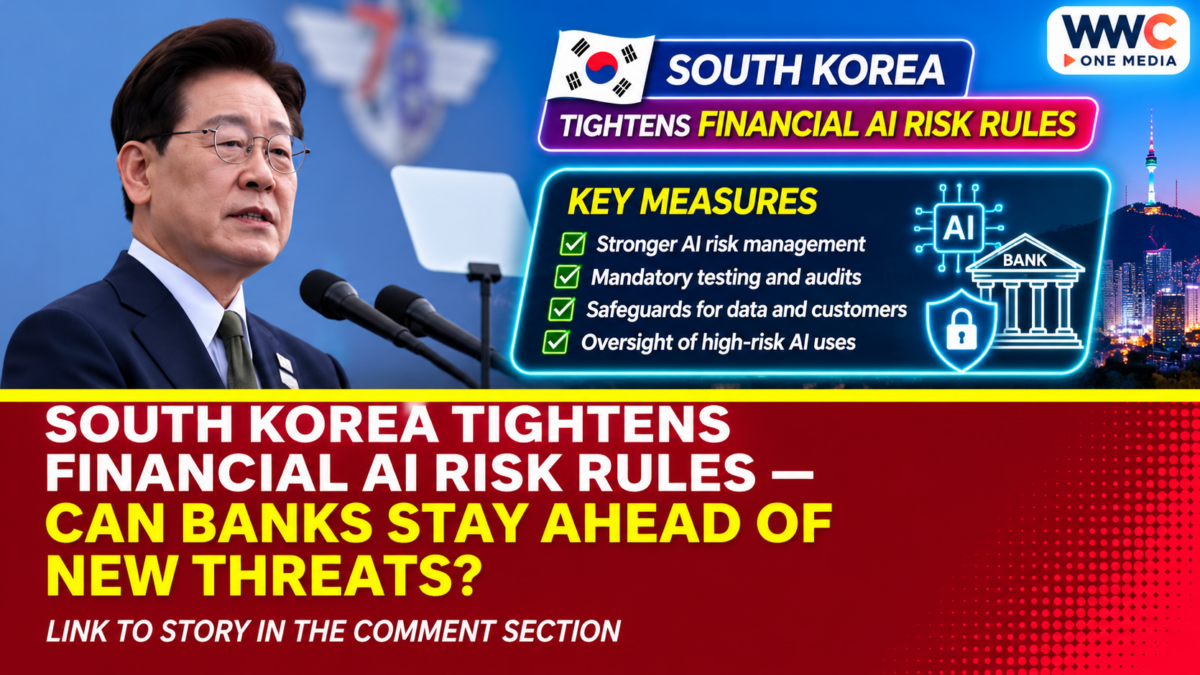
SEOUL, South Korea — South Korea’s Financial Services Commission proposed tighter cybersecurity oversight on Nov. 18, 2026, as authorities work to strengthen financial institutions’ defences amid the growing use of artificial intelligence. The proposal would expand IT-asset tracking and require large firms to obtain independent vulnerability evaluations every six months, building on AI risk-management guidelines introduced earlier this year.
The financial AI risk agenda is documented, but a separate report that financial companies have been instructed to disclose their financial exposure to AI-related investments has not been confirmed through a public directive reviewed for this article. The distinction matters: cybersecurity controls, use of AI within banks and financial exposure to AI companies are three different risks.
South Korea Financial AI Rules Move Toward Stronger Oversight
The Nov. 18 proposed revision to the supervisory regulation on electronic financial services would require covered institutions to identify their IT assets, classify their importance and assign responsibility for maintaining accurate asset lists.
It also proposes extending the scope of assessments to external connections and systems linked directly or indirectly to electronic financial transactions.
Larger companies meeting both thresholds of at least KRW2 trillion in total assets and 300 regular employees would need independent IT vulnerability evaluations every six months, instead of annually. The regulator indicated that more institutions could face the same frequency after implementation is reviewed.
The proposal was released for public comment from Nov. 18 through Nov. 30. Formal implementation is expected in the first quarter of 2027, following regulatory review, although some measures may begin through administrative guidance earlier.
These are proposed or planned steps, not all requirements already in force.
Earlier AI Guidelines Set Seven Principles
South Korea’s financial authorities introduced revised AI guidelines at a June 18 industry meeting and scheduled them to take effect June 22. The guidance covers financial companies and relevant fintech businesses using AI, while separate legal duties may apply to high-impact systems.
Its seven principles address governance, legal compliance, human responsibility, model and data credibility, financial stability, customer interests and security.
Crucially, the guidance treats AI as an assistance tool at the current stage, leaving final decisions and accountability with people responsible for the service.
The Financial Supervisory Service and Financial Security Institute were assigned complementary risk-management and security materials.
These policies concern how firms deploy AI; they do not amount to a verified inventory of loans, securities or private-credit funds connected to the AI industry.
Official Incident Figures Explain the Urgency
The Financial Services Commission’s Nov. 5 review recorded 40 reported hacking incidents across 37 financial companies between Sept. 30 and Nov. 3. The affected sectors included banks, securities firms, insurers, electronic financial businesses and virtual-asset providers.
The regulator said approximately 473,000 personal-information records or cases were affected, while no customer account passwords had been reported stolen at the time of the announcement.
It also described roughly KRW1 billion in lost funds at some smaller companies, mainly from management accounts, while stating that individual users had not then been identified as losing funds in those incidents.
The figures do not establish that AI caused every incident.
WWC ONE MEDIA previously examined South Korea’s investigation into possible AI-assisted bank cyberattacks.
The official policy response underlines why suspected AI involvement and confirmed technical findings must be kept separate.
Exposure to AI Investments Is a Different Question
Financial exposure can include direct lending, bonds, equity investments or other contractual commitments to companies developing or buying AI infrastructure.
Measuring that exposure would require defining the industries and assets counted, avoiding double-counting and identifying the reporting date.
A bank’s use of AI software is not itself evidence that it owns a large portfolio of AI-related securities. Conversely, a financial institution can have credit exposure to an AI infrastructure project without relying on AI to make lending decisions.
Analysis: Regulators assessing the risks of AI-intensive investment may need to examine concentration, repayment assumptions and borrowers’ dependence on future computing demand.
But an unverified request for data cannot be described as a binding national reporting exercise, and no aggregate South Korean AI-investment exposure amount has been established here.
WWC has also explored the distinction between AI infrastructure financing guarantees and money already paid.
The same accounting discipline matters when assessing potential financial exposure across institutions.
What Financial Customers and Investors Should Watch
For customers, effective safeguards involve maintaining secure systems, detecting suspicious activity and responding promptly when information is compromised.
South Korea’s authorities have outlined plans for stricter inspections and stronger prevention of secondary fraud after breaches.
WWC’s earlier report on the consumer fraud warning following Korean financial-data incidents provides additional context for the consumer-protection dimension.
What this could mean: More comprehensive controls could make vulnerabilities easier to discover and assign clear responsibility for remediation.
They cannot eliminate every cyberattack, nor can they guarantee that AI investments made by banks or funds will be profitable.
The distinction between an institution’s technology resilience and its balance-sheet exposures will remain essential when examining any future supervisory survey.
What Happens Next
The immediate procedural milestone is the Nov. 30 deadline for public comments on the cybersecurity rule proposal. Authorities then expect to review the provisions before anticipated implementation in the first quarter of 2027.
A separate, publicly accessible reporting instruction would be needed to verify any requirement that firms disclose loans, investments or other exposures specifically tied to AI businesses.
Until then, the primary record establishes a strengthened AI-era risk-management agenda, not the scope or totals of a new investment-exposure survey.
Frequently Asked Questions
Has South Korea ordered banks to report their AI investments?
A specific public directive requiring AI-investment exposure reports was not independently verified in the official records reviewed. The confirmed Nov. 18 proposal concerns IT cybersecurity controls.
What cybersecurity change did South Korea propose on Nov. 18?
Covered firms would maintain fuller IT-asset inventories. Larger institutions meeting specified asset and employee thresholds would undergo independent vulnerability reviews every six months.
Are South Korea’s financial AI guidelines already operating?
The Financial Services Commission scheduled the revised AI-sector guidelines to take effect on June 22, 2026. They address accountability, legal compliance, customer protection and security.
How many hacking incidents did the regulator report?
The Financial Services Commission counted 40 incidents involving 37 financial companies from Sept. 30 through Nov. 3, 2026.
Does using AI mean a bank has financial exposure to AI stocks?
No. Deploying AI technology and holding investments or loans tied to AI businesses are different activities and require different forms of risk assessment.