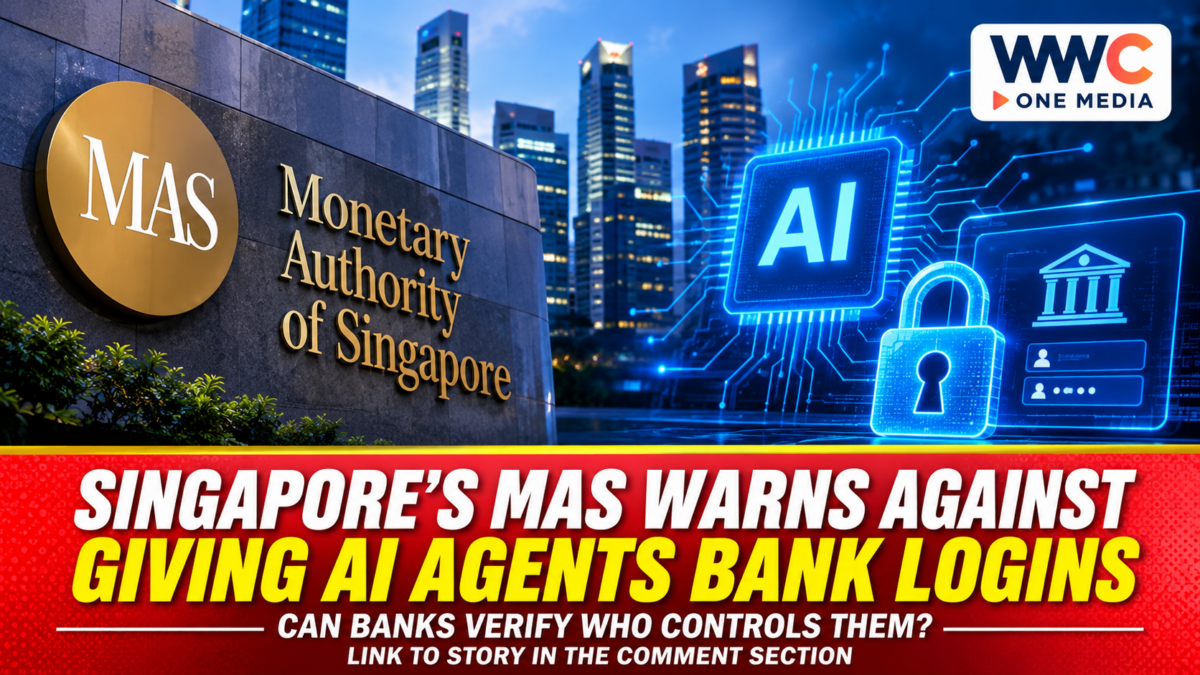
SINGAPORE — Nov. 19, 2026 — The Monetary Authority of Singapore (MAS) has cautioned consumers against giving personal artificial intelligence agents access to their financial-account login credentials, saying existing safeguards do not yet provide sufficient assurance that the systems will act safely and within authorised limits.
MAS Managing Director Chia Der Jiun also announced plans for a common “know your agent” protocol and an Agentic Money Sandbox with the Future of Finance Institute, signalling that Singapore is working towards a controlled framework for AI systems that may eventually initiate payments and manage financial transactions.
The announcement shifts the discussion from whether AI agents can perform financial tasks to a more difficult question: how can banks establish that an automated system is genuinely authorised to act for a customer, and who is responsible when it exceeds its instructions?
Why MAS is concerned about AI agent banking
AI agents are moving beyond answering questions. They can be designed to conduct research, interact with websites, assist with customer service and perform tasks on behalf of individuals or businesses.
In finance, those capabilities could extend to managing purchases, payments, cash positions and liquidity. But allowing an agent to access a bank account using a customer’s ordinary login details creates an accountability problem.
In his Nov. 19 Singapore FinTech Festival keynote, Chia said some users were already giving agents their financial-account credentials. He said he would not advise giving personal agents that access because there was insufficient assurance of safety.
His concern was not limited to whether an AI system could technically log in. A financial institution may be unable to establish whether the agent has the customer’s full authorisation or whether a transaction falls within the instructions the customer actually gave.
Chia also raised the question of responsibility when an agent carries out a transaction incorrectly or goes beyond its mandate.
That distinction matters. A customer may ask an agent to pay a bill, for example, but that instruction does not automatically establish permission for the system to make unrelated transfers, change account settings or initiate additional payments.
The issue is therefore one of identity, authority and enforceable limits—not simply whether an AI tool is convenient.
Singapore wants banks to know which AI agent is acting
MAS plans to facilitate a common “know your agent” protocol during the next phase of its Safeguards for Agentic Finance at Runtime initiative, known as SAFR.
The proposed protocol is intended to allow customer agents and financial institutions to exchange information needed to establish trust. This includes:
- Agent identity: Which agent is making the request and whom it represents.
- Authority: What permission the customer or organisation has granted.
- Mandate: Which actions are allowed, including relevant limits and conditions.
- Reliability: What assurance exists about the agent’s origin and trustworthiness.
This information would help financial institutions determine whether to accept an agent’s request and what conditions should apply. MAS also envisages a dedicated secure channel for agent access.
The concept is important because a bank should not have to treat every automated instruction as though it came directly from an authenticated customer. It needs a way to distinguish a legitimate, authorised agent from an unknown or improperly controlled system.
WWC previously examined a related industry effort involving Visa, Mastercard and Ant International’s Know Your Agent framework. That initiative addresses agent identity across payment ecosystems, while MAS is developing an approach for trusted access to financial services. The two developments share a problem to solve, but they should not be treated as one established system.
Four safeguards shape the proposed framework
MAS outlined four lessons from the first phase of SAFR that should guide the safe use of financial agents.
First, agents need bounded autonomy. They should have enough freedom to complete useful tasks but remain within clearly defined boundaries.
Second, their identity and authority must be established. Financial institutions need to know which system is acting and the basis on which it is permitted to do so.
Third, mandates must be specific. The permitted actions, limits and conditions should be clear rather than relying on broad or ambiguous instructions.
Fourth, safeguards should match the level of authority granted. An agent with permission to carry out high-impact financial actions requires stronger controls and assurance than one limited to a narrow administrative task.
These principles are consistent with the SAFR framework published by MAS and industry participants on July 3, 2026. That framework describes governance checkpoints intended to verify and record proposed agent actions before execution.
The practical challenge is making those controls work across different banks, payment providers and AI platforms. A standard that works within one institution may not automatically provide the same assurance when an agent interacts with another financial service.
Agentic Money Sandbox will test payments and corporate treasury
MAS also plans to establish an Agentic Money Sandbox with the Future of Finance Institute. The programme will bring together AI agents and programmable money, initially focusing on corporate treasury management and payment services.
For corporate treasury, banks could allow an authorised agent to monitor liquidity positions and upcoming payments, determine when funds should move and use tokenised deposits to execute permitted treasury actions.
The corporate would establish the mandate, while participating banks would set controls and decide the terms for accepting instructions from the agent.
The payments use case would allow banks and payment service providers to test customer-agent payment instructions using digital money, including tokenised deposits or stablecoins. Participating providers would verify the agent’s identity and authority and apply risk controls before executing transactions.
These are proposed sandbox use cases, not confirmation that consumers can already hand unrestricted control of their bank accounts to AI assistants.
WWC’s Nov. 18 report on Singapore’s AI banking programme covered the wider financial-sector initiatives involving fraud detection, small-business financing and automated payments. The new Agentic Money Sandbox adds another layer to that programme: testing how automated instructions can be handled while keeping authority and oversight clear.
The risks extend beyond mistaken payments
The consequences of poorly controlled agents could go beyond a single incorrect transaction.
If a financial institution cannot reliably establish an agent’s identity or authority, it may struggle to determine whether a payment was genuinely authorised. Disputes could become more complicated when a customer, an AI provider and a financial institution each have different records of what was instructed and executed.
There is also a wider question of unequal access. In his keynote, Chia said more capable agents could potentially secure better prices and terms than less capable ones. He also referred to research suggesting that agents might interact in ways that produce collusive outcomes even without an explicit instruction to collude.
These were identified as potential risks in an emerging area, not as evidence that financial agents are already manipulating Singapore’s markets.
For consumers, the immediate lesson remains straightforward: convenience does not justify handing an unverified system unrestricted access to financial credentials.
That caution also connects with the earlier Singapore advisory on personal AI agents and account permissions, which covered the risks of granting agents broad access to emails, applications and sensitive information.
What happens next
The next stage will depend on how MAS, the Future of Finance Institute and participating financial institutions translate the proposed protocol and sandbox into practical safeguards.
The developments to watch include:
- Know your agent protocol: How institutions establish common information requirements for agent identity, authority and mandates.
- Secure access channels: How banks determine the conditions under which customer agents can connect to financial services.
- Sandbox testing: Whether corporate treasury and payment experiments demonstrate reliable controls before transactions are executed.
- Responsibility and dispute handling: How customers and institutions address transactions that are incorrect, unauthorised or outside an agent’s mandate.
- Consumer protections: Whether the safeguards eventually provide clear and understandable ways for customers to set limits and retain control.
Singapore is preparing for a financial system in which software may increasingly act on behalf of people and businesses. But the ability to automate a transaction is not the same as proving that the transaction was authorised.
The central test will be whether banks can verify the agent, enforce the customer’s instructions and establish accountability before money moves.
FAQ
1. Should I give an AI agent my bank login details?
MAS Managing Director Chia Der Jiun advised against giving personal AI agents access to financial-account login credentials, citing insufficient assurance of safety.
2. What is the know your agent protocol?
It is a proposed MAS initiative to help financial institutions verify an AI agent’s identity, the person or organisation it represents, its authority, its mandate and its reliability.
3. Can AI agents already make bank payments in Singapore?
Some financial institutions and payment providers are developing agent interfaces, but MAS said many institutions have yet to establish terms or channels for agent access. The planned sandbox is for controlled testing, not unrestricted consumer access.
4. What is the Agentic Money Sandbox?
It is a planned MAS and Future of Finance Institute initiative to test AI agents with programmable money in corporate treasury management and payment services.
5. Who is responsible if an AI agent makes an unauthorised payment?
MAS identified responsibility as an unresolved challenge. Its proposed framework emphasises clear identity, authority, mandates and safeguards, but the Nov. 19 speech did not set out a complete consumer dispute or liability regime.