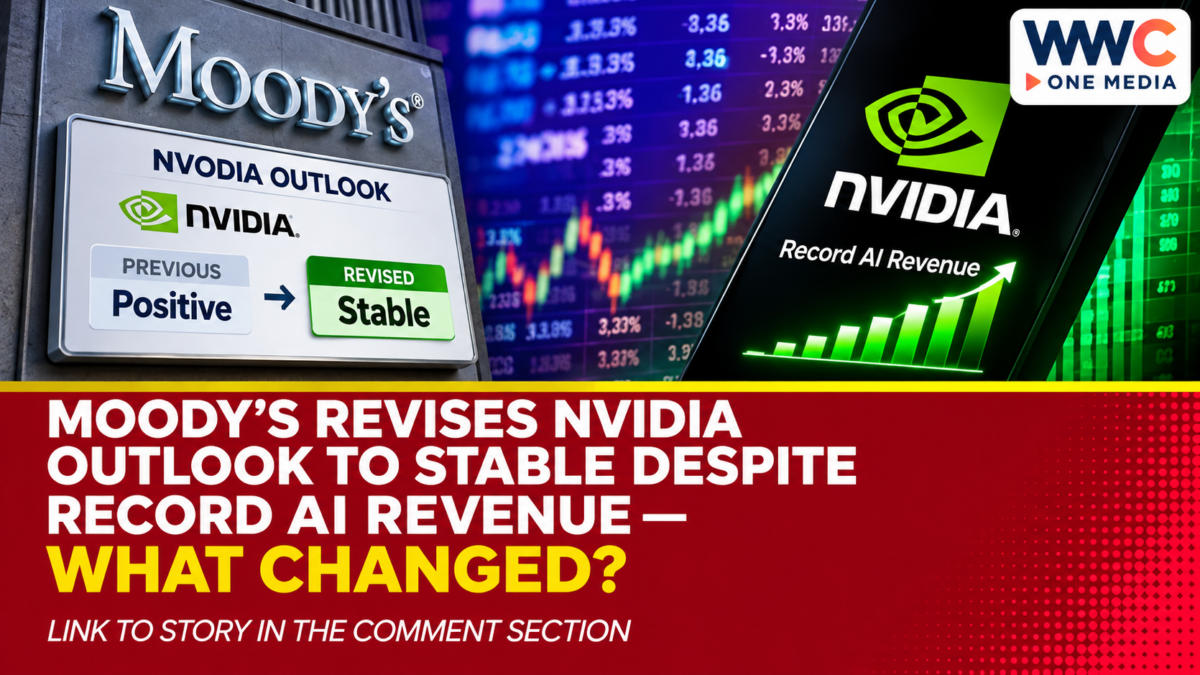
SANTA CLARA, United States — Moody’s Ratings changed its credit outlook for Nvidia from positive to stable on Nov. 18, 2026, while affirming the chipmaker’s Aa1 senior unsecured rating. The decision followed Nvidia’s Nov. 12 leadership transition and a Nov. 17 earnings report showing quarterly revenue of US$115.8 billion, up 103% from a year earlier.
A stable outlook does not mean Nvidia’s debt was downgraded. The distinction matters to lenders and investors assessing the company’s creditworthiness during a period of rapid AI expansion and organisational change.
Nvidia Credit Outlook Changes, but Aa1 Rating Remains
Moody’s public rating-action listing identifies the change to a stable outlook and the affirmation of Aa1 senior unsecured ratings. The rating itself was not lowered in the published action title.
An outlook conveys a rating agency’s assessment of the likely direction of a rating over a period of time. It is separate from the current grade. A change from positive to stable therefore removes the previous positive direction without automatically indicating deteriorating ability to meet obligations.
The full analytical discussion accompanying Moody’s action was not accessible for independent examination. Consequently, this article does not attribute a particular risk calculation, analyst quotation or numerical upgrade probability to the agency.
Nor should a rating action be confused with Nvidia’s equity-market valuation. A credit assessment concerns the issuer’s capacity to meet financial obligations, whereas shareholders face a different set of earnings and valuation risks.
A Leadership Transition Adds an Unanswered Question
Nvidia’s Nov. 12 corporate announcement confirmed that Jensen Huang resigned as president, chief executive officer and director, effective immediately. Its board named Colette Kress interim chief executive, while she continued serving as chief financial officer.
The board also appointed Harvey C. Jones as its first chair and initiated a search for a permanent chief executive, considering internal and external candidates. These are company-confirmed governance decisions; no claims about Huang’s private circumstances are necessary to understand them.
A leadership change can introduce uncertainty about future priorities without demonstrating that current operations have weakened. Nvidia’s release said the existing management team would continue executing the technology roadmap and customer commitments.
Analysis: For creditors, succession planning may matter because investment policy, capital allocation and contractual guarantees can extend beyond a single management tenure. That is a general consideration, not an independently verified statement of Moody’s detailed rationale.
Record Sales Show Why the Company Retains Financial Strength
Nvidia’s fiscal third quarter ended Oct. 25 with US$115.8 billion in revenue, compared with US$57.0 billion a year earlier. Data Centre sales were US$107.6 billion, an increase of 110% year on year.
The company reported GAAP net income of US$65.3 billion and operating cash flow of US$48.3 billion for the quarter. Its next-quarter revenue outlook was US$130 billion, plus or minus 3%, and included an additional reporting week.
The unaudited balance sheet listed US$29.089 billion in cash and cash equivalents, US$24.423 billion in marketable debt securities, and US$32.371 billion in long-term debt as of Oct. 25. Marketable equity securities were reported separately and should not be treated as identical to cash.
These figures help explain why rapid growth and a stable credit outlook are not inherently contradictory. Strong operating results provide financial resources, but forecasts and financial commitments still involve uncertainty.
WWC ONE MEDIA has examined Nvidia’s record earnings alongside the Federal Reserve’s concerns about AI financing, a broader debate distinct from this credit-rating action.
AI Financing Commitments Complicate the Credit Picture
Nvidia’s Nov. 17 chief financial officer commentary disclosed US$118 billion in maximum gross exposure under specified guarantees as of Oct. 25. The figure comprised US$105 billion connected to an Ohio infrastructure project, US$9.5 billion in power and systems support, and US$3.5 billion in other neocloud-related guarantees.
The company stated it had not made payments under those guarantees by the reporting date. The maximum exposure is not an amount already spent or a conventional outstanding loan balance.
Nvidia also listed US$32 billion of future additional commitments associated with neocloud agreements. Those commitments depend on financing and operational conditions being satisfied.
WWC previously explained why Nvidia’s AI guarantees are not the same as cash payments. The distinction is essential when comparing contingent exposure with debt recorded on the balance sheet.
What this could mean: A company can have strong near-term liquidity while taking on contractual obligations that become more significant if counterparties struggle. The public numbers do not prove that a payment will be triggered.
Export Assumptions and Capital Allocation Still Matter
Nvidia’s forecast for the fiscal fourth quarter assumed no Data Centre compute revenue from China. That is a forward-looking assumption for one category, not evidence that every shipment to China has stopped.
WWC’s examination of Nvidia’s China chip-sales disclosures places that distinction in context. Policy changes, customer demand and supply arrangements can influence future revenue without changing the results of a completed quarter.
Meanwhile, Nvidia said its board authorised an additional US$150 billion for share repurchases in September. Approximately US$227.3 billion remained authorised at the end of the third quarter. An authorisation is permission to repurchase shares, not a promise that the entire sum has already been spent.
Analysis: Credit assessment requires balancing cash generation with capital allocation and commitments. Neither large repurchase capacity nor an expanding AI business guarantees a future rating upgrade.
What Happens Next
Nvidia’s permanent chief-executive search, subsequent financial disclosures and actual performance of supported infrastructure projects will provide more evidence about strategy and risk. Investors can also monitor any later rating actions rather than assuming a stable outlook sets a permanent credit grade.
The verified picture is precise: Moody’s affirmed Aa1 while changing the outlook to stable, and Nvidia continues to report substantial earnings and cash generation during a leadership transition. The company’s full future financial obligations will depend partly on how conditional arrangements develop.
Frequently Asked Questions
Did Moody’s downgrade Nvidia’s credit rating?
No. Moody’s public action affirmed Nvidia’s Aa1 senior unsecured rating while changing the outlook from positive to stable.
What does a stable credit outlook mean?
It indicates the agency’s current directional assessment for the rating. It is not a guarantee against a future upgrade or downgrade.
Who is Nvidia’s current chief executive?
Colette Kress was appointed interim chief executive on Nov. 12, 2026, and continues as chief financial officer while Nvidia searches for a permanent successor.
How much revenue did Nvidia report in November 2026?
Nvidia reported US$115.8 billion for the fiscal quarter ended Oct. 25, 2026, up 103% year on year.
Has Nvidia already paid US$118 billion in AI guarantees?
No. The figure is maximum gross conditional exposure; Nvidia said no payments had been made under its guarantees as of Oct. 25.