
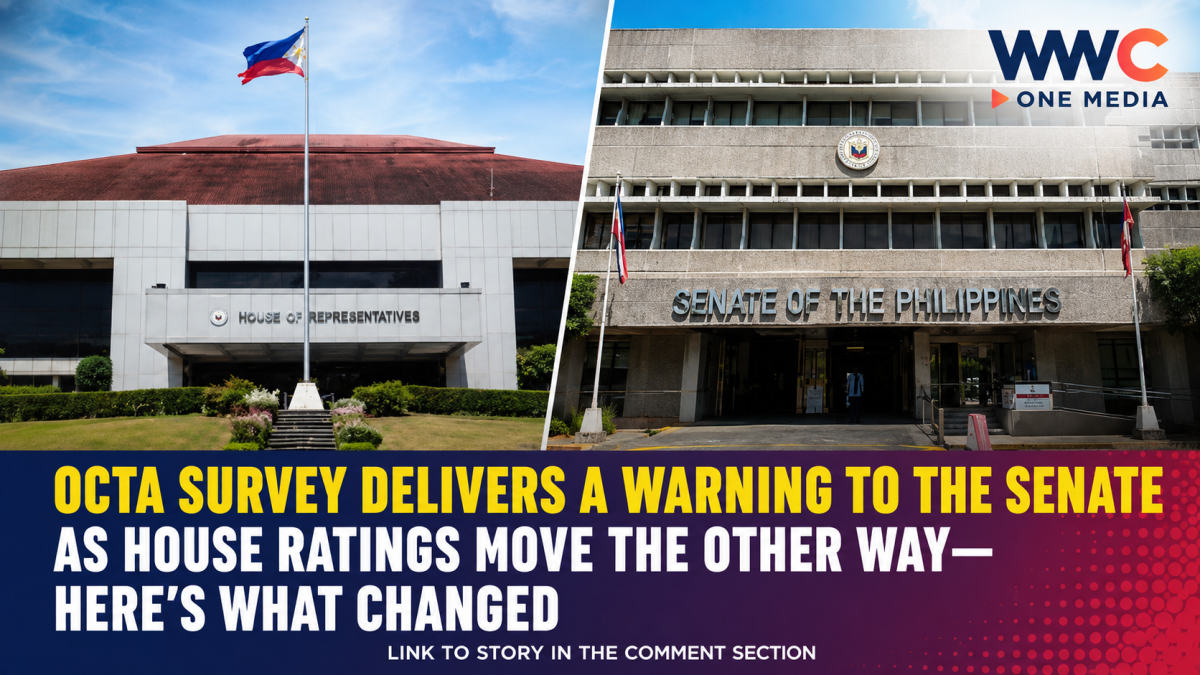
MANILA, Philippines — Public sentiment toward the country’s two chambers of Congress moved in opposite directions in the second quarter of 2026, with the Senate suffering declines in both trust and satisfaction while the House of Representatives posted modest gains, according to the latest OCTA Research Tugon ng Masa survey.
OCTA Research reported that trust in the Senate dropped from 44% in the first quarter to 41% in the second quarter, while the proportion of Filipinos who expressed distrust increased from 24% to 27%.
The Senate’s performance rating also weakened. Satisfaction fell from 42% to 38%, while dissatisfaction climbed from 27% to 32%.
The results put the Senate’s overall public standing under renewed scrutiny as the chamber navigated a turbulent political period.
House of Representatives moves in the opposite direction
While the Senate lost ground, the House of Representatives recorded improvements in both trust and satisfaction.
Trust in the lower chamber increased from 36% in Q1 to 38% in Q2, while distrust declined from 33% to 28%.
Satisfaction with the House’s performance likewise edged up from 35% to 37%, while dissatisfaction fell from 35% to 32%.
Nationwide, OCTA found that 38% of adult Filipinos trusted the House, compared with 28% who distrusted it and 33% who were undecided.
For performance, 37% said they were satisfied, 32% dissatisfied and 31% undecided.
The figures show that neither chamber commanded an overwhelming majority of public trust, but the direction of the two institutions’ ratings was notably different.
Timing of the survey is crucial
OCTA’s findings come with important political context.
The survey was conducted from July 4 to 11, 2026, through face-to-face interviews with 1,200 Filipino adults aged 18 and above. It carries a ±3 percentage-point margin of error at a 95% confidence level.
That fieldwork period coincided with a major shake-up in Senate leadership and the opening days of the impeachment trial of Vice President Sara Duterte, which began when the Senate convened as an impeachment court on July 6.
OCTA itself noted the overlap between the survey period, the Senate leadership controversy and the impeachment proceedings. The timing provides important context for interpreting the ratings, although the survey does not establish that these events caused the changes in public opinion.
Senate decline comes amid broader political pressure
The latest numbers are part of a broader period of shifting public sentiment toward national political leaders.
An earlier release from the same Q2 OCTA survey showed that President Ferdinand Marcos Jr. and Vice President Sara Duterte also experienced declines in their trust and performance ratings.
Marcos’ trust rating fell to 49%, while his performance rating declined, according to reports on the same OCTA survey. Duterte’s trust and performance ratings also fell below majority levels during the period covered by the poll.
The survey also found that inflation remained Filipinos’ top national concern, while fighting graft and corruption rose to third place, highlighting the economic and governance pressures shaping public sentiment.
That broader backdrop is significant: the congressional ratings were recorded at a time when Filipinos were simultaneously confronting concerns about prices, wages, government accountability and high-profile political disputes.
What the numbers really mean
The Senate’s decline should not automatically be interpreted as a collapse in public confidence.
At 41% trust versus 27% distrust, the Senate still had more respondents expressing trust than distrust. However, the movement from the previous quarter is unfavorable: trust dropped three points while distrust increased by three points.
The House, meanwhile, improved on both measures, although its ratings also remained far from majority territory.
The results therefore point less to a wholesale rejection of Congress and more to a changing public assessment of the two chambers at a politically consequential moment.
The next question is whether these movements represent a temporary reaction to the events surrounding the survey period—or the beginning of a longer-term shift in how Filipinos view Congress.
That answer will depend on what happens in the coming months and whether subsequent OCTA surveys confirm or reverse the latest trend.
WWC ONE MEDIA MJE



Leave a Reply