
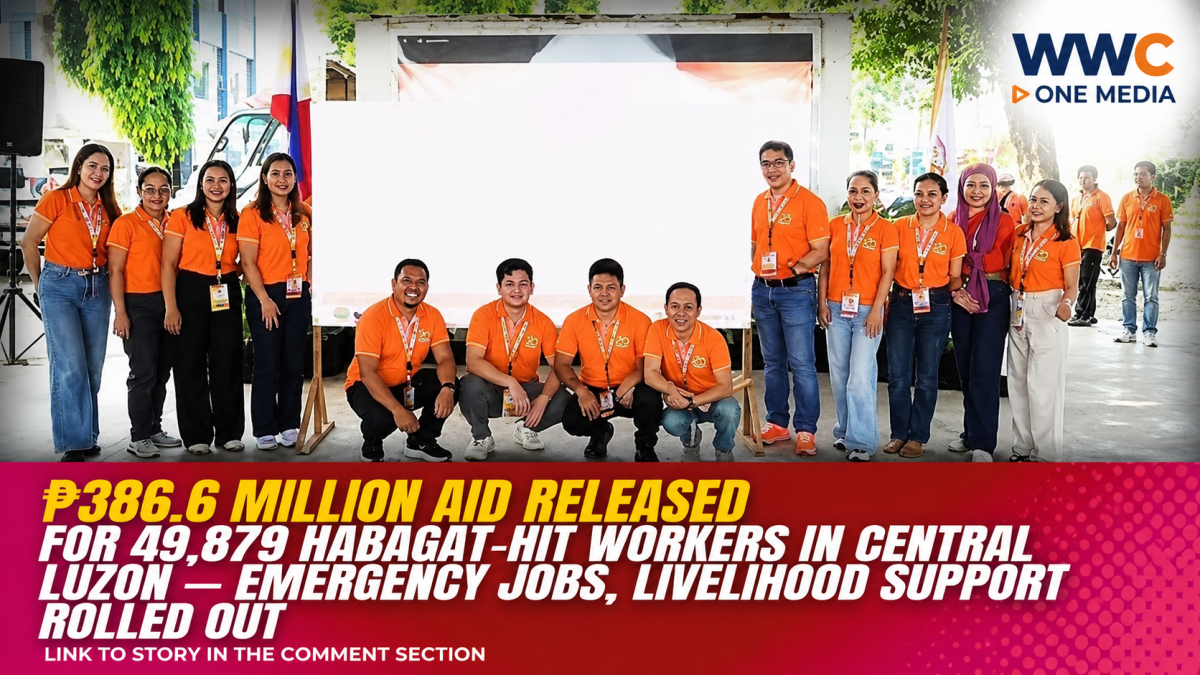
MANILA, Philippines — Nearly 50,000 workers in Central Luzon affected by prolonged flooding and the enhanced Southwest Monsoon, or Habagat, are set to receive emergency employment and livelihood assistance worth ₱386.6 million, as the government shifts from immediate disaster response toward economic recovery.
The Department of Labor and Employment (DOLE) said the assistance will benefit 49,879 workers through its Tulong Panghanapbuhay sa Ating Disadvantaged Workers (TUPAD) program and the DOLE Integrated Livelihood and Emergency Employment Program (DILEEP).
The move comes after weeks of heavy rains, flooding and weather disturbances caused widespread disruption across Central Luzon, leaving workers and small livelihood operators struggling to resume normal income.
₱357.85 million set aside for emergency jobs
The biggest portion of the assistance — ₱357.85 million — has been allocated under TUPAD for 48,667 beneficiaries in Bataan, Bulacan, Nueva Ecija, Pampanga and Tarlac.
Rather than simply providing cash assistance, TUPAD places qualified beneficiaries in temporary employment, including community-based cleanup and rehabilitation activities designed to help affected communities recover from the disaster.
The program can cover activities such as clearing debris, cleaning waterways and rehabilitating community facilities.
DOLE’s regular TUPAD guidelines provide temporary public employment for disadvantaged workers, with projects generally lasting 10 to 90 days depending on the work involved. Eligible workers include those whose livelihoods were disrupted by natural disasters and other crises.
Another ₱28.79 million targets livelihood recovery
For workers who need help rebuilding their sources of income, DOLE is allocating ₱28.79 million to 1,212 beneficiaries under its livelihood program.
The assistance can support small economic activities including:
- Farming equipment
- Sari-sari stores with bigasan
- Food vending
- Fishing
- Livestock
- Food and agricultural processing
- Repair services
- Other small enterprises
The goal is to move affected workers beyond short-term relief and help them establish or restore more sustainable sources of income.
Bulacan could receive additional ₱22.4 million
DOLE Regional Office III is also seeking another ₱22.487 million from local government units for additional TUPAD implementation in Bulacan.
If funded, the proposed assistance would cover 3,500 workers from Calumpit, Guiguinto, Hagonoy, Paombong, Bulakan, Angat and Sta. Maria.
Those beneficiaries would be engaged in 10- to 15-day emergency employment, including cleanup, rehabilitation and other community recovery projects.
The assistance comes as Central Luzon absorbs heavy flood damage
The scale of the employment response reflects the severity of the recent flooding.
Pampanga was placed under a state of calamity in August after widespread flooding associated with the enhanced Habagat. Provincial authorities reported that 297 barangays across 17 local government units were flooded, affecting hundreds of thousands of families and individuals. Agriculture also suffered significant losses.
Across the country, the combined effects of the enhanced Habagat and recent tropical cyclones have affected millions of Filipinos, prompting a broader government relief and recovery operation.
Central Luzon has been among the areas repeatedly hit by flooding, with the disruption affecting not only households but also farmers, fishermen, informal workers and small businesses.
This isn’t the first major TUPAD response in Central Luzon
DOLE has previously used TUPAD as a disaster-recovery tool in the region.
In 2025, around 194,000 people in Central Luzon received ₱1.3 billion in TUPAD assistance, including nearly 30,000 workers and residents directly affected by tropical cyclones Tino and Uwan. Beneficiaries participated in post-disaster rehabilitation work such as clearing canals, repairing evacuation facilities and restoring access infrastructure.
DOLE also updated its TUPAD and livelihood guidelines earlier this year to strengthen the transition from emergency assistance toward skills training, employment opportunities and more sustainable income sources.
What this means for affected workers
For thousands of workers whose livelihoods were interrupted by the floods, the latest program could provide two critical forms of support: immediate income through temporary work and longer-term assistance to rebuild their livelihoods.
But the emergency employment is temporary. The larger challenge will be helping workers return to stable jobs and businesses once the government assistance ends.
As Central Luzon continues its recovery from the Habagat, the ₱386.6-million package represents a significant attempt to put income back into the hands of workers while simultaneously helping communities repair the damage left by the floods.
For thousands of families, the real test now is whether emergency assistance can become a bridge to a more stable livelihood.
WWC ONE MEDIA J.M.D




Leave a Reply