
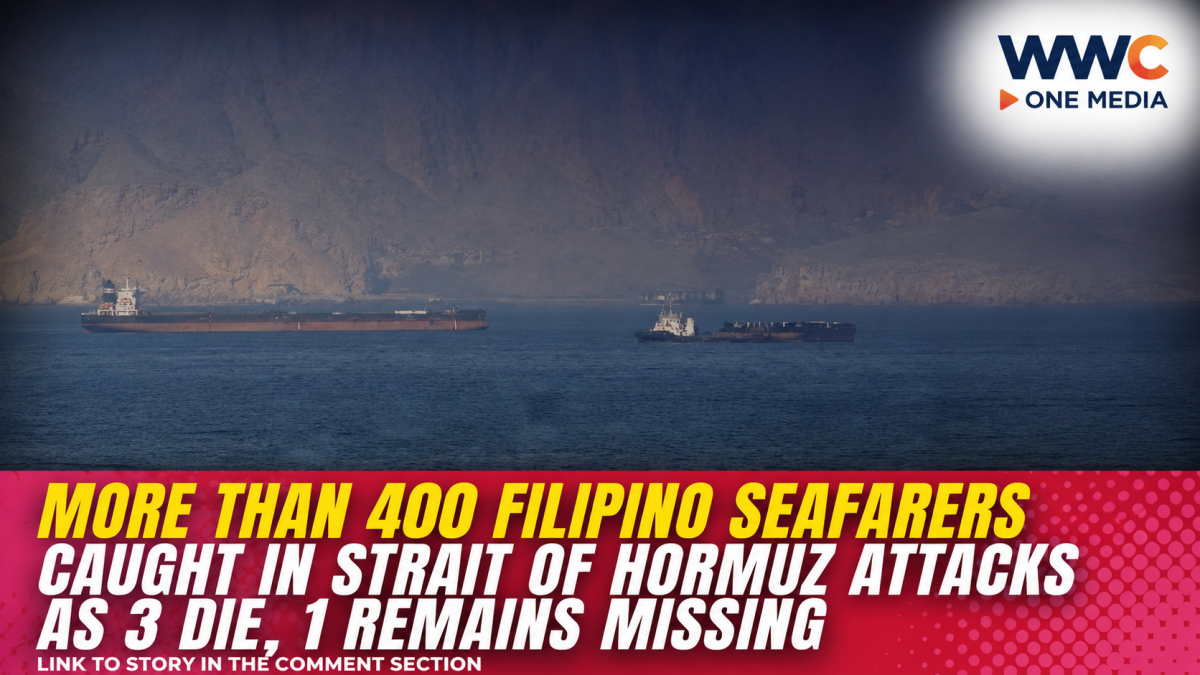
MANILA, Philippines — The danger facing Filipino seafarers in the Middle East has escalated, with the Department of Migrant Workers (DMW) reporting that 421 Filipino seafarers were aboard 31 international vessels involved in attacks in and around the Strait of Hormuz since February 28, 2026.
The latest figures come as the Philippine government works to repatriate survivors and assist the families of two Filipino seafarers killed when the Saudi-flagged crude oil tanker Sidr was struck by unidentified projectiles near the strategic waterway on August 31.
The development has renewed concerns over the safety of thousands of Filipino maritime workers who remain in the wider Persian Gulf.
Two Filipinos killed aboard Saudi oil tanker
The latest fatal incident involved the Sidr, operated by Saudi Arabia’s national shipping company Bahri.
The tanker was carrying 16 Filipino seafarers when it was struck late August 31 while approaching or transiting the Strait of Hormuz. The attack triggered a fire, which the crew managed to contain.
Two Filipino crew members were killed, while the other 14 Filipinos survived and were reported safe. Their remains were brought to Oman, where arrangements were being made for repatriation.
Saudi authorities have attributed the attack to Iran, while Iranian authorities have not publicly accepted responsibility for the incident, according to reports. Reuters reported that maritime authorities had earlier received reports that a tanker was struck by unidentified projectiles.
President Ferdinand Marcos Jr. has ordered government agencies to provide immediate assistance to the families of the two victims, including applicable benefits, compensation and insurance proceeds.
DMW says 421 Filipino seafarers were aboard attacked vessels
The latest DMW figures show how much broader the problem has become.
According to Migrant Workers Secretary Hans Leo Cacdac, 31 vessels carrying 421 Filipino seafarers have been involved in attacks since February 28.
The DMW said:
- 406 were unharmed
- 10 were injured but have recovered
- 3 were killed
- 1 remains officially missing
- 268 have already been repatriated to the Philippines
The department also estimates that around 3,000 Filipino seafarers remain aboard vessels in the wider Persian Gulf, although they are not necessarily all inside the Strait of Hormuz itself.
There is a small numerical discrepancy in the DMW’s reported breakdown: 406 + 10 + 3 + 1 equals 420, rather than 421. The figures should therefore be treated as the department’s reported totals pending clarification.
The Strait of Hormuz has become a major danger zone
The Strait of Hormuz is one of the world’s most strategically important maritime chokepoints, connecting the Persian Gulf with the Gulf of Oman and the Arabian Sea.
The International Maritime Organization said in late August that up to 400 ships carrying around 6,000 seafarers remained unable to safely leave the Persian Gulf after the conflict began. The IMO also said at least 70 attacks on international shipping had been verified, with 19 seafarers killed.
The situation has also disrupted global energy shipments. Reuters reported that Iran has expanded its blacklist of vessels barred from passing through the Strait, with the list reaching 56 ships, further complicating commercial navigation through the waterway.
DMW stops short of a blanket deployment ban
Despite the escalating risks, the Philippine government has not imposed a blanket ban on Filipino seafarers aboard vessels that may pass through the Strait of Hormuz.
Cacdac said the government is balancing seafarer safety with the broader implications of restricting navigation through a critical international shipping route.
Instead, the DMW is requiring shipowners and licensed manning agencies to conduct risk assessments, establish security protocols and reporting mechanisms, and consider rerouting vessels when possible.
Most importantly, the DMW has reiterated that Filipino seafarers have the right to refuse to sail into high-risk or warlike areas, and that right must be respected.
The department had already issued an advisory in March directing shipowners and manning agencies to avoid sending Filipino crews through the Strait of Hormuz and other high-risk maritime chokepoints unless absolutely necessary and supported by a comprehensive security assessment.
Families now demand answers
The latest tragedy is also raising questions about how Filipino seafarers are informed when their vessels are diverted into dangerous waters.
The family of one of the Filipino victims aboard the Sidr has said he allegedly learned only after boarding that the vessel was heading toward the Strait of Hormuz. His family said the route was not part of what they understood from his original employment arrangement. GMA News reported that the family is seeking answers and that the manning agency had not yet responded to its request for comment at the time of publication.
The case could intensify scrutiny over route changes, risk disclosures, crew consent and the enforcement of Filipino seafarers’ right to refuse sailing in high-risk areas.
The bigger concern for thousands of Pinoy seafarers
This latest wave of attacks comes after months of disruption in the region.
In July, the DMW reported that approximately 3,000 Filipino seafarers were stranded aboard around 400 ships in the Persian Gulf, while thousands more had already managed to leave the danger zone.
By August, additional Filipino crews had been repatriated after their vessels were hit by drone or missile strikes while operating in the Persian Gulf, Strait of Hormuz and Black Sea.
For the Philippines, the challenge is no longer simply getting individual crews home.
It is how to protect one of the country’s largest overseas maritime workforces while keeping Filipino seafarers from being placed in increasingly dangerous shipping routes.
With thousands still in the wider Persian Gulf and attacks continuing, the question now is whether existing safety measures will be enough — or whether Manila will have to impose tougher restrictions on Filipino crews entering the world’s most dangerous maritime corridors.
WWC ONE MEDIA J.M.D




Leave a Reply