
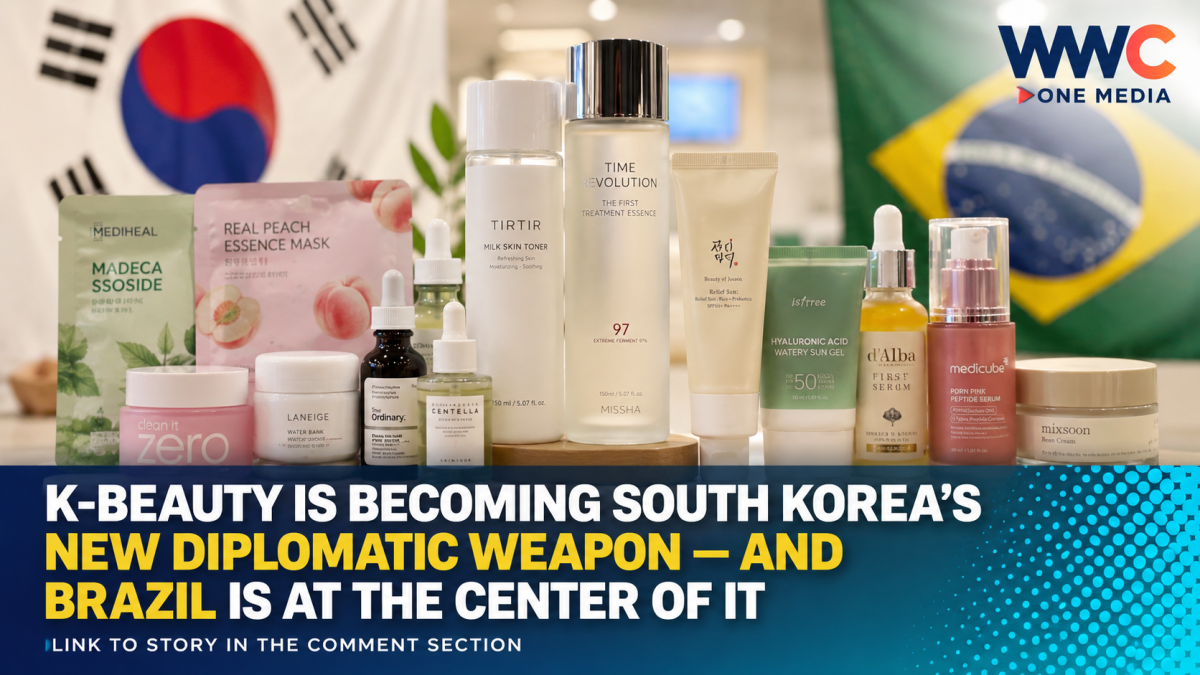
South Korea is taking K-beauty far beyond skincare counters and social media trends — and Brazil is emerging as a major test of how cosmetics can become an instrument of economic diplomacy.
During South Korean President Lee Jae Myung’s state visit to Brazil in July, K-beauty was placed alongside commercial aircraft and critical minerals as one of the areas with potential to deepen the two countries’ economic relationship.
That unusual combination highlights just how important South Korea’s beauty industry has become to Seoul’s global strategy.
At a Korea-Brazil business roundtable in São Paulo on July 28, executives from major Korean beauty companies including AmorePacific Holdings, APR, Goodai Global and Silicon2 joined a broader business delegation. A separate “K-Beauty Glow Big in Brazil” showcase also introduced brands such as Beauty of Joseon, d’Alba, Isntree and Mixsoon to Brazilian retail buyers.
Brazil’s K-beauty boom is already showing up in the numbers
The push is not happening in a vacuum.
South Korean cosmetics exports to Brazil increased from about $5.17 million in 2020 to $54.36 million in 2025, representing more than a tenfold increase in five years, according to Korea Customs Service data cited by CSIS and Korean media.
Momentum accelerated further in 2026.
During the first half of the year, cosmetics exports from Korean small and medium-sized companies to Latin America increased 131.9 percent year over year, while exports to Brazil alone jumped 237.4 percent, according to South Korea’s Ministry of SMEs and Startups.
Brazil’s enormous consumer market makes the country particularly attractive. South Korean officials are increasingly viewing it not only as a destination for finished beauty products, but also as a potential gateway into the wider Latin American market.
Seoul is turning beauty into a government-backed export strategy
The expansion is receiving direct support from the South Korean government.
In July, South Korea’s Ministry of SMEs and Startups met with Brazil’s cosmetics industry association ABIHPEC and Mercado Livre to explore ways for Korean beauty SMEs to enter the Brazilian market.
The discussions included joint research and development, production partnerships combining Brazilian natural resources with Korean cosmetic technology, regulatory cooperation and stronger online distribution.
Mercado Livre also discussed working with Korean government agencies to help promising K-beauty companies list, promote and market their products in Brazil and potentially throughout South America.
The strategy builds on an agreement reached earlier in the year.
In February, South Korea’s Ministry of Food and Drug Safety and Brazil’s health regulator, Anvisa, expanded their regulatory cooperation to include cosmetics. The agreement covers areas such as information sharing, safety-management systems, regulatory cooperation and technologies including electronic labeling.
That matters because entering Brazil’s cosmetics market can involve significant regulatory and logistical hurdles. Under Brazil’s current framework, foreign cosmetics companies generally need a Brazilian-established company to act as the local legal holder and responsible party for products marketed in the country.
The China lesson is shaping Seoul’s next move
There is also a geopolitical calculation behind the expansion.
K-beauty previously relied heavily on China, but the industry suffered after South Korea agreed to deploy the U.S. THAAD missile-defense system in 2016. Beijing responded with economic and tourism restrictions that hurt Korean businesses, including the cosmetics sector.
Since then, Korean beauty companies have increasingly diversified their markets.
The United States became South Korea’s largest cosmetics export destination in 2025, while shipments to China declined. Overall Korean cosmetics exports reached a record $11.43 billion in 2025, up 12.3 percent from the previous year, with Korean beauty products being exported to 202 countries.
Brazil therefore represents more than another overseas market.
It is part of a broader effort to make K-beauty less dependent on any single region while transforming the popularity of Korean culture into sustainable commercial relationships.
From K-pop soft power to commercial power
For years, K-beauty was considered a byproduct of the Korean Wave, alongside K-pop, K-dramas and Korean entertainment.
That equation is changing.
Korean cosmetics generated more than $10 billion in trade surplus in 2025, according to the CSIS analysis, making beauty a significant contributor to South Korea’s overall trade performance.
Brazil is now showing how cultural influence can translate into actual commercial demand.
Brazilian consumers are increasingly encountering Korean skincare through influencers, social media, retailers and e-commerce platforms. Brazilian media outlet Folha reported that Korean cosmetics, perfumery and hygiene-product exports to Brazil reached a record $54.3 million in 2025, compared with $31.5 million in 2024.
The growing popularity has also helped Korean brands move from niche online products toward physical retail channels.
But Seoul has not signed a “K-beauty deal” with Brazil — yet
Despite the attention surrounding cosmetics during President Lee’s visit, it is important not to overstate what has actually been agreed.
South Korea and Brazil have not concluded a standalone bilateral K-beauty trade treaty.
Instead, cosmetics have been incorporated into a much broader strategy involving trade, regulation, investment, technology and cultural exchanges.
Lee and Brazilian President Luiz Inácio Lula da Silva also agreed to strengthen their strategic partnership and pursue closer cooperation in areas including critical minerals, aerospace, defense, energy, advanced industries and culture. The two governments additionally expressed renewed support for advancing Korea-MERCOSUR trade negotiations.
The South Korean president specifically said the two countries would work together to promote K-beauty and K-food in response to Brazil’s growing enthusiasm for Korean culture.
That distinction is crucial: the current story is less about a single blockbuster cosmetics agreement and more about Seoul building the regulatory, commercial and diplomatic infrastructure needed for Korean beauty brands to expand.
Why Brazil could become K-beauty’s next major battlefield
Brazil offers South Korea something increasingly valuable: access to a huge consumer market far removed from the geopolitical pressures that once made China such a dominant destination.
At the same time, Brazilian companies possess expertise in natural ingredients and a deep understanding of the Latin American beauty market, creating opportunities for partnerships rather than simple one-way exports.
If those partnerships succeed, the implications could stretch well beyond cosmetics.
K-beauty would demonstrate that a cultural export can evolve into a tool for trade diversification, business diplomacy and long-term bilateral engagement.
And that may be the most important development of all.
South Korea is no longer simply selling the world the image of Korean beauty.
It is increasingly using that image to open doors for Korean business — and Brazil may be where the next chapter begins.
WWC ONE MEDIA G.A


Leave a Reply