NEW YORK / CHICAGO, UNITED STATES — November 12, 2026 | WWC ONE MEDIA | Global Aviation, Business, Luxury Travel and Airline Industry
American Airlines is bringing fresh food back to First Class on flights between New York and Chicago for the first time since 2019, marking another step in its increasingly aggressive campaign to reclaim wealthy travelers from rivals Delta Air Lines and United Airlines.
The US aviation giant announced on November 11 that premium passengers traveling between Chicago O’Hare International Airport and New York’s John F. Kennedy or LaGuardia airports will soon be able to choose from freshly prepared light meals instead of relying on the smaller packaged snacks previously offered on the routes.
The upgraded dining service begins in November 2026, with breakfast, lunch and dinner selections designed to appeal to travelers willing to pay higher fares for convenience and comfort.
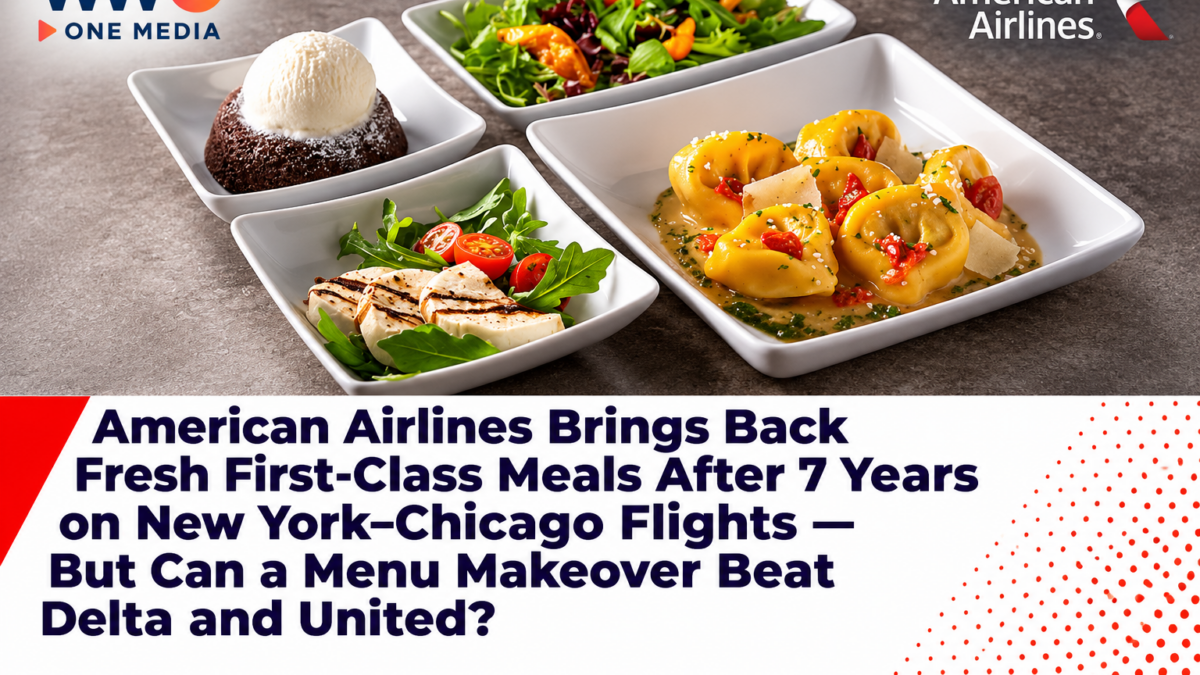
The new offerings include prosciutto and melon, apple cinnamon chia pudding, Thai noodle salad and Mediterranean-style mezze plates.
While the changes may appear modest compared with multimillion-dollar aircraft renovations, they reflect a much larger commercial battle.
American Airlines is attempting to close the gap with Delta and United, which have invested heavily in premium cabins, airport lounges, inflight dining and the overall passenger experience.
According to CNBC’s November 11 report, American’s decision to restore fresh food follows years in which the carrier has struggled to match the profitability and premium-service investments of its two biggest US competitors.
For American, the stakes are considerable.
The airline has revealed that approximately 30% of its seats generate about half of its revenue, demonstrating the financial importance of travelers purchasing premium products.
As previously examined by WWC ONE MEDIA in its analysis of how American Airlines earns 50% of revenue from approximately 30% of its seats, attracting higher-spending passengers has become a central component of the company’s long-term business strategy.
Now, American is betting that even a relatively simple improvement in inflight dining can strengthen its appeal.
But will bringing back fresh food be enough to challenge Delta and United?
American Airlines Restores Fresh First-Class Dining After Seven-Year Absence
The new service marks the return of fresh First-Class food options on the affected New York–Chicago routes after a seven-year absence.
According to CNBC, the airline last offered fresh food in First Class on these routes in 2019.
Since then, eligible travelers have generally received a smaller packaged snack rather than a fresh light meal.
American’s latest announcement changes that arrangement for selected services.
Passengers flying in First Class between Chicago O’Hare and either JFK or LaGuardia will be offered two light-bite options, with selections varying by meal period.
The company plans to rotate its menus regularly throughout the year.
That means passengers traveling on the same route at different times may encounter different choices.
Raphael Girardoni, American Airlines’ vice president of culinary strategy and operations, said the initiative aims to deliver a more substantial dining experience on one of the carrier’s popular routes.
The airline is positioning the new menu as part of its broader effort to improve service quality rather than simply increase the quantity of food.
Importantly, the initiative is not a return to elaborate multi-course dining on every short domestic flight.
The products are described as light bites, and American has not announced that every domestic First-Class route will immediately receive the same service.
The initial rollout is specifically focused on eligible flights connecting Chicago O’Hare with New York’s two major airports.
What’s on the New American Airlines First-Class Menu?
American’s official announcement includes a broader range of breakfast, lunch and dinner options than the examples highlighted in CNBC’s initial report.
<box gap={3}> <row align=”start” gap={3}> <AsyncImage query=”elegant prosciutto and melon appetizer airline first class fresh food plated” aspectRatio=”5:4″ maxWidth=”136px”/> <box flex=”1″ gap={1}> **Breakfast selections**
  Prosciutto and melon, smoked salmon, tropical chia overnight oats, apple cinnamon chia pudding, fruit and cheese, or prosciutto and brie.
</box>
</row> <divider color=”subtle”/> <row align=”start” gap={3}> <AsyncImage query=”premium airline cabin Thai noodle salad plated fresh vegetables restaurant food” aspectRatio=”5:4″ maxWidth=”136px”/> <box flex=”1″ gap={1}> **Lunch and dinner selections**
  Thai noodle salad, curry chicken salad, turkey and Gouda sandwich, whipped burrata, poached shrimp with noodle salad, mezze plate, blackened chicken, or grilled vegetable wrap.
</box>
</row> </box>
Passengers will not receive every dish listed. American says travelers will be offered a choice between two available items, with the menu rotating.
The airline also confirmed that the fresh light bites will be available exclusively onboard rather than through its meal-preordering system.
This means passengers should not assume that a particular item can be reserved before departure.
The selection is intended to provide greater variety without transforming the relatively short New York–Chicago flight into a full long-haul dining experience.
Why American Airlines Is Spending More to Attract Wealthy Travelers
The return of fresh food is part of a strategic effort to improve American’s premium passenger proposition.
In recent years, airlines have increasingly focused on customers willing to pay extra for larger seats, priority boarding, lounge access and upgraded onboard services.
These travelers can generate substantially more revenue than passengers purchasing basic economy fares.
American Airlines CEO Robert Isom highlighted the importance of this market during a September 2026 aviation conference.
He said roughly 30% of the company’s seats were generating approximately 50% of revenue.
The figure captures the importance of premium products across the airline’s network.
It does not mean that traditional First Class alone accounts for half of American’s revenue.
The broader premium category includes several seating products and services.
Nevertheless, the numbers help explain American’s investment priorities.
Higher-paying travelers are commercially important, and improving their experience could support customer loyalty and stronger revenue performance.
Food may seem like a small detail, but passengers compare airlines across the entire journey.
A traveler choosing between similar departure times and ticket prices may consider seat comfort, lounge access, food quality, reliability and frequent-flyer benefits.
The airline that delivers a more consistent experience can potentially strengthen its position.
American’s challenge is demonstrating that these improvements justify premium fares while remaining operationally efficient.
Delta and United Are Raising the Stakes in America’s Premium Travel War
American’s latest announcement comes amid intense competition among the three largest US network carriers.
Delta Air Lines has spent years positioning itself as a premium airline through cabin upgrades, lounge investments, onboard service improvements and partnerships with major consumer brands.
United Airlines has also expanded its premium offerings, including Polaris business-class products, upgraded aircraft interiors, improved entertainment and broader lounge facilities.
Both competitors have generally delivered stronger profitability than American in recent years, although individual results vary by quarter.
This has increased pressure on American to strengthen its own product.
Rather than relying exclusively on price, the company is trying to compete through service quality and a more attractive premium travel experience.
That strategy extends far beyond meals.
American is investing in new cabins, upgraded aircraft interiors, premium lounges and better entertainment technology.
The return of fresh meals on New York–Chicago flights therefore represents one piece of a wider effort to convince customers that American deserves consideration alongside its strongest rivals.
However, the company has not disclosed how much additional revenue or profit it expects to generate specifically from the new dining service.
Any suggestion that fresh meals alone will reverse American’s competitive disadvantages would therefore be premature.
American Airlines Is Also Redesigning Its Long-Haul Aircraft
One of the clearest signs of American’s premium strategy is its investment in widebody aircraft interiors.
In September 2026, the airline began introducing a redesigned Boeing 777-300ER configuration featuring significantly more premium seating.
According to Reuters, the updated aircraft increases premium seat capacity from 116 to 144 seats.
That raises the premium proportion of the cabin from approximately 38% to 44%.
The redesigned aircraft includes 70 Flagship Suite business-class seats, 44 Premium Economy seats and 30 Main Cabin Extra seats.
The Flagship Suites offer enhanced privacy, including doors and lie-flat seating.
The aircraft modernization is scheduled to continue through 2027.
Interestingly, American is also eliminating the traditional eight-seat Flagship First cabin from these redesigned aircraft.
At first glance, that appears to contradict its new emphasis on First-Class service.
But the two developments involve different markets.
The fresh-food program concerns domestic First Class on selected short-haul flights.
The aircraft changes involve long-haul international premium cabins, where business-class suites have increasingly replaced traditional First Class as the principal luxury product.
The distinction is significant.
American is not abandoning premium travel.
It is reorganizing premium offerings around products that management believes can attract more customers and generate stronger commercial returns.
As WWC ONE MEDIA previously reported in its analysis of American Airlines’ changing premium cabin strategy, the airline is shifting resources toward a larger and potentially more profitable premium seating portfolio.
JetBlue’s New First-Class Product Adds Another Competitive Threat
The premium aviation race is not limited to American, Delta and United.
JetBlue Airways is also preparing to introduce its BlueFirst premium cabin on selected domestic routes.
The product is scheduled to debut in December 2026 and will include wider seating, premium meals and additional airport services.
JetBlue has promoted limited introductory one-way fares beginning at $249 on selected flights, although prices will vary by route, availability and booking conditions.
The move demonstrates how airlines outside the traditional US network-carrier group are increasingly competing for passengers seeking an upgraded domestic experience.
Read the related WWC ONE MEDIA report: JetBlue Introduces $249 BlueFirst Premium Flights Ahead of December Launch — But Its Biggest Challenge Against Delta and United Is Still Ahead.
For American, this expanding competition increases the importance of delivering value across different aspects of the journey.
Improved food, better seating, more reliable service and convenient schedules can all influence booking decisions.
But customer preferences vary.
Some travelers prioritize ticket prices and flight frequency, while others place greater value on cabin comfort or premium services.
The airline that can serve these segments profitably may gain an advantage.
American Is Upgrading Airport Lounges and Dining Beyond the Aircraft
American’s fresh-food initiative follows several other improvements across its passenger experience.
The airline has refreshed its complimentary Main Cabin snack offerings.
It has expanded its partnership with Texas barbecue restaurant Pecan Lodge to additional eligible First-Class departures from Dallas Fort Worth International Airport.
American has also reopened its redesigned Flagship Dining facility at Los Angeles International Airport.
Food and beverage offerings have been enhanced across selected Flagship and Admirals Club lounges.
These improvements form part of a broader attempt to strengthen the premium journey before, during and after the flight.
For wealthy business travelers, airport time can be an important part of the overall travel experience.
Access to comfortable lounges, dining facilities and quieter working spaces may influence which airline a customer chooses.
American’s strategy appears designed to improve its position across these touchpoints.
However, premium infrastructure requires substantial spending.
Lounges must be maintained and staffed, while higher-quality onboard food introduces additional catering and logistics requirements.
The financial test is whether these improvements help generate enough incremental revenue and customer loyalty to justify their cost.
What the Changes Mean for Travelers Flying Between Chicago and New York
Passengers on eligible American Airlines flights between Chicago O’Hare and New York’s JFK or LaGuardia airports can expect a more substantial food offering in First Class beginning this month.
The improvement is especially relevant to business travelers and frequent flyers using the route.
Chicago and New York are major commercial centers connected by frequent air services.
Travelers often have multiple airlines and departure times to consider.
American’s new light-bite menu adds another factor to the premium service comparison.
Nevertheless, travelers should be aware of several limitations.
The announcement does not establish that fresh meals will be offered in economy class on these routes.
It also does not guarantee that every flight will feature the same menu.
The airline has not announced the exact service launch date for every individual departure.
Passengers should therefore check their booking details and the carrier’s latest onboard-service information.
The new menu is an upgrade for eligible First-Class customers, not evidence of a universal change across American’s entire domestic network.
Why This Matters to Filipino Travelers and the Global Aviation Market
Although the new dining program concerns US domestic flights, the broader premium-travel competition has implications for international travelers.
Chicago O’Hare and New York are major gateways for passengers traveling between North America and Asia.
Filipino travelers flying to the United States may connect onward to domestic destinations through American or other US carriers.
The quality of those connecting flights can influence the overall travel experience.
Chicago has become particularly relevant to Philippine aviation following the launch of Philippine Airlines’ nonstop Manila–Chicago service on November 9, 2026.
As WWC ONE MEDIA reported on Philippine Airlines’ historic Manila–Chicago route launch, the new service strengthens connections between the Philippines and America’s Midwest.
Passengers using Chicago as a gateway may have access to additional domestic flights operated by US carriers, although specific connections depend on ticketing arrangements, schedules and availability.
American’s premium-service investments also reflect a trend visible across international aviation.
Singapore Airlines, Emirates, Qatar Airways and other global carriers continue to invest in more sophisticated premium cabins and onboard experiences.
These developments illustrate how airlines increasingly compete through comfort, privacy, dining and customer experience rather than ticket prices alone.
Could Fresh Meals Help American Airlines Improve Profitability?
American’s return to fresh First-Class dining represents an investment in passenger experience, but the company’s broader financial goals remain more complicated.
Premium customers can generate higher fares, and improved amenities may help an airline attract or retain those travelers.
However, operating costs must also be considered.
Fresh food can require more complex catering arrangements than packaged snacks.
Airlines must manage food safety, supply logistics, menu availability and waste while ensuring meals can be delivered efficiently during relatively short flights.
There is also the question of customer willingness to pay.
A premium passenger may appreciate better dining without necessarily choosing the airline solely because of the menu.
The service could contribute to an improved customer perception, but the commercial effect would be difficult to isolate from other factors.
Aircraft quality, punctuality, route frequency, loyalty benefits and fare levels all influence airline choice.
American has not released a forecast quantifying the financial contribution of the new meals.
Therefore, the program should be viewed as part of a wider premium-service investment strategy rather than a guaranteed profit driver.
What Happens Next for American Airlines?
The initial rollout will provide an opportunity for American to evaluate customer response to the upgraded dining service.
If the program proves popular and operationally manageable, management could consider similar improvements elsewhere.
But no companywide expansion of this specific light-bite menu has been confirmed.
Meanwhile, American will continue upgrading aircraft interiors and enhancing premium customer services.
Its competitors are unlikely to stand still.
Delta and United are also investing in premium products, creating an ongoing race to attract travelers willing to spend more.
The commercial success of these strategies will depend on whether airlines can improve customer satisfaction while controlling costs.
A premium experience must ultimately deliver value to both passengers and shareholders.
The Bigger Picture: America’s Airline Luxury War Is No Longer Just About Seats
The return of fresh food to First Class on New York–Chicago flights illustrates how intensely competitive the US aviation market has become.
What might once have been considered a small catering decision is now part of a major commercial strategy.
American Airlines is investing in upgraded cabins, airport facilities, onboard technology and dining to improve its position against Delta and United.
The seven-year return of fresh meals is a visible example of that effort.
For travelers, greater competition could lead to more attractive premium products and improved service.
For airlines, however, those improvements must be supported by profitable operations.
American has already demonstrated the financial importance of premium travelers, with approximately 30% of seats accounting for half of its revenue.
The challenge is keeping those customers satisfied while competing against carriers investing heavily in similar experiences.
American Airlines is bringing fresh meals back to New York–Chicago First Class after seven years, but its ambitions extend far beyond the dining tray. The company is trying to convince high-paying travelers that its premium experience can once again compete with the industry’s strongest performers.
And as Delta, United and JetBlue continue upgrading their own services, could American’s fresh-food comeback become the beginning of a major turnaround — or will the airline discover that winning the premium travel war requires much more than a better menu?