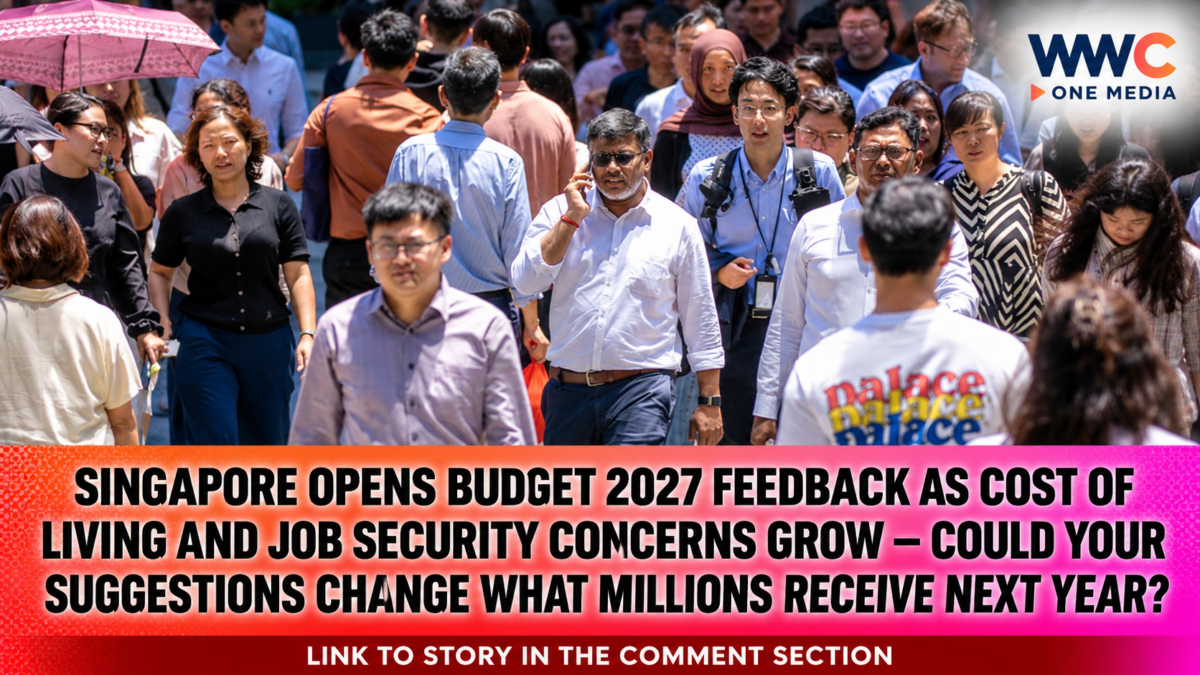
SINGAPORE — Singaporeans will have eight weeks to tell the Government what they want prioritised in the next national Budget, as the Ministry of Finance (MOF) opens its public feedback exercise for Budget 2027 on November 12.
Individuals, businesses and organisations can submit their views and proposals until January 6, 2027, giving the public an opportunity to influence discussions on economic competitiveness, employment, household support and the country’s longer-term financial priorities.
The consultation will cover three broad themes: strengthening Singapore’s economic resilience and competitiveness, investing in workers, and providing greater assurance for Singaporeans.
The Budget 2027 statement is scheduled to be delivered in February 2027.
The announcement comes as households continue to face concerns about living expenses, workers navigate technological disruption and businesses prepare for an economy increasingly shaped by artificial intelligence.
But the bigger question is whether public feedback will translate into practical measures that people can actually feel in their daily lives.
EIGHT WEEKS TO MAKE SUGGESTIONS: HOW SINGAPOREANS CAN PARTICIPATE
The MOF’s feedback exercise runs from November 12, 2026, to January 6, 2027.
This year’s consultation period is two weeks longer than the corresponding exercise for Budget 2026.
There are several ways to participate.
Five online channels are available:
- The official Singapore Budget website
- The REACH Budget 2027 microsite
- REACH Singapore’s Facebook page
- REACH Singapore’s Instagram page
- The People’s Association’s ShareYourViews platform
The Government’s feedback and engagement unit, REACH, will also organise a physical pre-Budget Listening Point. Details are expected to be announced through its social media channels closer to the event.
The People’s Association and its grassroots organisations will separately engage residents through ShareYourViews activities in neighbourhoods and online community channels.
This means participation is not limited to business groups, economists or established organisations. Individual Singaporeans can also submit their views.
THREE BIG THEMES THAT COULD SHAPE BUDGET 2027
The Government has identified three main areas for public feedback.
1. Strengthening economic resilience and competitiveness
Singapore faces an increasingly uncertain global economic environment, with technological changes, international competition and geopolitical developments affecting businesses and investment.
The Government is seeking ideas on how the country can strengthen its economic position, improve productivity and remain attractive to international businesses.
This includes questions about how local companies can adopt new technologies, develop new capabilities and compete in changing global markets.
The issue is particularly relevant as artificial intelligence becomes a bigger part of business operations.
The Monetary Authority of Singapore said in October that AI-related industries are expected to remain important drivers of economic growth in 2027, although activity could moderate from the exceptional pace seen in 2026.
Semiconductor production, data-centre investment and other technology-related activities are among the areas supporting this outlook.
However, economic growth alone does not guarantee that every business or worker will benefit equally.
2. Investing in workers
The second theme focuses on helping Singaporeans remain employable, develop relevant skills and secure better opportunities as the economy changes.
This is particularly important as AI and automation transform jobs across professional services, manufacturing, finance, communications and other industries.
Workers have already raised concerns about whether training programmes provide skills that employers actually need.
In NTUC’s pre-Budget discussions in October, participants called for more practical, industry-specific training, better links between courses and real job opportunities, and clearer safeguards when employers use AI in hiring and workplace decisions.
The concerns are not limited to experienced employees.
Fresh graduates are also facing questions about entry-level opportunities as AI tools increasingly perform tasks traditionally assigned to junior workers.
WWC ONE MEDIA previously examined this issue in Singapore Launches 3,000 Tech Internships as AI Takes Over Entry-Level Tasks — But Could the Next Generation Still Struggle to Find Jobs?.
The programme reflects a wider effort to create pathways for young people to gain practical experience as technology changes the workplace.
Another important development is Singapore’s expansion of AI-related training. More than 200 AI courses and a new career and skills centre were introduced in September under the Skills and Workforce Development Agency.
Read more: Singapore Launches 200+ AI Courses and New Career Centre as Workforce Agency Targets Future-Ready Jobs.
The question for Budget 2027 is whether existing support is sufficient — and whether more assistance should be directed towards workers who need to change careers, older employees, lower-wage workers and people at risk of displacement.
3. Providing greater assurance for Singaporeans
The third theme focuses on the support Singaporeans need at different stages of life.
This includes household expenses, financial security, retirement, access to essential services and support for people facing difficult circumstances.
For many households, the cost of food, housing, transport, healthcare and education remains a major concern.
Prime Minister Lawrence Wong has identified cost-of-living pressures and access to better jobs as continuing priorities for the Government.
He has also acknowledged that economic growth is uneven: some industries are doing well, while other workers and businesses continue to face pressure.
The public consultation gives Singaporeans an opportunity to explain which forms of assistance they believe should be strengthened and where existing support may not be reaching those who need it.
COST OF LIVING REMAINS A MAJOR TEST FOR THE NEXT BUDGET
Household expenses are likely to be among the issues attracting significant public attention.
Singapore introduced several support measures under Budget 2026 and subsequent announcements.
These included:
- S$500 CDC Vouchers, brought forward to June 2026.
- S$400 to S$600 Cost-of-Living Special Payments for eligible Singaporeans in September 2026.
- S$300 CDC Vouchers scheduled for January 2027.
- Additional U-Save rebates of up to S$190 for eligible HDB households across October 2026 and January 2027.
- Expanded interim ComCare assistance for eligible lower-income households.
These measures are part of the existing support framework. They should not be confused with new benefits already approved under Budget 2027.
The next consultation could give the Government a clearer picture of whether households want further direct financial assistance, more targeted subsidies, stronger wage support or improvements to essential services.
WWC ONE MEDIA previously reported on public concerns about the Government’s ability to address rising expenses and employment disruption in AsiaOne Survey Finds Mixed Confidence in Government Plans After National Day Rally 2026.
The survey found that cost of living was the leading concern among respondents, followed by job security, healthcare affordability and the challenges associated with an ageing population.
Those findings provide useful context for the new consultation, although they are not a substitute for the Government’s own analysis of all public submissions.
WILL AI JOB DISRUPTION BECOME ONE OF THE BIGGEST BUDGET 2027 ISSUES?
Artificial intelligence could become one of the most important policy questions facing Singapore in the coming years.
The technology is creating new opportunities in areas such as semiconductor manufacturing, finance, healthcare and professional services. At the same time, it is changing the tasks employers need workers to perform.
In October, Singapore’s President Tharman Shanmugaratnam warned that AI was already reducing demand for some entry-level jobs, particularly in sectors where routine work can be automated.
The concern is that young people could find it increasingly difficult to secure their first jobs and gain the experience needed to build long-term careers.
The Government has introduced training, career guidance and job-matching support to help workers adapt.
However, workers and employers have also argued that training must lead to practical employment opportunities rather than simply increasing the number of available courses.
This raises several questions for Budget 2027:
- Should more funding go towards industry-specific AI training?
- Should companies receive stronger incentives to retrain existing employees?
- How can fresh graduates gain meaningful work experience?
- What additional support should be available to workers displaced by automation?
- Should stronger safeguards apply when AI is used in recruitment and employee assessments?
The outcome could influence how Singapore balances technological growth with employment security.
BUSINESSES ALSO HAVE A STAKE IN THE NEXT BUDGET
Budget 2027 is not only about household assistance.
Businesses, especially small and medium-sized enterprises, will also be able to submit suggestions on how the Government can improve Singapore’s competitiveness.
Companies are dealing with changing consumer demand, manpower constraints, technology costs and international uncertainty.
For smaller firms, adopting AI and other digital tools can require significant investment in software, infrastructure and employee training.
The Government will need to consider how support can help businesses become more productive without creating unnecessary administrative burdens.
Singapore’s latest retail figures also show why business conditions deserve attention.
WWC ONE MEDIA reported that Singapore Retail Sales Rebound to 1.7% in September 2026 as F&B Spending Returns to Growth — But One Major Warning Remains.
Although retail and food-and-beverage sales returned to year-on-year growth in September, the recovery was uneven across business categories, while seasonally adjusted monthly retail sales declined.
This highlights an important distinction: stronger headline economic figures do not necessarily mean every business is experiencing the same recovery.
For Budget 2027, business groups may seek measures that improve access to financing, encourage digital adoption, support workforce transformation and strengthen domestic demand.
WHAT HAPPENS AFTER THE FEEDBACK PERIOD CLOSES?
The public consultation will remain open until January 6, 2027.
After submissions close, the Government will consider the feedback as part of the preparations for the national Budget.
The Budget 2027 statement is scheduled for February 2027, when the Government will announce its spending priorities, revenue measures and support programmes for the coming financial year.
Not every suggestion will necessarily become policy.
The consultation is an opportunity for individuals and organisations to contribute ideas, but the final decisions will also depend on fiscal resources, economic conditions, national priorities and the Government’s assessment of what can be implemented.
The extended eight-week period gives participants more time to develop proposals and explain the problems they want policymakers to address.
THE BIG QUESTION: WILL BUDGET 2027 ADDRESS WHAT SINGAPOREANS ARE REALLY WORRIED ABOUT?
Singapore’s next Budget is being prepared at a time when the country is balancing several major challenges.
Businesses need to remain competitive. Workers must adapt to AI and changing job requirements. Younger Singaporeans need clearer pathways into employment, while older residents face questions about retirement and long-term financial security.
At the same time, households want relief from everyday expenses and confidence that essential services will remain accessible.
The November 12 consultation gives the public a chance to make those priorities heard before the February Budget announcement.
But the real test will come after the submissions are collected.
Will the next Budget deliver more practical help for households? Will it create better opportunities for workers facing technological disruption? And will businesses receive the support they need to remain competitive?
Singaporeans now have until January 6, 2027, to put forward their ideas.
The opportunity is open. What the Government ultimately does with that feedback is the decision millions will be watching.