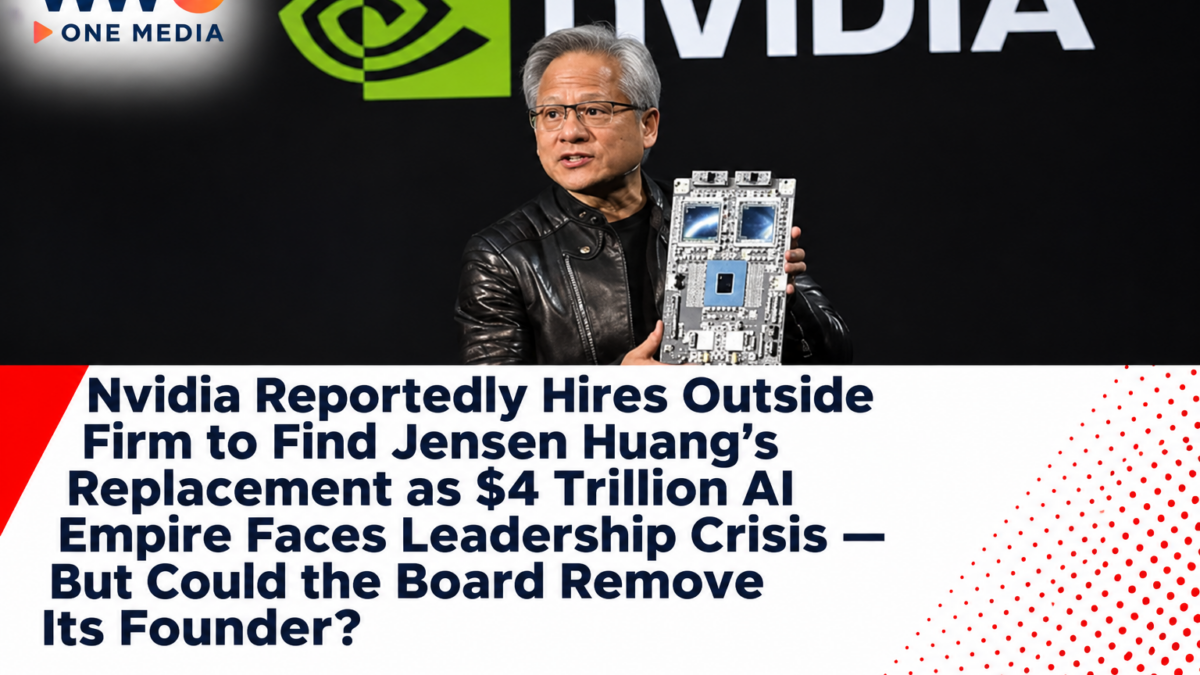
SANTA CLARA, CALIFORNIA / MANILA, PHILIPPINES — November 12, 2026 — Nvidia’s board is reportedly working with an outside firm to identify potential replacements for Chief Executive Officer Jensen Huang, a dramatic development that could reshape leadership at one of the world’s most valuable technology companies.
According to Bloomberg’s November 11 report, citing a person familiar with the situation, Nvidia directors have been working with an external firm to identify possible CEO candidates and are considering appointing an interim chief executive while searching for a permanent replacement.
The discussions follow allegations involving Huang’s personal relationships, including a reported relationship with a business executive suspected by US intelligence officials of having connections to China.
Huang has acknowledged being unfaithful to his wife. But the intelligence allegations remain disputed and under investigation, and no public finding has established that he knowingly participated in espionage or compromised Nvidia’s technology.
The controversy has nevertheless triggered a widening corporate-governance crisis.
The Wall Street Journal separately reported that Nvidia’s board was preparing to consider removing Huang. Reuters said the directors were meeting to determine his future, while cautioning that it could not independently verify every aspect of the removal report.
For Nvidia shareholders, the possibility of an abrupt leadership transition is particularly significant.
Huang co-founded Nvidia in 1993 and has spent more than three decades transforming the company from a graphics-chip developer into the dominant supplier of processors used in advanced artificial intelligence.
His leadership is deeply connected to Nvidia’s technology roadmap, customer relationships, corporate culture and public identity.
The central question is no longer simply who could replace Jensen Huang. It is whether Nvidia has become so dependent on its founder that losing him could disrupt the global artificial intelligence industry.
Nvidia’s Board Reportedly Begins Search for Jensen Huang’s Successor
Bloomberg reported that Nvidia’s directors are working with an outside firm to identify potential CEO candidates.
The board is also considering the possibility of appointing an interim leader while a permanent search takes place.
The external firm has not been publicly identified in the reporting reviewed.
Neither has Nvidia disclosed a formal shortlist of candidates.
The distinction is important.
Identifying potential replacements does not mean Huang has already been dismissed, resigned or agreed to step aside.
Companies may explore succession options to ensure continuity during periods of uncertainty.
However, in Nvidia’s case, the reported search comes amid an unusual combination of an independent investigation, shareholder concerns and heightened scrutiny of the CEO’s personal and professional relationships.
Bloomberg also reported that directors met on November 11 to discuss Huang’s future.
The discussions represent a potentially historic turning point for a company that has had the same chief executive since its founding.
Wall Street Journal Reports Board Is Considering Huang’s Removal
The outside search follows a separate Wall Street Journal report that Nvidia’s board was preparing to remove Huang after allegations concerning multiple extramarital relationships.
Reuters reported the development on November 11, citing the Journal.
According to Reuters, the board was expected to meet as soon as Wednesday to determine the CEO’s future.
The reporting does not establish that a final decision to dismiss Huang has been made.
Nvidia had not publicly identified a successor.
The company’s earlier position was that Huang would remain CEO while cooperating with an independent investigation.
That leaves investors facing substantial uncertainty.
One possible outcome is that Huang remains in charge.
Another is that directors establish new oversight arrangements or impose governance changes.
A third possibility is an interim appointment followed by a permanent leadership transition.
Until Nvidia announces a formal decision, those remain possibilities rather than confirmed developments.
Nvidia’s Investigation Brings National Security Into the Leadership Crisis
The controversy began after reports concerning Huang’s personal relationship with a business executive identified as Alice Huang.
The executive previously worked with Singapore-based technology company Megaspeed, which had commercial relationships involving Nvidia chips.
US intelligence officials reportedly suspect that Alice Huang was involved in intelligence activities for China.
The allegations have not been established through a publicly reported judicial finding.
China has rejected the espionage accusations as unsubstantiated.
Megaspeed has denied allegations that it improperly circumvented US export restrictions.
Jensen Huang has acknowledged an extramarital relationship but has not publicly admitted to knowingly assisting a foreign intelligence operation.
Nvidia’s board announced an independent investigation on November 8.
The company said it had no reason to believe that national security or confidential Nvidia information had been compromised.
Nevertheless, the directors committed to examining the available evidence.
The investigation is significant because Nvidia produces some of the most strategically important computing technology in the US-China artificial intelligence competition.
Independent Law Firm Joins Nvidia’s Investigation
On November 10, Nvidia’s independent directors retained law firm Wachtell, Lipton, Rosen & Katz to assist with their inquiry.
The investigation is being led by Joon H. Kim, a former acting US attorney for the Southern District of New York.
His involvement underscores the seriousness with which the board is treating the allegations.
The review is separate from reported government investigations concerning possible intelligence activity and compliance with technology export restrictions.
The board must determine whether the circumstances raise questions about company policies, executive judgment, disclosure obligations or potential security vulnerabilities.
However, appointing an outside law firm does not demonstrate that misconduct occurred.
A credible investigation must assess evidence before reaching conclusions.
As WWC ONE MEDIA reported in its examination of Nvidia’s board independence and corporate oversight, the crisis has also renewed questions about whether directors with longstanding relationships with Huang can exercise sufficiently independent judgment.
Nvidia’s governance response may ultimately have consequences beyond the investigation itself.
Why Replacing Jensen Huang Would Be Exceptionally Difficult
Jensen Huang is not an ordinary corporate chief executive.
He is a co-founder who has led Nvidia continuously since 1993.
Under his leadership, the company evolved from producing graphics processors for video games into developing computing systems that support artificial intelligence, scientific research, cloud infrastructure and advanced industrial applications.
Huang is also known for his unusual management structure.
He has said that more than 60 executives report directly to him.
Many of those executives are highly specialized technical leaders.
The structure gives Huang extensive visibility across Nvidia’s engineering and commercial operations.
But it may also make succession more complicated.
Unlike companies with a conventional hierarchy and a clearly designated second-in-command, Nvidia has not publicly identified an obvious heir apparent.
As WWC ONE MEDIA examined in its report on Nvidia’s Jensen Huang succession crisis and stock-market losses, investors are confronting the possibility that Nvidia’s extraordinary success has created a substantial leadership-concentration risk.
Replacing a founder with Huang’s knowledge, relationships and influence could prove difficult even if the company’s underlying products remain in strong demand.
Who Could Replace Jensen Huang as Nvidia CEO?
Several executives have been discussed publicly by analysts and corporate-governance specialists.
However, none has been confirmed as a candidate chosen by Nvidia’s board.
Colette Kress — Chief Financial Officer
Kress is among the most visible executives at Nvidia.
She regularly represents the company during earnings calls and communicates its financial strategy to investors.
Her experience could make her a potential source of management continuity during a transition.
However, her name appearing in analyst discussions does not establish that the board has selected her as an interim or permanent replacement.
Chris Malachowsky — Nvidia Co-Founder
Malachowsky helped establish Nvidia alongside Huang and Curtis Priem in 1993.
His history with the company and knowledge of its technology could make him relevant to succession discussions.
But there is no verified public announcement that he is seeking or being considered for the CEO position.
Ian Buck — Senior Nvidia Technology Executive
Buck is closely associated with Nvidia’s accelerated-computing technology and the development of CUDA, the software platform central to its computing ecosystem.
His technical expertise could be valuable in a company whose competitive advantage depends heavily on engineering.
However, technical expertise alone does not establish readiness or interest in leading a global corporation.
Rene Haas — Arm CEO
Haas has also been mentioned by outside commentators as a possible candidate.
He has substantial semiconductor-industry experience, including previous work at Nvidia.
But Haas currently leads Arm, a separate publicly traded company.
No official approach or candidacy has been confirmed.
Other high-profile semiconductor and technology executives have appeared in speculative discussions.
These discussions should not be confused with Nvidia’s actual candidate search.
Could an Interim CEO Stabilize Nvidia?
One possibility reportedly being considered is appointing a temporary chief executive.
An interim CEO could provide continuity while directors complete the investigation and search for a permanent replacement.
That arrangement could help avoid forcing the board to make a rushed long-term appointment.
An interim leader would likely need to prioritize maintaining customer confidence, ensuring continuity in product development and communicating clearly with employees and investors.
For Nvidia, that responsibility would be particularly complex.
The company is involved in major technology and commercial relationships with cloud-computing providers, enterprise customers, governments and AI infrastructure developers.
Any sudden change in leadership could raise questions about strategy and execution.
But an interim appointment would not necessarily signal a change to Nvidia’s existing technology roadmap.
Products already in development, manufacturing partnerships and established customer orders could continue under the existing management team.
The effect would depend on how the transition is handled.
Nvidia Shares Fall as Investors Confront Leadership Uncertainty
Wall Street has reacted sharply to developments surrounding Huang.
Reuters reported that Nvidia shares declined approximately 8% in after-hours trading on November 11 following reports about a possible leadership change.
The company had already experienced substantial stock-market losses earlier in the week.
Reuters estimated that Nvidia’s market capitalization had fallen by approximately $600 billion over the period including the November 11 after-hours move.
Market capitalization reflects the value investors assign to a company’s shares at prevailing prices.
It is not the same as cash leaving the business.
Nevertheless, the losses illustrate how sensitive investors have become to uncertainty surrounding Nvidia’s leadership.
As WWC ONE MEDIA reported in its analysis of Nvidia’s $4-trillion AI business and the investigation involving Huang, the company’s influence extends far beyond its own stock.
Its processors are important components of the infrastructure behind the global AI investment boom.
Changes in investor confidence can therefore influence sentiment toward semiconductor manufacturers, cloud providers and technology infrastructure companies.
However, falling share prices do not automatically mean Nvidia’s current chip orders or operating revenues have declined by a comparable amount.
Nvidia’s $4 Trillion Valuation Makes the Stakes Enormous
Nvidia’s market value has made it one of the most influential companies in global equity markets.
At a valuation of approximately $4 trillion, even a modest share-price change can produce an enormous movement in market capitalization.
A 5% decline in a $4-trillion company would represent approximately $200 billion in market value.
The scale helps explain why news about Huang has attracted attention across financial markets.
Nvidia is heavily represented in major stock-market indexes.
Its performance affects investment funds and retirement portfolios that track those benchmarks.
The company’s leadership uncertainty can therefore have consequences for investors who do not own Nvidia shares directly.
Nevertheless, short-term market losses should not be interpreted as permanent financial damage.
Share prices can recover or decline further depending on company performance, market conditions and new information.
Nvidia’s AI Products Remain Central to the Industry
Despite the leadership controversy, Nvidia retains an important position in AI computing.
Its GPUs are widely used to train and operate artificial intelligence models.
Its CUDA software ecosystem has helped developers build applications optimized for Nvidia hardware.
Major cloud-computing companies continue investing heavily in infrastructure designed around advanced AI accelerators.
The company’s product roadmap includes technologies associated with its Blackwell and Rubin computing platforms.
Analysts interviewed by Reuters argued that demand for Nvidia’s established products could remain strong in the near term even if the company experiences a leadership transition.
That is an important distinction.
Nvidia’s commercial success depends on thousands of engineers, researchers, software specialists and operational employees, not only its CEO.
But Huang’s influence over technology strategy and customer relationships creates uncertainty about the company’s longer-term direction.
A new leadership team would need to demonstrate that it can preserve Nvidia’s innovation capabilities while managing increasingly intense competition.
Could AMD and Broadcom Benefit From the Uncertainty?
Nvidia’s rivals may see opportunities if customers become concerned about leadership continuity.
Advanced Micro Devices is competing for a larger share of the AI accelerator market.
Broadcom is involved in developing custom computing chips and networking technology for major technology companies.
Other chip designers and cloud providers are also investing in alternatives to Nvidia’s products.
However, a CEO controversy does not automatically result in customers abandoning Nvidia hardware.
Changing AI infrastructure suppliers can require significant engineering investment, software modifications and operational testing.
Nvidia’s established ecosystem creates switching costs for some customers.
The company’s competitive position therefore cannot be assessed solely through short-term stock-market movements.
The more important question is whether any leadership transition affects product development, customer support or strategic decision-making over time.
Nvidia’s Board Independence Faces a Critical Test
The developing crisis has intensified scrutiny of Nvidia’s directors.
Corporate boards are responsible for overseeing management, protecting shareholder interests and ensuring appropriate governance.
Those responsibilities become particularly important when allegations involve a founder who has led the company for decades.
Nvidia’s board includes directors with long tenures and extensive familiarity with Huang.
Supporters of such arrangements argue that experienced directors understand the company’s technology and strategic challenges.
Critics worry that longstanding professional relationships can make it harder to challenge a powerful executive.
The investigation and succession discussions will therefore test the board’s independence.
As WWC ONE MEDIA reported in its examination of Nvidia’s nearly $4-trillion valuation and leadership concentration, Nvidia’s extraordinary dependence on Huang has become a major corporate-governance concern.
The board must demonstrate that it can make decisions based on the company’s long-term interests rather than personal loyalty or short-term market pressures.
US-China Technology Tensions Raise the Stakes
The allegations involving possible foreign intelligence activity have added a geopolitical dimension to Nvidia’s leadership crisis.
The United States regulates exports of certain advanced semiconductors and computing systems to China.
Nvidia is directly affected because its processors are important to AI development.
Washington has sought to limit China’s access to some advanced chips over national-security concerns.
At the same time, Nvidia has argued that access to the Chinese market can help American technology companies compete internationally.
The controversy surrounding Huang has prompted additional questions from US lawmakers.
However, allegations about intelligence activities and possible export-control violations remain subject to investigation.
No publicly established finding in the reporting reviewed proves that Huang knowingly transferred confidential technology to China.
The distinction is essential.
Government scrutiny does not, by itself, establish criminal conduct.
Why the Entire AI Industry Is Watching
Nvidia’s position at the center of AI infrastructure makes any leadership transition unusually consequential.
Cloud-computing companies have committed substantial resources to data centers containing advanced Nvidia processors.
Technology startups depend on access to GPUs for training and operating AI models.
Large enterprises are developing applications using Nvidia-compatible systems.
The company also maintains relationships with chip manufacturers, equipment suppliers and infrastructure providers.
A sudden leadership disruption could create uncertainty around future partnerships or investment decisions.
But it would not necessarily stop those businesses from operating.
Existing contractual obligations, engineering teams and manufacturing programs would continue unless disrupted by other developments.
The greater risk may be that uncertainty damages investor confidence during an already volatile period for AI-related stocks.
What the Crisis Means for Asia-Pacific Technology Markets
Nvidia’s leadership uncertainty could also affect investor sentiment across Asia.
Semiconductor manufacturers and electronics suppliers in Taiwan, South Korea and Japan are connected to the global AI hardware supply chain.
Taiwan Semiconductor Manufacturing Company plays a major role in producing advanced chips used by Nvidia.
South Korean memory-chip manufacturers supply components essential to high-performance computing.
Japanese companies contribute equipment, materials and technologies used in semiconductor manufacturing.
For the Philippines, the relevance is primarily through global financial markets, electronics supply chains and business investment in AI infrastructure.
However, the available reporting does not establish that Nvidia’s CEO controversy has caused production cuts, canceled orders or specific Philippine job losses.
Such claims would require independent evidence.
What Happens Next for Jensen Huang?
Investors will be watching for several developments.
The first is whether Nvidia’s board issues an official statement confirming or rejecting reports of an impending leadership change.
The second is the progress of its independent investigation.
The third is whether directors formally name an interim chief executive or announce a permanent succession process.
The fourth is whether government authorities or lawmakers disclose findings that materially affect the company.
The fifth is how major customers, employees and investors respond to any leadership decision.
Until those developments become clearer, speculation about Huang’s departure is likely to remain a source of market volatility.
The Bottom Line: Nvidia Faces a Leadership Test Unlike Any in Its History
Nvidia’s reported decision to work with an outside firm to identify potential CEO candidates represents a significant escalation in the uncertainty surrounding Jensen Huang’s future.
The company that helped power the artificial intelligence revolution may now need to prepare for a future without the executive who has led it since 1993.
The board is reportedly considering an interim leadership arrangement while reviewing allegations involving Huang’s personal relationships and possible national-security concerns.
Those allegations remain under investigation.
Huang has not been publicly confirmed as removed, and Nvidia has not named a successor.
For shareholders, the central challenge is determining whether the company can maintain its technological leadership and commercial relationships through an unexpected management transition.
For the wider technology industry, the stakes are equally significant.
Nvidia’s processors, software and engineering capabilities remain central to the global AI economy.
The company’s technology is not built by one individual, but its leadership structure has become deeply associated with Jensen Huang.
As Nvidia’s directors reportedly search for potential replacements and weigh an interim CEO, could the company successfully begin a new era without its legendary founder—or will the leadership crisis expose an even bigger weakness at the center of the world’s AI boom?