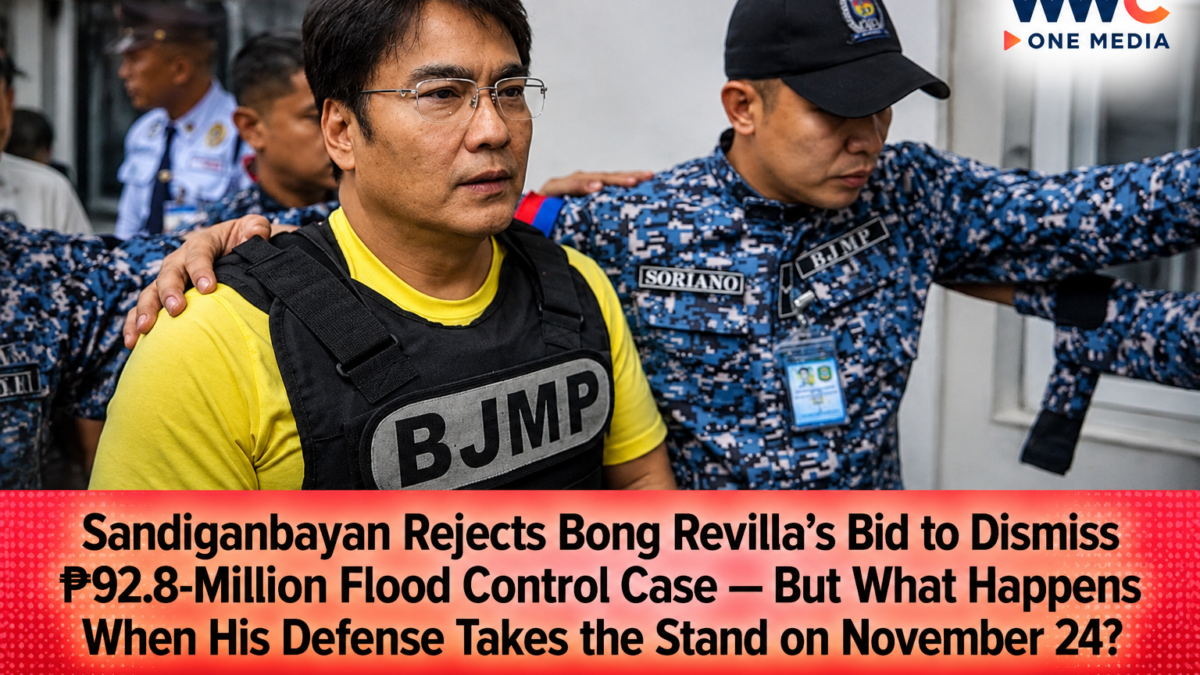
MANILA, Philippines — November 12, 2026 — Former senator Ramon “Bong” Revilla Jr. has suffered another legal setback after the Sandiganbayan rejected his request for permission to seek the dismissal of the malversation case involving an alleged ₱92.8-million ghost flood control project in Pandi, Bulacan.
The Sandiganbayan Third Division denied Revilla’s motion for leave of court to file a demurrer to evidence, a legal remedy that allows an accused to argue that the prosecution has failed to present enough evidence to justify continuing the case toward a conviction.
The development, confirmed by the court’s Third Division Clerk of Court Dennis Pulma, means Revilla did not obtain the court’s permission to pursue that particular dismissal procedure at this stage.
However, the ruling does not mean that Revilla has been found guilty.
The former senator remains out on bail following an earlier court decision, while the criminal proceedings continue. His defense is scheduled to begin presenting evidence on November 24.
The case is among the high-profile legal proceedings connected to allegations of irregularities in Philippine government flood control spending—an issue that has raised broader questions about public infrastructure, government accountability and the protection of taxpayers’ money.
Sandiganbayan Denies Revilla’s Request to File Demurrer to Evidence
The Sandiganbayan Third Division rejected Revilla’s motion seeking permission to file a demurrer to evidence in the pending malversation case.
According to court officials cited by multiple news organizations, Revilla had attached a copy of his proposed demurrer to his motion for leave.
The court, however, merely took note of the attached document. It did not grant the requested permission.
A demurrer to evidence is a legal pleading filed by the defense arguing that the prosecution’s evidence is insufficient to support a conviction.
Under Philippine criminal procedure, an accused may ask the court for permission to file a demurrer after the prosecution has completed its presentation of evidence.
The distinction is important: the court’s latest action concerned permission to use that legal remedy. It was not a final judgment on whether Revilla committed the alleged offense.
Daily Tribune and GMA News separately reported the denial, while ABS-CBN News also confirmed that the court rejected Revilla’s request.
The ruling leaves the case moving toward the next stage: the presentation of evidence by the defense.
Why the ₱92.8-Million Pandi Flood Control Project Is Under Scrutiny
The criminal case centers on an alleged flood control project in Barangay Bunsuran, Pandi, Bulacan.
Prosecutors allege that government funds were released for a project that was supposedly never constructed.
The amount identified in the case is approximately ₱92.8 million.
According to the information previously reported by Philstar, the Office of the Ombudsman alleged that the accused conspired between July 2024 and May 2025 to facilitate the release of public funds for the supposed construction of the flood control structure despite the alleged absence of actual implementation.
Prosecutors further alleged that at least ₱76.9 million was paid to SYMS Construction Trading in connection with the project.
The case also involves allegations of falsified public documents and the alleged receipt of kickbacks or commissions.
Revilla was accused of helping facilitate the inclusion of the project in the 2025 General Appropriations Act and receiving benefits connected to the funds allocated for it.
These are allegations contained in the criminal proceedings. They have not been established as facts through a final conviction.
Revilla has repeatedly denied the accusations.
The Earlier Bail Ruling: Why Revilla Is Still Out of Jail
One of the most important details in the case is the Sandiganbayan’s earlier decision allowing Revilla to post bail.
On July 31, 2026, the Third Division granted his petition for bail in a split 2-1 ruling and set his cash bond at ₱1 million.
The court found that the prosecution had failed to establish strong evidence of guilt for purposes of the bail application concerning the malversation charge.
The ruling also discussed the absence of proof showing that Revilla had explicitly or implicitly agreed to receive an advance kickback.
That finding became one of the grounds cited by Revilla in his later attempt to seek permission to file a demurrer to evidence.
But the two court actions involve different legal questions.
The bail ruling addressed whether the prosecution had established strong evidence of guilt under the applicable standard for bail in a non-bailable offense.
It did not decide whether Revilla was ultimately guilty or innocent.
The criminal case therefore remained active even after he was allowed to post bail.
This distinction is essential: being granted bail is not the same as being acquitted, and the denial of a demurrer-related motion is not the same as a conviction.
Defense Presentation Set for November 24
With the court rejecting Revilla’s request for permission to file a demurrer, attention now shifts to the defense proceedings.
The initial presentation of defense evidence is scheduled for November 24.
Revilla and his co-accused will have the opportunity to respond to the prosecution’s allegations through the judicial process.
The accused include former officials and personnel of the Department of Public Works and Highways’ Bulacan First District Engineering Office.
Those named in reports include Brice Hernandez, Jaypee Mendoza, Arjay Domasig, Emelita Juat, Juanito Mendoza and Christina Pineda.
The court’s proceedings will determine how the defense responds to the evidence presented by prosecutors and whether the allegations can ultimately be established beyond reasonable doubt.
The next hearings could become significant in determining the direction of the case.
The Bigger Issue: Public Money and the Philippines’ Flood Control Controversy
The Revilla case is part of a much wider national controversy involving allegations of irregularities in government infrastructure projects.
Flood control projects are intended to protect communities, reduce the impact of heavy rainfall and help prevent damage to homes, roads, businesses and public facilities.
When a project is allegedly funded but not constructed, the consequences go beyond a financial dispute.
Communities may remain exposed to flooding, while taxpayers are left questioning whether public funds were used for their intended purpose.
The controversy has also prompted greater scrutiny of project planning, procurement, implementation and government monitoring.
WWC ONE MEDIA previously examined the wider flood control controversy in its report, ₱1.9 Trillion Spent, Yet Filipinos Still Flood: Senate Moves to Scrutinize ₱107-Billion DPWH Budget.
The broader investigation has also involved financial scrutiny. In a separate development, the Anti-Money Laundering Council secured a freeze order covering assets allegedly connected to flood control kickback investigations. A freeze order, however, is a legal measure to preserve assets and does not itself establish criminal guilt.
Read WWC ONE MEDIA’s related report: AMLC Secures Freeze Order on Assets Linked to Flood Control Kickbacks.
Another related case involved former senator Revilla’s unsuccessful effort to have an associate justice removed from the division hearing his case. The court rejected the request after finding insufficient basis to establish bias or partiality.
That earlier development is discussed in Sandiganbayan Rejects Revilla’s Second Bid to Remove Justice From ₱92.8-Million Case.
WWC ONE MEDIA has also followed the wider investigation into alleged irregularities in government infrastructure spending, including the NBI’s examination of 51 flood control projects in Davao.
These separate developments illustrate why flood control spending remains a major public accountability issue. They should not, however, be treated as proof of the allegations against Revilla in his individual case.
What Happens Next in the Bong Revilla Case?
The immediate next milestone is November 24, when the defense is scheduled to begin presenting its evidence.
The prosecution has already completed its presentation, and the court will continue evaluating the case under the applicable rules of criminal procedure.
Several questions remain:
- What evidence will Revilla and his co-accused present?
- How will the defense respond to the prosecution’s allegations involving the Pandi project?
- Will the evidence establish whether public funds were improperly released or misused?
- What will the Sandiganbayan ultimately decide after both sides have had the opportunity to present their cases?
The answers will depend on the evidence and the court’s assessment—not on the political profile of the accused or the public reaction to the controversy.
A Legal Setback, but Not the Final Verdict
The Sandiganbayan’s rejection of Revilla’s request marks another important development in the legal battle over the alleged ₱92.8-million ghost flood control project.
The former senator failed to secure permission to pursue a demurrer to evidence, but the court has not convicted him.
His earlier bail ruling also remains a separate legal matter and does not end the criminal proceedings.
For now, the spotlight shifts to the defense presentation scheduled for November 24.
The case carries implications beyond one former senator. It has become part of a wider national debate over infrastructure spending, public accountability and whether government projects funded by taxpayers are actually delivered.