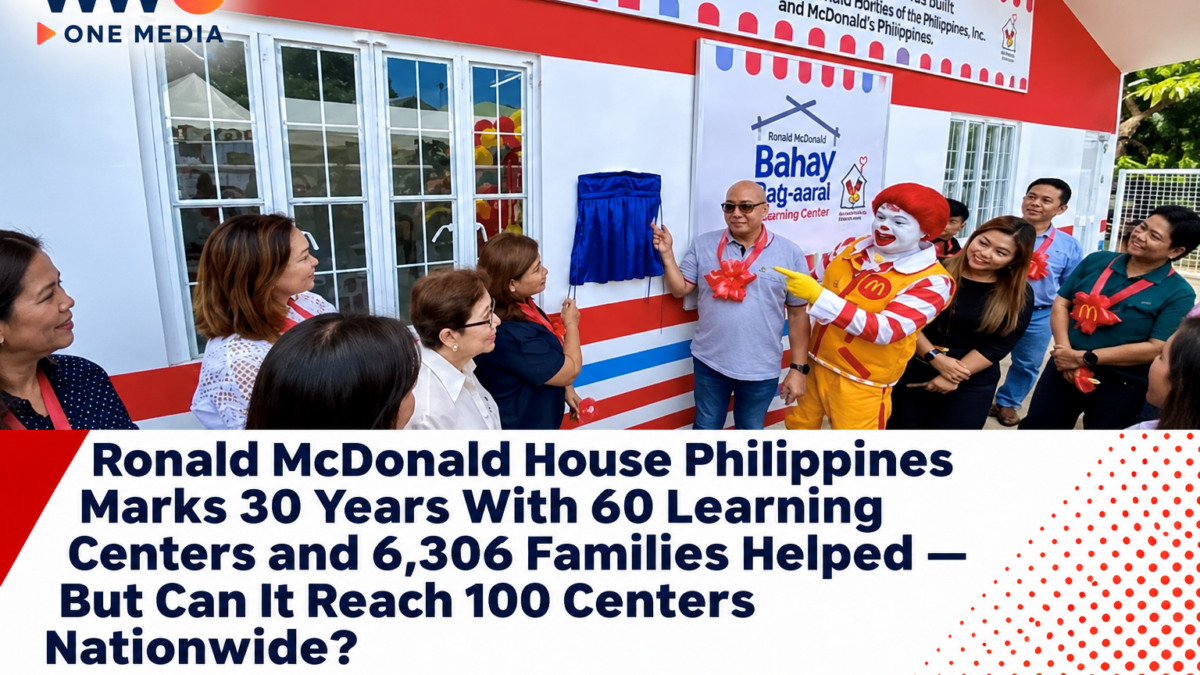
MANILA, Philippines — November 12, 2026 — What began as an effort to give underserved Filipino children a better start in life is evolving into a broader mission encompassing education, preventive healthcare and support for families navigating childhood illness.
As Ronald McDonald House Philippines celebrates its 30th anniversary, the charitable organization is expanding its work beyond classrooms, with 60 early childhood learning centers nationwide and a hospital-based Family Room that has already assisted 6,306 families.
Formerly known as Ronald McDonald House Charities of the Philippines, the organization has officially adopted the name Ronald McDonald House Philippines as it enters its fourth decade of service.
The anniversary marks an important milestone for the charity, which has supported children and families since 1996 through partnerships with communities, local governments and healthcare institutions.
But the organization is looking beyond its achievements.
It wants to increase its network of Ronald McDonald Bahay Bulilit Learning Centers from 60 to 100, strengthen childhood immunization support through its BACK-to-BAKuna program, and expand services that help families remain close to children receiving medical care.
For Filipino parents facing the combined challenges of education expenses, preventive healthcare and hospital visits, the mission addresses several of the pressures that can affect children’s well-being.
The bigger question is whether Ronald McDonald House Philippines can transform three decades of community programs into a stronger nationwide support system—and reach more families who need help.
Ronald McDonald House Philippines Celebrates 30 Years of Service
According to InsiderPH’s November 12 report, the organization is marking its anniversary with an expanded commitment to the well-being of Filipino children.
The organization began supporting early childhood education in 1996, establishing programs intended to provide safe and nurturing environments for young learners.
Its activities have since grown to include healthcare initiatives and support for parents and caregivers.
The name change reflects that broader mission.
Rather than focusing only on educational programs, Ronald McDonald House Philippines now emphasizes the connection between learning, health and family well-being.
These are closely related challenges.
A child who lacks access to quality early education may face difficulties entering formal schooling.
A child who misses recommended vaccinations may be exposed to preventable illnesses.
And when a young patient requires medical treatment, the needs of parents and caregivers can become an important part of the family’s overall experience.
The organization’s expanded approach seeks to address those different needs through programs operating in schools, communities and healthcare facilities.
From 60 Bahay Bulilit Centers to a Nationwide Goal of 100
One of the charity’s most established initiatives is the Ronald McDonald Bahay Bulilit Learning Center program.
The centers provide early childhood learning opportunities in underserved communities.
They offer spaces where young children can participate in age-appropriate educational activities and develop foundational skills before entering formal school.
Ronald McDonald House Philippines reports that it has established 60 learning centers nationwide.
Its next target is 100 centers, meaning another 40 would be needed to achieve the announced goal.
However, the organization has not specified a confirmed completion date for all 40 additional centers in the anniversary report.
The planned expansion matters because early childhood education can influence children’s readiness for primary school.
Learning environments that support early literacy, communication and social development can help prepare children for more structured classroom activities.
But the presence of a learning center does not automatically guarantee improved educational results.
Staffing, teaching quality, materials, maintenance and consistent attendance remain important.
The long-term impact will depend on how effectively the centers continue serving local communities.
McDonald’s Philippines Expands Its Education Partnerships
The anniversary comes alongside broader educational initiatives supported by McDonald’s Philippines.
The company has participated in school improvement programs, volunteer activities and teacher-support projects.
As previously reported by WWC ONE MEDIA in its coverage of McDonald’s education programs reaching 13.2 million students, the company has reported involvement with thousands of schools and educators through its cumulative education initiatives.
These include teacher recognition, classroom furniture support and activities involving employee volunteers.
The 13.2-million-student figure represents the company’s reported cumulative educational reach across multiple programs.
It should not be treated as the number of children served by Bahay Bulilit alone.
Similarly, Ronald McDonald House Philippines’ 60-center figure describes its learning-center network rather than the number of individual students enrolled.
Keeping these measures separate helps provide a more accurate picture of the organization’s activities.
Why Early Childhood Education Remains a Major Philippine Challenge
The expansion of Bahay Bulilit comes as the Philippines continues to face serious challenges in foundational learning.
Some students enter elementary school without having developed the reading skills expected for their grade level.
In Cebu Province, for example, education authorities reported that more than 31,600 Grade 1 to Grade 3 learners were not reading at the expected level at the end of School Year 2025–2026.
As WWC ONE MEDIA reported in its examination of Cebu’s early-grade reading challenges, difficulties with foundational literacy can affect pupils as they progress into more demanding subjects.
The Cebu findings are not a direct assessment of Ronald McDonald House Philippines’ programs.
However, they demonstrate why educational support during children’s early years remains relevant.
Community learning centers can complement public education services by providing additional opportunities for young learners.
Their effectiveness should ultimately be assessed through measurable educational outcomes and sustained access.
BACK-to-BAKuna Brings Preventive Healthcare Into the Mission
Ronald McDonald House Philippines is also expanding its focus on childhood healthcare through BACK-to-BAKuna.
The initiative aims to help parents and caregivers complete their children’s recommended immunizations.
The program uses behavioral science and community partnerships to address practical barriers that may prevent families from returning for subsequent vaccine doses.
Those barriers can include forgotten appointments, transportation difficulties, uncertainty about schedules and a lack of reliable information.
BACK-to-BAKuna provides support through reminders, practical planning tools, peer engagement and coordination with local health services.
The goal is not simply to encourage a first vaccination visit.
It is to help families complete recommended immunization schedules through the appropriate healthcare providers.
This approach recognizes that access to healthcare can depend on practical support as well as the availability of medical services.
Vaccination Program Wins 2026 CSR Health Award
BACK-to-BAKuna has also received recognition for its community-based approach.
In September 2026, the Philippine News Agency reported that the initiative was named the 2026 Outstanding CSR Project for Health at the League of Corporate Foundations Guild Awards.
The program was piloted beginning in August 2025 in Iloilo City and Janiuay, Iloilo.
Its activities included group vaccine cards, milestone calendars, digital reminders, transportation support and health-promotion efforts.
These interventions were designed to support existing public vaccination services rather than replace them.
The recognition demonstrates that the program’s approach has attracted attention within the corporate social responsibility sector.
However, an award should not be confused with independently verified evidence that the initiative has achieved a particular nationwide increase in vaccination completion.
The anniversary announcement does not provide an audited figure for the total number of children whose full immunization schedules were completed because of the program.
Future evaluations could help establish that impact more precisely.
Philippines Continues Fighting Gaps in Childhood Immunization
The program’s expansion comes at a time when Philippine health authorities are working to close childhood vaccination gaps.
During 2026, the Department of Health implemented supplemental measles-rubella immunization activities in different regions.
The campaigns were intended to reach eligible children and strengthen protection against vaccine-preventable diseases.
As WWC ONE MEDIA reported in its coverage of Vigan City’s campaign targeting 2,779 children, public-health officials have emphasized the importance of maintaining protection even in areas without reported outbreaks.
Similarly, WWC ONE MEDIA’s report on Oriental Mindoro’s free measles-rubella vaccination drive highlighted efforts to reach children who may have missed recommended protection.
These government immunization campaigns are separate from BACK-to-BAKuna.
The connection is their shared emphasis on helping children obtain recommended preventive healthcare.
Parents should consult licensed healthcare professionals or their local health centers about the appropriate immunization schedule for each child.
A Family Room That Has Helped 6,306 Families
Perhaps the most personal example of the charity’s expanding mission is the Ronald McDonald House Family Room at the Philippine Children’s Medical Center in Quezon City.
Opened in December 2024, the facility provides a place for parents and caregivers of pediatric outpatients to rest while remaining close to their children’s medical appointments and treatments.
The organization reports that the Family Room has served 6,306 families since opening.
The space acknowledges a reality that can be overlooked during medical treatment: caring for a sick child can create significant emotional and physical demands for parents and other caregivers.
Hospital visits may involve lengthy travel, waiting periods, changing schedules and considerable uncertainty.
A nearby space to rest can provide some relief during those experiences.
The facility is intended to make the healthcare journey more manageable for families.
However, it should not be described as a full residential facility or a medical treatment center.
The confirmed program provides supportive space for caregivers of pediatric outpatients.
Why Family-Centered Healthcare Matters
Healthcare experiences affect more than the patient receiving treatment.
Parents and caregivers often coordinate appointments, prepare documents, manage transportation and support children through unfamiliar medical procedures.
They may also be balancing employment, household obligations and the needs of other family members.
These responsibilities can become exhausting, particularly when treatment requires repeated hospital visits.
A family-centered approach recognizes that the patient’s support network can also need assistance.
Ronald McDonald House Philippines Executive Director Marie Angeles explained the philosophy behind its Family Room:
“Families should never have to choose between caring for their child and caring for themselves.”
The organization’s decision to provide caregiver space at PCMC reflects that principle.
It aims to support parents without separating them from the children they are accompanying.
Although the facility has served thousands of families, the available report does not establish specific medical outcomes resulting from its use.
The verified achievement is the provision of a supportive environment to 6,306 families.
From Education to Healthcare: A Broader Mission
Taken together, the organization’s three major areas of work demonstrate its changing priorities.
The Bahay Bulilit program focuses on early learning.
BACK-to-BAKuna supports families in completing recommended immunizations.
The Family Room offers comfort and assistance during children’s medical care.
Each initiative responds to a different challenge.
But they are connected by the idea that supporting children often requires supporting their families and communities.
The strategy also reflects the importance of partnerships.
Education projects depend on cooperation with local communities and education stakeholders.
Vaccination support requires coordination with health workers and appropriate medical services.
Hospital-based family programs need collaboration with healthcare institutions.
The potential for expansion will depend partly on whether those partnerships can be sustained.
What’s Next for Ronald McDonald House Philippines?
As the organization enters its fourth decade, its stated priorities include expanding educational access, strengthening preventive healthcare support and developing additional services for families.
One important goal is increasing Bahay Bulilit Learning Centers to 100 nationwide.
The organization has also referred to an upcoming Ronald McDonald House program as part of its broader efforts to support families with children receiving medical treatment.
However, the anniversary report does not establish a confirmed opening date, address, capacity or final operating model for that future program.
Those details should not be assumed.
For families, local government units and potential supporters, future announcements will clarify how the next phase of expansion will operate.
The charity’s progress can be assessed through several practical questions.
How many additional learning centers become operational?
How many families receive sustained support?
How effective are programs at helping caregivers complete their children’s recommended immunizations?
And can family-centered services remain accessible to those facing difficult medical circumstances?
Answering those questions will be important in measuring the organization’s long-term impact.
The Bigger Challenge: Turning Corporate Social Responsibility Into Lasting Results
Ronald McDonald House Philippines’ 30th anniversary also raises broader questions about corporate-supported charity programs.
Private-sector initiatives can contribute resources, volunteers, partnerships and specialized services.
They can support public institutions and help address needs that may otherwise remain unmet.
But charitable programs cannot replace the responsibilities of government in providing accessible education and healthcare.
Their strongest contributions often come when they complement existing public services and work with local communities.
The organization’s achievements provide a foundation for further expansion.
Sixty learning centers demonstrate an established educational network.
The BACK-to-BAKuna initiative illustrates an effort to address practical barriers to preventive healthcare.
The Family Room’s 6,306 families served show reported use of a new hospital-based support service.
The next challenge is translating expansion plans into sustained, measurable benefits for children and caregivers.
The Bottom Line: Thirty Years of Service, With a Bigger Mission Ahead
Ronald McDonald House Philippines has reached an important milestone in its support for Filipino children and families.
Three decades after beginning its educational mission, the organization is broadening its work through learning centers, childhood immunization support and hospital-based family services.
Its 60 Bahay Bulilit centers provide a foundation for its target of 100 nationwide.
Its award-winning BACK-to-BAKuna initiative aims to address barriers to completing childhood immunizations.
And its Family Room at the Philippine Children’s Medical Center has already served 6,306 families since December 2024.
These accomplishments reflect meaningful community engagement, but further growth will require continued resources, partnerships and careful evaluation.
The next chapter will be measured not simply by how many facilities are announced, but by how consistently they support the children and families who depend on them.
As Ronald McDonald House Philippines celebrates 30 years and pushes toward 100 learning centers, could its expanded education and healthcare mission become a model for nationwide family support—or will reaching more underserved communities prove to be its biggest challenge yet?