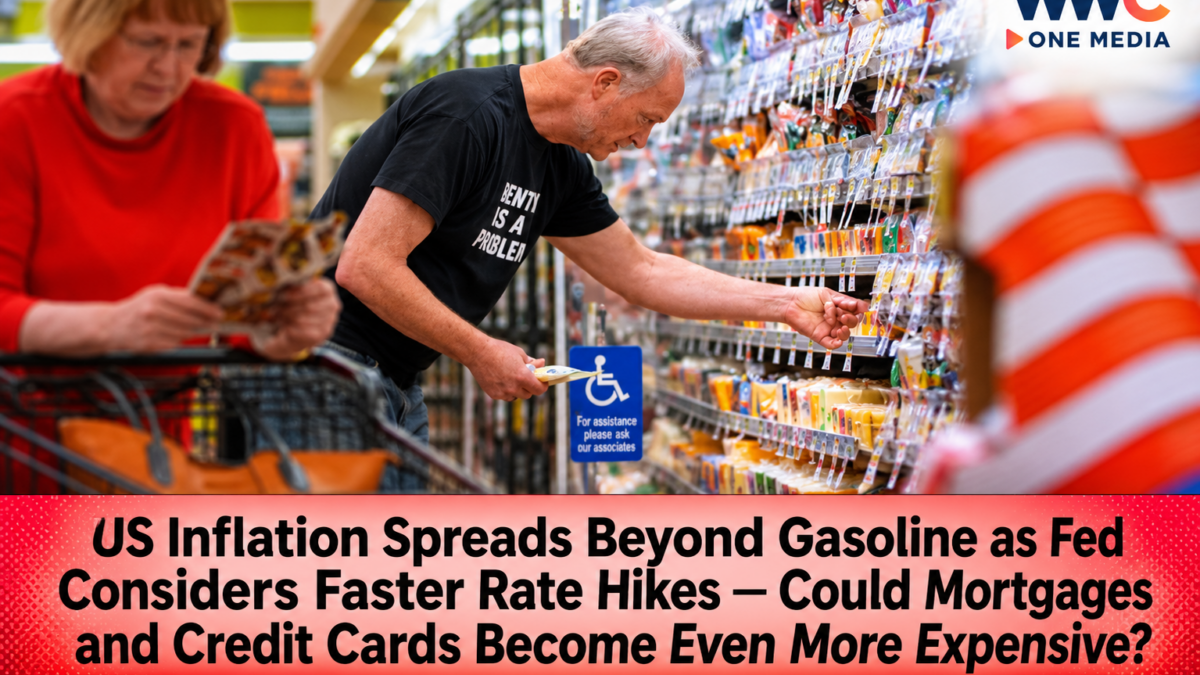
WASHINGTON, United States — November 12, 2026 — America’s inflation problem is becoming harder to contain, and the latest warning is that rising prices are spreading far beyond gasoline stations.
Fresh government data released this week showed that consumer prices increased more than economists expected in October, with higher costs appearing across groceries, housing, transportation, insurance, healthcare and consumer electronics.
The development has put the Federal Reserve under renewed pressure to control inflation, with several policymakers suggesting that additional interest-rate increases may be necessary — potentially at a faster pace than previously anticipated.
For American households, the consequences could reach well beyond the supermarket checkout.
Higher borrowing costs could make mortgages, car loans and credit-card debt more expensive, adding another financial challenge for consumers already struggling with elevated living expenses.
The October Consumer Price Index (CPI) increased 0.4% from September, compared with a 0.6% monthly increase in September. Core inflation, which excludes food and energy, also rose 0.3%, matching the previous month’s increase.
Both readings were higher than economists had expected.
The figures suggest that inflationary pressures are not disappearing as quickly as policymakers had hoped, even as some energy-price pressures have moderated.
The central question facing financial markets is whether the Federal Reserve will respond with another conventional rate increase or consider a larger move in December.
Inflation Is Spreading Beyond Gasoline and Energy Costs
For months, policymakers and economists have debated whether America’s inflation problem would ease once the effects of higher fuel prices, tariffs and geopolitical disruptions began to fade.
The latest figures suggest that the problem may be more complicated.
According to the US Bureau of Labor Statistics, the overall CPI rose 0.4% in October after increasing 0.6% in September.
Core CPI, which excludes volatile food and energy prices, increased 0.3% for the third consecutive month.
That measure is particularly important because it helps policymakers evaluate whether inflation is becoming embedded across the wider economy rather than being driven mainly by temporary movements in fuel and food prices.
The October report showed increases in several everyday expenses.
Food prices climbed 0.5%, while the food-at-home index, which measures groceries purchased for consumption at home, rose 0.4%.
Shelter costs increased 0.3%, accounting for more than 30% of the monthly increase in the overall CPI.
Energy prices advanced 0.7%, following a much larger 5.2% increase in September.
The figures show that although some inflation pressures have eased from their earlier pace, consumers are still facing increases across essential categories.
Gasoline Prices Continue to Put Pressure on American Households
Gasoline remains one of the most visible sources of financial pressure for American consumers.
The BLS reported that gasoline prices increased 1% in October on a seasonally adjusted monthly basis.
Its published index also showed gasoline prices 37.4% higher over the reported 12-month comparison, although the overall CPI’s standard year-over-year October comparison was unavailable because of missing October 2025 data.
That distinction matters when interpreting the latest inflation figures.
Fuel costs influence more than the amount motorists pay at the pump.
Businesses rely on gasoline, diesel and other petroleum products to transport goods, operate vehicles and move supplies through distribution networks.
When fuel becomes more expensive, transportation and logistics companies can face higher operating costs. Some businesses absorb those expenses, while others pass part of the increase to customers.
The impact can therefore extend to food distribution, manufacturing, delivery services and other consumer-facing industries.
The Associated Press also reported that Federal Reserve officials are increasingly concerned that oil-related inflation pressures linked to the Iran war could persist longer than initially expected.
Even if crude prices retreat, shipping insurance, transportation disruptions and limited refining capacity may keep certain fuel costs elevated.
That creates another challenge for policymakers attempting to bring inflation back toward the Federal Reserve’s 2% objective.
Food, Insurance and Everyday Services Are Also Getting More Expensive
The latest inflation report is particularly concerning because price increases are appearing in categories that are not directly dependent on gasoline.
The Associated Press highlighted rising costs involving beef, streaming services and automobile insurance.
Consumer electronics also recorded increases.
Smartphone prices climbed 1.4% between September and October, the largest monthly increase for that category in the available historical data, according to the report.
Computer prices rose 0.5%, while television prices increased 3.3%.
These increases are notable because consumer electronics have historically benefited from technological improvements and manufacturing efficiencies that often helped reduce prices over time.
However, the rapid expansion of artificial intelligence infrastructure has increased demand for certain components and materials.
The construction of data centers requires advanced processors, memory chips, power-generation equipment, cooling systems and copper.
That investment can create pressure across parts of the technology supply chain.
AI-related spending is not the sole explanation for American inflation, but it has become one factor economists and policymakers are monitoring.
The broader concern is that price increases are occurring in several unrelated sectors simultaneously, making it harder for the Federal Reserve to rely on falling gasoline prices alone to bring inflation under control.
Federal Reserve Officials Warn That Faster Rate Hikes May Be Necessary
The latest inflation data have intensified debate within the Federal Reserve over how aggressively monetary policy should respond.
Dallas Federal Reserve President Lorie Logan said she supports at least two additional quarter-percentage-point interest-rate increases.
She also suggested that policymakers may need to move more rapidly this winter than they have during the previous months.
Logan’s concern is that inflation could become more persistent if policymakers allow above-target price increases to continue for too long.
Her comments are particularly significant because she is a voting member of the Federal Open Market Committee, the body responsible for setting US monetary policy.
Federal Reserve Governor Christopher Waller has also raised the possibility of a larger increase.
Before the October inflation report was released, Waller said policymakers should consider a half-percentage-point increase at the December meeting if monthly core inflation reached 0.3% or higher.
The latest report recorded exactly that increase.
A half-percentage-point move would be twice the size of the conventional quarter-point adjustment.
However, Waller’s remarks do not mean that the Federal Reserve has decided to raise rates by 0.50 percentage points.
The final decision will depend on the full range of economic information available to policymakers before their next meeting.
Philadelphia Federal Reserve President Anna Paulson also warned that underlying inflation remained above the central bank’s target and had not yet shown sufficient improvement.
However, she favored a more gradual approach to additional rate increases.
The differing views show that policymakers agree inflation remains a problem but may disagree about the speed and size of the response.
Why Higher Federal Reserve Rates Could Make Borrowing More Expensive
Interest-rate increases are one of the Federal Reserve’s main tools for controlling inflation.
When borrowing becomes more expensive, consumers and businesses may reduce spending, delay major purchases and reconsider expansion plans.
That can gradually reduce demand across the economy and help slow the pace of price increases.
But higher rates also have direct consequences for households.
Mortgage borrowers: Higher market interest rates can increase the cost of new home loans and refinancing. Existing borrowers with fixed-rate mortgages are generally protected from immediate changes to their contracted rates.
Car buyers: Auto financing can become more expensive when lenders adjust loan rates in response to broader borrowing conditions.
Credit-card users: Many credit-card interest rates are variable, meaning they can increase as benchmark rates rise.
Small businesses: Companies relying on loans or credit lines may face higher financing costs, potentially affecting investment, hiring and expansion.
The challenge is that monetary tightening does not immediately reduce the price of groceries, insurance or fuel.
Instead, it works through financial conditions and demand over time.
That means households can face the double burden of elevated living costs and more expensive borrowing.
The Iran War and Oil-Supply Risks Add Another Inflation Threat
Energy markets remain a major uncertainty in the inflation outlook.
The conflict involving Iran has contributed to concerns about oil supply, shipping routes and the cost of transporting petroleum products.
One particular concern involves the Strait of Hormuz, a strategically important passage for global energy shipments.
Federal Reserve Governor Christopher Waller has warned that the cost of insuring oil tankers and taking additional precautions against attacks could add substantial expenses to oil transportation.
The AP reported that these measures could add approximately US$20 to US$30 per barrel to oil costs.
Even if fighting subsides, energy prices may not immediately return to previous levels.
Refining capacity is another concern.
Damage to energy infrastructure and limitations on refining can keep diesel and other fuel prices elevated even when crude oil prices decline.
That is important because diesel powers much of the transportation and industrial equipment used to move goods across the United States.
A prolonged period of elevated energy costs could therefore continue influencing inflation even after the original geopolitical shock weakens.
Wall Street Raises Expectations for a December Rate Increase
Financial markets reacted quickly to the latest inflation report and the more aggressive comments from some Federal Reserve officials.
Investors increased their expectations that the central bank could raise borrowing costs at its December 8–9 meeting.
According to reporting by the Associated Press, futures-market pricing showed approximately 90% odds of a rate increase at the next meeting, while expectations for another increase in January also rose.
Those figures reflect market expectations at the time of reporting, not a confirmed Federal Reserve decision.
Reuters separately reported that the possibility of a half-percentage-point increase briefly gained attention after Waller’s comments and the stronger-than-expected core inflation reading.
Treasury yields also moved higher as investors reassessed the likely direction of monetary policy.
Higher bond yields can influence mortgage rates, corporate financing and the valuations investors place on stocks.
That is one reason inflation reports can move financial markets even before the Federal Reserve announces any change to interest rates.
For Wall Street, the concern is not only that borrowing could become more expensive. It is also that prolonged inflation may force policymakers to maintain restrictive financial conditions for longer.
The Federal Reserve Faces a Difficult Choice Between Inflation and Economic Growth
The central bank’s challenge is to bring inflation under control without unnecessarily damaging the economy.
Higher rates can reduce demand, but excessive tightening can also weaken business investment, hiring and consumer spending.
If borrowing costs rise too quickly, companies may postpone projects, households may delay major purchases and financially vulnerable borrowers may face increasing pressure.
On the other hand, allowing inflation to remain elevated for too long can undermine purchasing power and make it more difficult for consumers and businesses to plan.
The Federal Reserve must therefore weigh price stability against employment and economic growth.
The latest comments from Logan, Waller and Paulson demonstrate that policymakers are actively debating how quickly to respond.
Their differences also show why investors should avoid treating one official’s comments as a final decision by the entire central bank.
The next policy meeting will depend on the broader economic picture, including additional inflation reports, labor-market conditions and financial-market developments.
What Rising US Inflation Could Mean for the Philippines
The latest American inflation figures also matter to countries beyond the United States, including the Philippines.
Federal Reserve interest-rate decisions can influence global investment flows, the value of the US dollar and financing conditions in emerging markets.
If US interest rates rise, dollar-denominated investments may become more attractive to international investors.
That can contribute to pressure on currencies such as the Philippine peso, although exchange rates are also influenced by domestic economic conditions, trade balances, capital flows and Bangko Sentral ng Pilipinas policy.
A weaker peso can increase the local-currency cost of imported petroleum and other goods priced in dollars.
For the Philippines, this matters because imported fuel influences transportation, electricity generation, logistics and the cost of moving products throughout the country.
Higher international borrowing costs can also affect businesses that depend on foreign financing.
However, a US rate increase does not automatically result in higher Philippine interest rates or a weaker peso.
The Bangko Sentral ng Pilipinas makes its own decisions based on local inflation, economic growth and financial stability.
The connection is important, but the effects are not automatic.
Why Slower Inflation Does Not Necessarily Mean Cheaper Living Costs
One of the biggest misunderstandings about inflation is the difference between prices increasing more slowly and prices actually falling.
When inflation slows, it generally means that prices are rising at a slower rate.
It does not necessarily mean consumers will pay less than they did previously.
For example, if a household product costs US$100 and its price rises by 10%, it becomes US$110.
If inflation later slows to 3%, the same product would rise to US$113.30.
The rate of increase has slowed considerably, but the product is still more expensive.
This explains why consumers may continue feeling financial pressure even when official inflation readings improve.
Meaningful relief requires more than a temporary slowdown in monthly inflation.
Households need stable prices, stronger purchasing power and income growth that can keep pace with everyday expenses.
The Next Inflation Reports Could Determine the Fed’s December Decision
The Federal Reserve’s next scheduled policy meeting is set for December 8–9.
Before then, policymakers will receive additional information about inflation, employment and economic activity.
The latest October CPI figures have strengthened arguments for further monetary tightening, but they do not settle the question of how large the next increase should be.
A sustained improvement in inflation could support a more measured response.
Another series of strong price increases could strengthen the case for faster or larger rate hikes.
The central bank must also consider the possibility that aggressive tightening could weaken economic activity more than intended.
For American households, the stakes are immediate.
Higher prices are affecting groceries, housing, transportation, services and consumer electronics. At the same time, a more restrictive monetary policy could make borrowing more expensive.