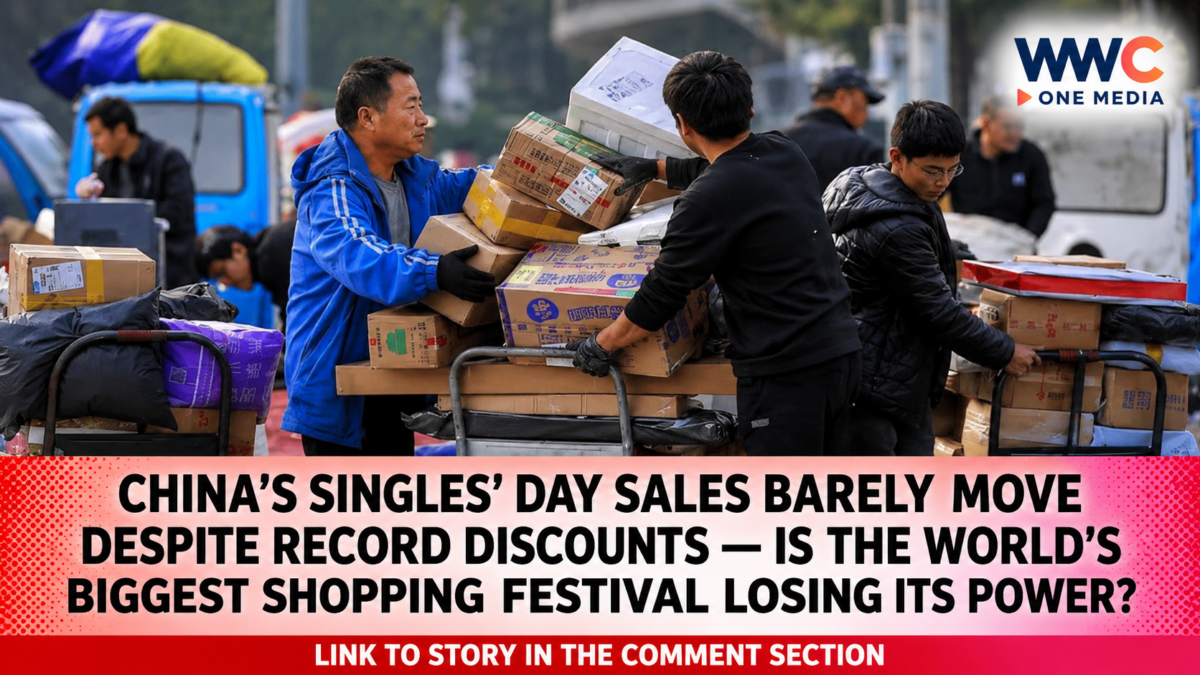
HONG KONG / BEIJING — November 12, 2026 — China’s biggest online shopping festival has delivered another warning about the country’s consumer economy: even massive discounts, celebrity livestreams and artificial intelligence-powered shopping tools are struggling to persuade cautious households to spend more.
Singles’ Day, also known as Double 11, traditionally turns November 11 into a major shopping event, with platforms such as Alibaba’s Taobao and Tmall, JD.com and Douyin competing for billions of yuan in purchases.
But this year’s early sales figures suggest that the excitement surrounding the festival is losing some of its momentum.
Retail data platform Syntun estimated that cumulative Singles’ Day sales had exceeded 1 trillion yuan, approximately US$154 billion, by October 31. The total was broadly comparable with the same period last year, according to reporting by The Associated Press.
A separate Reuters report, citing Syntun data, said sales increased 2.4% between October 7 and October 31.
Those figures do not indicate a collapse in online shopping. They point instead to relatively modest growth despite an extended promotional period and enormous retail participation.
The distinction matters because Singles’ Day has become more than a shopping event. It is an important indicator of how willing Chinese households are to spend, particularly when the world’s second-largest economy is trying to strengthen domestic demand.
The problem is that consumers are becoming increasingly selective about what they buy.
A prolonged property downturn, concerns about income and employment, weaker demand for expensive products and growing frustration with year-round discounts are changing shopping habits.
For China’s retail giants, the challenge is no longer simply offering the biggest discount.
It is convincing consumers that they can afford to spend in the first place.
Singles’ Day Sales Reach More Than 1 Trillion Yuan, But Growth Remains Modest
Singles’ Day began as an online shopping promotion in 2009 and gradually developed into one of the world’s largest e-commerce events.
Originally associated with China’s celebration of singlehood on November 11, the festival became a major commercial opportunity for retailers offering discounts on fashion, cosmetics, electronics, household appliances and other consumer products.
Its promotional period has expanded considerably.
Instead of concentrating purchases on November 11, platforms now begin their campaigns weeks earlier, with different companies using different launch dates and promotional schedules.
That makes comparisons between years more complicated.
Syntun’s estimate of more than 1 trillion yuan in cumulative sales by October 31 indicates that the campaign remains enormous. However, the AP reported that the figure was broadly similar to the corresponding period last year.
Reuters separately reported a 2.4% increase for the October 7–31 comparison period.
The two figures describe the same broad campaign but should not be confused with a final, independently audited total for the entire shopping festival.
Alibaba and JD.com have also moved away from publishing a single comprehensive transaction-value figure for their overall Singles’ Day campaigns, making third-party estimates particularly important.
For context, Syntun estimated that platform sales during the 2025 festival reached nearly 1.7 trillion yuan.
The larger promotional window has helped retailers maintain impressive headline totals, but the latest numbers suggest that extending a sale does not automatically create a proportionate increase in consumer demand.
Why Chinese Consumers Are Holding Back
One of the biggest pressures on household spending is China’s prolonged property market downturn.
For many Chinese families, residential property represents a major share of personal wealth.
When home values decline, homeowners may feel less financially secure, even if their regular income remains unchanged.
The Associated Press reported that Chinese home prices have fallen roughly 20% or more from their 2021 peak, with some smaller cities and the secondhand housing market experiencing particularly significant pressure.
The effect extends beyond property transactions.
Consumers who feel less wealthy may postpone purchases of expensive electronics, furniture, fashion products and other nonessential items.
That caution is visible in the shopping habits described by people interviewed by AP.
Some consumers said they were buying fewer skincare products, avoiding additional electronics and becoming less interested in expensive international brands.
The concern is not necessarily that Chinese households have stopped spending altogether.
Rather, many are prioritizing essential purchases and savings over discretionary shopping.
The country’s broader economic figures reinforce that concern.
China’s economy expanded 4.6% year-on-year during the first nine months of 2026, according to figures cited by AP. However, retail sales of consumer goods increased by only 1.1% over the same period.
The difference highlights a central problem for Beijing: economic growth is continuing, but household consumption is not keeping pace.
The Property Slump Is Affecting More Than Housing
China’s real estate difficulties have consequences throughout the wider economy.
A weaker housing market can affect construction companies, furniture manufacturers, appliance retailers, developers, building-material suppliers and local businesses that depend on property-related activity.
It can also make households more reluctant to take on additional debt.
This is especially important for businesses that rely on big-ticket purchases.
A family uncertain about the value of its home may think twice before purchasing a new television, replacing furniture or buying a luxury product.
The consequences can spread through retail supply chains.
Manufacturers may continue producing goods, but weaker domestic demand makes it harder to sell everything at home.
Some businesses respond by lowering prices, increasing promotional activity or looking for customers overseas.
That can intensify competition in an already crowded market.
WWC ONE MEDIA previously examined this imbalance in its report, China’s Factory Boom Masks Growing Strain as Consumer Spending Slows.
The report explored how strong industrial production can coexist with weaker household demand, leaving manufacturers increasingly dependent on external markets.
Discount Fatigue Is Weakening the Singles’ Day Shopping Frenzy
Another problem facing the festival is what analysts call discount fatigue.
Singles’ Day originally attracted shoppers because November 11 offered some of the most anticipated deals of the year.
Consumers waited for the event to purchase products they had been considering for months.
But that sense of urgency has weakened as e-commerce platforms expanded their promotional calendars.
Discounts are now common throughout the year, with major campaigns taking place across several platforms and shopping seasons.
As a result, consumers may no longer believe that November 11 offers the best opportunity to save money.
Yaling Jiang, founder of market research company ApertureChina, told AP that shoppers were increasingly experiencing discount fatigue.
Shaun Rein, managing director of China Market Research Group, also pointed to weaker middle-class confidence and less attractive promotional offers.
The problem is particularly important for retailers selling products that customers can easily postpone buying.
If a shopper believes a camera, game console or designer product will be discounted again next month, there may be little reason to purchase it immediately.
The festival has therefore become a longer contest for consumer attention rather than a single day when shoppers rush to buy.
For brands, that means promotions alone may no longer be enough to generate the same excitement.
Alibaba and JD.com Turn to Artificial Intelligence to Attract Shoppers
With consumers becoming more cautious, China’s e-commerce companies are increasingly relying on artificial intelligence to improve the shopping experience.
Alibaba has integrated its Qwen AI technology into its Taobao and Tmall platforms, giving users tools for product research, recommendations and shopping assistance.
JD.com has also expanded its AI shopping assistant, Dongdong.
According to Reuters, JD.com said Dongdong attracted nearly 80 million users seeking shopping advice during this year’s Singles’ Day campaign, more than three times the figure recorded a year earlier.
AI-powered shopping is also expanding through Douyin, China’s leading short-video and social-commerce platform.
Data from WPIC Marketing + Technologies cited by Reuters showed that AI-generated chatbot links accounted for approximately 5% of purchases on Douyin in October.
For more considered purchases, such as dietary supplements, the share exceeded 20%.
The technology allows shoppers to ask questions, compare products and receive recommendations without manually searching through thousands of listings.
Virtual try-on tools are also becoming more common, helping customers preview clothing and other products before purchasing.
However, the growing use of AI does not necessarily mean that consumers are spending more overall.
It may simply change how shoppers discover products and decide what to buy.
There is also a potential disadvantage for retailers: brands that do not appear in AI-generated recommendations could lose visibility even if their products remain competitive.
Reuters reported that analysts are watching how the technology changes competition between merchants and platforms.
AI Products Are Becoming a Shopping Category of Their Own
Artificial intelligence is not only being used to sell products. It is also becoming something consumers can purchase.
This year’s Singles’ Day campaign prominently features AI-related products, including computing credits known as AI tokens.
These tokens represent units of computing used by artificial intelligence models and services.
Alibaba has promoted AI token packages through its shopping ecosystem, while JD.com has introduced a dedicated section featuring services from several AI providers.
The trend received additional attention when popular Chinese livestreamer Li Jiaqi, widely known as the “Lipstick King,” promoted AI products during a Taobao Live broadcast.
According to Reuters reporting carried by AsiaOne, the livestream sold 100,000 monthly memberships of Alibaba’s QwenWork office AI service within approximately 30 minutes.
The memberships represented around two trillion AI tokens, according to the report.
The development illustrates how China’s shopping festival is expanding beyond traditional consumer goods.
AI software subscriptions, productivity tools and computing credits are becoming part of the promotional market.
WWC ONE MEDIA examined the same shift in China’s Lipstick King Ditches Beauty Products for AI — 100,000 Subscriptions Sold in Just 30 Minutes.
However, the growing popularity of AI products should not be mistaken for evidence that the wider consumer economy has recovered.
A new category can perform exceptionally well while overall household spending remains cautious.
China’s Export Boom Is Masking Weak Domestic Demand
Perhaps the most striking part of China’s economic picture is the contrast between its domestic retail market and its overseas trade performance.
While consumers at home are becoming more cautious, Chinese manufacturers continue to benefit from strong international demand.
Reuters reported on November 10 that China’s merchandise trade surplus reached approximately US$1.04 trillion during the first 10 months of 2026.
October exports rose 35.2% year-on-year, supported in part by demand for high-tech products and equipment connected to artificial intelligence infrastructure.
The performance demonstrates the strength of China’s manufacturing and export industries.
However, it also highlights the country’s reliance on overseas buyers.
The Associated Press reported that passenger car sales inside China declined by almost 25% during January–September, while passenger car exports increased by approximately 71% over the same period, according to industry data.
The automotive figures reveal how manufacturers can find stronger demand abroad even when domestic customers are reluctant to purchase additional products.
Luxury spending has also come under pressure.
Companies including LVMH and Kering have reported softer demand in China in recent months, reflecting a more cautious market for high-end consumer products.
For Beijing, the challenge is to ensure that strong manufacturing performance translates into stronger household consumption.
WWC ONE MEDIA previously examined the country’s expanding export performance in China’s Trade Surplus Blows Past $1 Trillion Despite Trump’s Tariffs as Exports Surge 35% — But Is Washington Losing Its Trade War?.
The report explains why China’s overseas sales can remain strong even while its domestic economy faces significant challenges.
Not Every Consumer Category Is Struggling
Despite weaker demand for some discretionary purchases, certain retail categories are performing relatively well.
Health, wellness and lifestyle products are among the areas attracting stronger interest.
Data from Beijing-based consultancy WPIC Marketing + Technologies, cited by AP, showed that online sales of imported fish oil increased nearly 43% year-on-year during the 12 months ending in September.
Other supplements targeting sleep, joint health and bone strength recorded growth between 28% and 37%.
These figures suggest that Chinese consumers are not abandoning shopping altogether.
Instead, they are becoming more selective about where their money goes.
Products associated with health, personal well-being and practical everyday needs may be more attractive than expensive fashion items or unnecessary electronics.
Some consumers are also placing greater value on experiences and personal fulfillment rather than traditional status purchases.
This shift creates opportunities for retailers that understand changing household priorities.
However, it also means brands cannot assume that the same promotional strategies will continue generating strong results across every product category.
Why China’s Weak Consumer Spending Matters to the Global Economy
China is one of the world’s largest consumer markets and a major trading partner for economies across Asia, Europe and the Americas.
A sustained slowdown in domestic consumption can affect companies that sell products into China, including international fashion houses, electronics manufacturers, automakers and consumer-goods businesses.
It can also influence regional suppliers and exporters.
For Southeast Asian economies, China’s demand for imported products, industrial materials and consumer goods remains commercially important.
If Chinese households continue postponing major purchases, companies dependent on the country’s domestic market may need to adjust their sales forecasts and investment plans.
At the same time, Chinese manufacturers looking overseas for customers could intensify competition in international markets.
This creates a complicated picture for the global economy.
China’s export strength can support international trade, but weak domestic demand and excess industrial capacity may also put pressure on producers in competing countries.
The country’s ability to strengthen household consumption will therefore matter well beyond its own borders.
Can Beijing Convince Consumers to Spend Again?
Chinese policymakers have repeatedly emphasized the need to strengthen domestic demand and make consumption a more important driver of economic growth.
The challenge is that consumer confidence cannot be restored through discounts alone.
Households need greater confidence in their income, employment prospects and financial security.
The property market is also important because housing remains a major component of household wealth.
Government trade-in subsidies and other incentives can encourage purchases in selected categories, but temporary support may not be enough to resolve deeper concerns about future income and economic stability.
A more durable recovery would likely require stronger household purchasing power, improved confidence and conditions that encourage consumers to spend without depending entirely on promotional events.
China’s policymakers must also consider how to balance export-led manufacturing growth with the development of a stronger domestic consumer market.
WWC ONE MEDIA explored this broader challenge in China’s Q3 Economic Growth Set to Rebound as Export Boom Drives Manufacturing, but Weak Consumer Spending Raises Concerns.
The report examined the growing divide between China’s manufacturing strength and the persistent weakness in household consumption and investment.
What Happens Next for Singles’ Day and China’s Retail Industry?
The early Singles’ Day figures show that the festival remains enormous, but its ability to generate additional consumer spending appears more limited than in its earlier years.
Retailers are responding by changing their strategies.
Artificial intelligence is helping shoppers discover products, compare options and complete purchases. Livestreaming is evolving, and health-related products are attracting stronger interest.
But the central challenge remains household confidence.
The coming months will reveal whether China’s consumers become more willing to spend or continue prioritizing savings and essential purchases.
Several developments will be worth watching:
- Property-market confidence: Whether housing values stabilize enough to improve household sentiment.
- Retail sales growth: Whether consumer spending begins to accelerate beyond the modest pace recorded during the first nine months of 2026.
- AI-powered commerce: Whether shopping assistants and personalized recommendations generate genuinely higher purchases rather than simply redirecting existing demand.
- Luxury and automotive demand: Whether households regain confidence in expensive discretionary products.
- Export dependence: Whether strong overseas demand continues to compensate for weak domestic consumption.
The final assessment of Singles’ Day should also account for the different promotional periods and measurement methods used by e-commerce platforms and data providers.
The early sales estimates are a warning sign, not a final verdict on the entire retail sector.
The Bigger Question: Is China’s Shopping Boom Losing Its Power?
China’s Singles’ Day festival has grown into a global retail phenomenon, but the 2026 campaign is exposing a problem that discounts and technology cannot easily solve.
Consumers are becoming more careful with their money.
The property downturn has weakened confidence, household spending remains subdued, and shoppers are increasingly questioning whether promotional offers are worth the expense.
Meanwhile, Chinese manufacturers continue selling products overseas, creating a striking contrast between strong export performance and cautious domestic demand.
AI may transform how people shop, but it cannot automatically restore the financial confidence needed to encourage households to spend more.
For Alibaba, JD.com and other major retailers, the next challenge is not simply attracting more clicks or extending promotional campaigns.
It is convincing consumers that they have enough financial security to open their wallets again.
Singles’ Day still generates more than a trillion yuan in estimated sales, but the early growth figures reveal a market that is struggling to accelerate. If China’s biggest shopping festival can no longer persuade cautious households to spend freely, could weak consumer confidence become one of the biggest obstacles to Beijing’s economic recovery?