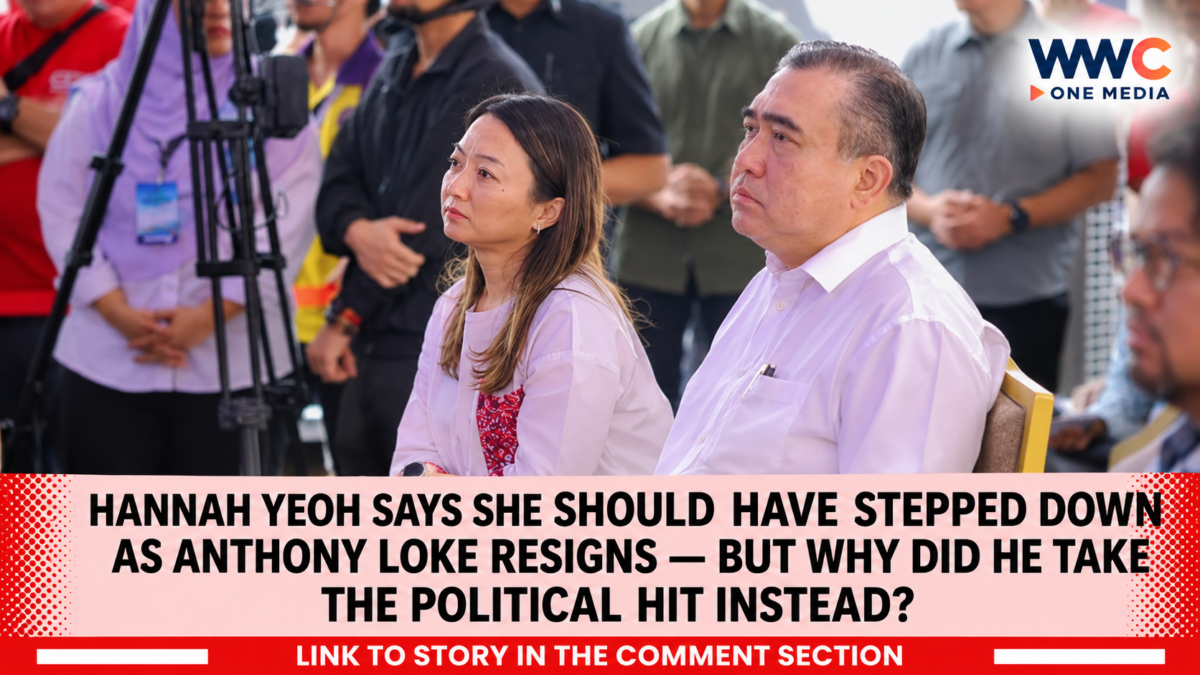
KUALA LUMPUR, Malaysia — Malaysia’s political tensions have taken another turn after Minister in the Prime Minister’s Department Hannah Yeoh said she should have been the one to step down from the Cabinet, following the resignation of Democratic Action Party (DAP) secretary-general Anthony Loke as Transport Minister.
In a Facebook statement on November 10, Yeoh said Loke wanted DAP ministers to remain in government to fulfil their commitments to the public and complete unfinished work.
“I should have stepped down today, but my Secretary-General wants us to fulfil all our promises to the people and complete the unfinished work. In the end, he paid the price himself,” she said.
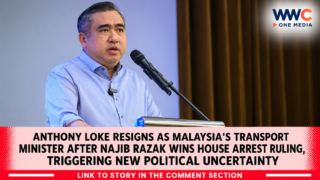
Her remarks came after Loke announced that his resignation as Transport Minister would take effect immediately, following a Kuala Lumpur High Court decision allowing former prime minister Najib Razak to serve the remainder of his sentence in the SRC International case under house arrest.
The comments have drawn attention to the political calculation inside DAP: Loke left the Cabinet over the Najib decision, while the party’s other ministers, including Yeoh, remained in government.
But the episode is about more than one minister leaving office. It highlights the difficult balance Prime Minister Anwar Ibrahim’s unity government must maintain between coalition cooperation, political accountability and competing positions on Najib’s conditional royal pardon.
Hannah Yeoh Says Loke Wanted DAP Ministers to Finish Their Commitments
Yeoh’s statement was a public acknowledgement that Loke’s resignation carried a political cost for the party.
As DAP secretary-general, Loke had to manage the party’s opposition to Najib’s house-arrest arrangement while also considering the consequences of withdrawing DAP representatives from the federal administration.
Rather than having every DAP minister leave the Cabinet, the party maintained a distinction between Loke’s individual resignation and its continued participation in the government.
Yeoh’s remarks suggest that Loke wanted the remaining ministers to continue their work and fulfil promises already made to the public.
However, her statement should not be interpreted as an announcement that she had formally submitted a resignation letter. She said she should have stepped down, but she did not announce her departure from the Cabinet.
The distinction matters because Yeoh remains part of the administration, while Loke’s resignation was formally announced as effective immediately.
Why Anthony Loke Resigned After Najib’s House-Arrest Ruling
Loke’s resignation followed through on a position he had announced weeks earlier.
In September 2026, after Malaysia’s Pardons Board granted Najib a conditional royal pardon allowing him to serve the remainder of his SRC International sentence under house arrest, Loke offered to resign as Transport Minister.
He said the decision reflected DAP’s position on corruption and accountability, particularly given Najib’s conviction in the SRC International case, which was linked to the wider 1Malaysia Development Berhad (1MDB) scandal.
Loke initially remained in office after Prime Minister Anwar Ibrahim asked him to continue temporarily.
He later clarified that his resignation would take effect once Najib actually began serving his sentence at home.
That condition was fulfilled on November 10, when the Kuala Lumpur High Court issued a new order allowing Najib to serve the remainder of his reduced six-year SRC International sentence under house arrest.
Loke then announced his immediate departure from the Transport Ministry.
He thanked Anwar for the opportunity to serve in the Cabinet since December 2022 and expressed appreciation to the ministry’s management and staff. He also pledged to cooperate with the handover process to ensure that ongoing programmes and responsibilities would continue.
The sequence was reported by Bernama, Malay Mail, The Star and Channel NewsAsia.
For more on the minister’s departure and the political implications, read WWC ONE MEDIA’s report: Anthony Loke Resigns as Malaysia’s Transport Minister After Court Allows Najib Razak to Serve Sentence Under House Arrest.
DAP Ministers Remain in Anwar’s Government Despite Loke’s Exit
One of the most important details in this development is that Loke’s resignation does not amount to DAP withdrawing from the unity government.
The party had previously indicated that its other ministers and deputy ministers would remain in their positions to maintain political stability and complete outstanding commitments.
That decision leaves DAP in a politically delicate position.
The party is expressing its disagreement with the Najib house-arrest arrangement through Loke’s departure, but it is not abandoning its role in Anwar’s administration.
Yeoh’s statement reinforces that distinction. Her comments point to the party’s intention to continue working inside government even as one of its most senior leaders steps away from a Cabinet post.
This arrangement also reflects the broader challenge facing Anwar’s coalition, which brings together political parties with different histories, constituencies and positions on major national issues.
Loke’s departure therefore does not automatically mean the government has lost its parliamentary majority or is on the verge of collapse.
It does, however, expose the political tensions that can emerge when coalition partners disagree over a highly sensitive legal and constitutional issue.
Najib’s House Arrest Was the Immediate Trigger — But the Legal Dispute Was More Complicated
The court decision behind Loke’s resignation followed several days of uncertainty over how Najib’s conditional pardon should be implemented.
Najib had been serving a prison sentence at Kajang Prison following his conviction in the SRC International case, involving RM42 million linked to a former subsidiary of 1MDB.
His original 12-year prison sentence and RM210 million fine were reduced in January 2024 through a partial royal pardon. The prison term was cut to six years, while the fine was reduced to RM50 million.
In September 2026, a further conditional pardon allowed him to serve the remainder of that sentence under house arrest, subject to the required conditions, including payment of the RM50 million fine.
UMNO subsequently paid the fine.
However, an earlier court discharge order issued on November 6 created uncertainty about whether the payment meant Najib had completed his SRC sentence or whether he still had to serve the remaining term under the house-arrest arrangement.
The Attorney-General’s Chambers (AGC) sought a review and clarification of that order.
On November 10, High Court Judge Datuk Aslam Zainuddin set aside the earlier order and issued a new one directing Najib to serve the remainder of his reduced SRC sentence under house arrest at his Langgak Duta residence until August 23, 2028.
He is then scheduled to return to Kajang Prison on August 24, 2028, to serve the sentence in his separate 1MDB case.
Najib subsequently returned to his residence that evening.
The distinction is important: the house-arrest order concerns the SRC International sentence. It does not erase his conviction or resolve his separate 1MDB-related case, in which he received a 15-year prison sentence and has an appeal pending.
The Associated Press, Bernama and The Straits Times have reported on the legal dispute and its implications.
WWC ONE MEDIA has also followed the developments surrounding the royal pardon and the separate sentence: Malaysia’s King Warns Against Defying Najib Razak’s Royal Pardon After RM50-Million Payment — But Could a Second 15-Year Prison Sentence Keep Him Behind Bars?.
Anwar Faces Questions Over the Transport Ministry Vacancy
Loke’s immediate resignation has also created a vacancy in one of Malaysia’s key ministries.
The Transport Ministry oversees major national responsibilities, including public transportation, aviation, maritime affairs and road transport.
A leadership transition will therefore be important to ensure that existing projects and public services continue without disruption.
When asked about a possible Cabinet reshuffle on November 10, Anwar said it was too early to discuss changes.
His response came before Loke formally announced that his resignation would take effect immediately later that day.
Anwar did not announce a successor or provide a timetable for filling the Transport Ministry position.
WWC ONE MEDIA previously reported on Anwar’s response to speculation about Cabinet changes: Anwar Says Cabinet Reshuffle Is “Too Early” as Anthony Loke’s Resignation Creates Vacancy in Malaysia’s Government.
The immediate question is whether Anwar will appoint a new minister quickly or temporarily rely on existing ministry leadership while considering the next steps.
Loke Also Challenges BN Politicians Who Criticise the Government
Following his resignation, Loke continued to make political statements about the responsibilities of ministers and coalition partners.
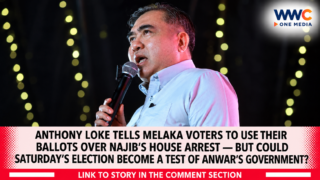
At a political gathering in Melaka on November 10, he challenged Barisan Nasional (BN) lawmakers who continue to criticise Anwar and government policies while remaining part of the administration.
His message was direct: politicians who no longer agree with the government should consider leaving their Cabinet positions.
Loke questioned why some coalition figures would continue attending Cabinet meetings while publicly attacking the prime minister and the administration.
The remarks added another dimension to the political debate surrounding his departure.
They also underscored the tension within a coalition government where parties must cooperate in Cabinet despite sometimes having sharply different political positions.
His challenge does not establish that BN ministers intend to resign. It reflects Loke’s criticism of what he described as inconsistent behaviour among politicians who remain in government while openly opposing its leadership.
Could Loke’s Resignation Deepen Divisions Within the Unity Government?
The latest developments place Anwar in a difficult political position.
On one side, DAP has to maintain its credibility among supporters who expect the party to uphold its position on corruption and accountability.
On the other, the party has chosen to remain in government rather than withdraw its ministers and risk creating further instability.
Loke’s resignation allows DAP to demonstrate disagreement with the Najib arrangement without immediately removing its entire Cabinet presence.
Yeoh’s statement makes the party’s other priority clear: completing commitments to the public.
But that approach may not silence criticism from voters who believe that remaining in government weakens the impact of Loke’s departure.
The political question is whether DAP can continue to defend its position while working alongside coalition partners who have different views on Najib’s case.
For Anwar, the challenge is to keep the coalition functioning while managing the consequences of a decision that has already cost him one senior Cabinet minister.
What Happens Next?
Three developments will be closely watched:
- The Transport Ministry appointment: Anwar must determine who will take over from Loke and ensure that ministry operations continue smoothly.
- DAP’s position in government: The party’s other ministers remain in the Cabinet, but the political consequences of Loke’s resignation may continue to test its relationship with coalition partners.
- The wider Najib legal proceedings: The house-arrest arrangement applies to the SRC International sentence, while Najib’s separate 1MDB-related conviction and appeal remain significant legal issues.
For now, Yeoh has made clear that Loke’s departure was not intended to pull every DAP minister out of government.
Her statement also offers a glimpse into the party’s internal political calculation: one senior leader would take the step of resigning, while the rest would stay to finish the work they had promised voters.
But whether that strategy will preserve DAP’s credibility or intensify criticism from its supporters remains uncertain.
Loke has left the Cabinet, but the political dispute that prompted his resignation is far from over. The bigger test for Anwar and DAP may be whether they can maintain public trust while continuing to govern together.