
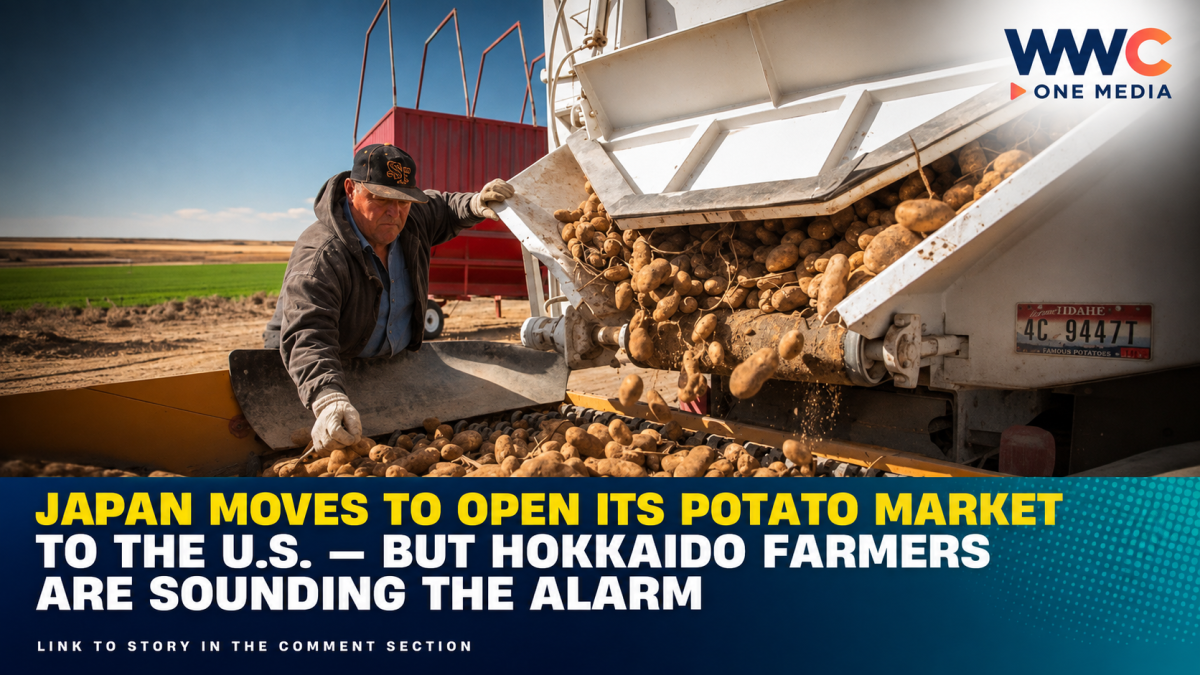
Japan is taking another major step toward allowing fresh potatoes from the United States into its general consumer market — a move that could reshape the country’s potato industry, potentially affect prices and intensify a growing confrontation with farmers.
But despite headlines suggesting the ban is being lifted, Japan has not yet approved general imports of fresh U.S. potatoes.
Instead, the Japanese government is advancing a lengthy plant-quarantine review that could eventually lead to an import agreement. The process is being conducted on scientific and quarantine grounds, following a U.S. request dating back to 2020.
The issue is attracting renewed attention because U.S. potatoes have historically faced strict restrictions in Japan due to concerns that pests and plant diseases could enter the country and threaten domestic agriculture.
Japan currently permits a limited exception for U.S. potatoes destined for processing into products such as potato chips. That exemption dates back to 2006. Fresh potatoes for general distribution, however, have remained essentially off-limits.
Now, the rules could be heading for a major change.
The decision is not final
Japan’s Ministry of Agriculture, Forestry and Fisheries says it is following procedures under the World Trade Organization’s sanitary and phytosanitary framework after receiving the U.S. request.
The ministry has been conducting a scientific assessment of potential pests and diseases associated with U.S. potatoes.
According to MAFF, the review follows an 11-stage standard procedure. The government has now completed the risk-assessment phase and is moving toward identifying pests and diseases that would require specific risk-management measures.
MAFF will hold an online briefing on September 18 to explain the progress of the quarantine negotiations and the results of its pest-risk assessment.
That means consumers should not expect American fresh potatoes to suddenly appear on Japanese supermarket shelves.
The government has indicated that even if the quarantine process is ultimately completed, actual imports could still take several years to begin.
Why farmers are worried
The biggest resistance is coming from Japan’s potato-producing regions, particularly Hokkaido.
Hokkaido dominates Japan’s domestic potato production, accounting for roughly 80% of the country’s output, according to The Japan Times.
Local producers fear that allowing potatoes from one of the world’s biggest agricultural producers could expose Japanese fields to additional pests and diseases while also increasing competitive pressure on domestic farmers.
Hokkaido Gov. Naomichi Suzuki has said the prefecture cannot accept lifting the restrictions unless safeguards are established to prevent the introduction of pests and diseases and protect domestic production.
Agricultural organizations have also urged the government to base any decision firmly on scientific evidence.
MAFF Agriculture Minister Norikazu Suzuki has acknowledged the concerns, saying the government understands farmers’ fears about disease and pest introductions. He has also stressed that Japan must prevent agricultural pests capable of damaging domestic production from entering the country.
Could American potatoes make Japanese food cheaper?
That is one of the arguments behind the push for greater access.
Japanese consumers and businesses could potentially gain another source of potatoes, while restaurants and food processors that use large quantities of the crop could benefit from increased supply and competition.
Japanese television reporting has highlighted expectations among some food businesses that imported potatoes could help stabilize procurement costs.
But cheaper imports are not guaranteed to translate directly into cheaper supermarket prices.
The eventual impact would depend on the final quarantine requirements, transportation costs, exchange rates, import volumes and the prices of Japanese-grown potatoes.
There is also an unusual factor in the current market: Japan is already expecting abundant domestic potato supplies this month.
MAFF’s September outlook says Hokkaido’s potato crop is generally progressing well, with shipments expected to exceed the normal level and prices expected to remain below the usual level during September.
That makes the timing particularly sensitive for domestic growers.
The real battle is over quarantine
The central question is not simply whether U.S. potatoes are cheaper.
It is whether Japan can establish quarantine conditions that allow imports while preventing potentially damaging pests and diseases from entering Japanese farmland.
Japan already maintains detailed phytosanitary requirements for the U.S. potatoes permitted for processing. Existing rules include inspections, certification and safeguards concerning pests such as potato cyst nematodes.
For general retail potatoes, however, Japan must determine what additional safeguards would be necessary.
MAFF says the next phase will involve considering risk-management measures for the pests and diseases identified during the assessment. Possible measures can include treatment and inspections, depending on the specific risk involved.
A trade issue with consequences far beyond potatoes
The dispute illustrates a broader tension in Japan-U.S. agricultural trade.
Washington has pushed for greater access to Japan’s market, while Tokyo has maintained that plant-quarantine decisions must be based on scientific assessments and protection against agricultural threats.
MAFF has explicitly said that under WTO rules, Japan is required to respond to such requests through scientific quarantine discussions. The ministry has also pointed out that Japan itself negotiates quarantine access for Japanese agricultural exports to the United States.
For now, therefore, this is not a story about U.S. potatoes flooding Japanese supermarkets tomorrow.
It is the beginning of a potentially much bigger battle over how far Japan is willing to open its agricultural market — and how much protection it can maintain for the farmers who dominate domestic potato production.
The next major checkpoint comes on September 18, when Japan’s agriculture ministry is scheduled to explain the latest findings from the quarantine review.
And that is when the real question may become clearer: Can Japan open the door to American potatoes without putting Hokkaido’s farmers and agricultural defenses at risk?
WWC ONE MEDIA MJE

Leave a Reply