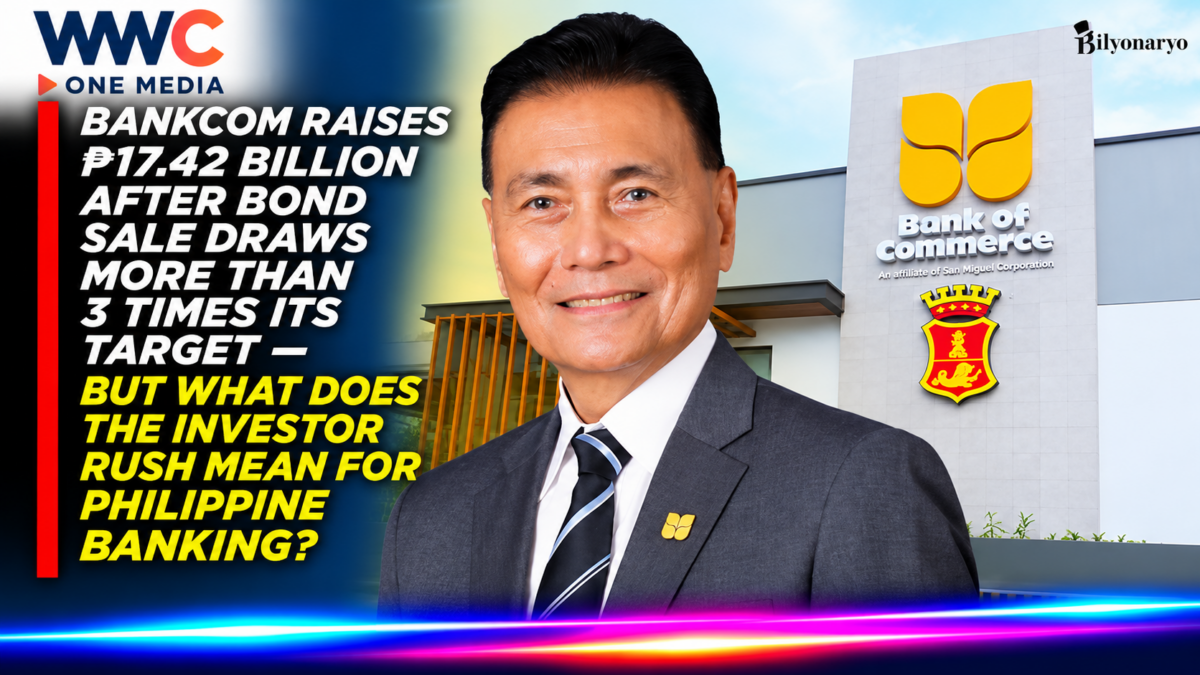
MANILA, Philippines — November 11, 2026 — Investor demand has delivered a major fundraising win for San Miguel Corporation-backed Bank of Commerce (BankCom), which raised ₱17.42 billion through its latest peso bond offering—more than three times its original ₱5-billion target.
The transaction highlights the appetite for fixed-income investments in the Philippines, particularly securities offering regular interest payments and returns above many traditional deposit products.
But the headline fundraising figure is only part of the story.
BankCom’s latest issuance features two fixed-rate bond series, including a three-year tranche carrying an annual coupon of 7.6563%. The bonds were listed on the Philippine Dealing & Exchange Corporation (PDEx) on November 11.
The offering represents the fourth tranche under the bank’s expanded ₱80-billion peso bond program.
For BankCom, the successful transaction provides additional funding and broadens its financing sources. For investors, however, the attractive interest rates come with important considerations involving credit risk, liquidity and the absence of deposit insurance.
The question now is whether the strong demand signals growing confidence in BankCom—or reflects investors’ search for higher-yielding opportunities in a changing interest-rate environment.
BankCom Raises ₱17.42 Billion, More Than Triple Its ₱5-Billion Target
BankCom’s latest bond transaction significantly exceeded its minimum offering size.
According to Bankero’s November 11 report, the bank raised ₱17.42 billion against an initial target of ₱5 billion.
That represents approximately 3.48 times the original target, or ₱12.42 billion more than the minimum amount.
The offering was conducted under BankCom’s updated ₱80-billion peso bond program, which provides a framework for issuing peso-denominated debt securities in multiple tranches.
The latest transaction is the fourth issuance under that program.
The bonds were officially listed on PDEx on November 11, allowing them to enter the exchange’s secondary market, subject to applicable trading conditions.
The successful fundraising follows the bank’s earlier efforts to tap the domestic debt market and attract both institutional and individual investors.
Bankero reported the completed ₱17.42-billion fundraising here.
Two Bond Options: 6.9882% and 7.6563% Annual Interest
The latest offering consists of two fixed-rate peso bond series with different maturities and interest rates.
Series E Bonds
- Maturity: 2028
- Tenor: 1.5 years
- Annual coupon: 6.9882%
- Interest payments: Quarterly
Series F Bonds
- Maturity: 2029
- Tenor: 3 years
- Annual coupon: 7.6563%
- Interest payments: Quarterly
The Series F bonds carry the higher coupon, reflecting their longer maturity compared with Series E.
The published coupon rates are annual rates, not quarterly returns. Interest is paid every three months according to the bond terms.
BankCom’s October 26 announcement set the minimum investment at ₱100,000, with additional investments in increments of ₱50,000.
For illustration, a ₱100,000 investment at a 7.6563% annual coupon would generate approximately ₱7,656.30 in gross interest over one year, assuming the investment is held at face value and the issuer makes the scheduled payments.
Actual investor returns can differ depending on the purchase price, applicable taxes, fees and holding period.
The final amount received by an investor should therefore not be calculated from the headline coupon alone.
Where Will the ₱17.42 Billion Go?
BankCom said proceeds from the issuance will support three main objectives:
- Balance-sheet management
- Diversification of funding sources
- General corporate purposes
For banks, funding diversification is important because financial institutions rely on different sources of financing to support lending, investments and daily operations.
Deposits remain a major funding source, but issuing bonds provides another way to secure longer-term peso financing.
A bond transaction also establishes contractual interest and principal repayment obligations for the issuer.
BankCom’s latest fundraising therefore gives the bank additional funding flexibility, although its eventual financial benefit will depend on how effectively the proceeds are managed and deployed.
BankCom’s Fundraising Comes After a 13% Increase in First-Half Profit
The bond sale also comes as BankCom reports improved financial performance.
For the six months ended June 30, 2026, the bank recorded ₱2.11 billion in net income, up 13% from ₱1.86 billion during the same period in 2025.
The bank also reported a return on equity of 11.56% and a return on assets of 1.47%.
BankCom attributed its first-half performance to its core banking operations and client-related foreign exchange gains.
These figures provide important context for the fundraising, although higher earnings alone do not eliminate the risks associated with debt securities.
Investors evaluating a bank’s bonds should consider its profitability alongside capital adequacy, asset quality, liquidity, funding costs and ability to meet future obligations.
BankCom is an affiliate of San Miguel Corporation, which has been associated with the bank since 2008.
The bank operates as a publicly listed universal bank in the Philippines.
A History of Strong Demand: BankCom Previously Raised ₱18 Billion
The latest ₱17.42-billion transaction is not BankCom’s first major oversubscribed bond offering.
In February 2025, the bank raised ₱18 billion through its previous dual-tranche peso bond issuance, exceeding its ₱5-billion minimum offer size by 3.6 times.
That transaction involved:
- Series C bonds carrying a 6.1942% annual coupon
- Series D bonds carrying a 6.3494% annual coupon
Both series paid interest quarterly and were listed on PDEx.
The earlier transaction was reported by The Philippine Star and confirmed in BankCom’s own announcement.
The comparison shows that BankCom has previously attracted substantial investor demand through the domestic bond market.
However, coupon rates from separate offerings should not be compared without considering their respective maturities, market conditions, pricing and risk profiles.
The latest Series F coupon of 7.6563% is higher than the coupons on the 2025 bonds, but that difference alone does not establish that the newer securities are either safer or riskier.
Why Philippine Banks Are Turning to the Bond Market
BankCom’s latest fundraising reflects the broader role of debt markets in financing Philippine banks and businesses.
Bond issuance allows financial institutions to diversify their liabilities rather than rely exclusively on deposits and other funding arrangements.
It can also provide longer-term funding that helps banks manage their balance sheets and plan lending activities.
In August 2026, The Philippine Star reported that BankCom was preparing to return to the domestic bond market as part of its funding plans.
The bank’s chief financial officer had previously discussed the importance of strengthening its funding profile while maintaining a cautious approach to loan growth amid elevated borrowing costs and economic uncertainty.
The latest transaction demonstrates that the bank was able to attract substantially more subscriptions than its initial target.
The wider market is also seeing other financial institutions use bonds to access investors.
For example, WWC ONE MEDIA previously examined BPI’s ₱5-billion sustainability bond offering, illustrating how banks use debt securities to diversify funding and reach investors.
Meanwhile, WWC ONE MEDIA’s report on Philippine bank lending and domestic liquidity provides additional context on the country’s broader banking and financing environment.
The Important Warning: BankCom Bonds Are Not PDIC-Insured Deposits
Despite the bank’s strong fundraising result, investors should understand that these securities are not equivalent to savings accounts or time deposits.
BankCom explicitly states that its bonds are not deposit instruments and are not insured by the Philippine Deposit Insurance Corporation (PDIC).
That distinction is crucial.
Eligible bank deposits may receive PDIC protection within the applicable statutory coverage limit. Corporate bonds, however, are debt securities issued by an entity.
When investors purchase bonds, they become creditors of the issuer and depend on that issuer to meet its contractual payment obligations.
If the issuer encounters financial difficulties, bondholders may face delayed payments or losses, depending on the circumstances and legal terms of the securities.
Investors who sell before maturity may also receive less than their original investment if market prices have declined.
A PDEx listing provides a trading venue, but it does not guarantee that buyers will always be available or that the bonds can be sold at the original purchase price.
For additional context, WWC ONE MEDIA has examined the risks and resilience of Philippine banks amid rising bad loans. That broader banking-sector discussion reinforces why investors should look beyond headline interest rates when evaluating financial institutions.
What Investors Should Consider Before Buying Bank Bonds
The oversubscribed offering may attract attention from investors seeking predictable peso-denominated interest income.
However, a high coupon should not automatically be treated as a guarantee of attractive returns.
Potential investors should consider several factors:
1. Credit risk
The issuer must remain financially capable of paying interest and repaying principal according to the bond terms.
2. Liquidity risk
Although the securities are listed on PDEx, investors may not always find a buyer immediately or at a favorable price if they need to sell before maturity.
3. Taxation
Applicable withholding taxes can reduce the actual interest income received. Investors should confirm their tax treatment with the selling agent or a qualified tax adviser.
4. Investment horizon
Series E and Series F have different maturities. Investors should consider whether they can keep their money invested for the corresponding periods.
5. Portfolio concentration
Putting a substantial portion of savings into a single issuer’s bonds may expose an investor to unnecessary concentration risk.
The offering circular and final pricing documents should be reviewed before making an investment decision.
What the ₱17.42-Billion Bond Sale Means for BankCom
BankCom’s latest fundraising represents a substantial addition to its domestic capital-market activity.
Raising ₱17.42 billion against a ₱5-billion minimum target demonstrates that the offering attracted demand well above its original size.
The transaction also strengthens the bank’s access to peso funding through the bond market, supporting its stated objectives of balance-sheet management and funding diversification.
Its improved first-half earnings provide additional context for investors assessing the bank’s financial position.
Nevertheless, the successful offering should not be interpreted as proof that the bonds are risk-free or that future fundraising transactions will attract the same level of demand.
For investors, the important question is not simply how much money BankCom raised, but whether the interest offered appropriately compensates them for the risks and investment period involved.
The Bigger Question: Will Investor Demand Continue?
BankCom has demonstrated that its latest bond offering can attract subscriptions far beyond its initial target.
The ₱17.42-billion result is a significant fundraising milestone, particularly as Philippine banks continue using capital markets to diversify their financing sources.
The two bond series also offer investors different combinations of maturity and fixed annual interest rates, with the three-year Series F carrying the higher coupon.
But the absence of PDIC insurance, together with credit and liquidity risks, means investors must look beyond the advertised returns.
BankCom has secured more than three times its original bond target—but as Philippine investors search for higher-yielding opportunities, will this strong demand mark the beginning of an even bigger bond-market boom, or will concerns over risk and liquidity eventually slow the rush?