DUBAI, United Arab Emirates — November 11, 2026
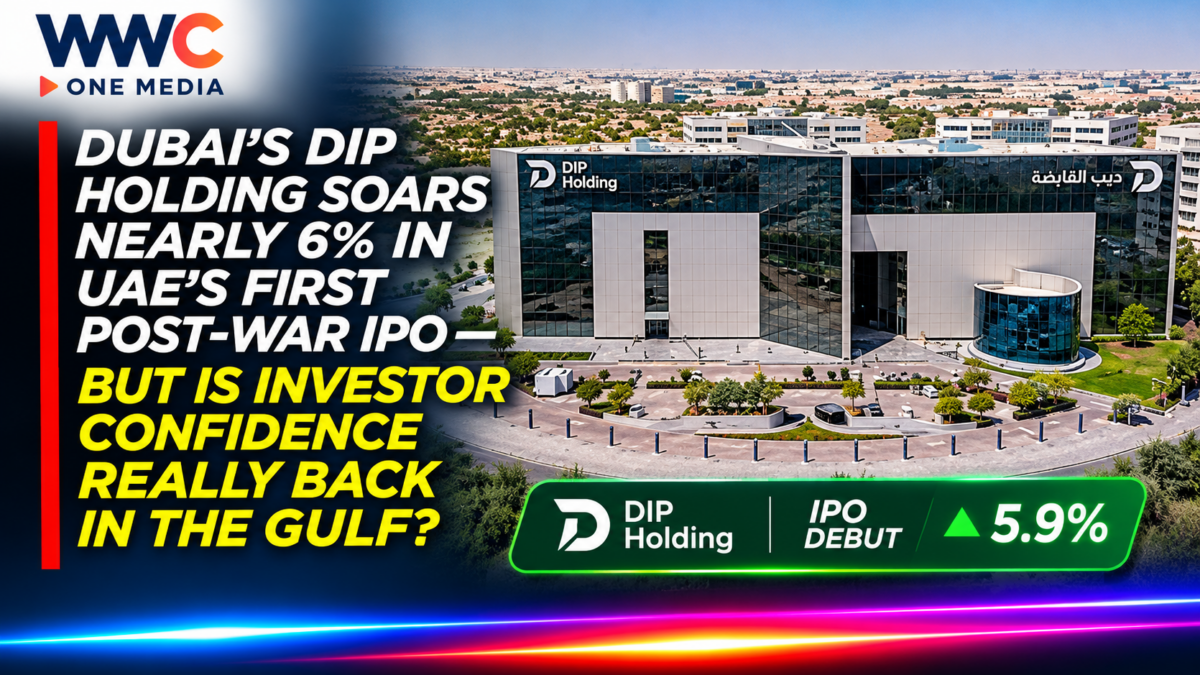
Dubai’s stock market has received a closely watched vote of confidence after shares of DIP Holding jumped more than 5% during their debut on the Dubai Financial Market (DFM), following a US$529 million initial public offering that marked the United Arab Emirates’ first IPO of 2026.
The company’s shares opened a new chapter for the operator of Dubai Investments Park, one of the emirate’s largest industrial, logistics, commercial and residential developments.
According to Khaleej Times, DIP Holding shares were trading at AED1.18 during early Wednesday trading, up 5.35% from their AED1.12 IPO price. More than 52 million shares changed hands during the first 15 minutes, representing approximately AED61.68 million in trading value.
Bloomberg reported that the shares climbed as much as 6% after listing, reflecting the strong initial response to the offering.
The debut is significant because the UAE’s IPO market had experienced a prolonged slowdown following the regional conflict that disrupted investor confidence and economic activity across the Gulf.
But while the opening performance offers an encouraging signal, one successful listing does not automatically mean the region’s capital markets have fully recovered.
The bigger question is whether investors are ready to put substantial money back into Gulf businesses despite continuing geopolitical uncertainty.
DIP Holding’s Shares Jump on Dubai Financial Market Debut
DIP Holding began trading on the Dubai Financial Market on Wednesday, November 11, following the completion of its AED1.9 billion initial public offering.
The shares were priced at AED1.12 each, with the company’s market capitalization estimated at approximately AED9.7 billion, or US$2.6 billion, at the IPO price.
During early trading, the stock advanced to AED1.18, representing a gain of approximately 5.35%.
The early trading activity was also notable.
Khaleej Times reported that approximately 52.27 million shares changed hands within the first 15 minutes, with total transactions valued at AED61.68 million.
That made DIP Holding one of the most actively traded stocks during the opening session.
The initial rise suggests investors were willing to buy shares above the IPO price.
However, an opening-session gain should not be confused with a guaranteed long-term return. Share prices can fluctuate as investors assess valuations, earnings, dividends and broader market conditions.
The coming trading sessions will provide a clearer picture of whether the debut momentum can be sustained.
Dubai Investments Raises $529 Million by Selling 20% of DIP Holding
The IPO allowed Dubai Investments PJSC to raise approximately AED1.94 billion, equivalent to US$529 million, through the sale of 20% of DIP Holding.
A total of 1,735,243,300 existing shares were offered to investors.
Following the transaction, Dubai Investments retains an 80% ownership stake in the company.
An important detail is that the IPO involved the sale of existing shares rather than newly issued shares.
This means the net proceeds go to Dubai Investments as the selling shareholder, rather than directly into DIP Holding’s corporate bank account.
Dubai Investments said the transaction would provide greater financial flexibility for the group to support its wider investment portfolio and pursue selected opportunities.
The distinction matters for investors because the IPO itself does not mean DIP Holding received AED1.9 billion in fresh capital to finance new projects.
Instead, the listing gives the company a public market valuation, introduces additional shareholders and creates a publicly traded platform through which investors can gain exposure to its business.
Why DIP Holding’s IPO Matters After the Regional War
The listing is significant beyond the company itself.
It marks the UAE’s first IPO of 2026 and one of the most closely watched public offerings since the regional conflict disrupted Gulf markets.
Before the conflict, the UAE had become an important destination for companies seeking to raise capital through public listings.
Dubai and Abu Dhabi attracted substantial investor interest, supported by economic diversification, infrastructure investment and the expansion of major private and government-linked businesses.
But geopolitical uncertainty changed the environment.
The National reported that UAE companies raised approximately US$1.1 billion through three IPOs in 2025, compared with US$13 billion raised across the broader Middle East in the previous year.
The regional IPO slowdown reflected several pressures, including geopolitical instability, market volatility and concerns about investor appetite.
DIP Holding’s successful offering therefore provides an important test of whether companies can attract public-market capital despite the difficult environment.
The offering attracted demand from local, regional and international investors and was covered multiple times, although the company did not disclose the exact subscription multiple.
That response is encouraging, but the true test will be how the shares perform after the initial excitement surrounding the listing fades.
Dubai Investments Park: The Business Behind the IPO
DIP Holding’s main attraction is its ownership of Dubai Investments Park Development Company, which operates Dubai Investments Park.
The development covers approximately 23 million square metres, making it one of Dubai’s largest integrated industrial, logistics, commercial and residential communities.
It is not simply a residential property development.
The park combines several types of economic activity, including:
- Industrial and manufacturing facilities
- Warehouses and logistics operations
- Commercial and retail properties
- Residential communities
- Schools and medical facilities
- Hotels and other supporting services
According to the company information reported by Khaleej Times, the development has approximately 1,000 tenants, around 5,700 sub-leases and more than 150,000 residents.
Its ground-lease occupancy stood at 99.9% as of June 2026.
That occupancy figure is particularly important because DIP Holding’s business model is built around long-term land leases and infrastructure-related services.
Rather than relying exclusively on selling individual properties, the company generates recurring income from businesses and other users operating within the development.
This provides a different investment profile from a traditional residential developer whose earnings may depend heavily on launching and selling new projects.
DIP Holding’s Financial Performance: Revenue, EBITDA and Profitability
The company’s financial performance provides another reason investors have been paying attention.
DIP Holding reported approximately AED960 million in revenue for 2025.
Adjusted EBITDA reached AED678 million, producing an adjusted EBITDA margin of approximately 71%.
EBITDA, or earnings before interest, taxes, depreciation and amortization, is a measure frequently used to assess operating profitability before financing and certain accounting costs.
A margin of approximately 71% indicates that the company generated substantial adjusted operating earnings relative to its reported revenue.
However, EBITDA is not the same as net profit or free cash flow.
Investors still need to consider financing expenses, taxes, capital expenditure, maintenance requirements and other cash obligations.
For a business operating a large industrial and commercial development, the ability to maintain infrastructure and attract tenants will remain important to long-term financial performance.
The 7.5% Dividend Yield Is a Major Part of the Investment Pitch
One of the most attractive features of the DIP Holding IPO was its planned dividend distribution.
At the final IPO price of AED1.12 per share, the company indicated an expected dividend yield of approximately 7.5% for 2027.
Its stated annualised cash dividend expectations are:
- 2026: AED700 million
- 2027: AED725 million
- 2028: AED750 million
The company intends to distribute dividends twice a year, subject to board recommendations, shareholder approval and applicable regulatory requirements.
The first post-IPO distribution is expected to total AED350 million in April 2027, relating to the second half of 2026.
For 2027, the company expects two distributions of AED362.5 million each.
The planned dividend increases to AED750 million for 2028, with payments expected to be made in two equal instalments.
These amounts are company expectations, not guaranteed payments.
The distinction is important because dividend policies remain subject to financial performance, available cash, corporate approvals and regulatory requirements.
Still, the proposed payout schedule gives investors a clearer picture of the income component behind the IPO.
For investors seeking recurring distributions rather than relying entirely on share-price appreciation, the dividend proposition may be an important consideration.
Why the IPO Was Priced at AED1.12 Instead of the Top of the Range
DIP Holding initially announced an IPO price range of AED1.10 to AED1.15 per share.
The final offer price was set at AED1.12, close to the midpoint of the range.
This was notable because some recent UAE IPOs had priced at the upper end of their marketed ranges.
The company said the pricing reflected a decision to provide investors with an attractive entry point while supporting a sustainable aftermarket.
The offer was reportedly covered multiple times during the subscription period, which ran from October 27 to November 3.
The final price implied a market capitalization of approximately AED9.7 billion.
The decision to price below the upper end of the range may have helped balance the interests of the selling shareholder and incoming investors.
A lower entry price can potentially provide more room for aftermarket demand, although it does not guarantee that the stock will continue rising.
The early share-price increase suggests that some investors were willing to pay more than the IPO price once trading began.
What the IPO Reveals About Investor Confidence in Dubai
The successful listing comes at a sensitive moment for the Gulf’s financial markets.
The regional conflict has affected investor sentiment, energy markets, travel activity and business confidence.
But Dubai continues to benefit from its position as an international hub for trade, logistics, finance and investment.
The city’s economic model is also supported by a broad range of activities beyond oil production.
That diversification matters when investors evaluate the resilience of the UAE economy.
Commercial real estate, industrial facilities, logistics networks and business services can generate economic activity even when some other sectors face pressure.
DIP Holding’s business is particularly relevant because its development supports companies operating across multiple industries.
Its tenant base and land-lease model may offer a degree of recurring-income visibility.
However, the company is not immune to economic shocks.
A prolonged regional conflict could affect tenant demand, logistics activity, operating expenses and investor confidence.
The strong IPO response therefore reflects interest in the company’s business model, but it should not be interpreted as proof that geopolitical risks have disappeared.
Dubai’s Real Estate Market Faces a More Complicated Picture
DIP Holding’s successful listing also comes as different parts of Dubai’s property market experience contrasting conditions.
Industrial and logistics properties have benefited from demand for warehousing, distribution facilities and regional supply-chain infrastructure.
Residential real estate, meanwhile, has faced a more cautious environment.
The National reported in October that Dubai’s residential home sales value fell 47% year over year in the third quarter of 2026, while transaction volumes declined 38%.
The figures reflected a more cautious buyer environment following the regional conflict.
This distinction matters because DIP Holding’s business is not identical to a residential property developer.
Its industrial and commercial land-lease operations provide exposure to tenants and businesses that use the park for their daily operations.
That could make its revenue profile different from companies relying heavily on residential launches and unit sales.
For context, WWC ONE MEDIA recently examined how Ayala Land’s ₱67-billion residential reservations reveal a divided property market, where premium housing demand remained resilient even as broader property conditions weakened.
The comparison highlights a wider real estate theme: demand can remain strong in selected property segments even when other parts of the market experience a slowdown.
Global Markets and the War Factor Remain Important
The performance of DIP Holding cannot be separated entirely from the broader investment environment.
Investors are still assessing how geopolitical developments affect oil prices, interest rates, currency markets and economic growth.
Energy-market volatility can influence business costs, inflation and the financial outlook for companies operating across the Gulf.
WWC ONE MEDIA recently reported on the sharp decline in global oil prices following hopes of a pause in US-Iran strikes, while also examining the risk that renewed shipping disruptions could reverse the recovery.
Currency movements are another factor.
A changing US dollar outlook can influence international capital flows and the relative attractiveness of emerging and regional markets.
In a separate report, WWC ONE MEDIA examined the dollar’s rally and changing Federal Reserve rate expectations.
For Gulf investors, these developments matter because interest-rate expectations, energy prices and regional risk premiums can all influence how investors value listed companies.
A strong IPO debut is encouraging, but sustained market confidence will depend on the broader economic environment as well as company-specific results.
What Investors Should Watch After DIP Holding’s Debut
The first trading session is only the beginning.
Investors will now be watching several important indicators.
1. Share-price stability
Can DIP Holding maintain its gains after the initial listing excitement, or will early investors take profits?
2. Dividend delivery
Will the company meet its expected dividend distributions for 2026, 2027 and 2028?
3. Occupancy and tenant retention
Can Dubai Investments Park maintain its reported high ground-lease occupancy and continue attracting businesses?
4. Revenue and cash generation
Will the company sustain its reported operating margins while funding maintenance and infrastructure requirements?
5. Regional geopolitical conditions
Could a renewed escalation affect tenant activity, logistics operations or investor appetite for Gulf equities?
6. Parent-company ownership
Dubai Investments retains an 80% stake, meaning the parent company remains the controlling shareholder after the IPO.
These factors will help determine whether the listing becomes a lasting success or simply a strong opening-day performance.
The Bigger Picture: A Successful IPO, but a Bigger Market Test Lies Ahead
DIP Holding’s debut is an important milestone for Dubai’s capital markets.
The company raised approximately AED1.9 billion through a 20% share sale, achieved an implied valuation of AED9.7 billion and attracted multiple-times investor demand despite a challenging regional environment.
Its shares advanced more than 5% during early trading, while the proposed dividend yield of approximately 7.5% adds another element to its investment proposition.
The business also offers exposure to a large integrated industrial, logistics, commercial and residential development with a substantial tenant base.
But the bigger story is not simply that one stock rose on its first day.
It is whether the UAE can rebuild a consistent pipeline of public offerings and restore investor confidence after months of geopolitical uncertainty.
DIP Holding has delivered an encouraging first result.
Yet one successful listing cannot erase the risks facing Gulf markets, nor can a strong debut guarantee long-term returns.
For Dubai, the next challenge is turning this IPO milestone into sustained capital-market momentum.
DIP Holding has opened the door for the UAE’s IPO market to return—but will investors keep walking through it, or was this rally only the first burst of optimism before the region’s next major test?