NEW YORK / LONDON / SINGAPORE / MANILA — November 11, 2026 | WWC ONE MEDIA | Global Business, Artificial Intelligence, Renewable Energy and Climate Change
The global artificial intelligence revolution is running into an increasingly serious obstacle: the world’s electricity networks are struggling to keep up with the enormous amount of power needed to operate new data centers.
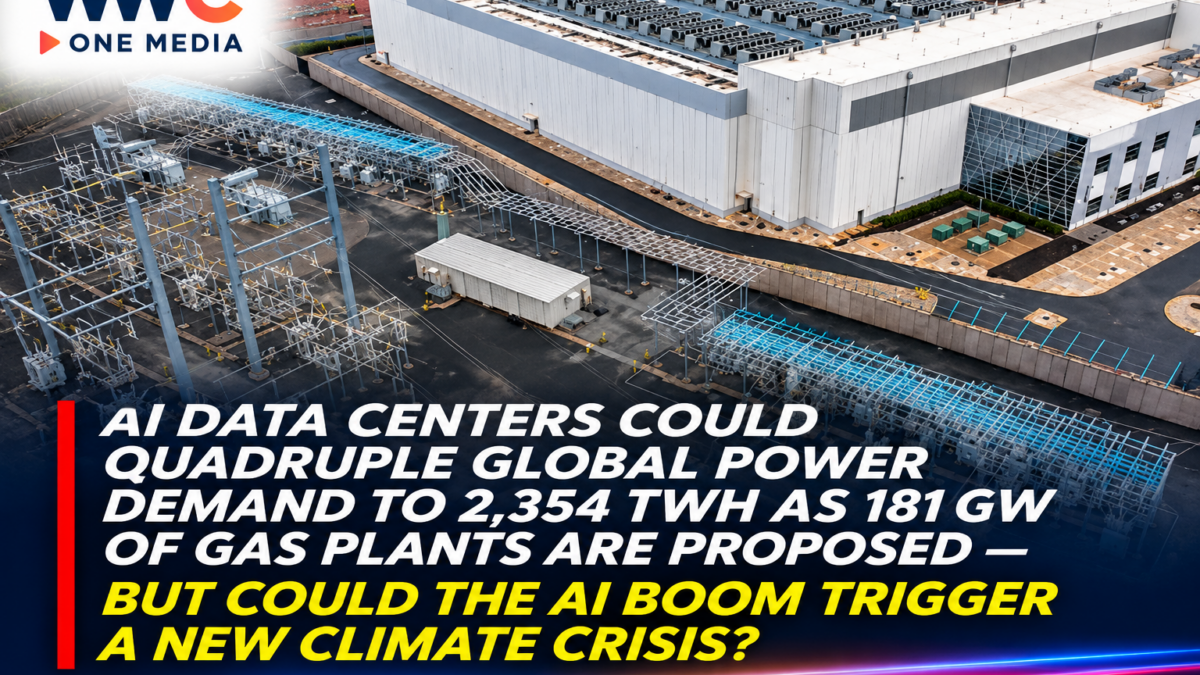
A new BloombergNEF report warns that data-center electricity consumption could nearly quadruple to 2,354 terawatt-hours annually by 2035, equivalent to approximately 7% of global electricity demand.
But the biggest concern is not simply how much power artificial intelligence will consume.
It is how that electricity will be generated.
With grid connections delayed for years in some markets, technology companies and data-center developers are increasingly considering dedicated natural-gas power plants to operate their facilities sooner.
BloombergNEF has identified 181 gigawatts of announced gas-fired generation capacity proposed alongside data centers, with more than 90% located in the United States.
If all the proposed US gas facilities were constructed and operated under the research firm’s modeled assumptions, they could produce approximately 345 million metric tons of carbon dioxide equivalent annually.
That would be substantially more emissions than supplying the same computing facilities with electricity from the average American power grid.
Governments are now examining ways to speed up grid connections, require financial commitments from developers and encourage cleaner sources of power.
But the policy response remains fragmented.
Some countries want to accelerate data-center construction.
Others are imposing tighter conditions because of electricity shortages, environmental concerns and rising costs for ordinary consumers.
As technology companies spend hundreds of billions of dollars building the infrastructure behind artificial intelligence, can governments modernize electricity grids fast enough to prevent an enormous expansion of fossil-fuel power—or will the race to develop AI create a new climate problem?
BloombergNEF Warns Data Center Power Demand Could Almost Quadruple
The November 11 findings come from BloombergNEF’s report, Powering the Data Center Boom: How Grid Policy Can Deliver Clean Power Faster, commissioned by Bloomberg Philanthropies.
The research estimates that data-center electricity demand could reach 2,354 TWh by 2035.
To understand the scale, one terawatt-hour equals one billion kilowatt-hours.
The projected 2,354 TWh therefore represents approximately 2.354 trillion kilowatt-hours of annual electricity consumption.
That is a massive quantity of electricity dedicated to servers, processors, cooling systems and other data-center equipment.
The forecast reflects the anticipated expansion of artificial intelligence, cloud computing and digital services.
However, it remains a projection.
Actual consumption will depend on the number of facilities built, the efficiency of computing equipment, utilization rates and the pace of technological development.
The findings underline a critical shift in the global technology industry.
Access to advanced computer chips is no longer the only constraint on AI growth.
Electricity availability is becoming just as important.
The 181-Gigawatt Gas Pipeline Raises Climate Concerns
BloombergNEF identified 181 GW of announced gas-fired power-generation projects proposed alongside data centers.
More than 90% of the announced capacity is in the United States.
The projects reflect growing pressure on developers to secure electricity as quickly as possible.
A dedicated gas-fired plant can potentially supply a facility without waiting for the completion of every planned grid upgrade.
But this strategy raises environmental concerns.
Natural-gas generation produces greenhouse-gas emissions.
Developing large amounts of dedicated fossil-fuel capacity could increase emissions for years, particularly if the plants continue operating after the surrounding electricity grid becomes more reliable.
BloombergNEF warned that the economics of operating these facilities may encourage developers to keep them running even after their initial purpose has changed.
That creates a potential risk of long-term dependence on fossil-fuel infrastructure.
Importantly, 181 GW represents announced proposals, not completed projects.
The research firm explicitly cautioned that the pipeline contains projects at different stages of development and should not be treated as a forecast of actual installed capacity.
Some projects may be delayed, modified or canceled.
AI Gas Plants Could Produce 345 Million Tons of Emissions Annually
The potential environmental consequences are significant.
BloombergNEF modeled a scenario in which all announced US data-center-linked gas plants are completed and operated under specified assumptions.
The resulting annual emissions could reach approximately 345 million metric tons of carbon dioxide equivalent.
That would be around 152 million metric tons more than the emissions associated with supplying the corresponding data-center capacity from average US grid electricity.
The additional emissions would be equivalent to approximately 10% of US power-sector emissions in 2025.
This does not mean data centers are already producing that amount.
It is a conditional estimate of what could happen if the proposed facilities are built and operate as modeled.
The calculation also depends on the electricity mix used for comparison.
A grid with substantial clean-energy generation may provide a lower-emissions alternative to dedicated gas plants.
A grid heavily dependent on coal could produce a different comparison.
The central conclusion is that electricity procurement decisions can substantially affect the environmental consequences of AI expansion.
Delayed Grid Connections Are Becoming a Major Economic Problem
Data centers cannot operate without dependable electricity.
Many large facilities need high-capacity connections to transmission and distribution networks.
Obtaining those connections may require new transformers, substations, power lines and upgrades to existing infrastructure.
The process can take years.
GlobalData reported in October that some developers in Europe’s major data-center markets face grid-connection waits of seven to ten years.
The company also cited International Energy Agency analysis indicating that more than 2,500 GW of renewable energy, storage and large electricity-consuming projects are waiting in connection queues worldwide.
These queues include many types of projects, not just data centers.
A separate GlobalData assessment found that projects beginning construction between the third quarter of 2025 and the third quarter of 2026 had waited slightly more than two years on average from announcement to groundbreaking.
That compared with approximately 18 months for an earlier group of projects.
The increase reflects a combination of electrical infrastructure shortages, local opposition, permitting requirements and difficulties obtaining equipment.
For technology companies, these delays have financial consequences.
Expensive computing facilities may remain idle while waiting for electricity.
Developers may also face higher financing costs if their projects take longer to become operational.
Governments Are Testing New Ways to Connect AI Facilities
BloombergNEF reviewed grid-connection policies across 17 markets.
The measures include faster approval processes, financial commitments from developers, flexible grid connections, designated development zones and mechanisms to support clean-power purchases.
Each approach addresses a different problem.
Financial commitments may discourage developers from reserving electricity capacity they do not intend to use.
Flexible connections can allow customers to accept certain limits on electricity supply in exchange for earlier access.
Special development zones can concentrate new computing facilities where infrastructure is already available or easier to expand.
Clean-energy procurement rules can encourage technology companies to support additional renewable generation.
However, BloombergNEF found limited empirical evidence establishing which approaches will be most effective.
That is a crucial qualification.
A government announcing new rules does not mean it has already solved its grid-connection problems.
The policies must still be implemented, tested and evaluated.
The International Energy Agency Identifies 134 Policies
The International Energy Agency reached similar conclusions in its October 14 report, Powering Artificial Intelligence.
The IEA reviewed policy developments across 34 jurisdictions covering approximately 90% of global data-center capacity.
It identified 134 policies and regulations concerning the integration of data centers into electricity systems.
Nearly 40% had been announced or implemented during the preceding 12 months.
Many of the policies focus on improving information about the location, timing and size of proposed data-center electricity demand.
That information is essential because utilities cannot plan efficiently when developers submit uncertain or duplicated requests for grid capacity.
The IEA also examined arrangements requiring data centers to bring their own power supplies or contribute to grid stability.
But the agency emphasized that policy design must balance energy affordability, reliability and sustainability.
The goal is not simply to connect facilities faster.
It is to do so without creating excessive costs or unnecessary environmental damage.
US Lawmakers Want Big Tech to Pay More for Grid Expansion
The United States is one of the most important markets in the debate.
American technology companies are investing heavily in new computing infrastructure.
But households and smaller businesses are increasingly concerned that the required electricity investments could increase their utility bills.
On November 9, the US Senate voted 73–25 to advance debate on bipartisan energy legislation addressing electricity infrastructure and permitting.
The proposal includes measures intended to ensure that large data-center operators bear more of the costs created by their electricity demand.
In related coverage, WWC ONE MEDIA examined the US Senate’s proposed electricity-cost protections for households and the political fight over accelerating major energy projects.
The legislation has not completed the congressional process.
Supporters argue that it could help build power plants and transmission lines more quickly while protecting consumers.
Critics warn that some permitting changes could weaken environmental oversight and increase fossil-fuel development.
Both the cost-allocation rules and environmental safeguards remain central to the debate.
US Utilities Are Developing Special Data Center Tariffs
Utilities are also introducing their own contractual arrangements.
Reuters reported on November 10 that Duke Energy had proposed special tariffs for large electricity users in North Carolina.
The arrangements would apply to qualifying loads of at least 50 MW.
They include long-term contractual commitments, minimum payments based on reserved electricity demand, connection charges and potential termination fees.
Under the proposal, qualifying customers could be required to pay for at least 75% of contracted demand even when they use less electricity.
Wisconsin regulators have also approved specialized tariffs affecting large customers of WEC Energy Group.
Those arrangements include long-term commitments and requirements addressing infrastructure construction costs.
The aim is to prevent ordinary electricity customers from being left with expensive facilities if a data-center developer cancels its project.
In related reporting, WWC ONE MEDIA examined the growing controversy over electricity bills and who should finance the power-grid upgrades associated with the global AI boom.
The broader challenge is ensuring that digital infrastructure investment does not unfairly shift costs to people who receive limited direct benefits from the projects.
Norway Moves to Restrict Data Center Expansion
Norway provides another example of a government taking a more selective approach.
On November 10, Norwegian authorities announced plans to introduce a licensing regime for data centers.
The government said electricity demand from proposed facilities was exceeding what the country’s power system could realistically accommodate.
According to national grid operator Statnett, approximately 800 MW of data-center demand was already connected.
Another 4,200 MW had reserved grid capacity.
Applications totaling approximately 9,100 MW were in the connection queue, with requests for a further 18,000 MW also submitted.
Norway’s government intends to prioritize digital infrastructure that provides broader public benefits.
It is also considering requirements for large new electricity users to contribute more toward infrastructure costs.
The government expects to present the main principles of its licensing system in autumn 2027.
These are proposed reforms, not a fully implemented licensing framework.
Norway’s decision illustrates how electricity availability may increasingly determine which AI projects receive permission to proceed.
Malaysia’s Data Center Demand Could Rise Sixfold
Southeast Asia is becoming another major center of data-center investment.
Malaysia has attracted substantial interest from international technology companies.
BloombergNEF forecasts Malaysian data-center electricity consumption rising from approximately 7 TWh in 2025 to 45 TWh by 2035.
That would represent more than a sixfold increase.
The report warns that additional demand could increase reliance on existing coal and natural-gas generation in the near term.
Longer-term expansion may also encourage additional gas-fired capacity or extensions to the operating lives of some coal plants.
Malaysia allows certain corporate renewable-energy procurement arrangements, providing an opportunity for data centers to support new solar projects.
However, grid charges and other commercial requirements influence the financial attractiveness of those arrangements.
The country must therefore address electricity supply and environmental concerns simultaneously.
Indonesia Faces a Different Clean-Energy Challenge
Indonesia’s electricity system presents a different policy environment.
According to BloombergNEF, coal and gas supplied approximately 82% of electricity generated on the main grid operated by state utility PLN in 2025.
That creates a substantial emissions challenge for new data-center developments.
The report also identified restrictions preventing data-center operators from directly contracting with independent renewable-energy producers under existing arrangements.
Those restrictions can make it harder for technology companies to demonstrate that their demand is supporting additional clean-electricity generation.
Indonesia has considerable renewable-energy potential.
However, developing new capacity requires suitable rules, transmission infrastructure and investment.
For data-center operators, the resulting emissions footprint depends heavily on the local electricity supply.
A facility powered predominantly by fossil fuels may have a very different climate impact from a similar facility supplied by low-emission sources.
India Could See Data Center Electricity Demand Increase Eightfold
India is another important market for AI infrastructure.
BloombergNEF projects data-center electricity demand rising from approximately 11 TWh in 2025 to 91 TWh in 2035.
That would represent an increase of more than eight times.
In the near term, existing coal plants are expected to supply a significant share of the additional electricity under BloombergNEF’s modeled scenario.
However, Indian companies can also procure renewable electricity through bilateral agreements and dedicated generation arrangements.
Some data-center developers are already supporting new solar and wind projects.
The challenge is ensuring that such arrangements result in additional clean-energy supply rather than merely transferring renewable-energy claims between customers.
As demand accelerates, investment in transmission, storage and flexible generation will become increasingly important.
Renewable Energy Can Help, but It Needs Better Infrastructure
Renewable electricity is central to reducing the climate impact of data centers.
Solar and wind generation can provide electricity without directly burning fossil fuels during normal operation.
But their output varies with weather and time of day.
Data centers typically need reliable electricity around the clock.
That means operators and utilities may also need storage, backup generation, grid connections and other flexibility measures.
The IEA reported that data-center operators signed approximately 45 TWh of renewable power purchase agreements during the first half of 2026.
That was almost 20% higher than during the comparable period in 2025.
These contracts can support the development of new clean-electricity capacity.
However, the electricity covered by a purchase agreement does not necessarily match a facility’s consumption every hour.
The climate benefit depends on the design of the agreement, the generation added and the broader electricity system.
The AI Industry Faces a Growing Environmental Contradiction
Artificial intelligence can support scientific research, environmental monitoring and more efficient industrial systems.
But running advanced AI systems requires electricity-intensive computing infrastructure.
That creates a potentially significant contradiction.
Technology used to support environmental research may also increase energy demand and associated emissions.
In related coverage, WWC ONE MEDIA examined how environmental organizations are using artificial intelligence to protect wildlife while the data centers supporting AI create new electricity and water demands.
The earlier analysis cited an IEA estimate of approximately 945 TWh of data-center electricity consumption by 2030.
That figure should not be confused with BloombergNEF’s new 2,354-TWh projection for 2035.
The estimates refer to different time horizons and modeling assumptions.
Both analyses point toward substantial growth in electricity consumption.
The precise scale remains uncertain.
Thailand Tightens Environmental Scrutiny of AI Infrastructure
Thailand is also responding to growing concerns about large data-center developments.
Authorities are examining environmental issues involving electricity demand, water use, heat and noise.
In related reporting, WWC ONE MEDIA examined Thailand’s environmental scrutiny of major AI data centers amid rapid growth in proposed technology investment.
The Thai approach focuses on environmental permitting and operational impacts.
It is different from BloombergNEF’s proposed grid-connection policies.
Nevertheless, the underlying issue is similar.
Governments want to attract investment in digital infrastructure without sacrificing public safety, environmental standards or electricity reliability.
A balanced policy must consider both the economic benefits and the costs imposed on surrounding communities.
What the Data Center Boom Means for the Philippines
The Philippines is also seeking to expand its digital infrastructure.
Reliable electricity is essential to attracting cloud-computing operators, telecommunications companies and AI-focused investors.
However, electricity costs remain a concern for Philippine businesses and households.
The global debate demonstrates why data-center projects must be planned alongside their electricity requirements.
One Philippine initiative involves Meralco PowerGen Corporation and VITRO.
The companies signed a memorandum of understanding to explore potential data centers integrated with renewable-energy supply.
The initiative remains exploratory.
It should not be described as a completed data-center or power-generation project.
Nevertheless, the partnership illustrates how Philippine companies are beginning to evaluate electricity and computing infrastructure together.
For regulators, the international experience suggests several priorities.
Large electricity users should provide credible demand forecasts.
Grid investments should be properly coordinated.
Cost-allocation rules should be transparent.
And new developments should be evaluated for their potential effects on electricity reliability and emissions.
Five Major Questions Governments Must Answer
1. How quickly can electricity grids expand?
New transmission infrastructure and grid equipment must keep pace with computing demand.
2. Should technology companies pay more for dedicated connections?
Policymakers must prevent the costs of speculative projects from falling unfairly on existing customers.
3. How much gas-fired generation will actually be built?
BloombergNEF’s 181-GW figure covers announcements, and many projects may never reach completion.
4. Can clean energy support the AI boom?
Renewable generation, storage, reliable networks and suitable purchasing arrangements will all matter.
5. Which policies will deliver measurable results?
BloombergNEF cautions that there is still limited evidence demonstrating which grid-connection reforms will be most effective.
The Bottom Line: AI’s Biggest Bottleneck May Be Electricity, Not Computer Chips
The global artificial intelligence boom is transforming energy investment.
BloombergNEF now projects data-center electricity consumption reaching approximately 2,354 TWh by 2035.
That would represent roughly 7% of global electricity demand.
The industry is also considering substantial amounts of dedicated gas-fired generation, including 181 GW of announced projects worldwide.
If built and operated under the report’s assumptions, the proposed US gas facilities could produce hundreds of millions of tons of greenhouse-gas emissions each year.
Governments are responding with policies intended to accelerate grid connections, protect electricity customers and encourage cleaner power.
But those reforms are still developing.
No single solution will work equally well in countries with very different electricity systems.
The United States and Europe face long grid-connection queues.
Malaysia and India are preparing for rapid increases in electricity demand.
Indonesia faces restrictions affecting corporate renewable procurement.
Norway is considering stronger controls over which developments can receive scarce grid capacity.
For the Philippines, the lesson is clear: attracting AI investment requires more than offering land, connectivity and financial incentives.
The country must also ensure that electricity infrastructure can support new facilities without worsening existing affordability and reliability problems.
Artificial intelligence could transform the global economy, but its success increasingly depends on an electricity system that was never designed for such rapid growth. With data-center power demand projected to nearly quadruple and 181 GW of gas-fired generation already proposed, can governments deliver cleaner, faster and more affordable grid connections—or will the next stage of the AI revolution create an environmental and financial burden far greater than expected?