BRASÍLIA, BRAZIL / SÃO PAULO / MANILA, PHILIPPINES — November 11, 2026 | WWC ONE MEDIA | Global Economy, Latin American Markets and Financial News
Brazilian President Luiz Inácio Lula da Silva’s economic team is preparing a multibillion-real fiscal adjustment package as his government scrambles to restore investor confidence following a punishing post-election selloff that sent the Brazilian real tumbling, government bond yields soaring and stocks sharply lower.
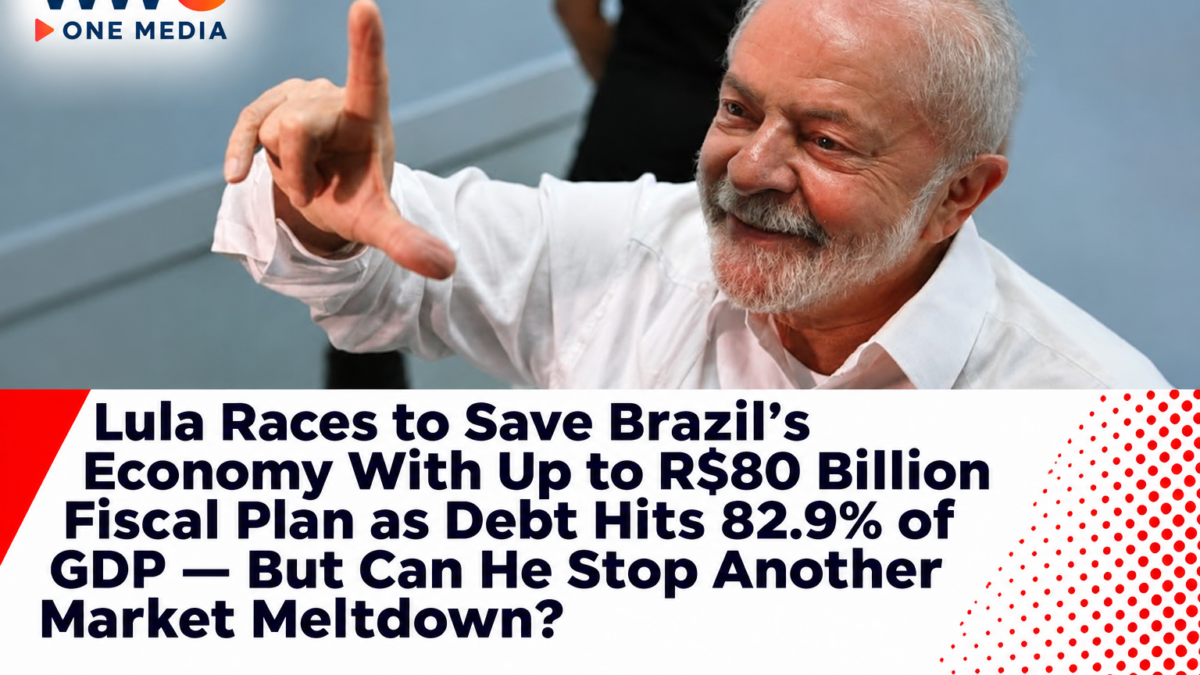
The proposed measures could generate R$70 billion to R$80 billion in fiscal savings during 2027, according to Reuters’ November 11 reporting, as officials seek to demonstrate that Brazil can contain its mounting debt without abandoning Lula’s promises to protect social spending.
Bloomberg separately reported that officials had discussed spending restraints amounting to R$50 billion to R$60 billion in adjustments for 2027.
The different figures reflect proposals that remain under negotiation. They should not be treated as two separate savings packages or added together.
The urgency is unmistakable.
Brazil’s gross public debt has climbed to approximately 82.9% of gross domestic product, while the central bank has paused its interest-rate-cutting cycle and kept the benchmark Selic rate at 13.75%.
Investors are demanding proof that Lula can deliver fiscal discipline after his surprise reelection on October 25.
But the president faces a political dilemma: spending cuts may reassure financial markets while risking opposition from supporters who helped return him to office.
With billions of reais in proposed savings, expensive borrowing costs and a divided Congress, can Lula rescue investor confidence without sacrificing the social programs at the center of his political agenda?
Brazil Prepares Fiscal Measures to Calm Nervous Investors
According to Bloomberg’s November 11 report, Lula’s economic advisers are preparing proposals intended to demonstrate how Brazil will meet its fiscal targets over the coming years.
Officials have discussed sending measures to Congress as early as the following week.
Reuters independently reported that a government source expects proposed changes to generate savings equivalent to approximately 0.5% of GDP in 2027.
The latest estimate translates to between R$70 billion and R$80 billion.
The proposed package is designed to improve the government’s budget outlook and address concerns about the sustainability of public debt.
However, important questions remain.
The final legislative text has not been approved, and the precise savings associated with each component have not been fully established.
Lawmakers could modify the measures before passage.
The government also faces uncertainty over how quickly the proposals could be implemented.
For investors, the announcement of a plan is only the beginning.
The real test will be whether Brazil can turn its fiscal promises into enforceable measures that produce lasting results.
What Is Inside Lula’s Proposed R$80 Billion Fiscal Package?
Reuters and Brazilian newspaper Folha de S.Paulo identified several measures being considered by Lula’s economic team.
One involves changing how extraordinary government revenue is treated when calculating constitutionally required minimum spending on healthcare and education.
Under the proposal, certain exceptional revenues would no longer automatically increase the spending base used for those calculations.
Another measure would reduce selected tax benefits and exemptions.
Officials are also examining changes that would permit tighter control of budget expenditures when revenue falls below expectations.
Folha reported that one proposal could allow an additional R$12.8 billion in spending reductions during 2027 if required to meet the fiscal target.
The mechanism could also permanently reduce the expenditure ceiling used in subsequent budget calculations.
These measures are intended to create fiscal savings without relying exclusively on traditional across-the-board spending cuts.
However, the consequences would vary considerably.
Reducing tax benefits could affect businesses and economic sectors currently receiving preferential treatment.
Changing the calculation of mandatory social spending could reduce the amount that the government would otherwise be required to allocate.
That does not necessarily mean nominal healthcare or education spending will decline.
But it could lower the statutory minimum compared with the amount required under existing rules.
The impact would depend on the final legislation, revenue performance and the actual budget approved by Congress.
Why Brazil’s Debt at 82.9% of GDP Is Worrying Investors
The central issue facing Lula is the country’s rising public debt burden.
According to Reuters, gross government debt increased by more than 10 percentage points of GDP during Lula’s current administration, reaching approximately 82.9%.
A country’s debt-to-GDP ratio measures the scale of government debt relative to its annual economic output.
It does not automatically determine whether a country will default.
Brazil benefits from issuing much of its public debt in its own currency and maintaining sophisticated domestic capital markets.
However, high interest rates can make a large debt burden increasingly expensive to service.
When the government must issue new bonds at elevated yields, future interest costs rise.
That can increase pressure on public finances and reduce the resources available for investment or services.
Investors are therefore concerned about whether Brazil can generate sufficient primary budget surpluses to stabilize its debt.
A primary surplus means government revenue exceeds spending before interest payments are included.
Brazil’s current fiscal projections anticipate a transition from a primary deficit of approximately 0.4% of GDP in 2026 to an effective surplus of 1.3% by 2030.
Some economists believe even larger surpluses may be necessary to stabilize the debt ratio.
The difference between the official targets and investors’ expectations is one reason markets remain nervous.
Lula’s Reelection Triggered a Sharp Brazilian Market Selloff
The urgency behind the fiscal proposals follows Lula’s October 25 reelection victory.
During the presidential campaign, investors had increasingly anticipated a possible political shift toward more restrictive government spending under opposition candidate Flávio Bolsonaro.
Those expectations helped push Brazilian stocks higher before the final round.
Lula’s eventual victory forced markets to reassess those expectations.
The Financial Times reported that the Brazilian real fell approximately 8% against the US dollar on the first trading day after the runoff, while the benchmark Ibovespa index plunged 13.9%.
Those were exceptional market moves, reflecting concern that the reelected administration might struggle to reconcile campaign promises with fiscal discipline.
The currency and equity market declines do not establish that Brazil was entering an immediate sovereign debt crisis.
But they demonstrated how dramatically investor confidence had deteriorated.
The government is now attempting to restore that confidence through a more detailed fiscal strategy.
Brazil’s Central Bank Holds Interest Rates at 13.75%
The country’s financial problems have also complicated monetary policy.
On November 4, Brazil’s central bank held its benchmark Selic rate at 13.75%, ending a sequence of five consecutive interest-rate cuts.
Officials cited a deteriorating inflation outlook and greater economic uncertainty.
The decision came as investors demanded higher returns on Brazilian government bonds and the real remained under pressure.
For Lula, high interest rates create multiple problems.
They increase financing costs for businesses and consumers.
They discourage certain investments.
They can also increase the government’s cost of refinancing debt.
But reducing rates too quickly could weaken the real further and worsen inflation expectations.
Central-bank Governor Gabriel Galípolo reiterated on November 10 that monetary policy would remain restrictive for as long as necessary to control inflation.
He also said the central bank was prepared to raise rates if conditions required it.
That means Lula cannot assume the central bank will reduce borrowing costs merely because the government announces a fiscal adjustment.
Investors will want evidence that the package improves the underlying inflation and debt outlook.
Lula Promises Fiscal Responsibility but Avoids Immediate Spending Cuts
On November 8, Lula delivered a televised address reaffirming his commitment to fiscal responsibility.
He acknowledged concerns about the public debt trajectory and elevated interest rates.
The president also pledged to preserve Brazil’s fiscal rules while supporting economic growth and social programs.
However, he did not announce the detailed spending measures investors had been waiting for.
Reuters reported that the address largely repeated commitments made during the presidential campaign.
The president also emphasized his ambition to increase investment to more than 20% of GDP, working in partnership with the private sector.
His argument is that Brazil needs both fiscal stability and stronger economic growth.
Supporters of that approach contend that public investment, social protection and household purchasing power are important for long-term development.
Fiscal conservatives argue that higher spending without credible funding sources can push up debt, inflation expectations and interest rates.
The central challenge is finding an adjustment that investors believe is sufficient without undermining the social commitments Lula has made to voters.
Political Resistance Could Derail the Fiscal Package
Lula’s economic advisers may be prepared to tighten spending rules, but the president does not govern without political constraints.
Brazil’s Congress includes parties with differing positions on public expenditure, taxation and economic reform.
Several lawmakers support greater fiscal discipline.
Others oppose measures that could reduce funding for social programs or public investment.
The president’s Workers’ Party has also emphasized that spending restraint should not come at the expense of low-income households.
That creates tension inside Lula’s own political coalition.
Reuters reported that government officials were discussing ways to strengthen fiscal targets while preserving the administration’s political priorities.
Meanwhile, Folha reported that lawmaker Lindbergh Farias had proposed changes that would make existing fiscal rules more flexible, including exemptions for certain public investments.
Those ideas differ from the more restrictive approach favored by parts of the economic team.
The competing proposals highlight why congressional approval cannot be assumed.
Brazil’s final fiscal package may look different from the measures currently under consideration.
Why the R$50 Billion and R$80 Billion Estimates Differ
A critical element of the November 11 reporting is the difference between the figures published by Bloomberg and Reuters.
Bloomberg reported discussions involving R$50 billion to R$60 billion in fiscal adjustments for 2027.
Reuters subsequently reported proposed measures intended to generate savings of R$70 billion to R$80 billion, citing a government source.
Brazilian reporting also described the broader potential package as being worth approximately R$70 billion to R$80 billion.
There are several possible explanations for the difference.
The reports may refer to different stages of the discussions, different components of the proposed package or different methods of estimating its financial effect.
However, the government has not publicly established a final, reconciled breakdown demonstrating exactly how each estimate was calculated.
Therefore, the responsible conclusion is straightforward.
The proposed adjustment remains under development, and its final size is not yet confirmed.
Neither amount should be described as savings already realized.
Nor should they be combined into a R$130 billion or larger package.
The final legislative text will be necessary to determine what the government is actually proposing to save.
Brazil’s Banking Industry Faces a High-Interest-Rate Test
The fiscal uncertainty is particularly important for Brazilian banks.
Higher interest rates can support certain banking income streams, but they also increase repayment pressure on households and businesses.
Companies borrowing to finance investment or working capital may delay expansion when financing becomes more expensive.
Consumers may also become more cautious about taking new loans.
At the same time, higher interest expenses can increase the risk of missed payments.
Brazil’s largest private-sector bank, Itaú Unibanco, has continued reporting substantial profits despite these pressures.
In related reporting, WWC ONE MEDIA examined Itaú’s R$12.6 billion quarterly profit, expanding R$1.54 trillion loan portfolio and the gradual increase in overdue loans.
The bank’s performance demonstrates that major lenders can remain profitable even during difficult monetary conditions.
However, profitability does not eliminate the risks associated with expensive credit.
A credible fiscal adjustment could help improve confidence and eventually create conditions for lower borrowing costs.
But that outcome would depend on inflation, central-bank policy and how financial markets respond.
Petrobras and Brazil’s Corporate Giants Are Also Exposed
Brazil’s fiscal challenges have implications for major corporations, including state-controlled energy producer Petrobras.
The company has reported strong earnings supported by production growth and refining activity.
But its investment decisions, financing costs and shareholder returns can be influenced by government policy and changing economic conditions.
Brazilian companies with substantial domestic borrowing requirements are particularly sensitive to interest rates and investor confidence.
A credible government fiscal strategy could improve the broader financing environment.
Conversely, prolonged uncertainty could maintain pressure on capital markets and discourage investment.
The effects will differ between companies depending on their debt structures, export revenues, currency exposure and operating conditions.
Why Brazil’s Fiscal Crisis Matters to Global Investors
Brazil is Latin America’s largest economy and a major supplier of agricultural products, metals, energy and other commodities.
Its financial stability matters to international investors and trading partners.
A sustained depreciation of the real could affect import costs, inflation and the competitiveness of Brazilian exports.
High bond yields could also influence how global investors evaluate debt issued by other emerging-market economies.
For international funds, Brazil’s market volatility creates both risks and potential opportunities.
Some investors may view lower stock valuations as attractive.
Others may remain cautious until the government provides a credible plan for stabilizing public debt.
However, Brazil’s fiscal problems should not automatically be interpreted as evidence of a wider emerging-market debt crisis.
Individual countries have different debt structures, reserve positions and policy frameworks.
The important question is whether Brazil can demonstrate progress toward sustainable fiscal targets while maintaining economic growth.
What the Fiscal Package Means for the Philippines
Brazil’s fiscal developments also offer lessons for Philippine economic policymakers.
Both countries must balance public investment, social spending, debt sustainability and borrowing costs.
For the Philippines, fiscal policy influences investor perceptions of government debt and the outlook for domestic interest rates.
Brazil’s experience illustrates how political uncertainty can quickly affect bond yields, exchange rates and financial-market confidence.
However, the Philippine and Brazilian economies have different fiscal frameworks, monetary conditions and financial structures.
Brazil’s 13.75% benchmark rate should not be treated as a forecast for Philippine interest rates.
Likewise, the Brazilian real’s depreciation does not establish that the Philippine peso will follow the same path.
The more relevant lesson is that credible and clearly communicated fiscal policy can matter significantly to international investor confidence.
Five Questions That Could Determine Brazil’s Financial Outlook
1. Will Lula approve the final fiscal package?
Government officials have been preparing proposals, but the president has not publicly endorsed every reported measure.
2. Can the measures pass Congress?
Lawmakers may modify or block provisions affecting tax benefits, expenditure rules and public services.
3. Will the package be large enough to stabilize debt?
The government must demonstrate how near-term savings will contribute to longer-term fiscal sustainability.
4. Can Brazil’s central bank resume cutting interest rates?
The Selic remains at 13.75%. Any future reductions will depend on inflation, expectations and broader economic conditions.
5. Will investors regain confidence?
Markets will evaluate implementation, not simply the announcement of headline savings targets.
The Bottom Line: Lula’s Biggest Economic Test Is Just Beginning
Brazil is approaching a decisive moment in its economic policy.
After Lula’s surprise reelection triggered a major selloff in stocks, bonds and the real, his government is preparing a fiscal package intended to reassure investors that public debt can be brought under control.
Bloomberg reported discussions involving R$50 billion to R$60 billion in adjustments.
Reuters subsequently reported a broader potential savings target of R$70 billion to R$80 billion for 2027.
Neither estimate has been enacted.
Meanwhile, public debt stands at approximately 82.9% of GDP, and the central bank is maintaining its benchmark interest rate at 13.75%.
The challenges are substantial.
Lula must convince financial markets that fiscal discipline is achievable while maintaining political support for the social and investment programs central to his administration.
For investors, the decisive test will be whether the proposed measures are detailed, credible and capable of passing Congress.
For Brazilian households and businesses, the stakes include borrowing costs, inflation, employment and economic growth.
Lula’s government is preparing a fiscal adjustment package worth as much as R$80 billion to calm financial markets after one of Brazil’s most dramatic post-election selloffs. But with public debt approaching 83% of GDP, interest rates stuck at 13.75% and lawmakers divided over spending cuts, will the plan restore confidence—or could Brazil’s financial turmoil enter an even more dangerous phase?