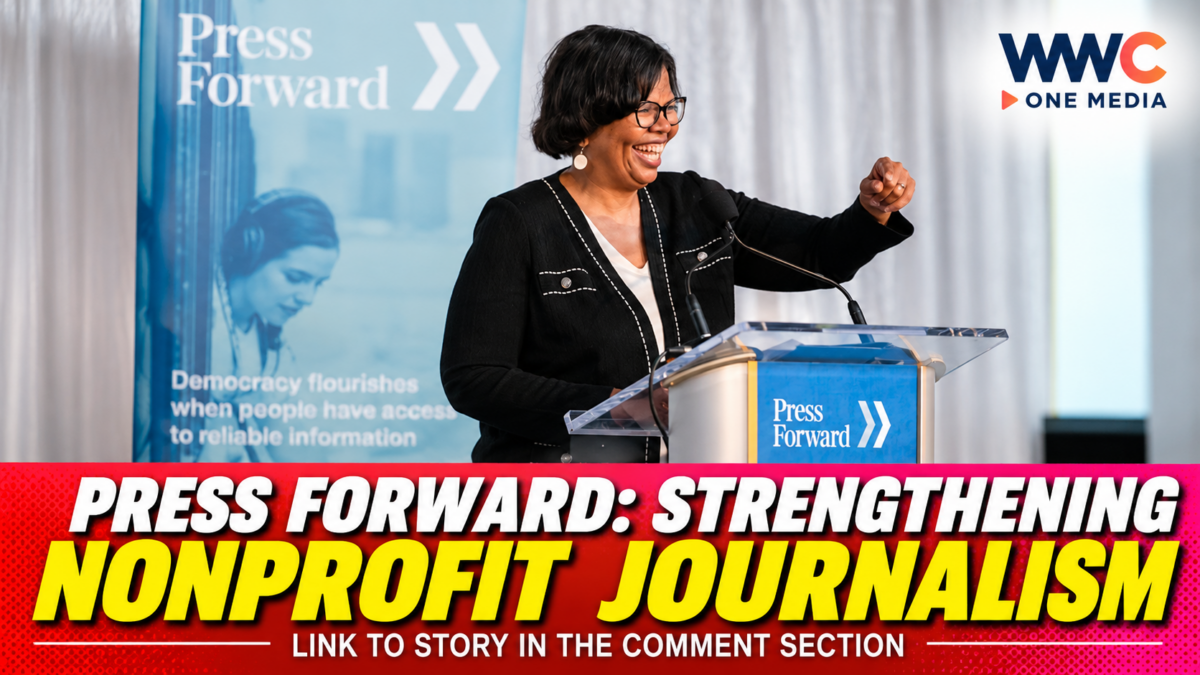
Press Forward Invests Nearly $600 Million in Journalism Two Years Early — But Can the Funding Save America’s Struggling Local Newsrooms?
By WWC One Media News Desk
November 11, 2026
WASHINGTON, D.C. — A major effort to rescue local journalism in the United States has reached a significant financial milestone ahead of schedule, with nonprofit coalition Press Forward reporting nearly $600 million in investments for news organizations.
But the achievement comes with a difficult question: Can hundreds of millions of dollars keep local journalism alive when newspapers continue to close, audiences are moving online and entire communities are losing access to reliable reporting?
Press Forward, a nationwide initiative launched in 2023, announced that it had completed nearly $600 million in investments in journalism organizations approximately two years earlier than originally planned.
The coalition’s achievement is significant for an industry facing mounting financial and technological pressures. Yet its leaders say the work is far from finished.
Executive Director Dale Anglin told The Associated Press that Press Forward intends to continue fundraising and expand its support for journalism, including initiatives designed to help newsrooms become more financially sustainable.
The MacArthur Foundation, one of the coalition’s founding funders, reported that Press Forward had invested approximately $594 million, surpassing its original $500 million goal ahead of schedule.
The milestone represents a substantial philanthropic commitment to local news. However, it does not mean the crisis facing American journalism has been solved.
America’s Local News Crisis Is Still Getting Worse
The timing of Press Forward’s announcement highlights the scale of the challenge.
Northwestern University’s Medill School of Journalism reported in its 2026 State of Local News study that the United States now has 238 news-desert counties — communities without a locally based professional news source.
That represents an increase of 26 counties in one year, or approximately 12%.
The report also found that another nearly 1,500 counties have only one local news source remaining. Together, these communities leave approximately 47 million Americans with limited or no access to local news.
Newspaper closures are accelerating.
Medill researchers counted 170 newspapers that closed or merged over the past year, equivalent to nearly three disappearing each week.
Meanwhile, the industry continues to lose readers and advertising revenue. Digital traffic to 100 of the largest local newspaper websites has fallen by approximately 50% over the past four years, according to the report.
The decline creates a serious problem for communities that depend on local reporters to cover government decisions, school boards, public safety, elections and other issues that directly affect residents.
When a local newsroom disappears, residents may lose more than a familiar newspaper. They can also lose an important source of independently gathered information about their own communities.
How Press Forward Is Distributing the Money
Press Forward was established in 2023 through a coalition of foundations and other philanthropic organizations seeking to strengthen local journalism.
Its founding supporters included the John S. and James L. Knight Foundation, the John D. and Catherine T. MacArthur Foundation and Democracy Fund, alongside other funders.
The coalition has since expanded to 144 funders and 50 local chapters, according to the AP report.
Those local chapters have invested approximately $87 million in their communities, including $53 million during the past year.
The initiative has also helped establish a $21 million impact-investing fund. Rather than relying exclusively on grants, the fund provides smaller loans to news organizations that may have difficulty securing financing through conventional lenders.
The approach reflects an important shift in how journalism funding is being considered.
Instead of simply providing money to publish more stories, funders are increasingly looking at the infrastructure, staffing, technology and financial systems that allow newsrooms to continue operating.
Press Forward’s Chicago chapter offers one example.
It has developed pooled funding arrangements that combine donations from multiple organizations and distribute support to several news outlets working on shared reporting priorities.
One project collected nearly $1 million from 12 donors to support immigration reporting across 12 news organizations, including outlets serving Latino and Chinese communities.
Another initiative supported additional reporting on education and Chicago Board of Education elections.
The model allows donors to support broader reporting projects without necessarily choosing which individual outlet receives every contribution.
It may also help smaller foundations participate in journalism funding while reducing concerns about appearing to influence the editorial decisions of a particular newsroom.
Did Previous Grants Actually Help Small Newsrooms?
The scale of Press Forward’s investment is impressive, but the effectiveness of its funding also matters.
A recent examination by Nieman Journalism Lab looked at how some recipients used an earlier Press Forward funding program.
The initiative distributed $20 million to 205 local news organizations over two years. Most recipients received $100,000, divided into two annual grants.
The report found that flexible funding helped some publishers pay bills, strengthen operations, upgrade equipment, retain staff and test new projects.
For smaller organizations, unrestricted grants could provide breathing room at a time when ordinary advertising and subscription income was not enough.
Some recipients also used the funding to improve their business operations and develop new ways to engage readers.
However, the funding did not guarantee survival for every organization.
Nieman Journalism Lab reported that Atlanta Civic Circle, one of the recipients, shut down earlier in 2026.
The experience illustrates a central problem with philanthropic support: a grant can provide time and resources, but it cannot automatically create a sustainable business model.
For some publishers, the money may help keep the newsroom operating. For others, it may be insufficient to overcome declining readership, weak advertising markets or persistent operating costs.
The results suggest that funding needs to be accompanied by longer-term planning, business support and a realistic understanding of local audience needs.
Why Philanthropy Alone Cannot Rescue Journalism
Press Forward’s leaders have acknowledged that financial assistance is not a permanent solution to the industry’s economic problems.
Knight Foundation President and CEO Maribel Perez Wadsworth emphasized the importance of developing stronger local funding networks rather than depending indefinitely on large national donations.
Her point reflects a broader concern among journalism funders.
Philanthropy can help news organizations survive difficult periods, experiment with new products and improve their reporting capacity.
But newsrooms still need reliable sources of recurring income.
That could include reader memberships, subscriptions, advertising, community partnerships and other revenue streams that do not compromise editorial independence.
Press Forward plans to expand its work through policy advocacy, cooperation between news organizations, shared resources and grants that help outlets build their operational capacity.
Its local chapters are also experimenting with different approaches based on the needs of their communities.
In some places, the priority may be helping an outlet cover an important local issue. In others, it may involve training new reporters, improving technology or helping a newsroom develop a more sustainable financial structure.
The challenge is that no single solution will work everywhere.
The Bigger Threat: Communities Losing Their Own Sources of Information
The decline of local journalism has consequences beyond the newspaper industry.
Local reporters often provide the public with information that national media organizations cannot consistently cover.
They attend local government meetings, examine public spending, investigate neighborhood concerns and explain decisions affecting schools, transportation, housing and public services.
Without those reporters, important local developments can receive less scrutiny.
Residents may increasingly depend on social media posts, unofficial community pages or information shared by individuals without the resources or editorial processes of a professional newsroom.
Those platforms can help distribute useful information, but they are not automatically substitutes for independent reporting and verification.
Medill’s 2026 report also found that 42% of surveyed respondents in news-desert counties reported getting news from social media at least once a day.
The distinction matters: having access to information online does not necessarily mean having access to reliable local journalism.
The problem is not simply that people have fewer newspapers to read. It is that communities can lose the reporting capacity needed to establish what is happening, verify claims and hold local institutions accountable.
What the Press Forward Milestone Means for Journalism’s Future
Press Forward’s nearly $600 million investment demonstrates that major philanthropic organizations are willing to treat local journalism as an important public resource.
The coalition has expanded its network, established local funding initiatives and supported newsrooms with grants and financial tools.
But the latest figures also show why the work remains urgent.
There are now 238 news-desert counties in the United States, 170 newspapers closed or merged in the past year, and approximately 47 million people live in counties with limited or no access to local news.
The industry is also experiencing major changes in audience behavior, digital technology and the economics of publishing.
The next test will be whether Press Forward’s investments can help news organizations build financial structures that remain viable after grant funding ends.
That means measuring more than the amount of money distributed. It also means examining newsroom survival, staffing, original reporting, audience engagement and the ability to generate recurring revenue.
For now, Press Forward has reached a major funding milestone ahead of schedule.
But the real measure of success will not be the amount of money invested.
It will be whether communities still have journalists covering their schools, local governments, businesses and public institutions years from now.
Can nearly $600 million rebuild the local news system — or will the next wave of newspaper closures show that even a historic financial commitment is not enough?