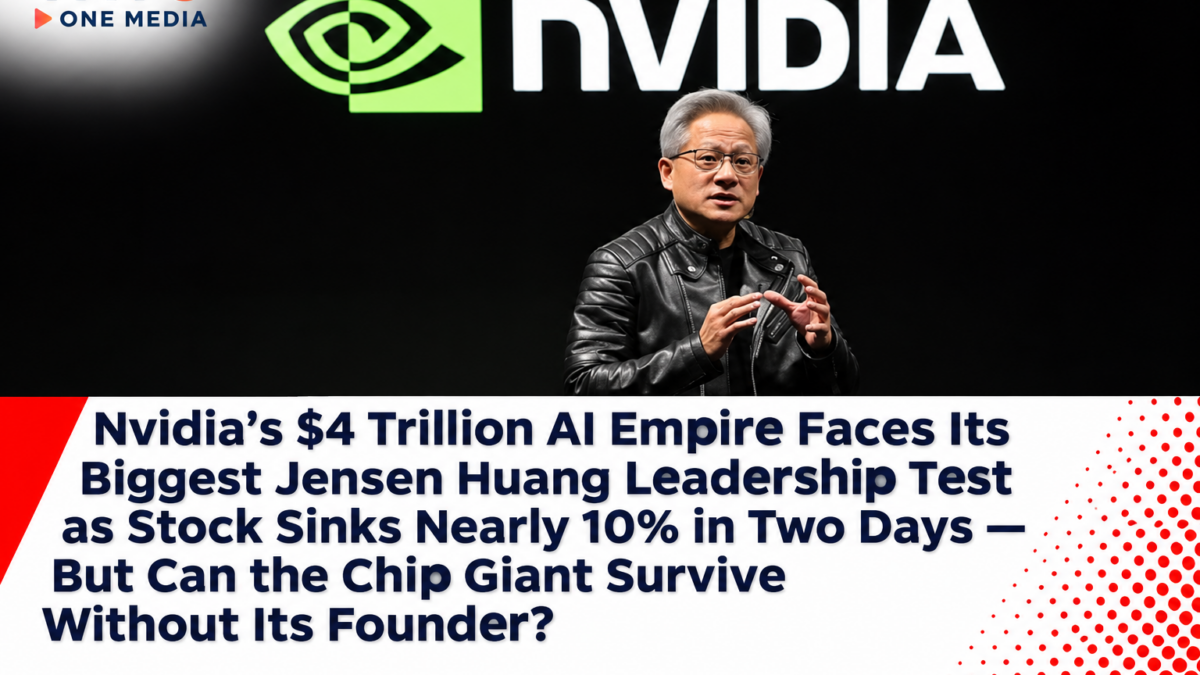
SANTA CLARA, CALIFORNIA / NEW YORK / MANILA — November 11, 2026 — Nvidia, the semiconductor powerhouse at the center of the global artificial intelligence revolution, is confronting a crisis that could prove more consequential than an ordinary stock-market selloff.
The company has built one of the most successful technology businesses in history. Its processors power advanced AI models, major cloud-computing platforms and enormous data centers around the world.
Yet the controversy surrounding longtime chief executive Jensen Huang has exposed an increasingly urgent question for investors: Has Nvidia become too dependent on the man who created it?
The issue intensified after Huang acknowledged an extramarital relationship with a business executive whom US intelligence authorities reportedly suspect of having links to Chinese intelligence.
Nvidia’s board announced an independent investigation on November 8 into whether its CEO was targeted by a foreign intelligence operation.
The company has emphasized that it has no reason to believe its confidential information or US national-security interests were compromised.
Huang remains chief executive and has pledged to cooperate with the investigation.
But the market reaction has been severe.
Nvidia shares fell approximately 4.3% on November 9 and another 5.5% on November 10, losing roughly 9.6% across the two sessions.
Reuters reported that the decline erased approximately $430 billion in market capitalization.
That loss in stock-market value came as investors reconsidered the company’s management risks, its exposure to US-China technology restrictions and the consequences of a possible leadership transition.
For Nvidia, whose market value remains around $4 trillion, the stakes extend well beyond one executive’s personal conduct.
The bigger question is whether a business central to the global AI economy has built a leadership structure strong enough to function without the founder who has directed it for more than three decades.
Nvidia’s $4 Trillion Business Faces an Unusual Leadership Crisis
Jensen Huang co-founded Nvidia in 1993 and has served as its chief executive ever since.
Over more than three decades, he helped transform the company from a specialist in computer graphics into a supplier of essential technology for artificial intelligence.
Its graphics processing units, or GPUs, are used to train and run increasingly sophisticated AI systems.
The company also supplies networking equipment, software tools and integrated computing infrastructure.
That combination has made Nvidia a major partner to cloud providers, research laboratories, enterprise technology companies and AI developers.
But Huang’s role goes far beyond public appearances and earnings presentations.
He has been deeply involved in product strategy, technology development, customer relationships and the company’s operating culture.
That involvement has become an enormous competitive advantage.
Now, amid the investigation, it is also being examined as a potential vulnerability.
If Huang were temporarily distracted, restricted in his duties or eventually replaced, investors would want to know whether Nvidia’s management structure could maintain the same pace of technological development.
The problem is often described as key-person risk: the possibility that an organization depends too heavily on one individual’s leadership, knowledge or relationships.
Jensen Huang Acknowledges Affair as Board Launches Investigation
The controversy escalated publicly on November 8.
Huang acknowledged that he had been unfaithful to his wife and apologized for his conduct.
The admission followed reporting concerning his relationship with Alice Huang, also known as Huang Le, a former executive associated with Singapore-based technology company Megaspeed International.
US intelligence officials reportedly suspect that Alice Huang had connections to a Chinese intelligence operation.
China has rejected those allegations as groundless.
The allegations remain unproven through publicly disclosed evidence.
Nvidia’s board responded by establishing an independent investigation into whether Jensen Huang had been targeted by foreign intelligence.
The company stated that it had no reason to believe confidential company information or US national-security interests had been compromised.
It also expressed confidence in Huang and his leadership team.
The distinction is essential.
Huang’s acknowledgement of an extramarital relationship is confirmed.
The alleged espionage connection and any potential compromise of sensitive information are separate matters that remain under investigation.
There has been no publicly established finding that Huang knowingly assisted a foreign intelligence service.
Nvidia Appoints Former Federal Prosecutor to Examine the Allegations
The independent investigation has moved beyond an initial announcement.
On November 10, Nvidia’s independent directors retained Joon H. Kim, a former acting US attorney for the Southern District of New York.
Kim is a partner at Wachtell, Lipton, Rosen & Katz, a law firm known for handling complex corporate matters.
His appointment gives the investigation an experienced legal lead.
The review is expected to examine the circumstances of Huang’s relationship and whether any risks to Nvidia or US national-security interests arose.
The appointment does not establish wrongdoing.
Independent investigations are designed to gather evidence, examine relevant events and provide a basis for decisions by corporate directors.
For shareholders, the independence and credibility of the process will be important.
A thorough investigation may help resolve uncertainty.
But any findings involving governance failures, security breaches or inadequate disclosure could create additional legal and commercial questions.
For now, the board has retained confidence in Huang.
No decision to remove him has been announced.
Why Replacing Jensen Huang Would Be So Difficult
Huang’s operating style is unusually centralized.
Reuters Breakingviews reported that Nvidia’s leadership structure involves more than 60 executives reporting directly to him.
That is a remarkably large number of direct reports compared with traditional corporate management structures.
The arrangement reflects Huang’s preference for close involvement in engineering and business decisions.
Supporters argue that this approach helps Nvidia respond quickly to technological developments and coordinate complex products.
Rather than relying exclusively on multiple layers of management, Huang receives information directly from senior specialists.
But the structure creates a succession challenge.
A replacement CEO would inherit responsibilities and relationships that have been organized around Huang’s personal leadership for decades.
The new executive might need to redistribute responsibilities, redesign reporting relationships or alter decision-making processes.
Those changes could be manageable.
But they could also create disruption during an intensely competitive period for artificial intelligence.
Nvidia has experienced executives and technical leaders.
However, it has not publicly identified a designated successor who would automatically replace Huang.
As WWC ONE MEDIA previously examined in its report on Nvidia’s succession crisis, the issue is not whether the company employs capable people.
It is whether the responsibilities concentrated in its founder can be transferred without damaging the strategy that helped make Nvidia successful.
Nvidia’s Board Has More Authority Than Investors May Realize
Although Huang is Nvidia’s co-founder and most influential executive, he does not control the company through a special class of super-voting stock.
Reuters Breakingviews reported that he owned approximately 3.58% of the company as of March 2026.
Nvidia has a single class of common stock.
That makes its governance different from technology companies in which founders hold shares carrying additional voting rights.
Nvidia’s directors therefore have substantial authority to oversee the CEO and make leadership decisions.
The board’s responsibility is to act in the company’s interests and exercise appropriate oversight.
But having the legal authority to replace a chief executive is different from determining whether doing so would be commercially wise.
Directors must weigh the facts emerging from the investigation against the risks of disrupting an organization built around Huang.
They must also consider employees, customers, regulators and shareholders.
A rushed decision could create uncertainty.
But failure to address a serious governance problem, if one is established, could create its own long-term risks.
The board’s challenge is balancing accountability with business continuity.
Nvidia Shares Lose Around $430 Billion in Two Sessions
The stock-market reaction has been dramatic.
On November 9, Nvidia shares closed at approximately $178.67, down 4.3%.
On November 10, the stock fell another 5.5%, ending around $169.
The two-day decline removed approximately $430 billion from Nvidia’s market capitalization, according to Reuters.
That figure represents a reduction in the market value of outstanding shares.
It does not mean Nvidia paid $430 billion to settle a claim or lost that amount from its corporate bank accounts.
But for investors, the change is economically meaningful.
Pension funds, institutions and individual shareholders holding Nvidia shares experienced declines in the market value of their investments.
The selloff also contributed to concerns about the concentration of major stock indexes in a handful of AI-related companies.
As WWC ONE MEDIA reported on Nvidia’s $190 billion decline during the November 9 Wall Street rally, the chipmaker’s weakness contrasted sharply with broader market gains.
That divergence demonstrated how company-specific leadership concerns can overwhelm otherwise positive market conditions.
The additional November 10 decline intensified the pressure.
Nvidia’s Business Is Still Generating Extraordinary Profits
The leadership controversy does not erase Nvidia’s recent financial performance.
In its most recent completed quarterly earnings report, released August 26, the company announced revenue of $96.2 billion.
That represented an increase of 106% compared with the same quarter a year earlier.
Its data-center business generated approximately $89 billion, up 117%.
GAAP net income reached approximately $59.7 billion.
Those are extraordinary results for a semiconductor company.
They demonstrate substantial commercial demand for Nvidia’s computing systems.
The company is not facing the same immediate financial situation as an early-stage AI business that has yet to achieve operating profitability.
But share prices reflect expectations about future performance, not simply earnings already reported.
Even a profitable company can lose substantial market value if investors become concerned about management stability, regulation or future sales.
For Nvidia, the question is whether strong customer demand can continue outweighing new corporate and geopolitical risks.
The Next Earnings Report Could Be a Defining Test
Nvidia’s next quarterly results are scheduled for November 17.
In its August earnings announcement, management projected approximately $108 billion in fiscal third-quarter revenue, subject to a 2% variation.
That figure is a forecast, not revenue already earned and reported.
The company’s actual results will provide a new measure of demand for AI chips and data-center infrastructure.
Investors will also evaluate profit margins, production capacity and management’s outlook for future quarters.
Strong earnings could redirect attention toward the underlying business.
But positive financial results may not fully resolve the uncertainty surrounding the leadership investigation.
Conversely, a weaker-than-expected quarter could intensify the market’s concerns.
The timing is therefore significant.
Nvidia is approaching a major financial announcement while its board is examining an unusually sensitive situation involving the company’s chief executive.
For investors, the earnings release and investigation will be separate but closely watched developments.
The China Chip Allegations Create a National-Security Risk
The controversy extends beyond corporate succession.
US authorities have imposed restrictions on exports of certain advanced AI processors to China because of national-security concerns.
Powerful chips can support commercial artificial intelligence, scientific research and potentially sensitive military applications.
The United States has therefore sought to limit China’s access to specified high-performance computing technologies.
The latest allegations concern whether intermediaries associated with Megaspeed helped Chinese customers obtain restricted Nvidia products.
Reuters reported allegations originally published by The Information concerning approximately 240,000 chips and transactions valued at more than $7.5 billion.
Those are reported allegations.
They should not be presented as proven illegal shipments.
The precise transactions, their legal status and the involvement of particular individuals remain subject to verification.
Nvidia has denied having reason to believe its confidential information was compromised.
The controversy raises a wider question about how sophisticated chip manufacturers monitor international customers and supply chains.
A Short Seller Raised Questions Months Before the Crisis
The company’s China exposure had already attracted scrutiny earlier in 2026.
In May, Culper Research published a report questioning whether Nvidia’s technology was reaching Chinese customers through intermediaries despite export restrictions.
The research firm disclosed a short position in Nvidia shares.
That financial interest matters because short sellers may benefit when the price of a stock declines.
Culper raised concerns involving Megaspeed and other companies operating across Southeast Asia.
Its findings have since attracted renewed attention.
As WWC ONE MEDIA examined in its report on the short seller’s earlier warning, the allegations existed before the latest investigation became public.
However, a short-seller report is not equivalent to a regulatory finding.
Its claims need independent corroboration.
The new investigation may examine some of the same business relationships, but that does not automatically validate every allegation in the earlier research.
For investors, the controversy highlights the importance of distinguishing identified risks from established violations.
Washington Wants Answers About Nvidia’s China Relationships
The matter is also attracting attention from US lawmakers.
Members of Congress have requested information about the company’s China-related business relationships, export controls and potential national-security exposure.
The concerns involve both intelligence allegations and Nvidia’s role in supplying advanced computing technology.
The political stakes are substantial because artificial intelligence has become central to the strategic competition between the United States and China.
American policymakers are attempting to preserve technological advantages while allowing US companies to compete internationally.
Nvidia has argued that excessive restrictions could encourage Chinese customers to develop or adopt alternative technologies.
Critics contend that advanced processors require particularly strong controls because of their strategic importance.
The latest controversy may intensify disagreements over how those policies should be enforced.
As WWC ONE MEDIA reported on renewed scrutiny of President Donald Trump’s relationship with Huang and US-China chip policy, the situation has become a political question as well as a corporate matter.
Nevertheless, political scrutiny does not establish that Huang or Nvidia knowingly violated export-control laws.
Those questions require evidence and appropriate legal findings.
Why Nvidia’s Crisis Matters to the Entire AI Industry
Nvidia’s importance extends far beyond its shareholders.
Its GPUs support AI systems developed by major technology companies, research laboratories and cloud providers.
The company also offers software libraries, networking technologies and integrated computing platforms.
This combination makes Nvidia deeply embedded in the wider AI infrastructure market.
Other companies develop competing processors.
Advanced Micro Devices, cloud providers and specialized chip designers are investing heavily in alternative hardware.
But migrating demanding workloads to new systems can involve technical and commercial challenges.
Developers may need to adapt software, validate performance and redesign parts of their infrastructure.
Nvidia’s established CUDA software ecosystem is an important reason its customers remain invested in its platforms.
A leadership crisis at Nvidia would not automatically shut down global AI services.
Existing chips and data centers would continue operating.
But prolonged disruption in product development, supply relationships or strategic decision-making could affect the timing and cost of future infrastructure projects.
That is why investors are treating Nvidia’s governance questions as relevant to the broader AI boom.
Investors Face a Difficult Choice Between Continuity and Accountability
The central challenge for Nvidia’s board is deciding how to respond to the investigation while preserving business stability.
If the inquiry finds no material compromise or conduct requiring leadership changes, Huang could remain CEO while the company strengthens certain procedures.
If serious problems are established, directors may need to consider more substantial action.
Either outcome requires careful handling.
Retaining the founder could preserve continuity and reassure major customers.
But the board also needs to demonstrate that it can exercise independent oversight.
Replacing Huang could address some concerns, depending on the evidence and circumstances.
Yet a sudden leadership transition might create disruption precisely when the company is managing extraordinary demand and intense competition.
No outcome is inevitable.
And the available evidence does not justify declaring that Huang will be removed.
The broader lesson concerns corporate resilience.
A company worth trillions of dollars should be able to demonstrate that its success does not depend entirely on one person’s continued leadership.
The Controversy Is Also a Test of Corporate Trust
The business implications extend beyond legal liability.
A company’s reputation influences its relationships with employees, investors, suppliers, customers and government agencies.
The current controversy has raised questions about Huang’s judgment and the adequacy of corporate oversight.
But reputational concerns must be distinguished from confirmed legal violations.
A company can respond to allegations through transparent investigation, appropriate disclosure and improvements to internal controls.
That process may help rebuild confidence.
Harvard Business Review has highlighted the importance of trust and leadership accountability in analyzing Huang’s situation.
For Nvidia, the challenge is particularly unusual because the chief executive is also one of the most recognizable symbols of the AI industry.
Huang’s public reputation has helped connect the company’s technology with a powerful narrative of innovation and growth.
The same visibility now magnifies scrutiny.
Investors are evaluating not only Nvidia’s products and earnings, but also its leadership culture.
Could Nvidia’s Troubles Benefit Its Competitors?
Leadership uncertainty at a dominant supplier can create opportunities for rivals.
Customers may become more interested in diversifying their hardware suppliers.
Competitors could emphasize the advantages of alternative chips, software systems or procurement arrangements.
But significant changes in market share are not automatic.
Nvidia’s technology remains deeply established in AI computing.
The company also continues generating substantial revenue and profits.
Customers making long-term infrastructure decisions will assess performance, availability, cost and compatibility rather than reacting only to headlines.
The controversy could nevertheless encourage some businesses to reconsider the risk of dependence on a single supplier.
This is especially relevant for companies making multibillion-dollar AI infrastructure commitments.
Diversifying suppliers may improve resilience, but it can also introduce additional complexity and development expense.
The long-term competitive outcome will depend on technology performance and commercial execution.
What Nvidia’s Crisis Means for Philippine Businesses and Investors
The effects of Nvidia’s controversy could extend into Asian technology markets.
Nvidia depends on a global semiconductor supply chain involving advanced manufacturing and components from multiple countries.
Its customers include international cloud providers and technology companies.
A major disruption could affect investment decisions across the sector.
For Philippine businesses using AI services, however, the board investigation does not directly mean that existing software products will stop functioning or that service prices will immediately increase.
Any such changes would depend on future developments in the supply chain, commercial agreements and technology markets.
For Filipino investors with exposure to Nvidia through international funds, the controversy illustrates the risks of concentrated positions in individual stocks.
Even a company generating extraordinary profits can experience substantial market volatility.
Diversification and understanding the difference between operational performance and market valuation remain important considerations.
The immediate development is an investigation, not a confirmed collapse of Nvidia’s business.
What Happens Next for Jensen Huang and Nvidia?
Several developments will determine the future of the controversy.
First, Nvidia’s independent investigation. Directors will assess the available evidence and decide whether further action is required.
Second, the federal inquiry. Authorities may clarify whether any intelligence-related or export-control allegations can be substantiated.
Third, congressional oversight. Lawmakers could seek additional documents or testimony about Nvidia’s security procedures and international business relationships.
Fourth, the November 17 earnings report. Investors will compare actual results with the company’s earlier $108 billion revenue forecast.
Fifth, succession planning. Shareholders may seek greater clarity about how Nvidia would operate if Huang became unavailable or eventually retired.
Sixth, international chip restrictions. Future US policy decisions could influence Nvidia’s access to Chinese customers and the economics of its global business.
These developments could strengthen or weaken investor confidence.
But the outcome remains uncertain.
There is no confirmed finding that Huang knowingly assisted foreign intelligence, and Nvidia has not announced his removal.
The Bigger Picture: Nvidia’s Greatest Strength May Also Be Its Biggest Vulnerability
Nvidia’s rise has been one of the defining business stories of the artificial intelligence era.
The company has transformed the market for advanced computing.
Its technology supports some of the world’s most ambitious AI projects.
Its quarterly revenue has climbed to extraordinary levels.
And its market value remains around $4 trillion despite the latest selloff.
At the center of that success stands Jensen Huang.
His technical knowledge, long-term strategy and personal leadership have helped Nvidia achieve its dominant position.
But the latest controversy is exposing the potential costs of concentrating so much influence in one individual.
The investigation has created uncertainty involving corporate governance, national security, export controls and executive succession.
Investors must now consider whether Nvidia’s organizational structure is as resilient as its technology.
For the board, the challenge is to establish the facts while protecting the company’s long-term interests.
For Huang, it is to rebuild confidence while remaining accountable to shareholders and employees.
And for Wall Street, it is to decide how much leadership uncertainty should affect the valuation of one of the world’s most important AI companies.
Nvidia has built a $4 trillion technology empire around the vision of Jensen Huang, but the crisis surrounding its founder has forced investors to reconsider a risk long overshadowed by booming AI chip sales. With an independent investigation underway and no publicly identified successor, can the company prove it has the leadership strength to thrive beyond its iconic CEO—or could dependence on one man become the greatest vulnerability in the artificial intelligence revolution?