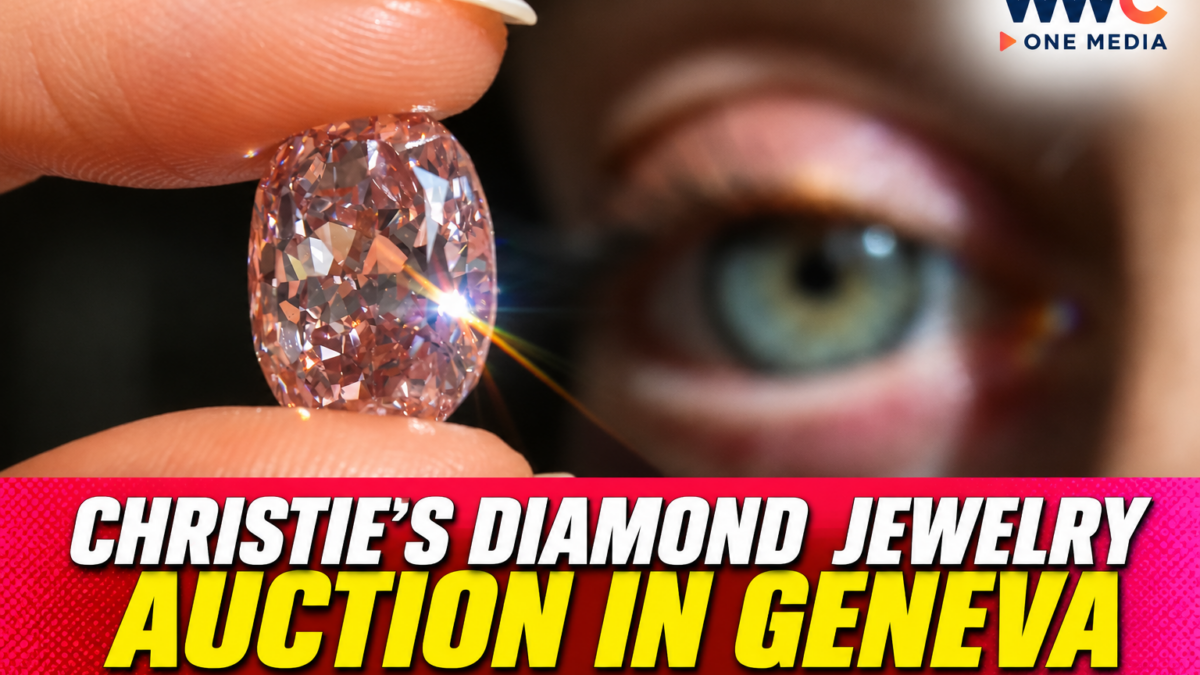
A 24-Carat Pink Diamond Just Sold for $14.6 Million — But Its 70-Year Family History Makes It Even More Extraordinary
GENEVA, Switzerland — November 11, 2026 | WWC ONE MEDIA | International Business, Luxury Markets and Jewelry
A rare 24-carat pink diamond ring has sold for more than $14.6 million at Christie’s Geneva auction, turning one of the world’s most extraordinary colored gemstones into the headline attraction of the international luxury market.
Known as the Bulgari Pink, the emerald-cut diamond fetched 12.1 million Swiss francs at auction on November 10, according to Christie’s and reporting by The Associated Press.
The final price exceeded $14.6 million, placing the jewel within its estimated auction range of 10 million to 15 million Swiss francs, equivalent to approximately $12 million to $18 million.
But the remarkable price is only part of the story.
The diamond reportedly remained within the same family for more than 70 years, following its acquisition in India during the 1950s. It was subsequently entrusted to Italian luxury jeweler Bulgari, which transformed the rare stone into the ring presented at the Geneva auction.
For collectors, the sale represents more than an expensive jewelry transaction. It highlights the continuing appeal of rare natural diamonds, historic provenance and exclusive luxury pieces that cannot easily be replicated.
And with its extraordinary size, intense pink color and decades-long ownership history, the Bulgari Pink offered something that wealthy collectors rarely encounter: an opportunity to acquire a jewel that had never previously appeared at public auction.
The Bulgari Pink Diamond Sells for $14.6 Million in Geneva
Christie’s Magnificent Jewels auction in Geneva featured the Bulgari Pink as its headline attraction.
The 24.00-carat stone was classified as Fancy Intense Pink and fashioned into an emerald-cut design, with the ring’s setting created by Bulgari.
The final auction price of CHF 12.1 million placed the diamond comfortably within its original estimate.
Before the sale, Christie’s had valued the ring at CHF 10 million to CHF 15 million, or approximately $12 million to $18 million.
The auction result is particularly significant because the jewel had remained in private ownership for more than seven decades.
According to Christie’s October announcement, it had never previously been offered for public sale.
That combination of rarity, history and exclusivity helped make the ring one of the most closely watched jewelry offerings of Geneva’s Autumn Luxury Week.
From India’s Historic Diamond Trade to Bulgari’s Italian Craftsmanship
The Bulgari Pink’s history reportedly began in India during the 1950s.
According to the family’s account reported by Christie’s, the current owner’s great-grandfather acquired the rough diamond before eventually entrusting it to Bulgari.
The Italian jewelry house transformed the stone into the finished ring.
The diamond is believed to have connections to India’s historic Golconda diamond region, an area associated with some of the world’s most celebrated historic gemstones.
The Golconda diamond trade has long been connected to famous stones, including the Koh-i-Noor and the Hope Diamond.
However, the precise geological origin of the Bulgari Pink should be treated cautiously. The auction house’s description refers to its qualities as reminiscent of historic Golconda diamonds, while the AP report describes its origin as believed to be Golconda.
The distinction matters because historical provenance and scientifically established geological origin are not necessarily the same thing.
Nevertheless, its reported Indian acquisition history and uninterrupted family ownership contribute significantly to the jewel’s appeal.
Why the Bulgari Pink Is Considered So Rare
The diamond’s classification adds another important dimension to its value.
Christie’s identifies the Bulgari Pink as a Type IIa diamond, a category representing fewer than 2% of gem-quality diamonds.
Type IIa diamonds contain extremely low levels of nitrogen impurities, making them among the chemically purest natural diamonds.
Their rarity does not automatically determine their market value, but it adds to the scientific and gemological interest surrounding exceptional stones.
The Bulgari Pink also possesses the Fancy Intense Pink color classification, an important characteristic in the colored-diamond market.
Natural pink diamonds are especially sought after because their color is uncommon and cannot simply be reproduced through conventional cutting and polishing.
Their distinctive appearance is associated with unusual structural characteristics within the diamond crystal.
The combination of a 24-carat weight, intense pink color and emerald-cut proportions makes the Bulgari Pink an especially notable example of high-value colored diamond jewelry.
Bulgari’s Connection to Hollywood’s Golden Age
The ring also carries a connection to the history of Italian luxury design.
During the 1950s, Bulgari became closely associated with Rome’s postwar glamour.
Its boutique on Via Condotti attracted prominent international personalities, including Elizabeth Taylor, Richard Burton, Audrey Hepburn and Mel Ferrer.
The city was experiencing a period of cultural growth as international film productions brought Hollywood stars to Cinecittà Studios.
Rome became known as Hollywood on the Tiber, and Bulgari’s jewelry developed a reputation for bold designs, colorful gemstones and distinctive Italian craftsmanship.
The Bulgari Pink reflects that period of luxury history.
Rather than presenting the diamond as a loose investment stone, the ring combines an exceptional natural gemstone with the design identity of one of Italy’s most recognized jewelry houses.
Its historical connection gives collectors another reason to appreciate the piece beyond its weight and color.
How the $14.6 Million Result Compares With Other Pink Diamonds
The Bulgari Pink’s auction result also provides another reference point for the market in rare pink diamonds.
JCK, a jewelry industry publication, highlighted the ring before the November auction and compared it with previous sales of important pink stones.
In June 2025, Christie’s sold the 10.38-carat Marie-Thérèse Pink, a purple-pink diamond set by JAR, for approximately $13.98 million in New York.
That sale exceeded the stone’s high estimate and established records for a purple-pink diamond and a JAR jewel.
The comparison demonstrates how exceptional colored diamonds can command multimillion-dollar prices even when their carat weights differ.
However, auction values cannot be compared using weight alone.
Color intensity, clarity, cut, origin, documentation, provenance, design and buyer demand all influence the final price.
The Bulgari Pink’s 24-carat size and long family ownership history therefore make it a distinctive auction offering rather than simply another large pink diamond.
What the Auction Reveals About the Global Luxury Jewelry Market
The Geneva sale arrives at a time when international auction houses continue competing for exceptional jewelry collections and historically significant gemstones.
Christie’s operates across major luxury markets, including Geneva, London, New York and Hong Kong, offering live and online auctions for jewelry, watches, art and collectibles.
Rare diamonds occupy a special position within this market because their appeal combines tangible scarcity with historical and aesthetic value.
Unlike mass-produced luxury accessories, exceptional natural gemstones are difficult to replace with identical pieces.
Their rarity can make them attractive to private collectors seeking objects with distinctive characteristics and documented ownership histories.
However, a multimillion-dollar auction result should not be interpreted as proof that all diamonds are appreciating investments.
The market for exceptional natural colored diamonds is highly selective, and individual results can vary considerably.
Buyers must also consider auction premiums, resale costs, certification and the difficulty of finding another buyer willing to pay a comparable price.
The Bigger Picture: Why Historic Provenance Matters as Much as the Diamond
The Bulgari Pink’s sale illustrates an important principle in the international luxury market.
A precious gemstone’s value is not determined by its physical characteristics alone.
Its history, previous ownership, craftsmanship and documented provenance can also influence how collectors perceive it.
The diamond’s journey from its reported acquisition in India during the 1950s to Bulgari’s workshops and eventually Christie’s Geneva auction gives it a narrative that distinguishes it from an ordinary luxury jewelry purchase.
For wealthy collectors, that history can be part of the attraction.
The $14.6 million result also reinforces Geneva’s importance as a center for high-value jewelry auctions, where rare stones and important private collections regularly attract international attention.
Yet the most interesting aspect of this particular sale may be the diamond’s long absence from the public market.
After more than 70 years in the same family, the Bulgari Pink finally appeared at auction, allowing collectors to compete for a piece of jewelry history.
Its final price exceeded $14.6 million.
But the story behind the stone may be what makes the sale truly unforgettable.
As rare natural diamonds continue attracting wealthy collectors, one question remains: Was the Bulgari Pink’s $14.6 million auction result driven primarily by its extraordinary gemstone qualities, or did its 70-year family history make it an opportunity money alone could rarely buy?