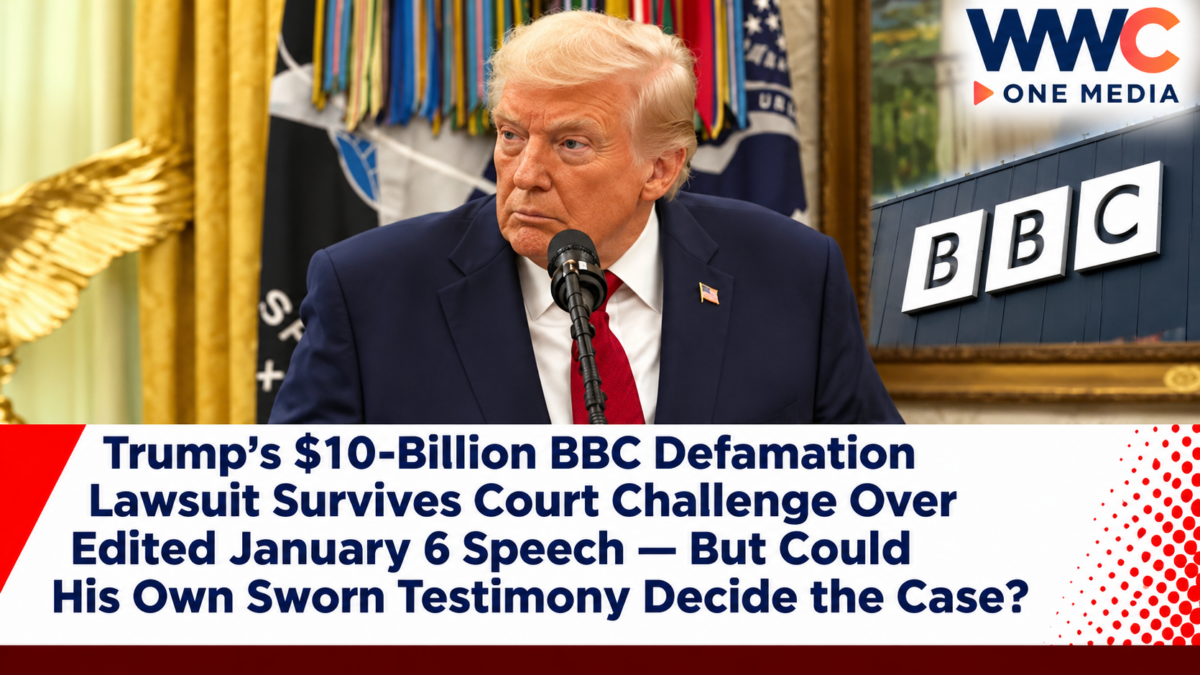
WASHINGTON, D.C. / LONDON, UNITED KINGDOM — November 11, 2026 — President Donald Trump has scored a significant legal victory against one of the world’s most prominent broadcasters after a US federal judge ruled that his multibillion-dollar defamation lawsuit against the British Broadcasting Corporation can move forward.
In a decision issued on November 10, US District Judge Jeffrey Kuntz in Florida rejected the BBC’s attempt to dismiss Trump’s defamation claim over an edited documentary segment concerning the president’s January 6, 2021, speech.
The case stems from a BBC Panorama documentary broadcast shortly before the 2024 US presidential election.
The program combined remarks Trump delivered nearly 55 minutes apart, creating the impression that he directly encouraged supporters to march on the Capitol and engage in violent action.
The BBC later acknowledged that the editing was misleading and apologized.
But the broadcaster continues to deny that the mistake constituted legally actionable defamation.
The latest ruling gives Trump’s case a path forward while eliminating a separate claim that the BBC violated Florida’s consumer-protection law.
And despite Trump’s demand for approximately $10 billion, no damages have been awarded.
The decision also sets up an extraordinary legal confrontation: the sitting US president is under a separate court order to answer questions under oath from lawyers representing the British broadcaster.
Trump has won the right to continue his defamation case. But can he prove the BBC knowingly or recklessly published a false portrayal—and substantiate the enormous damages he is seeking?
Florida Judge Rejects BBC’s Bid to End the Defamation Case
Judge Kuntz ruled that Trump’s complaint contained sufficient factual allegations to survive the BBC’s motion to dismiss.
At this stage, the court was required to assess whether the allegations, assumed true for purposes of the motion, could support a legally valid claim.
The judge concluded that the disputed editing went beyond an ordinary dispute about journalistic opinion.
The documentary combined statements from widely separated moments of Trump’s January 6 speech into a passage that he had not delivered as a continuous statement.
Kuntz determined that this could plausibly support Trump’s allegations that the broadcaster presented a materially misleading account of his remarks.
The judge also found that Trump had sufficiently alleged reputational harm to proceed.
But a critical distinction remains.
Surviving a motion to dismiss is not the same as winning a defamation lawsuit.
Trump must still prove the required legal elements using evidence.
The BBC retains the opportunity to contest his allegations, challenge the evidence and defend its journalism as the case progresses.
How the BBC Edited Trump’s January 6 Speech
The dispute focuses on a 12-second segment in the Panorama documentary Trump: A Second Chance, broadcast on October 28, 2024.
The documentary examined Trump’s political comeback and his path to reelection.
The controversial sequence combined two separate portions of the speech he delivered in Washington on January 6, 2021, before a mob of his supporters attacked the US Capitol.
In one part of the speech, Trump discussed supporters going toward the Capitol.
Nearly 55 minutes later, he used the phrase “fight like hell.”
The BBC presented portions of the two remarks together, making them appear to form a continuous passage.
The documentary also omitted a portion in which Trump called on supporters to demonstrate peacefully.
Trump’s lawyers argue that the editing falsely portrayed him as issuing a direct instruction to engage in violence.
The BBC acknowledges that the sequence created a misleading impression.
However, that editorial error is legally distinct from the wider historical question of Trump’s conduct and responsibility surrounding January 6.
The court’s decision concerns the allegedly defamatory editing of a particular documentary segment, not a comprehensive legal determination of everything that happened during the Capitol attack.
BBC Admits an Editing Error but Denies Defamation
The BBC previously apologized to Trump through its chairman, Samir Shah.
The broadcaster acknowledged that the sequence misleadingly appeared to show a single continuous section of the speech.
It also accepted that the edit gave viewers a mistaken impression that Trump had made a direct call for violent action.
The corporation characterized the problem as an editorial error.
But it rejected the claim that the documentary created a legally valid basis for defamation damages.
This difference lies at the center of the lawsuit.
Journalistic organizations can acknowledge mistakes, issue corrections and apologize without necessarily accepting legal liability.
Under US defamation law, especially where public figures are involved, courts examine more than whether a statement was inaccurate.
They also consider the nature of the alleged falsehood, the publisher’s state of mind and the legally relevant injury.
Trump argues that the BBC’s editorial decisions satisfy those requirements.
The BBC disputes that conclusion.
The judge’s latest ruling allows the disagreement to be tested through further litigation.
Why the Judge Focused on ‘Actual Malice’
One of the most important issues is the US legal standard known as actual malice.
Under the constitutional framework governing defamation lawsuits by public officials and public figures, a plaintiff generally must establish that the publisher knew a challenged statement was false or acted with reckless disregard for whether it was false.
This is a demanding standard.
It does not merely mean that a journalist disliked someone or wanted to publish negative coverage.
Nor does an ordinary mistake necessarily establish actual malice.
In the November 10 ruling, Judge Kuntz found that the unusual construction of the BBC’s edited passage could plausibly support an inference of knowing or reckless falsehood.
The judge also considered allegations about the broadcaster’s editorial history and its handling of previous concerns.
But he did not determine that the BBC had actually met the legal standard for liability.
The question will require evidence concerning what those responsible for the documentary knew, believed and did when producing the segment.
For news organizations, the case highlights the importance of ensuring that edits do not create statements or meanings that materially misrepresent the original footage.
Trump’s Unfair-Trade-Practices Claim Is Dismissed
The ruling was not a complete victory for the president.
Judge Kuntz dismissed Trump’s separate claim under Florida’s Deceptive and Unfair Trade Practices Act.
That statute addresses certain unfair or deceptive practices involving trade and commerce.
The court concluded that the BBC’s documentary constituted editorial content rather than the type of commercial activity covered by the relevant law.
The fact that a news organization may have subscribers or other commercial operations does not automatically turn every editorial publication into commercial advertising.
This distinction limits the scope of Trump’s case going forward.
His defamation claim survives.
But the separate Florida consumer-protection theory has been rejected.
The president’s original lawsuit sought at least $5 billion under each of two counts.
With one count dismissed, it would be inaccurate to suggest that both original claims remain fully intact.
The total damages Trump may ultimately pursue or recover will depend on the surviving claim, subsequent filings and judicial decisions.
Trump Celebrates the Ruling as a Major Victory
Trump welcomed the court’s decision and presented it as a significant victory in his long-running dispute with major news organizations.
The president has repeatedly accused media outlets of producing misleading or politically biased coverage.
He has also used litigation to challenge reporting he considers damaging.
For Trump’s supporters, the BBC editing controversy is an example of why news organizations should face accountability when they present public statements inaccurately.
Critics of Trump’s approach to media litigation argue that large damages demands by powerful political figures can create pressure on news organizations and raise concerns about freedom of expression.
The latest ruling does not resolve that wider debate.
It establishes that this particular defamation complaint may proceed under the applicable legal standard.
The BBC, meanwhile, expressed surprise at the decision while emphasizing that it respects the court and remains confident in its legal position.
Neither side has won a final judgment.
Trump Must Still Face BBC Lawyers Under Oath
The next major issue could be Trump’s own testimony.
On October 22, US Magistrate Judge Enjoliqué Lett ordered the president to sit for a deposition by December 11, unless the discovery schedule is changed.
A deposition is a formal process in which a party or witness answers questions under oath before trial.
The BBC’s attorneys have sought the president’s testimony as part of their preparation for defending the case.
The dispute over timing intensified after Trump canceled a previously arranged October 16 deposition.
His lawyers cited presidential responsibilities and other matters of national importance.
BBC attorneys challenged that explanation, noting Trump’s political campaigning that day.
The court subsequently imposed the December 11 deadline.
As WWC ONE MEDIA previously reported in its coverage of Trump’s court-ordered testimony in the same $10-billion BBC lawsuit, failure to comply could expose the president to sanctions, potentially including dismissal of the action.
No such dismissal has occurred.
But the obligation creates a complicated situation for Trump.
As the person who brought the civil lawsuit, he must participate in the legal process and provide testimony relevant to his claims.
The court’s decision to let the defamation case proceed does not cancel that requirement.
Could Trump’s Own Evidence Become His Biggest Legal Challenge?
The president’s legal strategy now faces a significant evidentiary test.
To win the case, Trump’s lawyers must establish that the BBC’s editing satisfied the elements of defamation.
They must also demonstrate legally recognizable harm.
The BBC may challenge Trump’s description of the injury and the amount of damages sought.
Earlier litigation included disputes over financial records relating to the Trump business organization and Mar-a-Lago.
In August, Trump received permission to revise aspects of his claims concerning alleged financial damage to his business brand.
The change affected disagreements about the extent of financial discovery.
Separately, the BBC has sought records relating to Mar-a-Lago membership as part of its effort to examine claimed reputational damage.
The evidence could become important because demanding billions of dollars is different from proving that such losses occurred.
The president’s reelection in November 2024 may also feature in arguments over alleged electoral or reputational harm.
Trump’s lawyers contend that the misleading documentary was damaging regardless of the election result.
The BBC has argued that the alleged harm is not adequately established.
The court will need to evaluate those competing positions under the applicable law.
The BBC’s Leadership Crisis Adds to the Controversy
The editing dispute had consequences inside the broadcaster before the latest ruling.
BBC director-general Tim Davie and news chief Deborah Turness resigned in November 2025 amid controversy surrounding the documentary and questions about editorial oversight.
A leaked internal memorandum helped intensify scrutiny of the program’s editing.
The controversy raised broader questions about how the public broadcaster reviews politically sensitive material.
For the BBC, the case is particularly challenging because it has already acknowledged an important editorial failure.
The organization must now defend itself against a claim that the mistake was not merely careless but legally actionable.
It also faces the reputational consequences of extended litigation involving the president of the United States.
The dispute highlights a lesson for news organizations: editorial corrections may be essential for accountability, but they do not automatically end a legal controversy.
Another High-Profile Defamation Lawsuit Shows the Wider Stakes
The Trump–BBC case is part of a broader period of high-profile litigation involving political figures, reputational claims and disputed public statements.
In another recent US case, billionaire investor Leon Black filed a multimillion-dollar defamation lawsuit against Congressman Robert Garcia over statements relating to Jeffrey Epstein.
As WWC ONE MEDIA reported in its analysis of Black’s $7.25-million lawsuit, such legal battles frequently turn on disputed factual claims, the context of the statements and whether compensable injury can be demonstrated.
The Black–Garcia litigation is separate from Trump’s action against the BBC.
The legal standards and factual circumstances may differ.
But the cases illustrate why courts distinguish between an allegation of reputational harm and a proven entitlement to damages.
Large monetary demands can attract public attention.
Ultimately, however, the evidence and legal requirements determine the outcome.
The Legal Fight Revives Concerns About Press Freedom
The case also raises wider questions about the relationship between political authority and journalism.
A free press must be able to investigate and criticize elected officials.
At the same time, journalists have a responsibility to avoid publishing materially false factual statements.
These obligations are not inherently incompatible.
A strong legal framework can protect legitimate reporting while permitting remedies for proven defamation.
But lawsuits seeking enormous sums from news organizations can generate concern about their potential chilling effects, particularly when brought by public officials with substantial political influence.
In related reporting, WWC ONE MEDIA examined Trump’s decision to bar CNN, MS NOW and Politico from White House access, a separate controversy involving presidential authority and media access.
That dispute did not concern the BBC’s documentary and should not be treated as evidence that the British broadcaster acted unlawfully.
It does, however, illustrate the broader tension between the administration and parts of the news media.
The BBC lawsuit now presents a more specific question: whether the broadcast met the demanding legal test for defamation.
Why This Case Matters to Journalists Beyond the United States
The lawsuit has implications for international reporting standards because the disputed material involved editing an existing speech rather than generating an entirely new interview or allegation.
Video editing is a routine part of broadcast journalism.
Long speeches are often condensed to fit time limits.
But edits can become misleading when material from separate moments is combined in a way that changes the speaker’s apparent message.
The BBC has acknowledged that its edit crossed an important editorial line.
The legal dispute concerns whether that mistake also constitutes actionable defamation.
This distinction matters to broadcasters, publishers and digital news organizations around the world.
Accuracy does not require publishing every second of a speech.
It requires preserving essential context and avoiding misleading representations of what someone said.
As WWC ONE MEDIA also examined in its coverage of President Ferdinand Marcos Jr.’s pledge to defend press freedom, democratic societies continue to face difficult questions about protecting independent journalism while maintaining accuracy and accountability.
The Philippine and American legal frameworks are different.
Nevertheless, both debates highlight the importance of truthful reporting and safeguards against the misuse of legal or political power.
What Happens Next in Trump’s $10-Billion BBC Lawsuit?
Several developments could determine the case’s next stage.
The first is Trump’s deposition, currently subject to the December 11 deadline.
The second is the completion of discovery, which has been scheduled to conclude on December 18 unless the court modifies the timetable.
The third is further litigation over the evidence supporting Trump’s accusations.
The BBC may seek additional opportunities to challenge the sufficiency of the case as it progresses.
The fourth is the potential trial.
Earlier court scheduling identified a provisional trial beginning in February 2027, although the timetable could change.
Finally, the parties may continue evaluating whether a settlement is commercially or legally preferable to extended litigation.
No verified settlement has been announced in the reviewed reporting.
The latest decision means that Trump’s defamation claim remains alive.
It does not mean a jury has found the BBC liable.
The Bigger Picture: Trump Wins the First Major Battle, but Not the War
The November 10 ruling represents an important development in Donald Trump’s confrontation with the BBC.
Judge Kuntz concluded that the president had sufficiently alleged defamation arising from the broadcaster’s misleading edit of his January 6 speech.
The BBC’s effort to dismiss that claim failed.
At the same time, the court rejected Trump’s separate unfair-trade-practices claim.
And the president must still establish the facts necessary to win a defamation judgment.
That includes proving the required fault standard and legally recognizable harm.
The BBC’s acknowledgment of its editorial mistake is significant.
But acknowledging misleading editing is not the same as accepting liability for billions of dollars in damages.
For Trump, the ruling offers an opportunity to press his case further.
For the BBC, it creates additional litigation exposure and another major test of its editorial credibility.
For the wider media industry, the dispute highlights the potential consequences of altering recorded statements in ways that change their meaning.
Donald Trump has won a significant procedural victory as a Florida judge allows his $10-billion defamation claim against the BBC to continue. But with the broadcaster still denying liability, one legal claim already dismissed and the president facing questioning under oath, could the next phase of the lawsuit deliver an even bigger confrontation—or expose weaknesses in the very case Trump brought?