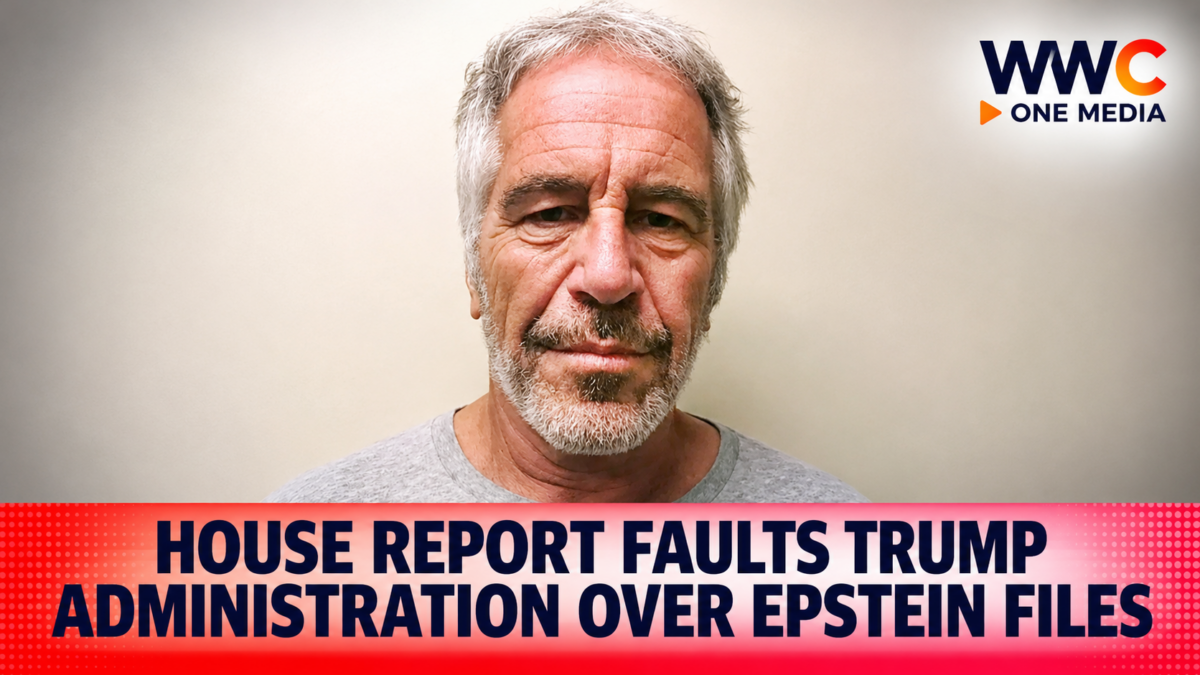
House Republicans Slam Trump’s DOJ Over Epstein Files — But One Major Finding Could Change the Political Fallout
WASHINGTON, November 10, 2026 — Nearly a year after Congress forced the federal government to release records connected to convicted sex offender Jeffrey Epstein, a Republican-led congressional investigation has delivered a damaging assessment of how the Trump administration handled the disclosure, raising fresh questions about government accountability, victim protection and the influence of powerful individuals.
In a 137-page report released Tuesday, the House Oversight Committee criticized the Justice Department for missing disclosure deadlines, providing inadequate communication about the release of records and failing to properly protect survivors whose personal information appeared in published documents.
The report also accused the government of applying inconsistent redactions, with some sensitive information belonging to survivors exposed while certain names connected to Epstein’s alleged criminal network remained concealed.
But the investigation produced another politically significant conclusion: Republican committee members said they found no documents implicating President Donald Trump in criminal activity connected to Epstein or his longtime associate Ghislaine Maxwell.
That conclusion, however, has not ended the controversy.
Democrats on the committee questioned the investigation’s completeness, arguing that additional documents, public hearings and further scrutiny of powerful individuals are still necessary.
The findings place the Epstein records controversy back at the center of Washington politics, with questions extending beyond the release of government documents to whether authorities adequately investigated one of the most notorious sexual abuse and trafficking cases in modern American history.
A 137-Page Congressional Report Reveals Serious Government Failures
The Republican-controlled House Oversight Committee released its report after a 15-month investigation examining the federal government’s handling of Epstein and Maxwell’s criminal investigations.
According to the committee, the inquiry included 19 transcribed witness interviews and depositions, reviews of Justice Department records, documents obtained from Epstein’s estate and an examination of financial records.
The investigation examined how Epstein maintained relationships with wealthy and influential individuals, how his criminal activities continued despite earlier warning signs and why federal authorities repeatedly failed to hold him accountable.
The committee concluded that government failures contributed to Epstein’s ability to continue abusing young women and girls.
One of its central criticisms involved the controversial non-prosecution agreement negotiated in 2007.
Instead of facing a federal prosecution at that time, Epstein received a deal that allowed him to plead guilty to state charges in Florida.
The arrangement became one of the most heavily criticized decisions in the history of the Epstein investigation because it allowed the wealthy financier to avoid broader federal charges.
The report argued that stronger federal action could have prevented additional crimes and delivered justice to survivors much earlier.
Trump’s Justice Department Faces Questions Over Missing Deadlines and Exposed Victims
The latest criticism also focuses on how the Trump administration handled the release of the Epstein files.
In 2025, Congress passed the Epstein Files Transparency Act, requiring the Justice Department to make covered government records relating to Epstein publicly available, subject to the law’s permitted protections.
President Trump signed the legislation.
The law followed growing public frustration over the government’s handling of the records and repeated demands for greater transparency.
However, the House Oversight Committee said the Justice Department’s implementation fell short of expectations.
The report identified several problems:
- Missed deadlines for releasing records.
- Inadequate communication about the disclosure process.
- Redactions that concealed information about alleged co-conspirators.
- Failure to properly remove survivors’ identifying information.
- Inconsistent treatment of sensitive information across released documents.
One particularly serious issue involved the exposure of survivors’ names and other personally identifiable information.
According to the report, lawyers representing some survivors identified thousands of potential redaction failures, with the identities of nearly 100 women reportedly exposed.
The committee criticized the Justice Department for failing to adequately protect people who had already suffered abuse.
The controversy highlights a difficult challenge for authorities: releasing information in the public interest while ensuring that victims are not exposed to further harm.
Transparency cannot come at the expense of survivor privacy.
More Than 3 Million Pages Were Released — But Questions Remain
The Justice Department released the bulk of the Epstein-related records in December 2025 and January 2026.
The disclosures included more than 3 million pages of documents, over 2,000 videos and approximately 180,000 images, according to the Associated Press.
The material included records involving Epstein’s prominent associates, financial relationships and communications with influential individuals across business, politics and entertainment.
Among the names and connections attracting public attention were former British royal Andrew Mountbatten-Windsor and billionaire entrepreneur Elon Musk.
However, appearing in documents, correspondence or photographs connected to Epstein does not, by itself, establish criminal wrongdoing.
The distinction is essential when interpreting the records.
The controversy also involves the way information was withheld or concealed.
The committee said some redactions were too broad and concealed names that lawmakers believed should have been disclosed.
One example involved an email referencing a so-called torture video. According to the committee’s review of an unredacted version, the recipient was Emirati businessman Sultan Ahmed bin Sulayem.
The report used the example to question whether the Justice Department consistently applied appropriate standards when deciding which information should remain confidential.
The wider issue is whether the government has fully complied with its legal disclosure obligations while protecting survivors.
What Did the Investigation Actually Find About Donald Trump?
Perhaps the most politically sensitive part of the report concerns President Donald Trump.
Trump’s past association with Epstein has remained a subject of public scrutiny, particularly because the two men moved in overlapping social circles before their relationship reportedly ended.
Democrats have repeatedly questioned whether the administration’s handling of the records provides sufficient transparency about powerful individuals connected to Epstein.
However, the Republican-led House Oversight Committee reached a specific conclusion concerning Trump.
The report stated that testimony from witnesses did not establish his involvement in Epstein and Maxwell’s criminal activities.
It also said the committee did not identify documents from its review of records belonging to Epstein’s estate, the U.S. Virgin Islands, JPMorgan, Deutsche Bank and the Justice Department that implicated Trump in criminal activity related to the case.
This is an important finding, but it should be understood accurately.
The committee’s conclusion reflects the evidence it reviewed during its investigation. It is not a judicial ruling, nor does it establish that every question concerning Epstein’s wider network has been answered.
Democratic lawmakers have also challenged the investigation’s scope and conclusions.
The report therefore creates a significant political divide: Republicans emphasize the absence of evidence implicating Trump in the materials they examined, while Democrats argue that the investigation must continue.
Democrats Challenge the Report and Promise Further Scrutiny
The committee’s top Democrat, Representative Robert Garcia, criticized the report and described the investigation as incomplete.
Garcia argued that the inquiry lacked public hearings and did not adequately address all outstanding questions involving powerful individuals who associated with Epstein.
He also raised concerns about documents that the Justice Department allegedly continues to withhold.
According to CBS News, Garcia said Democrats intend to continue investigating the matter after taking control of Congress in January 2027.
That transition could significantly change the political environment surrounding the Epstein investigation.
Following the November 3 midterm elections, Democrats secured control of both chambers of Congress, ending Republican control of the House and Senate.
With the incoming majority, Democratic lawmakers are expected to have greater opportunities to organize hearings, request records and conduct investigations into the administration.
However, congressional oversight does not automatically establish wrongdoing. Any new allegations will still require evidence and proper investigative procedures.
The Report Also Revisits Epstein’s Controversial Florida Plea Deal
Beyond the recent document-release controversy, the investigation examined how Epstein avoided federal prosecution following allegations involving underage girls in Florida.
The committee revisited the 2007 non-prosecution agreement approved by then-U.S. Attorney Alexander Acosta.
Under the arrangement, Epstein avoided federal prosecution in exchange for pleading guilty to state charges.
He received an 18-month jail sentence but was allowed extensive work-release privileges, enabling him to leave custody for up to 12 hours a day, six days a week.
The committee criticized the leniency of the arrangement, arguing that the privileges allowed Epstein to continue abusing women.
The report also raised questions about the responsibility of authorities who approved and supervised the arrangement.
Acosta later became Trump’s first-term labor secretary before resigning in 2019 amid renewed scrutiny of his role in the Epstein agreement.
The latest congressional findings reinforce long-standing concerns about how wealth, influence and institutional failures contributed to Epstein’s ability to avoid accountability for years.
Congress Wants the Justice Department to Reopen Questions Surrounding Epstein’s Associates
The House Oversight Committee did not simply criticize past investigations. It also recommended additional action.
Among its recommendations, the committee urged the Justice Department to:
- Interview or re-interview important witnesses who may possess additional information about Epstein’s activities.
- Further investigate allegations involving individuals connected to Epstein’s network.
- Establish a process allowing survivors and their representatives to access their personal records in unredacted form.
- Strengthen protections against conflicts of interest in federal investigations.
- Support legislation preventing nondisclosure agreements from being used to silence survivors of sexual abuse.
The report specifically identified Epstein’s former assistant Lesley Groff as someone whose potential knowledge and role should receive further scrutiny.
It also recommended further investigation of allegations raised by Sarah Kellen involving former Miami Beach Mayor Philip Levine and French celebrity hairstylist Frédéric Fekkai.
These are recommendations for further investigation, not findings that the individuals named have been convicted of or proven guilty of criminal conduct.
The Justice Department said it would continue following additional investigative leads relating to Epstein and encouraged survivors to contact the FBI.
The department also emphasized that the Epstein matter remains open.
Why the Epstein Investigation Could Become a Bigger Political Battle in 2027
The timing of the report is particularly significant.
Republicans released their findings just days after the November 3 midterm elections, which resulted in Democrats gaining control of both chambers of Congress.
The change in congressional leadership could create new opportunities for investigations into the Trump administration, including the Justice Department’s handling of sensitive government records.
For Democrats, the Epstein case presents an opportunity to demand greater accountability and examine how government institutions handled allegations involving powerful individuals.
For Republicans, the committee’s report provides an opportunity to highlight the administration’s stated transparency efforts and emphasize that its investigation found no evidence implicating Trump in Epstein-related criminal activity.
The political disagreement is likely to continue as lawmakers prepare for the next congressional session.
WWC One Media has previously examined the political consequences of the midterm results and the changing balance of power in Washington:
- Democrats Seize Control of US Congress in Historic Midterm Upset as Trump Accepts Defeat — How the incoming Democratic majority could reshape congressional oversight.
- Democrats Seize Congress as Hakeem Jeffries and Chuck Schumer Prepare to Confront Trump — The potential investigations and political priorities facing Democratic congressional leaders.
- Trump Loses Congress but Retains Power to Act Abroad — Why losing congressional control does not eliminate presidential authority.
- Trump Bans CNN, MS NOW and Politico From the White House — A closer look at the administration’s relationship with the press and broader questions about government accountability.
These developments illustrate how congressional control, government transparency and political oversight are becoming increasingly important issues as Washington prepares for 2027.
The Bigger Issue: Justice for Survivors or Another Political Fight?
For survivors of Epstein’s abuse, the latest congressional report raises a question that goes far beyond party politics.
For years, allegations involving Epstein were met with institutional failures, controversial legal agreements and inadequate protection for vulnerable women and girls.
The latest findings suggest that problems involving transparency and survivor privacy have continued even after Congress demanded the release of government records.
The report’s recommendations may create opportunities for further investigations, but their real value will depend on whether authorities act on credible evidence, protect survivors and hold responsible individuals accountable.
The political debate surrounding Trump and the Epstein files is likely to continue, particularly as Democrats prepare to assume congressional control.
Yet the central issue should remain the people who suffered abuse and the institutions that failed to protect them.
The release of millions of documents was supposed to bring greater transparency. Instead, the congressional report has exposed additional questions about how those records were handled.
And as a new Congress prepares to take over in January, one question remains: Will the next investigation finally deliver the accountability Epstein’s survivors have been waiting for, or will the controversy become another prolonged political battle in Washington?