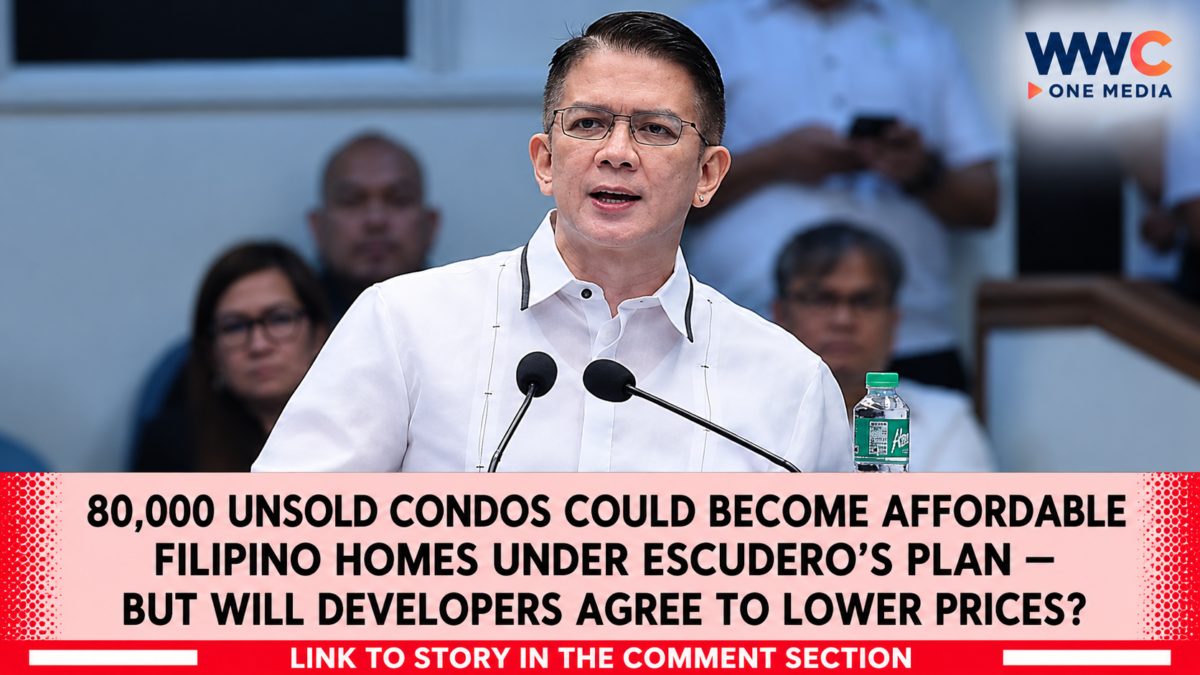
Senator Francis “Chiz” Escudero is pushing for a proposal that could turn thousands of unsold condominium units into affordable homes for Filipino families, highlighting a striking contradiction in the country’s property market: residential buildings with units waiting for buyers while millions of people continue to struggle to secure decent housing.
Escudero wants the government and private developers to explore integrating excess condominium inventory into the expanded Pambansang Pabahay para sa Pilipino (4PH) Program. The proposal could provide another route for qualified families to access existing residential units instead of relying entirely on newly constructed housing projects.
The issue gained attention after Colliers Philippines Research Director Joey Roi Bondoc cited an estimated 80,000 unsold condominium units in the National Capital Region during Escudero’s Chiz Wiz! podcast. Many of these properties were originally intended for the Philippine offshore gaming operator (POGO) market.
Escudero described the situation as a housing paradox: thousands of condominium units remain available while millions of Filipinos are still affected by the country’s housing backlog.
“Why build from scratch when there are already existing units that can be made available to our people?” he said, emphasizing the potential of public-private partnerships to make existing housing stock more productive.
The proposal could help address two problems at once: excess condominium inventory affecting property developers and the continuing difficulty ordinary Filipino households face in finding homes they can afford. However, the actual number of units that could qualify—and how much beneficiaries would have to pay—will depend on the program’s financing and eligibility rules. <Cite refs={[“turn251714search0″,”turn942106search2″,”turn942106search0”]} />
80,000 Unsold Condominiums Highlight the Philippines’ Housing Paradox
The estimated 80,000 unsold condominium units in Metro Manila represent a substantial amount of existing residential inventory.
According to Bondoc, many of these units were originally intended for the POGO industry, which once supported demand for condominium rentals in parts of the capital.
The contraction of that market, combined with weaker condominium demand and affordability pressures, has left developers facing a difficult inventory situation.
However, the 80,000 figure should not be interpreted as 80,000 completed and immediately available homes. Unsold inventory can include properties at different stages of development, and not every unit will necessarily meet the requirements of a government socialized-housing program.
Colliers has separately identified approximately 32,000 completed condominium units remaining unsold or idle, illustrating the scale of the challenge facing the industry.
BusinessMirror and other property-market reports have also highlighted the government’s effort to use Pag-IBIG financing to help developers sell existing condominium units, particularly properties priced at ₱3 million or below.
The proposed approach could make some strategically located properties available to qualified buyers at more accessible prices, provided developers are willing to adjust their selling prices and meet government standards. <Cite refs={[“turn942106search5″,”turn734427search1″,”turn251714search3”]} />
DHSUD Says Developers Can Already Enroll Excess Inventory Under 4PH
Department of Human Settlements and Urban Development (DHSUD) Undersecretary Marisol Anenias said the department already allows developers to enroll excess housing inventory under the 4PH Program.
However, participation may require property companies to accept lower profit margins or absorb losses to bring units within the program’s affordability requirements.
This is one of the biggest obstacles to turning the proposal into actual housing opportunities.
Developers originally priced their condominiums according to construction expenses, land values, financing costs and expected market demand. Converting some of those properties into socialized housing could require significant adjustments to selling prices and business arrangements.
Escudero is therefore encouraging policymakers to examine financing mechanisms, subsidies and longer repayment periods that could make the units affordable without making participation commercially impractical for developers.
The proposal is not simply about transferring unsold condominiums to the government. It requires a workable agreement between property companies, housing agencies, financing institutions and qualified beneficiaries.
Senate Bill No. 2571 Could Give Developers Another Way to Use Unsold Units
Escudero has also filed Senate Bill No. 2571, which seeks to expand compliance options for developers under the Urban Development and Housing Act of 1992.
The proposed measure would allow developers to convert eligible ready-for-occupancy condominium units into accredited socialized-housing units, provided they meet DHSUD price ceilings and development standards.
Once accredited, qualifying units could be credited toward existing or future balanced-housing obligations.
This could create an additional incentive for developers to make suitable completed properties available to the government’s affordable-housing initiatives.
The measure is particularly relevant because the existing balanced-housing framework requires developers of certain subdivision and condominium projects to comply with socialized-housing obligations. Republic Act No. 10884 sets the applicable requirements, including a minimum five-percent condominium project-area or project-cost obligation, subject to the law’s provisions.
Escudero is also backing Senate Bill No. 1992, which seeks to strengthen the government’s capacity to acquire land for socialized housing. According to the reports on his proposal, the measure has passed third reading in the Senate.
These initiatives point to a broader legislative effort to improve housing access, although the proposed changes must still go through the applicable legislative and implementation processes. <Cite refs={[“turn251714search0″,”turn734427search4”]} />
Government Already Preparing a Pag-IBIG Financing Route for Unsold Condos
Escudero’s proposal comes as the DHSUD and Pag-IBIG Fund are developing additional financing options under the Expanded 4PH Program.
In September, DHSUD Secretary Jose Ramon Aliling announced a planned program modality that would allow qualified buyers to purchase selected existing condominium units priced at ₱3 million or below using Pag-IBIG housing loans.
The initiative is intended to help developers move existing inventory while giving Filipino homebuyers more choices in accessible urban locations.
The proposed arrangement could be particularly important for families who want to live closer to workplaces, schools, hospitals and public transportation.
The government has also encouraged major developers to participate in its housing initiatives. According to Colliers, partnerships involving property companies and government-backed financing could help absorb unsold inventory while improving access to homeownership.
However, the September announcement said formal implementation guidelines were still being prepared. Buyers should therefore verify the latest program rules, participating projects, prices and eligibility requirements before assuming a particular condominium is already available through the scheme. <Cite refs={[“turn734427search2″,”turn942106search5″,”turn251714search6”]} />
Pag-IBIG’s 3% Housing Loan Could Help Qualified Low-Income Families
The Expanded 4PH Program is designed to make socialized housing more accessible through government support and Pag-IBIG financing.
According to the Philippine News Agency, Pag-IBIG released ₱12.10 billion in financing for 10,904 socialized-housing units in 2026, compared with 3,987 units financed in 2025.
The number of financed units increased by 173 percent, while the program’s share of Pag-IBIG’s total housing financing also expanded.
Qualified buyers of eligible socialized-housing units can access a subsidized annual interest rate of 3 percent, subject to program requirements.
This is an important distinction: the 3-percent rate is not automatically available for every condominium or every Pag-IBIG borrower. The property and applicant must meet the applicable socialized-housing and financing criteria.
For families considering homeownership, the affordability test goes beyond the advertised interest rate. Monthly amortization, down payment, income requirements, insurance, taxes, association dues and other costs must also be considered. <Cite refs={[“turn176727search6″,”turn191897search0”]} />
Escudero Says Affordable Housing Must Include More Than Just Building Units
Escudero stressed that the housing problem cannot be solved simply by increasing the number of available properties.
For many families, the bigger obstacle is whether they can realistically afford monthly payments over an extended period.
He urged policymakers to explore improved financing arrangements, subsidies and longer repayment periods to reduce the cost of homeownership.
He also called for more affordable rental housing for families that are not yet financially prepared to purchase a property.
Another part of his proposal involves improving mass transportation so Filipinos can live outside major urban centers without losing convenient access to employment opportunities.
This is significant because housing affordability is closely connected to location. A relatively inexpensive home can become financially burdensome if residents must spend substantial amounts on transportation to reach their workplaces.
The senator’s approach therefore combines existing housing inventory, financing support, rental options and transport improvements rather than treating construction alone as the solution.
WWC ONE MEDIA Reports on the Growing Housing Affordability Challenge
The proposal comes amid mounting pressure on the Philippine condominium market, where unsold inventory, buyer cancellations and financing difficulties have become major concerns.
WWC ONE MEDIA has previously reported on several developments connected to the issue:
- 9,000 Metro Manila Condo Purchases Cancelled as Unsold Inventory Hits 82,900 Units — Examines cancelled purchases, unsold inventory and affordability pressures.
- Pag-IBIG Brings 20,000 Homes to Davao With 3% Housing Loans and 30% Discounts — Explains housing options and financing offers presented at the Mindanao Housing Fair.
- Pag-IBIG and SMDC Open More Homes to Filipino Buyers Through Expanded Financing — Looks at the partnership between Pag-IBIG Fund and SMDC.
- Robinsons Land Opens More Homes to Pag-IBIG Financing — Examines how another major developer is expanding access to government-backed housing loans.
Together, these developments show why the government is looking for ways to connect existing residential supply with households that need affordable housing.
Can Unsold Condominiums Really Solve the Housing Backlog?
Escudero’s proposal offers a potentially faster way to make use of existing residential buildings, but its success will depend on whether the units can be made genuinely affordable.
The first challenge is pricing. Developers may need to reduce selling prices to meet socialized-housing ceilings, while government agencies must ensure that the resulting units remain financially viable and meet required standards.
The second challenge is accessibility. Some condominiums may be located near employment centers and public transportation, while others may not be suitable for the needs or budgets of intended beneficiaries.
The third challenge is financing. Even with lower interest rates and longer repayment periods, families must have sufficient and stable income to sustain their housing payments.
Finally, the government must establish transparent rules for selecting properties, evaluating beneficiaries and monitoring the long-term use of units.
The estimated 80,000 unsold condominiums represent a significant opportunity, but they are not automatically 80,000 affordable homes ready for distribution.
The real measure of success will be how many suitable units can be converted into homes that Filipino families can actually afford to purchase or rent.
For Escudero, the goal is to make better use of properties that already exist while addressing a housing shortage that continues to affect millions. Whether the government and developers can turn that proposal into a large-scale solution will depend on the details still to be worked out—and whether affordability finally becomes the deciding factor in the country’s housing strategy.