MANILA, PHILIPPINES — November 11, 2026 — Filipino consumers are sending a warning to the country’s biggest businesses: expensive products, confusing prices and unexpected charges are eroding public confidence, and even the most established corporate brands can no longer assume that customers trust them.
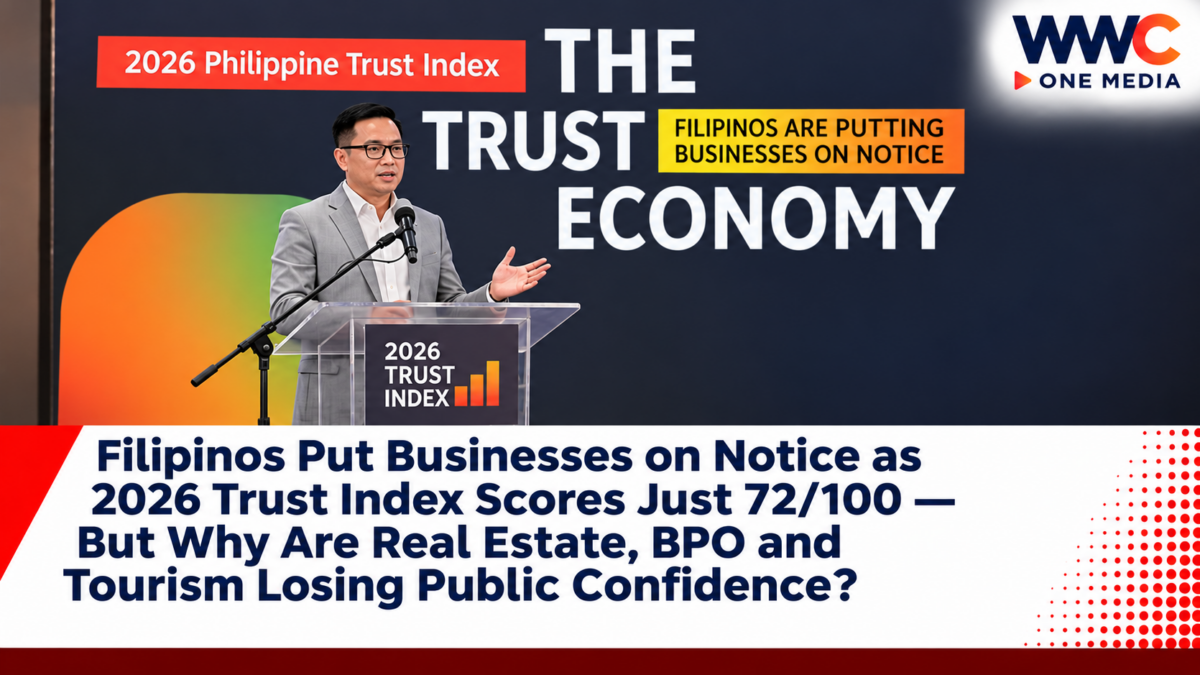
A new nationwide study by EON Group and Ateneo de Manila University found that Philippine businesses received an overall trust score of just 72 out of 100, placing them in a category described as Conditional Trust.
More troubling, none of the nine industries examined reached the study’s highest category, Robust Trust.
The results reveal a growing divide between commercial success and public confidence.
Among respondents who identified an industry they trusted least, 19.7% cited excessively high or unreasonable prices, while 14.7% pointed to unclear fees and another 11.7% complained about hidden charges.
The findings arrive as Philippine inflation reached 7.8% in October 2026, intensifying pressure on household budgets.
Real estate and construction received the lowest industry trust score at 67.7, while business process outsourcing, information and communications technology, and tourism and travel also struggled.
Even food, healthcare and retail—the sectors that performed comparatively better—failed to achieve a robust rating.
The study raises a difficult question for corporate Philippines: Are customers remaining loyal because businesses deserve their trust, or simply because consumers have few alternatives?
Philippine Business Trust Index Reveals Fragile Consumer Confidence
The findings come from the 2026 Philippine Trust Study, released on November 9.
The research was commissioned by EON The Stakeholder Relations Group and developed with Ateneo de Manila University’s Department of Sociology and Anthropology and Institute of Philippine Culture.
The study introduced the Philippine Business Trust Index as a benchmark for evaluating public confidence across major industries.
Its overall score of 72 out of 100 placed Philippine businesses in the Conditional Trust category.
That means respondents generally expressed a degree of confidence in businesses, but that confidence remains dependent on their experiences and perceptions.
The result should not be interpreted as meaning that only 72% of Filipinos trust businesses.
It is an index score generated using the study’s measurement framework.
Nor does it mean that every business in the Philippines is dishonest or unreliable.
Instead, it suggests that consumers evaluate trust through factors such as fair pricing, product quality, truthful communication and consistent service.
For companies, the message is significant.
Brand recognition, advertising budgets and market dominance are not enough to guarantee lasting customer confidence.
High Prices Become the Biggest Reported Reason for Distrust
The study identified pricing as a major source of dissatisfaction.
Among respondents who named a least-trusted sector, 19.7% identified excessive or unreasonable prices as a reason for distrust.
Another 14.7% cited unclear prices, charges or fees.
Meanwhile, 11.7% pointed to hidden or unexpected charges.
An additional 14.4% cited dishonest or insufficiently transparent transactions.
The numbers show that customers are concerned about more than how much they spend.
They also want to know whether businesses are communicating the full cost of products and services before a purchase is completed.
A customer may accept a higher price when the quality and terms are clear.
But an unexpected surcharge or misleading promotional offer can undermine confidence even when the total amount is relatively small.
For businesses, the issue is not simply whether they are charging the lowest possible price.
It is whether customers believe the price is fair, transparent and justified by the value received.
Importantly, the percentages come from the subset of respondents who identified a least-trusted sector. They are not percentages of all Filipino adults.
Inflation at 7.8% Makes Every Peso Matter
The survey’s findings become more consequential against the Philippines’ difficult economic backdrop.
The Philippine Statistics Authority reported that headline inflation reached 7.8% in October 2026.
Higher costs for food, transportation, utilities and other everyday expenses have placed significant pressure on household purchasing power.
When essential goods consume a larger share of income, consumers may become more sensitive to price increases and additional fees.
Businesses also face higher costs for fuel, logistics, labor and supplies.
These pressures can make pricing decisions more complicated.
In related reporting, WWC ONE MEDIA examined the growing risk of a broader inflation wave driven by food, fuel and labor costs.
That economic context helps explain why pricing has become such an important trust issue.
However, the trust survey was conducted between May and August 2026, before the October inflation figure was published.
The study therefore does not establish that October’s 7.8% inflation rate caused the reported distrust.
Instead, the inflation figure provides relevant context for the financial pressures confronting consumers.
Real Estate and Construction Rank Lowest
Among the nine sectors surveyed, real estate and construction recorded the weakest trust score at 67.7.
The result placed the industry in the study’s Fragile Trust category.
The concerns identified in qualitative discussions included delayed property turnovers and promises that did not consistently match customers’ experiences.
Property transactions often involve substantial financial commitments.
Buyers may spend years saving for a down payment before taking on mortgage obligations lasting decades.
When a project faces delays or buyers encounter conditions they did not anticipate, dissatisfaction can become especially serious.
But the survey does not establish that all developers engage in misleading practices.
It reflects respondents’ perceptions of the sector as a whole.
The finding is nevertheless significant at a time when some Philippine residential markets are experiencing weak demand and substantial unsold inventory.
As WWC ONE MEDIA reported in its examination of approximately 9,000 cancelled Metro Manila condominium purchases and an inventory of 82,900 unsold units, developers face challenges involving financing, purchase cancellations and changing buyer expectations.
Those market statistics come from separate property research and cannot be treated as causes established by the EON survey.
Together, however, the reports emphasize the importance of transparent terms, realistic delivery schedules and effective communication with homebuyers.
BPO and Technology Companies Also Struggle With Trust
The business process outsourcing and information and communications technology sector received a score of 68.6.
That placed it below the study’s threshold for Conditional Trust.
The result is important because BPO and technology services are major contributors to Philippine employment and economic activity.
Consumers and businesses increasingly depend on technology providers for communications, payments, customer support and digital services.
But greater reliance on technology does not automatically produce greater confidence.
The survey’s qualitative findings raised concerns about difficult customer-service experiences, including situations involving complicated automated support systems.
When customers cannot quickly reach someone who can resolve a problem, frustration can grow.
Digital platforms may be efficient, but they still require clear complaint procedures and accountable service delivery.
This is particularly relevant as companies expand their use of artificial intelligence.
Automation can improve response times and lower operating costs.
But if it creates obstacles for customers seeking assistance, the resulting experience may damage trust.
For the technology industry, the challenge is balancing efficiency with human accountability.
Tourism and Travel Face Similar Consumer Concerns
Tourism and travel also scored 68.6, matching the BPO and ICT category.
The study identified issues involving unexpected cancellation charges, peak-season prices and service expectations.
Travel customers often make reservations weeks or months in advance.
They may need to compare hotel rates, airfare, transfer costs and cancellation conditions.
Complicated terms can make those decisions difficult.
An advertised hotel rate may appear attractive until additional charges become clear.
A customer may also discover that a discounted booking carries restrictive cancellation terms.
Not every additional fee is inappropriate or hidden.
Businesses may have legitimate costs and contractual conditions.
However, clearly communicating those terms before customers commit is essential.
For Philippine tourism businesses, improving trust may involve presenting total prices more clearly, explaining refund policies and responding promptly to complaints.
A destination’s attractiveness alone may not be enough to retain visitors if the booking or service experience repeatedly falls short of expectations.
Even Fintech and Manufacturing Remain Under Scrutiny
Financial technology received a trust score of 70.8.
Manufacturing scored 70.9.
Both remained within the study’s Conditional Trust category, close to the threshold separating it from Fragile Trust.
These industries play important roles in daily economic activity.
Digital financial platforms support payments, transfers and other services.
Manufacturers provide food, household goods, clothing, construction materials and industrial products.
For fintech companies, transparent fees, reliable transactions, privacy and accessible customer support can be important elements of trust.
For manufacturers, consistency, safety, quality and accurate product claims matter.
The findings do not demonstrate that particular companies in these industries committed violations.
They instead indicate that consumers’ confidence remains conditional on how businesses perform.
Food, Healthcare and Retail Lead — But Still Fail to Reach Robust Trust
The highest-scoring industries were those associated with frequently used goods and services.
Food and agriculture received a score of 75.6.
Healthcare and pharmaceuticals followed at 75.4.
Commerce, e-commerce and retail recorded 75.0.
These were the strongest results among the nine sectors.
However, none crossed the Robust Trust threshold of 81.
That distinction is important.
The top-performing sectors demonstrated relatively stronger confidence, not universal consumer satisfaction.
Food and agricultural businesses are closely connected to basic household needs.
Healthcare providers and pharmaceutical companies play important roles in personal well-being.
Retailers influence how consumers access everyday goods.
For businesses in these sectors, trust may depend on consistency as much as price.
Customers may value reliable quality, accurate information, product safety and fair treatment.
A company can have a well-known brand while still losing confidence if its products or services repeatedly fail to meet expectations.
Discount Groceries Show Why Value for Money Is Becoming Critical
The study found that value for money was a recurring reason people trusted their preferred industries.
This helps explain the increasing relevance of retailers that emphasize affordable everyday products.
In the Philippines, discount grocery chain O!Save recently celebrated its 1,000th store.
Its expansion has been associated with a retail model centered on smaller outlets, limited product assortments and lower operating costs.
As WWC ONE MEDIA examined in its coverage of O!Save’s rapid nationwide expansion amid 7.8% inflation, value-focused shopping is becoming increasingly relevant to Filipino households.
The EON study did not rank O!Save or establish that discount retailers are inherently more trustworthy.
But the wider market trend illustrates why affordability and perceived value can influence shopping decisions.
Consumers may become more willing to try alternative stores when they believe existing retailers are charging too much.
That creates competitive pressure for companies to explain and justify their prices.
Honesty Beats Corporate Reputation
One of the study’s most revealing findings concerns the qualities Filipinos associate with trustworthy businesses.
Honesty emerged as the leading attribute among 16 characteristics examined.
Approximately 34.6% of respondents placed honesty first.
Product and service quality followed, along with competence, interpersonal trust, genuine care, accountability and transparency.
Traditional corporate reputation ranked at the bottom.
InsiderPH reported that only 6.8% cited reputation as a reason for trusting their most-trusted sector.
This suggests that a recognizable name does not necessarily outweigh direct customer experience.
A company’s history or public image may initially attract attention.
But trust is reinforced when products perform as promised, employees treat customers fairly and businesses disclose relevant information honestly.
The finding presents a challenge to organizations that invest heavily in advertising while overlooking customer complaints.
A polished marketing campaign can create awareness.
It cannot substitute for reliable service.
Big Businesses Have Almost No Trust Advantage Over Small Enterprises
The study also compared confidence in large corporations with that in micro, small and medium enterprises.
Large businesses received a score of 72.3.
MSMEs scored 71.7.
The difference was just 0.6 points.
That narrow gap indicates that company size alone does not establish significantly stronger public confidence.
Large corporations may have extensive distribution networks, bigger budgets and recognizable brands.
Small businesses may have closer customer relationships and a stronger presence within their communities.
But neither size nor familiarity guarantees trust.
Consumers can judge both types of businesses by similar standards.
They want products that work, transparent charges and promises that are fulfilled.
For MSMEs, the findings suggest that competing against larger companies does not necessarily require matching their advertising expenditure.
Consistent service, honest communication and fair treatment can also contribute to customer loyalty.
The Visayas and Mindanao Show a Striking Trust Gap
The EON study also identified regional differences.
The Visayas recorded a business trust score of 82.5.
Mindanao recorded 63.3.
The gap was substantial.
However, these scores should not be interpreted as proof that businesses in the Visayas are objectively more ethical than those in Mindanao.
Regional trust scores reflect respondents’ perceptions and experiences.
Differences could involve economic conditions, accessibility, service expectations or other factors requiring further investigation.
The study does not independently establish what caused the regional gap.
The finding nevertheless suggests that national businesses should avoid assuming customers experience their products and services in identical ways across the country.
A pricing model or service arrangement that works well in one market may create frustration elsewhere.
Companies operating nationwide should pay attention to regional customer feedback and the availability of alternatives.
Younger and Older Filipinos Judge Businesses Differently
The study found that age also shapes expectations.
Respondents aged 18 to 34 tended to place greater weight on product quality, execution and consistency.
Consumers aged 35 to 54 emphasized reciprocity, genuine care and two-way relationships.
Adults aged 55 to 74 were more likely to prioritize lawfulness, integrity and institutional responsibility.
These differences indicate that trust is not built through a single marketing formula.
Younger customers may be especially attentive to whether products perform as advertised.
Middle-aged consumers may value reliable service and responsive relationships.
Older consumers may place stronger emphasis on lawful conduct and institutional responsibility.
These are broad survey patterns rather than fixed characteristics of every individual within an age group.
Nevertheless, they suggest companies should consider both practical customer experiences and broader standards of corporate conduct.
Are Filipinos Staying With Businesses They Don’t Trust?
Perhaps the most provocative finding concerns what researchers described as compelled patronage.
Qualitative discussions suggested that some consumers continue buying from businesses they do not fully trust because alternatives are limited or switching providers is difficult.
This can happen in industries where customers face long contracts, high cancellation costs, geographic limitations or few competing service providers.
A household may be dissatisfied with a service but lack a practical replacement.
A property buyer may have already committed substantial funds to a development.
A consumer may continue using a digital service because moving to another provider would be inconvenient.
These situations complicate traditional assumptions about customer loyalty.
Repeat business does not necessarily prove satisfaction.
High customer retention can reflect genuine confidence, but it may also reflect barriers to switching.
For companies, that raises an uncomfortable question: Are their customers choosing them freely, or staying because leaving is too difficult?
How the Economic Slowdown Could Intensify the Trust Problem
The survey findings coincide with weakening Philippine economic growth.
Gross domestic product expanded by only 2.1% year on year in the third quarter of 2026.
Slower economic growth and high inflation create a difficult combination for households.
Consumers may limit discretionary spending, delay major purchases or become more selective about where they shop.
Businesses may simultaneously face weaker demand and higher operating expenses.
As WWC ONE MEDIA reported in its analysis of the Philippine economy’s 2.1% growth and rising inflation, the country is experiencing pressure from slowing activity and elevated consumer prices.
Such conditions can make the perceived fairness of business practices even more important.
But the economic slowdown does not prove that businesses have deliberately overcharged consumers.
A firm’s prices may rise because its own costs have increased.
The trust question concerns whether customers understand those changes and believe the business is treating them fairly.
Consumer Protection and Transparent Pricing Become More Important
The study also highlights the importance of existing consumer protection rules.
Under Philippine consumer protection laws, businesses face obligations concerning fair dealings, accurate product information and prohibited deceptive practices.
However, the precise legal requirements vary depending on the product, service and regulatory framework.
A high price is not automatically illegal.
Nor is every fee improper.
The concern arises when prices are misrepresented, charges are inadequately disclosed or businesses make misleading claims.
For consumers, comparing full prices and reviewing transaction terms can help reduce unpleasant surprises.
For companies, clearly disclosing charges before a purchase may prevent disputes.
The Department of Trade and Industry has also been working with businesses to manage prices of basic necessities amid the country’s challenging inflation environment.
As WWC ONE MEDIA examined in its coverage of government efforts to stabilize essential commodity prices ahead of the holiday season, pricing policies and consumer protection have become particularly important as household budgets tighten.
But the EON survey’s central message extends beyond regulatory compliance.
Businesses also need to demonstrate fairness and consistency in their everyday interactions with customers.
What Philippine Companies Should Do to Rebuild Trust
The study offers several practical lessons for corporate leaders.
First, businesses should make prices and additional fees understandable before customers commit to a purchase.
Second, they should ensure that advertising claims are supported by actual product and service performance.
Third, complaint systems need to be accessible, including when customers encounter complicated problems.
Fourth, companies should consider whether cancellation policies and service conditions are reasonable and clearly communicated.
Fifth, organizations should measure consumer trust independently from sales and customer retention.
Finally, businesses need to recognize that internal organizational behavior can affect public confidence.
Focus group discussions in the EON study included employee concerns involving broken management promises and insufficient workplace transparency.
A business that communicates poorly with its own workforce may face difficulties sustaining a culture of accountability.
These recommendations do not guarantee higher trust scores, but they address several of the issues identified by survey participants.
Understanding the Study’s Limitations
The 2026 Philippine Trust Study surveyed 800 Filipino adults across 160 barangays in 84 cities and municipalities.
Fieldwork took place from May to August 2026.
The research also included 82 focus group participants and 18 key informant interviews.
The reported margin of error for survey percentages was approximately plus or minus 3.5 percentage points.
Of the 800 surveyed adults, 53.1% did not identify a least-trusted industry.
The remaining 46.9%, or 375 respondents, did identify one.
That distinction is essential when reporting reasons for distrust.
The 19.7% citing unreasonable prices refers to respondents within the group who identified a least-trusted sector—not 19.7% of the entire Philippine population.
The study measures reported perceptions and attitudes.
It does not constitute an audit of the financial practices or legal compliance of every company in the country.
Nor does it establish that specific industries have engaged in systematic wrongdoing.
These limitations do not diminish the findings, but they are important for interpreting them accurately.
The Bigger Picture: Philippine Businesses Are Being Asked to Earn Trust Every Day
The 2026 Philippine Business Trust Index reveals that public confidence is not as secure as many corporate leaders might assume.
The country’s overall business trust score stood at 72 out of 100.
No surveyed industry achieved Robust Trust.
High prices, unclear charges and hidden fees emerged as leading sources of dissatisfaction among respondents who identified a least-trusted sector.
Real estate and construction scored lowest.
BPO, technology and tourism also faced comparatively fragile confidence.
Even food, healthcare and retail—the highest-ranked industries—remained below the study’s strongest trust threshold.
The findings suggest that Filipinos value honest communication, quality products and fair treatment more than brand prestige alone.
They also highlight a difficult reality: some customers may continue dealing with businesses they distrust because they lack practical alternatives.
For companies, that is not a foundation for sustainable customer loyalty.
It is a warning.
In an economy struggling with high prices and slow growth, consumers are becoming increasingly sensitive to what they receive in exchange for their money.
Businesses that communicate clearly and deliver consistently may be better positioned to retain confidence.
Those relying on customer inertia, unclear pricing or reputation alone could face greater scrutiny.
Filipino businesses have received a conditional vote of confidence, but none of the country’s nine major surveyed industries achieved a robust trust rating. As high prices and hidden charges continue troubling consumers, will corporate Philippines finally change the way it treats customers—or will businesses discover that the loyalty they counted on was never really trust at all?