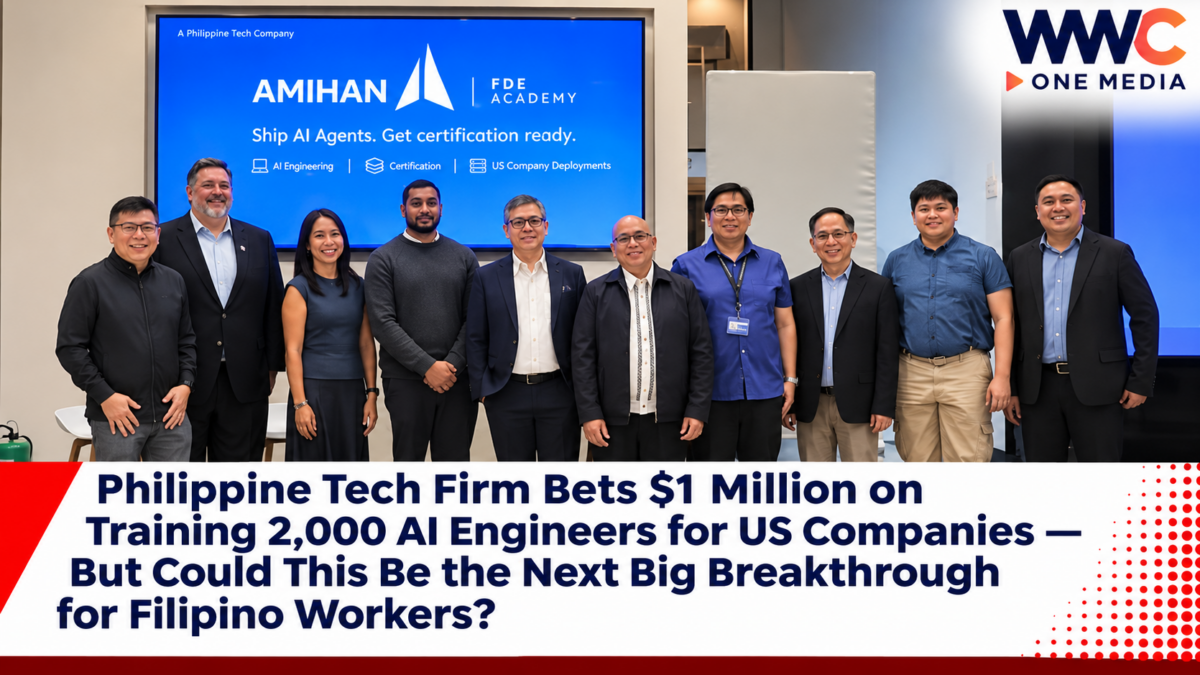
MANILA, PHILIPPINES — November 11, 2026 — The Philippines could be preparing for a major shift in its technology workforce as local firm Amihan Global Strategies commits approximately $1 million to an artificial intelligence engineering academy, aiming to train Filipino professionals for specialized work sought by companies around the world.
The ambitious initiative comes as artificial intelligence transforms traditional business process outsourcing, creates demand for new technical skills and forces employers to rethink how their organizations operate.
Amihan, led by Filipino technology entrepreneur Winston Damarillo, has launched its Forward Deployed Engineer (FDE) Academy in Makati City to develop engineers capable of turning powerful AI models into functioning business systems.
The company currently reports approximately 50 trained and certified engineers, including 22 prompt engineers, and is targeting 100 trained engineers by the end of 2026.
Its longer-term ambition is considerably larger: to help build a Philippine talent pool of 1,000 to 2,000 forward-deployed engineers through partnerships with universities, technology providers and government institutions.
The United States is expected to be a primary overseas market.
But as global companies race to integrate AI into everyday operations, an important question is emerging.
Can the Philippines move beyond conventional outsourcing and become a major supplier of the engineers who actually build and deploy the next generation of AI-powered businesses?
Amihan Puts $1 Million Behind a New AI Talent Pipeline
Amihan formally unveiled its Forward Deployed Engineer Academy on November 5, 2026, in Makati City.
The company says its planned $1-million investment will support curriculum development, research, engineering resources and training by professionals with practical experience deploying AI systems.
Damarillo explained that the initiative is intended to create skills that are useful not only within Amihan but also throughout the wider Philippine technology industry.
The company does not expect all its future engineers to be trained or employed exclusively by Amihan.
Instead, its longer-term goal is to work with academic institutions and industry partners to expand the number of qualified specialists available nationally.
The distinction matters.
The 1,000-to-2,000-engineer figure is an ambition for a broader talent ecosystem, not an announced number of guaranteed academy graduates or job placements.
Amihan’s immediate target is to increase its existing trained engineering pool to approximately 100 by year-end.
What Is a Forward-Deployed Engineer?
Forward-deployed engineers are technical specialists who work closely with businesses to develop and integrate software or AI systems into actual operations.
Unlike professionals who focus exclusively on building software products for general use, FDEs often work directly with organizations to understand their problems and design solutions for specific workflows.
For example, a bank may want an AI system that helps employees retrieve internal policy information securely.
A telecommunications company might need an automated assistant that supports customer-service representatives while using existing enterprise databases.
A logistics business could seek tools that analyze documents, identify operational issues or help employees coordinate complicated processes.
In each situation, the engineering challenge extends beyond writing a prompt for an AI chatbot.
A functioning system must be able to interact with relevant software, handle authorized data, respect access controls and provide dependable results.
That is the type of work Amihan wants Filipino engineers to perform.
The Academy Is Teaching Engineers to Build AI Agents
Amihan’s training program focuses heavily on agentic artificial intelligence.
An AI agent is a software system that can use AI models and connected tools to carry out defined tasks, sometimes across multiple steps.
Unlike a conventional chatbot that mainly responds to questions, an agent may be designed to retrieve information, interact with business software or perform approved workflow actions.
But practical deployment introduces new risks.
Organizations must decide what data an AI system can access, which actions require human approval and how errors will be detected.
They also need to consider cybersecurity, privacy, reliability and ongoing maintenance.
Amihan says the academy teaches engineers to integrate AI into production systems while incorporating governance from the beginning.
Participants work with technologies associated with Anthropic’s Claude, Amazon Web Services, SpaceX Super Intelligence and Nous Research’s Hermes Agent.
The company also emphasizes comparing different platforms rather than assuming a single technology provider will be suitable for every business problem.
The objective is to produce engineers who can build systems that operate reliably, not merely demonstrate impressive AI prototypes.
Anthropic and AWS Technologies Support the Training Program
According to Amihan’s official launch announcement, the academy draws on technologies from several international AI companies.
Anthropic’s Claude models are among the tools participants will learn to use when developing AI agents.
Amazon Web Services provides cloud infrastructure and services for building and operating enterprise applications.
Other engineering tools support development workflows, testing and integration.
Amihan identifies itself as a member of the Anthropic Claude Partner Network, an established AWS partner and a SpaceX Super Intelligence Transformation Partner.
These relationships provide a technology foundation for the academy.
However, participation in a partner network is not the same as a guarantee that a trainee will receive a job from Anthropic, AWS or another technology company.
Likewise, an academy-issued credential should not be assumed to be an official certification independently granted by every technology provider involved.
Prospective participants should check the precise certification terms and opportunities offered by the program.
AI Engineering Training Is Priced at ₱50,000 Per Participant
Amihan’s published academy information lists a standard training price of ₱50,000 per participant, excluding value-added tax.
The academy also offers team-based enrollment arrangements.
Its listed options include a five-person core-team package priced at ₱250,000 and an enterprise cohort of 20 participants priced at ₱1 million, both excluding VAT.
The training package includes four sessions, practical laboratory exercises, instructional materials and preparation for the Amihan Certified FDE Level 1 credential.
The company says certified FDE instructors lead the sessions.
According to The Philippine Star, the program’s first sessions are scheduled to begin on November 24.
The inaugural cohort is invitation-only and intended for selected enterprise clients and partners, while applications for later cohorts are being accepted.
Importantly, the announced $1-million investment is the company’s planned expenditure on developing the academy, not a scholarship fund guaranteeing free places for 2,000 people.
Amihan’s website also provides a scholarship application option, but eligibility, available places and funding arrangements should be confirmed directly with the provider.
For interested engineers and employers, complete program information is available at https://www.amihan.net/academy/.
Why the United States Is Amihan’s Primary Target Market
A major part of the academy’s strategy involves international demand for engineers who can turn AI technology into useful business applications.
Damarillo believes the United States offers particularly strong opportunities for this specialized work.
American companies are investing heavily in AI, but purchasing advanced models does not automatically allow them to integrate the technology successfully.
Organizations still need professionals who understand their existing software, internal processes and compliance requirements.
Amihan hopes Filipino engineers can compete for those assignments.
During the academy launch, Damarillo cited estimates of the limited number of forward-deployed engineers currently available in the United States.
However, different news reports quoted different figures for the existing American workforce.
The specific size of the US FDE workforce therefore should not be treated as independently established.
What is clear is that Amihan sees a commercial opportunity in offering specialized AI engineering services to international clients.
The initiative also does not necessarily mean that Filipino graduates will relocate to the United States.
Work could potentially be delivered from the Philippines, on-site with clients or through other arrangements, depending on employer requirements.
No guarantee of overseas deployment has been announced.
Could This Transform the Philippine BPO Industry?
For decades, the Philippines has built a major international services industry around customer support, administrative processing, financial operations and other outsourced business functions.
Artificial intelligence is now changing the economics of many of those activities.
AI tools can handle some repetitive inquiries, organize documents, summarize information and assist with standardized workflows.
This creates productivity opportunities for employers, but it can also reduce demand for some traditional tasks.
Amihan wants to position Filipino professionals for more technically complex work.
Instead of relying solely on conventional service delivery, the country could expand its role in building and maintaining the AI systems businesses increasingly use.
The transition would require stronger engineering, cybersecurity, data management and integration skills.
In related reporting, WWC ONE MEDIA examined how a major Philippine BPO employer began teaching applicants AI skills before hiring them.
That initiative focuses on basic workplace AI readiness, while Amihan is developing a more specialized engineering pathway.
Both reflect the same trend: Philippine workers may increasingly need the ability to use, supervise or build AI systems rather than perform only tasks that can be automated.
The AI Skills Race Comes as Philippine Outsourcing Jobs Evolve
The wider Philippine IT-BPM industry remains economically important, but its workforce requirements are changing.
Companies increasingly need employees who can manage automation, analyze information, supervise AI-assisted operations and solve complex customer or business problems.
Industry projections also suggest that revenue growth may increasingly outpace employment growth as productivity improves.
As WWC ONE MEDIA reported on the Philippine IT-BPM sector’s projected expansion toward nearly $45 billion in annual revenue in 2027, the industry is seeking higher-value services even as automation influences traditional employment patterns.
Amihan’s initiative fits into that effort.
But the existence of new AI engineering roles does not automatically mean all traditional outsourcing workers can move into them.
Forward-deployed engineering requires technical skills that may take substantial time and resources to develop.
A worker with a customer-service background may require additional preparation in programming, cloud systems, data architecture and security.
The transition will therefore depend on accessible training pathways, employer support and realistic job opportunities.
DOST-ASTI Joins the Initiative to Train Government Researchers
The academy is also expanding beyond private-sector businesses.
Amihan has signed a training agreement with the Department of Science and Technology’s Advanced Science and Technology Institute, or DOST-ASTI.
The arrangement is intended to help scientists and engineers strengthen their understanding of AI and its practical application.
DOST-ASTI Director Franz de Leon emphasized the importance of continuously improving local technical capabilities so Filipino researchers can develop technologies suited to national needs.
The partnership could help public-sector specialists evaluate the use of AI in research, government systems and other technical applications.
However, the training agreement should not be confused with a nationwide government certification requirement or an announced program covering every public agency.
Its initial scope concerns the agreed training activities involving DOST-ASTI personnel.
The development is especially relevant because public-sector AI adoption can be constrained by technical capacity as well as infrastructure.
Government AI Readiness Remains a Serious Challenge
Research from the Philippine Institute for Development Studies has identified significant gaps in AI readiness across local governments.
The study highlighted challenges involving technical skills, digital infrastructure, internet connectivity and funding.
As WWC ONE MEDIA reported on the low AI-readiness scores of Philippine local government units, many communities may struggle to introduce advanced AI systems without first strengthening basic institutional capabilities.
Amihan’s public-sector training initiative could contribute to addressing parts of this skills gap.
But an AI academy cannot solve infrastructure and organizational weaknesses by itself.
Government agencies also need reliable digital systems, suitable procurement arrangements, cybersecurity controls and clear rules governing the use of information.
Without those foundations, even well-trained engineers may struggle to deploy AI effectively.
Filipino Engineers Could Move Into Higher-Value Global Services
The Philippines already has a growing base of international businesses that employ Filipino professionals for sophisticated technical and operational work.
Global Capability Centers perform activities ranging from financial analysis and cybersecurity to software development and engineering support.
These operations demonstrate that the country’s outsourcing industry is no longer limited to customer-service work.
As WWC ONE MEDIA examined in its report on the projected expansion of the Philippine GCC workforce toward 289,000 professionals, the most promising new roles frequently require advanced technical skills.
AI engineering represents another potential growth area.
A forward-deployed engineer needs to understand both technology and the business problem that technology must solve.
That combination could allow Filipino professionals to compete for more complex assignments and higher-value services.
But employers will still evaluate candidates based on demonstrated ability, professional experience and project results.
Completing a training course is an important step, not an automatic ticket to international employment.
Why AI Automation Still Creates Risks for Filipino Workers
While Amihan is pursuing new technical opportunities, policymakers are also debating how to protect workers affected by automation.
Senator Erwin Tulfo has filed proposed legislation seeking stronger safeguards for employees whose jobs may be eliminated because of AI adoption.
The measure includes proposals involving advance notification, retraining considerations and separation benefits.
As WWC ONE MEDIA reported on the proposed six-month warning period and increased separation pay for AI-related layoffs, lawmakers are beginning to address the labor consequences of widespread automation.
The proposal has not become an enacted law.
Its significance lies in the growing recognition that AI can generate new employment opportunities while disrupting existing work.
For businesses, workforce development should therefore involve both advanced technical training and practical support for employees whose responsibilities are changing.
For workers, the priority is developing skills that remain useful across changing software platforms and business processes.
The Bigger Challenge: Turning AI Training Into Real Jobs
Amihan’s academy represents a concrete investment in the Philippine AI workforce.
But its success will depend on more than the amount of money committed or the number of people attending classes.
Several questions will determine whether the initiative delivers meaningful results.
How many participants will complete the training?
How many will earn the academy’s certification?
How many will deploy working AI systems for paying clients?
Will graduates secure better employment opportunities or higher-value assignments?
And will Amihan’s university and government partnerships produce a sustainable pipeline of qualified engineers?
Those outcomes will matter more than simply announcing an ambitious target.
The company has already identified a need for practitioners who can move AI beyond the demonstration stage.
The challenge now is proving that its training approach can produce those capabilities at scale.
What Happens Next for the Amihan FDE Academy?
The academy’s first program is expected to begin on November 24, following its November 5 launch.
Amihan aims to reach approximately 100 trained and certified engineers by the end of 2026.
It then hopes to work with academic and industry partners to expand the country’s broader pool of forward-deployed engineering talent toward 1,000 to 2,000 professionals.
The company has identified the United States as a primary overseas market while also targeting Philippine enterprises.
Its collaboration with DOST-ASTI adds a public-sector component.
However, the final number of graduates, job placements and commercial deployments remains to be determined.
Interested applicants should review the official academy’s admission requirements, training fees and certification arrangements before enrolling.
The Bigger Picture: Could the Philippines Become a Global AI Engineering Hub?
The artificial intelligence revolution is creating a difficult challenge for the Philippine economy.
On one side, automation threatens to transform traditional outsourcing work.
On the other, businesses increasingly need professionals who can design, integrate and maintain AI-powered systems.
Amihan Global Strategies is betting that Filipino engineers can compete in this emerging market.
Its $1-million academy aims to build practical capabilities around enterprise AI, cloud platforms, software integration and governance.
The initiative begins with a relatively small group of trained engineers, but its founders are targeting a national talent ecosystem reaching up to 2,000 specialists.
If the program succeeds, it could strengthen the Philippines’ position in higher-value international technology services.
But training alone will not guarantee that outcome.
Success will require real demand from employers, credible technical qualifications, competitive skills and AI applications that deliver measurable business results.
Amihan is investing $1 million to help Filipino engineers move from using AI tools to building the systems that run tomorrow’s businesses. But as automation threatens traditional outsourcing roles and global demand for advanced technical skills grows, will the Philippines become a major exporter of AI engineering talent—or could the opportunity pass before enough Filipino workers are ready?