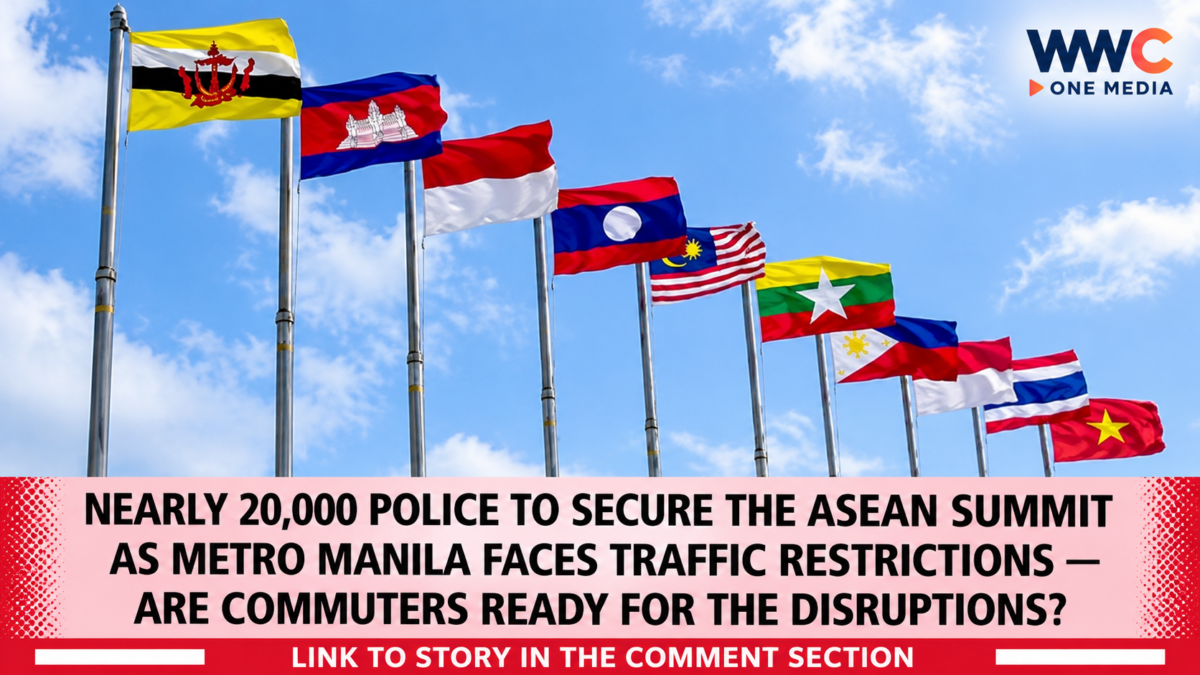
The Philippine National Police (PNP) is calling on motorists, commuters and the general public to exercise discipline and cooperate with authorities as the Philippines prepares to host the 49th Association of Southeast Asian Nations (ASEAN) Summit and Related Summits from November 15 to 18, 2026.
With foreign leaders and delegations expected in Metro Manila, police and traffic authorities are preparing security deployments, designated routes and temporary traffic arrangements. The PNP says public cooperation will be essential to keeping roads safe and preventing unnecessary congestion while the country welcomes international guests.
PNP chief General Jose Melencio Nartatez Jr. said the Highway Patrol Group (HPG) would assist the Metropolitan Manila Development Authority (MMDA) in enforcing traffic rules, managing congestion and helping motorists affected by delays.
He urged drivers to plan their journeys ahead, monitor official traffic advisories and prepare for possible rerouting. He also appealed for patience as authorities implement measures intended to protect delegates and the public. SunStar Publishing Inc.+1
Nearly 20,000 Police Personnel to Secure the ASEAN Summit
The public appeal comes as the PNP prepares a major security operation for the regional gathering.
PNP chief General Jose Melencio Nartatez Jr. earlier announced that 19,869 police personnel would be deployed to secure summit venues, hotels, billeting areas and motorcade routes. The operation will be coordinated with the Armed Forces of the Philippines, Presidential Security Command, government agencies and local governments. Daily Tribune+1
The NCRPO is also strengthening intelligence monitoring and assessing potential security risks. Acting regional director Brigadier General Christopher Abrahano said there was no verified threat to the gathering at the time of the announcement, but intelligence units would continue validating information and responding to credible reports.
The distinction is important: heightened security preparations do not mean authorities have confirmed an imminent attack.
Police are expected to remain on full alert during the summit period, with personnel assigned to protect foreign dignitaries while maintaining public safety across Metro Manila.
MMDA Clarifies Traffic Arrangements Around the PICC
Traffic management is expected to be one of the biggest challenges for commuters and motorists, particularly around Pasay City, where major summit activities will take place at the Philippine International Convention Center (PICC).
The MMDA has said it will establish a security exclusion zone around the PICC. Only authorized personnel and vehicles with valid ASEAN credentials will be allowed inside the restricted area.
The agency also announced that it would deploy 1,418 personnel to support traffic management, emergency response and other operational requirements. These personnel will coordinate with the PNP, HPG, Presidential Security Command, transport agencies and local governments. Daily Tribune+1
Although the MMDA previously said there would be no general road closures for the summit, motorists should not interpret this as a guarantee that all routes will remain unaffected. Temporary access restrictions, security controls, rerouting and stop-and-go traffic arrangements may still affect designated areas and roads.
The SunStar report specifically notes that a stop-and-go scheme will operate along designated routes from November 15 to 18.
Bus Lanes to Become Exclusive ASEAN Lanes
Another major adjustment involves the temporary conversion of designated bus lanes into ASEAN lanes.
These lanes will be reserved for the passage of authorized official vehicles and foreign delegations. The arrangement is intended to help motorcades move between venues and other designated locations.
The NCRPO has deployed police assistance teams to guide motorists and commuters affected by the changes. Officers are expected to coordinate with the MMDA and local traffic-management offices, direct drivers towards alternative routes and respond to roadside emergencies.
The public is being urged to allow additional travel time, follow instructions from traffic personnel and avoid entering restricted lanes.
For commuters who regularly use roads near the PICC and Cultural Center of the Philippines Complex, checking traffic advisories before leaving home will be particularly important. DZRH News+1
November 16–18 Declared Special Non-Working Days in Metro Manila
Malacañang has declared November 16, 17 and 18, 2026, as special non-working days in the National Capital Region to help ease traffic congestion and support security preparations.
The declaration is intended to reduce the number of vehicles on the roads during the summit’s main activities. It applies to Metro Manila and should not be mistaken for a nationwide holiday. Presidential Communications Office+1
The public should also remember that a special non-working day does not automatically mean all businesses, transport services and essential operations will stop. Workers should check with their employers, while commuters should continue monitoring announcements from transport operators and local authorities.
Security Preparations Also Affect Street Vendors and Public Events
The summit preparations have extended beyond police deployment and traffic management.
Parañaque City has conducted clearing operations in Baclaran, temporarily restricting street vending in designated areas along Roxas Boulevard, Redemptorist Road and nearby locations. The temporary vending restriction is scheduled to remain in place until November 20.
City officials said affected vendors would be allowed to return to their previous locations after the summit, subject to regulations and public-order requirements. The city has also discussed a planned permanent vending site through the Baclaran Gateway Market project. Daily Tribune
Meanwhile, the MMDA has temporarily suspended the issuance of permits for certain public activities, including fun runs, motorcades and processions, in Manila, Pasay, Parañaque, Makati and Taguig from October 24 to November 20.
These measures are intended to reduce competing demands on roads and help authorities manage security and transportation requirements.
WWC ONE MEDIA previously reported on the MMDA’s suspension of public-event permits in five Metro Manila cities ahead of the ASEAN Summit.
The restrictions have also raised questions about how the government can balance summit preparations with the livelihoods of street vendors, small businesses and other residents affected by clearing operations.
Police Must Protect Public Rights While Enforcing Security Rules
Beyond preventing unauthorized access, the PNP faces another responsibility: ensuring that security protocols are implemented professionally.
Abrahano has instructed police personnel to remain courteous, patient and respectful when dealing with motorists, commuters and other road users.
The directive matters because strict security measures can create confusion and inconvenience, especially when people are unfamiliar with restricted routes or identification requirements.
Police officers are expected to explain instructions clearly, assist people affected by temporary traffic arrangements and enforce restrictions without compromising public service.
WWC ONE MEDIA previously examined this issue in its report, Nearly 17,000 Personnel Mobilized for ASEAN Summit as Metro Manila Police Are Ordered to Enforce Strict Checkpoints.
The report explored the challenge of protecting visiting leaders while respecting the rights of ordinary Filipinos.
Another WWC ONE MEDIA report, Philippines Deploys Nearly 17,000 Security Personnel for ASEAN Summit as Clark and Subic Become Backup Gateways, examined how preparations extend beyond the capital region.
These developments show that the security operation is not limited to the summit venue. It involves multiple agencies, transport routes and locations that may be used by visiting delegations.
What Metro Manila Residents Should Do Before the Summit
With the main summit activities approaching, motorists, commuters and businesses should prepare for possible disruptions.
Residents should:
- Check official MMDA, PNP and local-government traffic announcements before travelling.
- Allow additional time for journeys near Pasay, Manila, Makati, Parañaque and Taguig.
- Follow instructions from authorized traffic personnel.
- Avoid entering designated ASEAN lanes unless authorized.
- Prepare alternative routes when travelling near the PICC and CCP Complex.
- Keep valid identification available if they need to access workplaces or facilities in restricted areas.
- Verify information through official government channels instead of relying on unconfirmed social-media posts.
Businesses operating near affected roads should also review delivery schedules, staff transportation and customer access arrangements.
The Philippines Faces a Major Test as ASEAN Leaders Arrive
Hosting the 49th ASEAN Summit is an important diplomatic opportunity for the Philippines, but it also places significant demands on the country’s security, traffic-management and public-service systems.
The PNP is asking the public to cooperate as nearly 20,000 police personnel prepare for security duties. The MMDA is deploying more than 1,400 personnel, while the NCRPO is organizing assistance teams to guide motorists and commuters through temporary traffic arrangements.
For ordinary Filipinos, the most visible effects may be additional travel time, restricted access near summit venues and temporary changes to familiar routes.
Authorities are asking for patience and cooperation, but the responsibility does not rest on the public alone. Government agencies must also ensure that restrictions are clearly communicated, consistently enforced and implemented with respect for residents and commuters.
The Philippines now faces a crucial test: welcoming regional leaders safely while keeping Metro Manila functioning for millions of people who still need to work, travel and go about their daily lives.