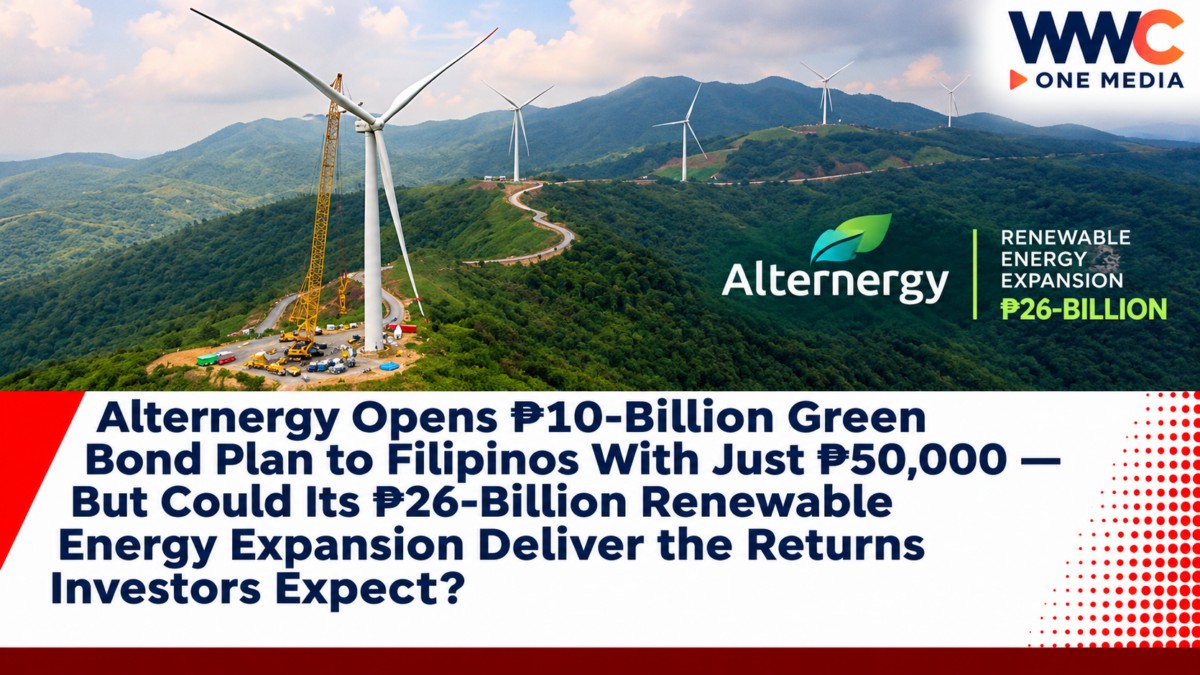
MANILA, PHILIPPINES — November 11, 2026 — Filipino investors could soon gain a new opportunity to help finance the country’s renewable energy expansion, as Alternergy Holdings Corporation prepares to offer fixed-rate green bonds with a planned minimum investment of ₱50,000.
The listed renewable energy developer, chaired by former Energy Secretary Vince Perez, has approved a proposed ₱10-billion green bond program designed to raise capital for major solar and wind developments.
But the headline figure comes with an important distinction: Alternergy is not immediately borrowing ₱10 billion.
Instead, the company intends to establish a five-year shelf registration program, allowing it to issue bonds in stages as its financing requirements develop.
Its first offering, targeted for the first quarter of 2027, will consist of ₱3 billion in bonds, with an oversubscription option of up to ₱1 billion.
That means the initial fundraising exercise could reach ₱4 billion if demand and approvals permit.
The proposed financing will support three renewable energy projects with a combined capacity of 320 megawatts, representing a total planned investment of approximately ₱26 billion.
For ordinary Filipinos interested in fixed-income investments, the initiative could provide another route into renewable energy financing.
However, the actual investment return remains unknown because Alternergy has not announced the final bond interest rate, maturity or payment terms.
And while the securities are intended to support environmentally beneficial projects, green bonds still carry financial risks.
The key question is whether Alternergy can translate its aggressive renewable energy expansion into dependable earnings and cash flows while meeting its obligations to bond investors.
Alternergy’s Board Approves ₱10-Billion Green Bond Program
On November 10, Alternergy’s board approved plans to register up to ₱10 billion in fixed-rate green bonds with the Securities and Exchange Commission.
The proposed shelf registration would allow the company to issue securities in multiple tranches over five years, subject to applicable regulatory requirements.
The structure gives Alternergy flexibility.
Rather than raising the entire amount immediately, it can seek funding as new projects advance toward construction and commercial operation.
During a press briefing following the company’s annual stockholders’ meeting in Makati City, Perez explained that Alternergy was not seeking to borrow the full ₱10 billion at once.
The initial offering is expected to be listed on the Philippine Dealing & Exchange Corporation, or PDEx, in the first quarter of 2027.
However, board approval is only one step.
The proposed retail securities still require the relevant registration process and final offering documentation.
As of November 11, no completed retail bond issuance has been announced under this program.
Why Alternergy Wants Ordinary Filipinos to Invest
One of the most notable features of the proposal is its planned ₱50,000 minimum investment.
That threshold would allow more individual investors to participate in a fundraising exercise supporting renewable energy infrastructure.
Historically, some corporate financing transactions have been directed primarily toward institutional investors, including banks and investment funds.
Alternergy’s latest plan is different because it is specifically designed to reach the retail market.
Perez said the company wants more Filipino professionals and families to participate in the country’s green energy transition.
The idea is to connect private savings with long-term infrastructure development.
For investors, the attraction of a fixed-rate bond generally lies in receiving scheduled interest payments and repayment of principal according to the bond terms.
But whether Alternergy’s securities offer an attractive investment will depend on information that has not yet been finalized.
Investors will need to compare the coupon rate, maturity, issuer credit quality, liquidity and associated risks before deciding whether to participate.
A ₱50,000 minimum investment also does not guarantee that the bonds will be suitable for every household.
Money needed for emergency expenses or short-term obligations may be inappropriate for a security that could be difficult or costly to sell before maturity.
Three Major Renewable Projects Will Receive Financing
Alternergy’s financing plan is connected to three projects awarded under the Department of Energy’s fourth Green Energy Auction, commonly known as GEA-4.
Together, the developments represent approximately 320 MW of planned renewable capacity.
The projects include:
140-MW solar-on-stilts project in Central Luzon
The development uses an elevated solar installation concept and represents one of Alternergy’s planned large-scale solar investments.
100-MW solar and battery energy storage project in Mindanao
This development combines solar generation with battery storage, which can help manage fluctuations in solar output and improve operational flexibility.
80-MW wind farm in Alegria, Cebu
The wind project is intended to expand Alternergy’s generation portfolio in the Visayas.
The three developments represent an ambitious expansion requiring substantial construction funding.
The planned ₱26-billion total project cost is significantly larger than the proposed initial bond issuance.
Alternergy therefore intends to combine capital raised through bonds with project-level bank financing and other available resources.
The projects are scheduled for development beginning in 2027, but their completion and operating dates will depend on execution, permits, procurement and grid-related requirements.
Alternergy Targets ₱26 Billion in New Energy Investment
According to Perez, the three projects are expected to require approximately ₱26 billion in capital expenditures.
The financing framework includes around ₱20 billion in project financing and ₱6 billion in equity-related funding requirements.
Four banks are competing to provide financing for the projects.
The planned initial bond issuance of up to ₱4 billion would help Alternergy meet part of its financing requirements.
However, the public disclosures do not yet provide a complete allocation schedule showing exactly how every peso of the eventual bond proceeds will be deployed.
That information will be important when the formal offering documents become available.
The scale of the planned investment illustrates how capital-intensive renewable energy development can be.
Solar and wind projects require financing for land access, engineering, equipment, grid connections and construction.
Even after major components are installed, projects may need testing, commissioning and regulatory approvals before they can generate full commercial revenues.
For lenders and bondholders, the timing of those milestones can affect how quickly a developer begins receiving cash from its investments.
Alternergy Wants to Double Its Asset Base
The bond proposal forms part of a larger expansion strategy.
BusinessMirror reported that Alternergy is targeting approximately ₱50 billion in assets within two years.
Perez said the company currently has an asset base of roughly ₱25 billion.
Adding the planned ₱26-billion investment program could substantially expand its portfolio.
However, a larger asset base does not automatically guarantee higher profits or stronger cash flows.
The financial results will depend on project completion, electricity sales, operating costs, borrowing expenses and contractual arrangements.
Alternergy has also outlined a longer-term ambition to reach one gigawatt of renewable energy capacity by 2030.
The new GEA-4 projects would represent a major step toward that objective.
But investors should distinguish between projects that are operating, those under construction and those still in development.
Planned capacity does not generate revenue until the relevant assets become commercially productive.
A ₱2-Billion Debt Issue Came Before the New Retail Plan
The proposed retail green bonds follow Alternergy’s earlier entry into the Philippine debt capital market.
In September 2026, the company completed a ₱2-billion issuance of enrolled corporate notes.
Those notes carried an annual interest rate of 7.75%, according to the company’s earlier offering information.
The financing was intended for qualified institutional investors, rather than the broader retail market.
As WWC ONE MEDIA reported in its earlier analysis of Alternergy’s ₱2-billion financing and its renewable energy pipeline, the transaction represented an important step in the company’s capital-raising strategy.
But the previous 7.75% rate should not be confused with the interest rate of the proposed 2027 retail bonds.
The new coupon has not been announced.
The securities may also differ in maturity, investor eligibility, security arrangements and other conditions.
For investors evaluating the future offering, assuming that the new bonds will pay the same interest rate would be misleading.
Why Alternergy Changed Its Preferred Share Plans
Alternergy previously considered issuing perpetual preferred shares as another way to raise capital.
The company has now deferred that proposal indefinitely in favor of the fixed-rate green bond program.
The shift is important because preferred shares and bonds represent different forms of financing.
A bond is a debt obligation under which the issuer promises payments according to contractual terms.
Preferred shares represent equity and may provide dividend preferences, but their distributions and repayment characteristics differ.
The distinction can affect investors’ legal rights, income expectations and risk exposure.
For Alternergy, the proposed green bond program offers a structure that can be issued in stages and matched with future financing needs.
However, the final debt obligations will also add to the company’s financial commitments once bonds are issued.
Management will need to ensure that its operating cash flows and financing arrangements can support those obligations.
Alternergy Begins Turning Projects Into Operating Assets
The new financing proposal arrives as several earlier investments are reaching important milestones.
Alternergy’s Balsik Solar Farm in Bataan began commercial operations in February 2026.
Its Dupinga run-of-river hydropower development in Nueva Ecija also began commercial operations in March.
The company’s Tanay wind project has been energized and has delivered electricity to the Luzon grid.
Additional wind facilities have been moving through testing and commissioning.
These developments matter because the transition from construction to operation is essential for a renewable developer’s financial performance.
During construction, projects typically require capital without generating full electricity sales.
Once operations begin, eligible projects can start contributing revenue and cash flow.
However, commissioning progress does not guarantee that all facilities have reached their expected long-term output.
Weather conditions, equipment performance, contractual terms and other operating factors can affect results.
For bond investors, understanding the performance of existing projects will be just as important as reviewing the potential of future developments.
Alternergy’s Latest Dividend Adds Another Investor Angle
On November 10, Alternergy also announced its second cash dividend on common shares since its March 2023 stock market debut.
The company declared approximately ₱40 million in common-share dividends, equivalent to ₱0.01 per share.
The payment is scheduled for November 26, with the record date set for November 20.
As WWC ONE MEDIA reported in its coverage of Alternergy’s latest dividend and approximately 225 MW of renewable energy projects reaching operation or advanced completion, the company is increasingly moving from development activity toward electricity-generating assets.
The dividend announcement may be encouraging to shareholders.
But common-share dividends and bond interest are different financial obligations.
A dividend does not establish that a future bond will be risk-free.
Similarly, the existence of operating renewable energy facilities does not eliminate financing or construction risks associated with the company’s expansion program.
Investors should assess the entire financial position rather than relying on any single announcement.
Green Bonds Explained: How Investors Could Earn Returns
Green bonds are debt securities intended to finance or refinance projects that meet specified environmental criteria.
They can support investments involving renewable energy, energy efficiency, sustainable transportation and other qualifying activities.
For a corporate green bond, the issuer generally promises to make interest payments and repay principal under the offering’s contractual terms.
The green designation concerns the intended environmental use of proceeds.
It does not mean the investment is guaranteed by the government or protected against losses.
Investors can face several risks.
Credit risk arises if the issuer encounters difficulties meeting its obligations.
Interest-rate risk can affect the market value of a fixed-rate bond when prevailing yields change.
Liquidity risk arises when investors cannot easily sell their bonds at a favorable price.
Project execution risk matters when an issuer is heavily exposed to developments that may experience delays or cost increases.
Finally, investors should review the specific green bond framework, reporting commitments and independent assessments of eligible project expenditures.
These details can help establish whether environmental claims are supported by transparent disclosures.
What Would a ₱50,000 Investment Actually Earn?
The answer is not yet known.
Alternergy has not announced the coupon rate or final maturity of the proposed retail green bonds.
A simple hypothetical example illustrates why the rate matters.
If a ₱50,000 bond paid an annual coupon of 6%, the gross annual interest would be ₱3,000.
At an illustrative 7% rate, gross annual interest would be ₱3,500.
At 8%, it would be ₱4,000.
These figures are purely examples and are not forecasts or announced terms for Alternergy’s bonds.
Actual investor proceeds would depend on the final coupon, taxes, any applicable fees and the payment schedule.
Market values could also fluctuate before maturity.
Retail investors should avoid treating the proposed ₱50,000 minimum as a recommendation to invest.
The prospectus and final terms must be reviewed before the potential risks and returns can be properly evaluated.
Citicore’s Renewable Expansion Shows the Scale of Competition
Alternergy is expanding in an increasingly competitive Philippine renewable energy industry.
Citicore Renewable Energy Corporation has also been accelerating investments in solar power.
The company reported reaching one gigawatt of installed renewable energy capacity in 2026 while pursuing an even larger multigigawatt portfolio.
As WWC ONE MEDIA examined in its reporting on Citicore’s 1-GW milestone and its longer-term 5-GW ambition, developers are facing growing challenges involving financing, land availability, grid access and project execution.
These issues are relevant to Alternergy as well.
Winning renewable energy contracts is only one part of the development process.
Companies must still secure financing, complete facilities and deliver electricity according to their commercial arrangements.
Competition may also affect demand for specialized equipment, contractors and qualified technical personnel.
For investors, the broader sector’s growth potential should be evaluated alongside the practical constraints that can delay new capacity.
Aboitiz Renewables’ 2-GW Milestone Highlights the Bigger Market
Another major industry player is Aboitiz Renewables.
The company reported surpassing two gigawatts of attributable renewable energy capacity in 2026.
Its portfolio includes solar, hydroelectric, geothermal, wind and battery storage investments.
In related coverage, WWC ONE MEDIA analyzed Aboitiz Renewables’ expansion beyond 2 GW and its continuing clean energy development pipeline.
The growth of multiple renewable developers demonstrates the scale of private-sector involvement in the Philippine energy transition.
The Department of Energy has established targets for renewable energy to account for 35% of the country’s power generation mix by 2030 and 50% by 2040.
Meeting those targets will require substantial investment in generation, transmission and supporting infrastructure.
However, rising renewable capacity does not automatically guarantee lower electricity prices.
Power costs also depend on generation contracts, grid conditions, fuel prices, transmission costs, market arrangements and other factors.
The country’s energy transition will therefore depend on both increasing clean generation and ensuring reliable, affordable electricity delivery.
Why the Green Energy Auction Matters
The Department of Energy’s Green Energy Auction Program is designed to encourage investment in new renewable electricity generation.
Under the program, developers compete for opportunities to supply power under specified arrangements.
Successful bidders obtain a framework for developing projects and delivering electricity subject to the relevant rules and contracts.
For developers, these awards can improve revenue visibility and support financing discussions.
But securing an auction award does not mean a project is already completed.
Projects still require permits, construction work, financing arrangements and grid connections.
Alternergy’s three planned developments form part of this wider national renewable energy program.
The combined 320-MW expansion could strengthen its future generation portfolio.
But the projects will need to reach operation before their full electricity output and economic contribution can be evaluated.
What Retail Investors Should Check Before Buying
Filipinos interested in Alternergy’s planned green bonds should pay close attention to the final offering documents.
The most important information will include the coupon rate, maturity, interest payment schedule, principal repayment arrangements and any early redemption provisions.
Investors should also review the issuer’s financial statements and the disclosures concerning existing borrowings.
The intended use of proceeds matters because green bonds are generally marketed in connection with identified environmental objectives.
Any third-party assessments, ratings or certifications should be read carefully to understand precisely what they evaluate.
A green label is not equivalent to a promise that the issuer cannot default.
Likewise, an exchange listing does not guarantee that investors can sell their bonds immediately at face value.
The Philippine Dealing & Exchange Corporation may provide a trading venue, but actual liquidity depends on market conditions and investor interest.
For households, the decision should also account for emergency savings, short-term cash needs and overall investment concentration.
The minimum entry amount is relevant, but suitability depends on more than affordability of the initial purchase.
What Happens Before the First Quarter of 2027?
Several milestones will determine whether the proposed offering proceeds as planned.
First, Alternergy must complete the necessary SEC registration process.
Second, the company must finalize the bond structure, including interest rates and maturities.
Third, it will need to publish the relevant offering documents and complete the arrangements for the planned PDEx listing.
Fourth, the company must continue securing the project financing needed for its three renewable developments.
Finally, potential investors will need to assess the terms when an authorized offering becomes available.
The ₱10-billion shelf amount provides potential future fundraising capacity, but the actual amount issued may be lower.
The first sale is planned at ₱3 billion, with a potential increase to ₱4 billion if the oversubscription option is exercised.
No final retail offering price, coupon rate or confirmed subscription dates have been disclosed as of November 11, 2026.
The Bigger Picture: A New Way for Filipinos to Finance Clean Energy
Alternergy’s proposed green bond program reflects a broader shift in how renewable developers seek funding.
As the Philippines accelerates construction of solar, wind, hydroelectric and battery storage facilities, financing requirements are increasing.
Bank loans and equity investments remain important.
But corporate bond markets offer another potential source of long-term capital.
By planning a ₱50,000 minimum investment, Alternergy is seeking to bring retail investors into a financing exercise previously more accessible to large institutions.
The company’s initial fundraising target of up to ₱4 billion would support the early stages of a ₱26-billion project development program.
Its three planned renewable energy developments could add approximately 320 MW of capacity to the national power system.
Still, the opportunity comes with uncertainty.
Regulatory approvals remain pending.
The interest rate and final offering conditions have not been announced.
And the company’s ability to deliver new projects will depend on financing, construction and commercial performance.
Alternergy wants ordinary Filipinos to help finance the next wave of Philippine renewable energy through a ₱10-billion green bond program. But as the company prepares its first retail offering and pursues ₱26 billion in new solar and wind investments, will the promise of clean-energy growth translate into dependable returns for bondholders—or will investors discover that even green investments come with serious financial risks?