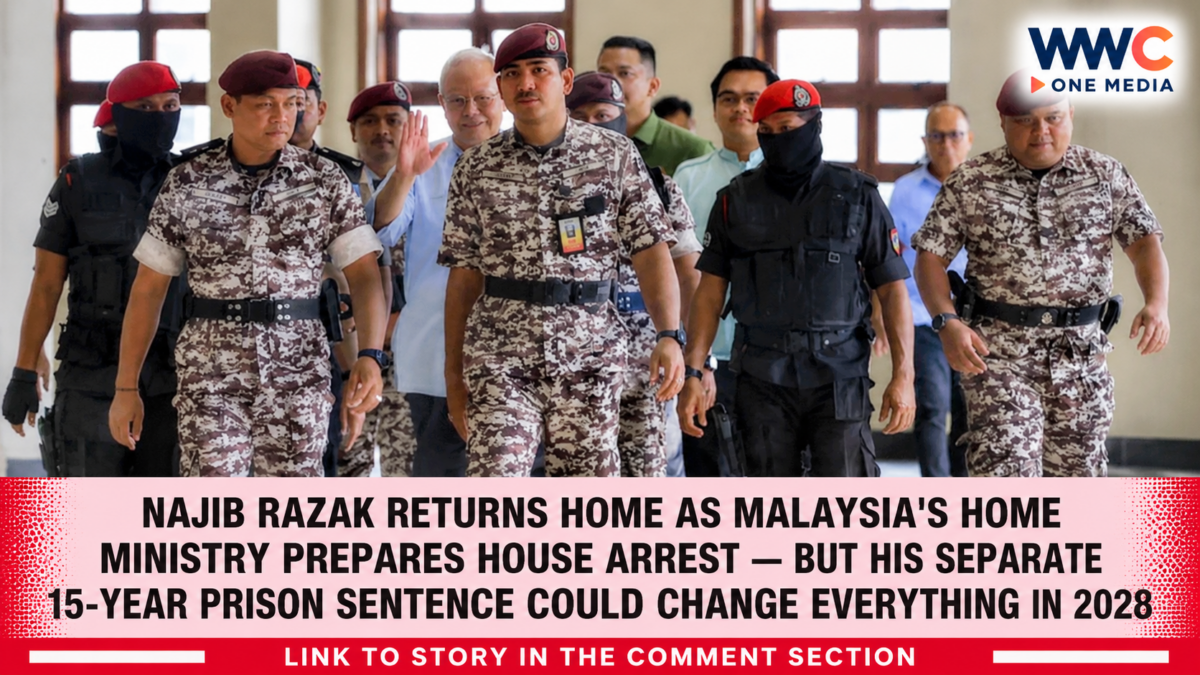
Former Malaysian prime minister Najib Razak has finally returned home after more than four years behind bars, arriving at his heavily secured Taman Duta residence in Kuala Lumpur on Tuesday night, November 10, to begin serving the remainder of his prison sentence under house arrest.
The 73-year-old former leader arrived at approximately 9.25pm in a silver sport utility vehicle accompanied by a convoy of prison and security vehicles.
His arrival marked the end of days of legal uncertainty after an earlier attempt to transfer him from Kajang Prison was delayed by the Attorney-General’s Chambers (AGC), which sought clarification over the legal effect of a previous court order.
Several supporters had gathered outside his residence, shouting “Hidup Bossku” as the convoy entered the property.
The transfer followed a fresh decision by the Kuala Lumpur High Court, which cleared the way for Najib to serve the remaining portion of his reduced six-year sentence in the SRC International corruption case at his private residence.
Under the new court order, he will remain under house arrest until August 23, 2028, before returning to Kajang Prison on August 24, 2028, to begin serving a separate 15-year sentence connected to another 1Malaysia Development Berhad (1MDB) corruption case, subject to the applicable legal orders.
The development represents a major turning point in one of Malaysia’s most controversial political and judicial sagas.
But while Najib is now home, his legal battles are far from over. AsiaOne+3
A Convoy of Vehicles Escorted Najib From Kajang Prison to His Kuala Lumpur Home
Najib’s journey back to his Taman Duta residence attracted considerable media and public attention.
According to reports from Malaysian news outlets, his vehicle left Kajang Prison at approximately 9pm and reached his home around 9.25pm.
The convoy included vehicles associated with the Prisons Department and security personnel.
Police had also increased security around the residence, with a controlled access area established along the road leading to the property.
Supporters who had gathered since the afternoon welcomed his arrival with chants of “Hidup Bossku”, a slogan closely associated with Najib during his years in Malaysian politics.
The former prime minister’s return followed a fresh High Court order issued earlier that afternoon.
The ruling provided the legal authority required for his transfer and replaced the earlier discharge order that had caused confusion over whether he was being released from his remaining sentence altogether.
High Court Ruling Finally Clears the House-Arrest Transfer
The decisive development came on November 10 when High Court Judge Datuk Aslam Zainuddin set aside the November 6 discharge order and replaced it with a new order.
The earlier document had been issued after Najib’s RM50 million fine was paid.
However, the Attorney-General’s Chambers argued that its wording could be interpreted as allowing Najib to leave prison without serving the remaining portion of his SRC International sentence.
That interpretation conflicted with the conditional royal pardon, which allowed him to serve the outstanding sentence under house arrest rather than granting an unconditional release.
The AGC therefore applied to the court for clarification.
After considering the relevant documents, including the conditional pardon and proof of payment, the judge ordered Najib to serve the remainder of his reduced six-year sentence at No. 11, Jalan Langgak Duta, Taman Duta, until August 23, 2028.
The order also provides for his return to Kajang Prison on August 24, 2028, to serve the separate 1MDB sentence.
The ruling removed the immediate legal obstacle that had prevented the Prisons Department from completing his transfer. BERNAMA+2
RM50 Million Fine Paid by UMNO Opened the Door to Najib’s House Arrest
One of the most important conditions behind Najib’s return home was the payment of a RM50 million fine.
The amount was paid by his political party, the United Malays National Organisation (UMNO), on November 6 to satisfy a financial condition attached to the conditional royal pardon granted in September 2026.
The fine had originally been RM210 million before Malaysia’s Pardons Board reduced it to RM50 million in January 2024.
Najib’s original 12-year prison sentence was also reduced to six years.
The September 2026 conditional pardon subsequently allowed him to serve the remaining portion of that sentence under house arrest, provided the required conditions were fulfilled.
However, the payment did not erase his criminal conviction or automatically terminate his remaining prison sentence.
That distinction became central to the legal confusion surrounding his initial attempted transfer.
The November 10 ruling finally clarified that the remaining SRC International sentence would continue under house arrest rather than being treated as completed.
Why Najib Was Initially Prevented From Going Home
Najib was initially expected to leave Kajang Prison on November 6 after UMNO completed the RM50 million payment.
However, the anticipated transfer was delayed after the Attorney-General’s Chambers intervened.
The AGC said it needed clarification regarding the conditional pardon and the legal consequences of the discharge order issued after the payment.
The dispute was particularly sensitive because Najib faces another prison sentence arising from a separate 1MDB-related conviction.
The government wanted to ensure that the completion date of his SRC sentence and the commencement of his other sentence were properly established.
Malaysia’s King, Sultan Ibrahim Sultan Iskandar, subsequently issued a strong statement defending the constitutional authority behind the conditional pardon.
The palace maintained that the royal decision was clear and that its conditions had been fulfilled.
The AGC, meanwhile, denied that it was challenging the King’s authority, explaining that seeking judicial clarification was necessary to ensure the order was implemented lawfully.
The November 10 High Court ruling eventually resolved the immediate disagreement.
Najib Will Remain Under House Arrest Until August 2028
Although Najib has returned home, his new arrangement does not mean he is completely free.
He must continue serving the remaining portion of his SRC International sentence under the conditions of the court order and conditional pardon.
The precise operational rules governing monitoring, visitors and movement are important aspects of the arrangement.
Najib’s lawyer, Tan Sri Muhammad Shafee Abdullah, said following the ruling that the defence had not yet received complete details of the house-arrest procedures.
He indicated that restrictions concerning visitors and family arrangements still needed clarification.
This means the practical conditions of Najib’s confinement remain an important issue even after his physical transfer from prison.
The arrangement should therefore be understood as a change in where he serves his sentence, not an acquittal or cancellation of his conviction.
A Separate 15-Year Prison Sentence Still Awaits Najib
Perhaps the biggest obstacle to Najib’s long-term freedom is his separate 1MDB-related conviction.
In December 2025, the High Court sentenced him to 15 years in prison after finding him guilty of abuse of power and money laundering involving more than RM2 billion connected to the state investment fund.
He was also ordered to pay substantial financial penalties.
Najib has appealed the conviction and sentence, with the appeal process still pending.
The latest house-arrest ruling applies only to his SRC International sentence.
It does not cancel the separate 15-year prison term.
Under the November 10 order, Najib is scheduled to return to Kajang Prison on August 24, 2028, to begin serving that sentence, subject to any subsequent court orders or changes resulting from his appeal.
This means his return home could be temporary.
If his appeal fails and the separate sentence remains enforceable, he could once again face imprisonment.
The distinction is crucial because the 1MDB scandal remains one of the largest financial corruption controversies in Malaysia’s history.
International investigations have estimated that approximately US$4.5 billion was misappropriated from 1MDB. Najib has maintained that he was misled by officials and fugitive financier Jho Low, while continuing to challenge his separate conviction. AP News+2
Anthony Loke Resigns Following Najib’s Return Home
Najib’s house arrest has also triggered political consequences.
Malaysia’s Transport Minister Anthony Loke announced his immediate resignation on November 10 following the High Court’s decision.
The Democratic Action Party (DAP) secretary-general had previously indicated that he would step down once Najib actually began serving his sentence under house arrest.
With the court now clearing the transfer and Najib arriving at his residence, Loke confirmed that his resignation would take effect immediately.
His decision reflects DAP’s longstanding opposition to the arrangement allowing Najib to serve his remaining sentence outside prison.
The development creates another challenge for Prime Minister Anwar Ibrahim’s unity government, which includes parties with sharply different positions on Najib and the 1MDB scandal.
However, Loke’s resignation should not automatically be interpreted as the collapse of the governing coalition.
The immediate question is how the government will manage the political disagreement and whether a replacement will be appointed to lead the Transport Ministry.
The 1MDB Scandal Continues to Haunt Malaysia
Najib’s return home is particularly controversial because of his association with the 1MDB scandal.
The state investment fund was established during his administration, when he served as prime minister from 2009 to 2018.
Investigators across several countries examined allegations that billions of dollars were diverted from the fund through an international network of financial transactions.
The scandal involved luxury properties, expensive jewellery, artwork, a superyacht and other assets allegedly purchased using misappropriated funds.
The controversy contributed to Najib’s political downfall following Malaysia’s 2018 general election.
His conviction in the SRC International case subsequently became one of the most significant corruption cases in the country’s modern history.
For many Malaysians, the house-arrest arrangement raises questions about accountability, equal treatment under the law and the relationship between political power and the justice system.
For Najib’s supporters, meanwhile, the implementation of the conditional pardon represents the fulfilment of a constitutional decision.
These competing perspectives explain why his return home has attracted such intense attention.
Related WWC ONE MEDIA Coverage
The latest development follows several earlier reports by WWC ONE MEDIA documenting Najib’s legal and political battles:
- Najib’s Family Still Waiting for House Arrest Rules as Authorities Have Yet to Finalise Process
- Malaysia’s King Rebukes Attorney-General as Najib’s RM50-Million House Arrest Deal Is Blocked
- Najib Says He Can’t Access Enough Money to Pay RM50 Million Fine
- Anthony Loke to Stay as Transport Minister Until Najib Begins House Arrest
What Happens Next After Najib’s Return Home?
The November 10 transfer marks the beginning of a new phase in Najib’s legal battle.
Authorities must now implement the house-arrest arrangement in accordance with the court order and the conditions of the royal pardon.
The Prisons Department will remain central to monitoring his detention, while his lawyers will continue dealing with the outstanding legal questions.
The next major milestone is August 23, 2028, when his SRC International sentence is scheduled to end.
The following day, he is expected to return to Kajang Prison to begin serving the separate 15-year sentence unless the legal position changes.
His pending appeal could therefore become one of the most important factors determining his future.
For Malaysia, the case is also a test of how constitutional clemency, judicial independence and government responsibilities operate when a high-profile former leader is involved.
Najib has finally returned to his mansion after more than four years in prison, but the controversy surrounding his convictions, royal pardon and political influence is nowhere near finished.
Two years at home, a separate 15-year sentence waiting and a political storm already unfolding — could Najib Razak’s return to Taman Duta be only a temporary break before another chapter of his prison battle begins?