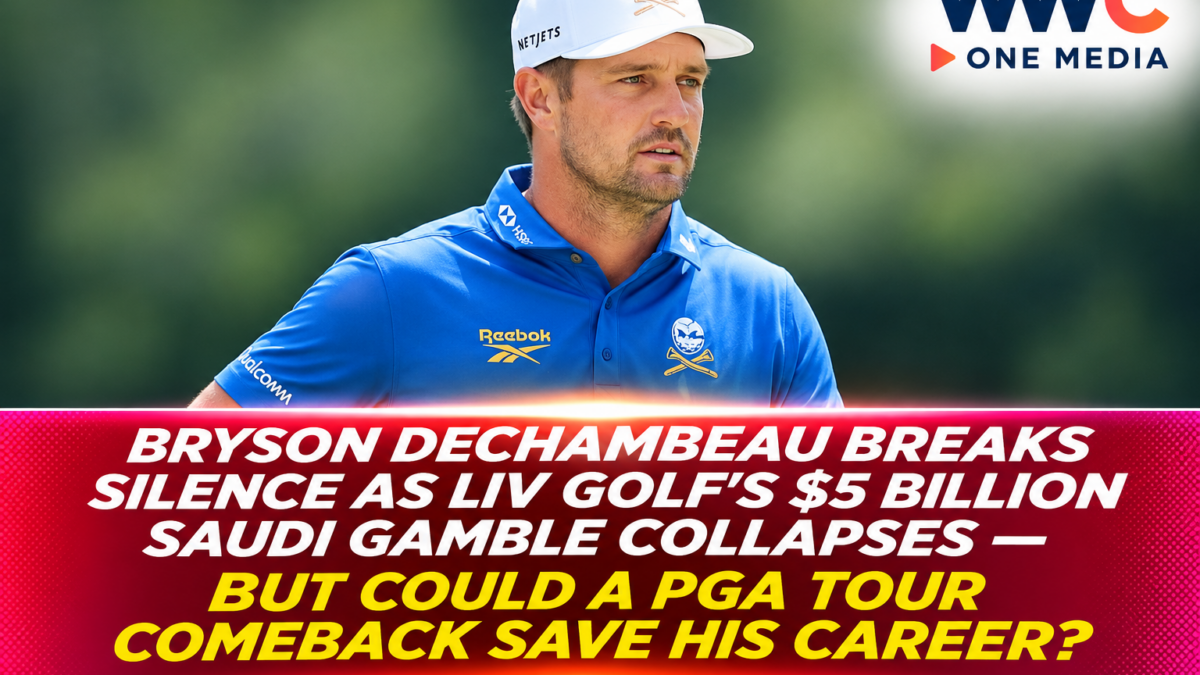
NEW YORK, UNITED STATES / MANILA, PHILIPPINES — November 10, 2026 — Two-time US Open champion Bryson DeChambeau has delivered an emotional message about his future as LIV Golf, the Saudi-backed competition that transformed professional golf, moves toward liquidation following the collapse of a multibillion-dollar investment experiment.
After four years defending the controversial breakaway league, the 33-year-old American has acknowledged that his next chapter remains uncertain.
But he insists he has no regrets about joining LIV Golf.
In a statement published on November 8, DeChambeau reflected on his decision to leave the PGA Tour, thanked the people who supported LIV and reaffirmed his belief that team-based golf can attract new audiences.
“I gave it everything I had to keep team golf alive,” he declared.
The remarks came just days after LIV Golf announced on November 5 that it would abandon its proposed 2027 relaunch and enter the liquidation phase of its Chapter 11 bankruptcy proceedings.
The decision followed the withdrawal of Saudi Arabia’s Public Investment Fund as its principal financial backer and the collapse of a proposed $300-million restructuring investment.
Now, DeChambeau faces one of the most important decisions of his professional career.
Should he seek a return to the PGA Tour, pursue a schedule on Europe’s DP World Tour, or wait to see whether another investor can revive part of the LIV Golf business?
And with other major champions already finding new competitive opportunities, could the former LIV superstar face a difficult road back to the sport’s established circuits?
Bryson DeChambeau Defends His Decision to Join LIV Golf
DeChambeau’s November 8 statement marked his first extended public response following the league’s decision to abandon its restructuring plan.
He said he stood by the decision he made when he left the PGA Tour in 2022.
The American emphasized that LIV had given him opportunities to compete before international audiences and help introduce professional golf to fans in countries that rarely hosted leading players.
He specifically remembered large crowds at tournaments in Adelaide, Australia, and Johannesburg, South Africa.
Those experiences reinforced his belief that golf could expand through different competition formats and international events.
DeChambeau also thanked LIV employees, tournament organizers, caddies, sponsors and his fellow players.
As captain of Crushers GC, he had become one of the league’s most recognizable advocates for its team competition format.
His statement was not a formal announcement of retirement or confirmation that he had signed with another tour.
Instead, it reflected appreciation for LIV’s achievements alongside uncertainty about what comes next.
LIV Golf’s Collapse Follows More Than $5 Billion in Saudi Investment
LIV Golf launched in 2022 with financial backing from Saudi Arabia’s Public Investment Fund.
Its arrival challenged the established structure of professional golf by offering shorter tournaments, team competitions and lucrative financial packages for major champions.
Bryson DeChambeau, Phil Mickelson, Dustin Johnson, Brooks Koepka and Jon Rahm were among the biggest names to compete on the circuit.
Supporters argued that LIV offered professional players greater financial opportunities and introduced new audiences to the sport.
Critics accused Saudi Arabia of using the competition to improve its international image despite longstanding human-rights concerns.
LIV’s commercial model required substantial financial backing.
Associated Press reported that the Saudi investment exceeded $5 billion before the PIF decided in April 2026 to discontinue its support.
That decision left LIV searching for alternative investors and a sustainable financial structure.
The league subsequently filed for Chapter 11 bankruptcy protection in September.
Its management attempted to develop a smaller competition for 2027, known as LIV Golf 2.0, with a revised structure emphasizing team ownership and lower operating costs.
But the proposed relaunch depended on attracting enough recognizable players to support a viable business.
That proved to be a major obstacle.
In earlier reporting, WWC ONE MEDIA examined LIV Golf’s $5-billion Saudi investment and the collapse of its proposed $300-million financial rescue.
The failed restructuring ultimately left the league without a confirmed financing plan for another season.
Why LIV Golf Announced Liquidation on November 5
LIV Golf’s immediate crisis intensified when negotiations involving BC Partners Credit failed to produce an agreement.
The investment firm had considered providing up to $300 million to support a restructured competition.
However, the financing proposal depended on securing commitments from enough leading golfers.
With several established players declining to participate, the investment case became increasingly difficult.
On November 5, LIV representatives told a bankruptcy court in New Jersey that the league would abandon its proposed relaunch and begin winding down operations.
The decision represented a dramatic reversal for a competition that had spent billions attempting to challenge the PGA Tour and DP World Tour.
However, liquidation is a legal process rather than an event completed immediately upon announcement.
Assets, contracts and creditor claims still need to be addressed through bankruptcy proceedings.
There also remains uncertainty about whether an investor could acquire selected assets or propose another transaction.
For players, the immediate consequence is that the league no longer has a confirmed future competition schedule.
A $50 Million Financing Move Could Offer One Last Hope
Despite the liquidation announcement, reports suggest another financial arrangement may still be possible.
The Financial Times reported on November 8 that BC Partners had revived discussions concerning LIV Golf’s approximately $50-million debtor-in-possession financing.
Under the proposal, the investor could potentially acquire the loan from Saudi Arabia’s Public Investment Fund.
Such a transaction might give the investor greater influence over the bankruptcy process and an opportunity to pursue a successor competition.
However, buying bankruptcy financing is not equivalent to acquiring and successfully relaunching the entire league.
Any restructuring would still require appropriate legal approvals, commercial investment and player participation.
It also remains uncertain whether enough golfers would commit to a revived competition.
For DeChambeau, the possibility creates another question.
Should he commit to an established professional tour now, or could waiting preserve an opportunity to participate in a new version of team golf?
As of November 10, no completed rescue agreement has been announced.
Jon Rahm and Brooks Koepka Move Toward New Opportunities
DeChambeau’s uncertainty stands in contrast with several former LIV stars who have already begun moving toward other competitive arrangements.
Former world No. 1 Jon Rahm rejected participation in the proposed LIV Golf 2.0 structure.
The Spaniard, a two-time major champion, is pursuing opportunities through the DP World Tour.
He won the Abu Dhabi Championship on November 8, reinforcing his standing among the game’s leading players.
Brooks Koepka has also moved away from LIV and regained PGA Tour membership through a Returning Member Program.
His reinstatement demonstrates that at least some former LIV competitors have found pathways back to the American circuit.
Patrick Reed has similarly indicated that he is leaving the Saudi-backed competition.
But their decisions do not establish that every former LIV player will receive identical treatment.
Eligibility requirements depend on an individual player’s circumstances, previous agreements and applicable tour rules.
DeChambeau’s situation may be more complicated because of his earlier involvement in litigation challenging the PGA Tour.
His next move could therefore require careful negotiation.
David Puig’s Exit Was an Early Warning Sign
The problems confronting LIV Golf became visible well before the liquidation announcement.
Spanish golfer David Puig confirmed in October that he would leave the proposed LIV 2.0 competition to pursue a full schedule on the DP World Tour.
His decision was important because LIV was not only losing established veterans.
It was also struggling to retain younger players seeking long-term careers through established professional tours.
For athletes, competitive schedules, world-ranking opportunities, major championship eligibility and financial stability all influence career decisions.
Puig’s departure added pressure to LIV’s proposed relaunch.
In related reporting, WWC ONE MEDIA documented David Puig’s decision to leave LIV while DeChambeau was considering additional European tournament opportunities.
At the time, LIV was still attempting to secure new financing.
The league’s subsequent liquidation announcement confirmed how serious its underlying problems had become.
Ian Poulter and Lee Westwood Highlight the Uncertain Future Facing LIV Players
The collapse has also affected experienced golfers who spent years supporting the breakaway circuit.
Former Ryder Cup star Ian Poulter announced in October that he would not participate in the proposed LIV Golf 2.0 competition.
Poulter said he wanted to focus more on his family and future playing opportunities.
His decision followed a series of departures that weakened LIV’s ability to retain a competitive roster.
As WWC ONE MEDIA reported on Ian Poulter’s departure after four years with the Saudi-backed league, the competition was already struggling to keep prominent names.
Lee Westwood has faced a different challenge.
The former world No. 1 disclosed that he had no confirmed playing arrangement after failing to agree to the proposed LIV 2.0 terms.
A possible return to the DP World Tour could involve tournament suspensions and other eligibility requirements.
In additional coverage, WWC ONE MEDIA examined Westwood’s admission that he was unemployed and the potential 10-tournament restriction affecting his comeback.
Together, the cases illustrate why LIV’s financial troubles extend beyond the collapse of a single business.
They also create difficult career decisions for the athletes who helped establish the league.
Could Bryson DeChambeau Return to the PGA Tour?
One of the biggest questions surrounding DeChambeau is whether he will seek reinstatement on the PGA Tour.
The American joined LIV in 2022 after establishing himself as a major champion and one of professional golf’s most recognizable personalities.
His powerful driving style, scientific approach to equipment and strong online following helped build a distinctive personal brand.
He won the US Open in 2020 and again in 2024.
His victories demonstrate that he remained capable of succeeding in major championships after leaving the PGA Tour.
However, his ability to resume regular PGA Tour competition is not guaranteed.
Players who competed in LIV have faced eligibility restrictions, and their paths back to established tours can differ.
The PGA Tour has introduced arrangements allowing certain former members to return, but that does not automatically grant DeChambeau immediate full playing privileges.
He has not publicly confirmed that he is applying for reinstatement.
A PGA Tour comeback remains a possibility rather than an announced decision.
DP World Tour Could Become DeChambeau’s Next Destination
Another potential option involves the DP World Tour.
According to reporting by Golf Channel, Sky Sports and The Telegraph, DeChambeau has been informed that full playing privileges could be available for the 2027 season if he applies for membership.
Sky Sports reported that he must communicate his intentions by November 15.
That deadline could become crucial.
If he chooses the European circuit, he could gain access to an established international tournament schedule while navigating uncertainty surrounding the American tour.
However, potential eligibility does not mean he has already accepted membership.
DeChambeau has not publicly confirmed his full 2027 schedule.
The distinction is important because some media reports describe his DP World Tour prospects as highly promising without establishing that a final agreement is in place.
His decision could influence which tournaments he enters and how he rebuilds his competitive schedule.
DeChambeau Confirms December Return at Nedbank Golf Challenge
While his longer-term plans remain uncertain, DeChambeau has confirmed his next competitive appearance.
He intends to participate in Gary Player’s Nedbank Golf Challenge in South Africa from December 3 to 6, 2026.
The tournament represents an opportunity to compete internationally outside LIV Golf.
DeChambeau said he was looking forward to returning to South Africa after experiencing strong support from fans during LIV’s earlier events.
His previous competitive appearance was at the LIV Golf Indianapolis tournament in August.
At that event, he finished tied for third.
The Nedbank Golf Challenge will therefore provide an early indication of his competitive readiness after several months away from regular tournament play.
However, one appearance should not be interpreted as confirmation of a full DP World Tour commitment.
His plans beyond December remain unresolved.
DeChambeau Acknowledges Past Comments That Divided the Golf World
Perhaps the most revealing part of DeChambeau’s latest statement was his acknowledgment that some of his previous remarks had not helped professional golf.
Throughout the LIV-PGA rivalry, players on both sides publicly criticized one another.
Disagreements over money, loyalty, tournament access and the future of professional golf created considerable tension.
DeChambeau was among LIV’s strongest public supporters.
But in his latest message, he adopted a more conciliatory tone.
He acknowledged the importance of respecting those who helped build the sport before him.
He also said he would approach the next stage of his career with humility.
That does not amount to an admission that his decision to join LIV was wrong.
He continues to defend the opportunities the league created for players and international audiences.
Instead, his remarks suggest a desire to move beyond some of the hostility that marked the competition between golf’s rival organizations.
For fans hoping to see the sport become more unified, the change in tone could be significant.
Did LIV Golf Change Professional Golf Despite Its Collapse?
LIV Golf’s financial failure does not automatically mean the competition had no lasting impact.
The league introduced substantial financial competition into professional golf.
Its signing bonuses, guaranteed compensation and tournament prize money challenged the economics of established tours.
The PGA Tour subsequently made changes to its own competition structure and financial incentives.
However, it would be inaccurate to attribute every PGA Tour reform exclusively to LIV.
The evolution of professional golf has involved television economics, sponsorship arrangements, player demands and other commercial factors.
LIV also demonstrated interest in team-based golf and international events outside traditional markets.
But the competition struggled to translate enormous financial investment into a sustainable business model.
Its collapse raises questions about the commercial viability of leagues that depend heavily on one principal investor.
The consequences may extend to future sports ventures attempting to challenge established organizations through aggressive spending.
For professional golf, LIV’s legacy remains contested.
Supporters may emphasize its influence on player compensation and innovation.
Critics may point to the financial losses, fractured tournament fields and prolonged disputes.
Both perspectives are likely to shape the sport’s future.
What Happens to Crushers GC and the Team Golf Concept?
DeChambeau captained Crushers GC, one of LIV Golf’s team franchises.
The team included players such as Paul Casey, Charles Howell III and Anirban Lahiri.
Crushers won LIV’s team championship in 2023, giving DeChambeau an important leadership role beyond individual competition.
He has repeatedly argued that team golf can attract fans who might not otherwise follow professional tournaments.
LIV’s liquidation raises questions about whether its team identities, trademarks and other commercial assets could survive through an acquisition.
Bankruptcy proceedings may allow certain assets to be sold.
However, there is no confirmed transaction guaranteeing that Crushers GC will continue competing.
DeChambeau has not announced that he has acquired the team or established a replacement competition.
His continued support for team golf is a statement of belief, not confirmation that a successor league exists.
Why November Could Decide DeChambeau’s 2027 Future
Several developments will be important in determining DeChambeau’s next move.
The first is the reported November 15 deadline to pursue DP World Tour membership.
The second is whether BC Partners or another investor advances a viable transaction involving LIV’s remaining assets or bankruptcy financing.
The third involves potential PGA Tour eligibility and any necessary negotiations.
The fourth is whether DeChambeau chooses to participate in a wider international schedule.
Finally, the December Nedbank Golf Challenge will give fans another opportunity to see him compete.
For a two-time major champion still in his early thirties, the end of LIV does not automatically signal the end of his elite competitive career.
But rebuilding a regular tournament schedule could be challenging.
The financial, legal and sporting rules surrounding former LIV players remain important.
DeChambeau’s next decision could also influence other golfers who have not finalized their post-LIV arrangements.
The Bigger Picture: A Golf Superstar at a Crossroads
Bryson DeChambeau joined LIV Golf believing it could transform professional golf.
Four years later, the Saudi-backed competition is entering liquidation after losing its principal financial support and failing to secure enough players for a proposed relaunch.
The league spent more than $5 billion attempting to establish itself as a permanent rival to traditional professional golf.
Its collapse has left players, employees, sponsors and creditors facing uncertainty.
DeChambeau’s response has been notably reflective.
He continues to stand by his original decision and the opportunity to introduce golf to new audiences.
But he has also acknowledged the divisions created during the rivalry and promised to approach his future with greater humility.
His next confirmed tournament is the Nedbank Golf Challenge in December.
Beyond that, the two-time US Open champion has not announced a definitive playing schedule.
Bryson DeChambeau helped turn LIV Golf into one of the most controversial experiments in sports history. But as the league he defended heads toward liquidation, will his next chapter bring a triumphant return to the PGA Tour, a new career in European golf—or one final attempt to keep the team-golf revolution alive?