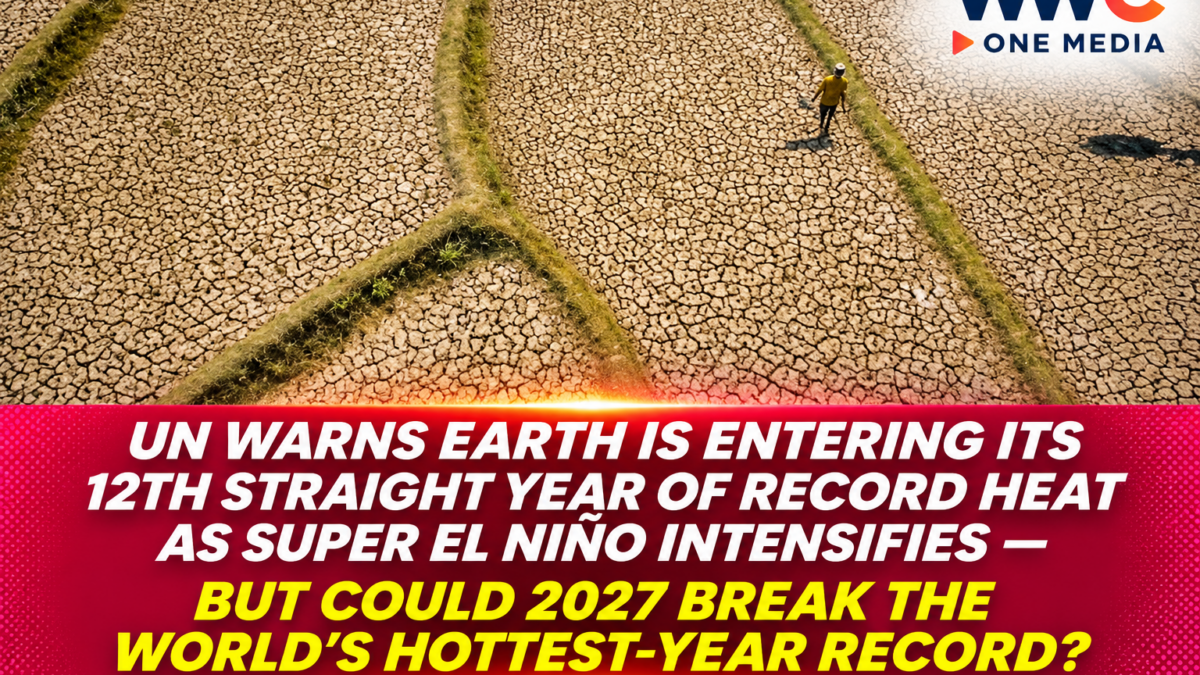
GENEVA, SWITZERLAND / MANILA, PHILIPPINES — November 10, 2026 — The planet is approaching another alarming climate milestone as the United Nations warns that 2026 is on track to become one of the four hottest years ever recorded, extending an unprecedented 12-year stretch of exceptionally high global temperatures.
And scientists fear the worst may not be over.
According to a new World Meteorological Organization (WMO) report released on November 9, global average temperatures from January through September 2026 were approximately 1.47°C above pre-industrial levels, while an unusually powerful El Niño threatens to push temperatures even higher through 2027.
The report confirms that every year from 2015 through 2026 is expected to rank among the 12 warmest years since reliable global temperature records began around 1850.
The warning comes as world leaders gather in Antalya, Türkiye, for the United Nations COP31 climate summit, where governments face mounting pressure to deliver meaningful reductions in greenhouse gas emissions.
But the crisis extends far beyond rising air temperatures.
The world’s oceans are accumulating unprecedented amounts of heat, global sea levels have reached record highs, and glaciers continue retreating.
For vulnerable countries such as the Philippines, the consequences could include more dangerous extreme heat, worsening coastal flooding, agricultural disruption and heightened risks from powerful tropical cyclones.
The biggest question now is whether governments can accelerate climate action before another year of record-breaking temperatures pushes the world closer to long-lasting and increasingly costly environmental damage.
Twelve Consecutive Years Among the Hottest Ever Recorded
The WMO’s State of the Climate Update 2026 presents a troubling picture of the planet’s long-term warming trend.
The organization analyzed nine internationally recognized temperature datasets to evaluate global conditions.
Its findings show that the period from 2015 through 2026 contains the 12 warmest individual years in the instrumental record.
Even more striking, 2023, 2024, 2025 and 2026 are expected to rank as the four hottest years.
The report estimates that January-to-September temperatures in 2026 averaged 1.47°C above the 1850–1900 baseline.
That compares with the following full-year temperature anomalies:
- 2023: Approximately 1.46°C above pre-industrial levels.
- 2024: Approximately 1.55°C, the highest annual average recorded.
- 2025: Approximately 1.43°C.
- January–September 2026: Approximately 1.47°C.
Because the latest figure covers only the first nine months of 2026, the final annual ranking has not yet been established.
However, scientists believe 2026 will finish among the four warmest years.
The European Union’s Copernicus Climate Change Service has gone further, predicting that 2026 is most likely to become the second-warmest year on record.
The continued warming reflects the accumulation of greenhouse gases in the atmosphere, with natural climate patterns influencing shorter-term variations.
Super El Niño Could Push Global Temperatures Even Higher in 2027
One of the biggest immediate concerns is the intensification of El Niño.
El Niño occurs when sea-surface temperatures in the central and eastern tropical Pacific become warmer than normal, affecting weather patterns around the world.
The phenomenon can influence rainfall, drought conditions, temperature extremes and atmospheric circulation.
The WMO says the current El Niño has strengthened since August and could become the strongest event observed in its records by December 2026.
The agency forecasts unusually high sea-surface temperature anomalies in the tropical Pacific during the November 2026 to January 2027 period.
El Niño typically increases global average temperatures by approximately 0.1°C to 0.2°C.
Its strongest effect on global temperature often occurs after the event begins intensifying.
That delay is why scientists are particularly concerned about 2027.
WMO Secretary-General Celeste Saulo warned that the developing El Niño could help produce another record-breaking year.
However, a new annual temperature record is not guaranteed.
Actual outcomes will depend on the evolution of El Niño and other climate conditions.
The underlying long-term warming trend is driven primarily by human-produced greenhouse gases, while El Niño temporarily adds to that warming.
Is the World About to Breach the Paris Agreement’s 1.5°C Limit?
Perhaps the most consequential finding concerns the international goal of limiting global warming to 1.5°C above pre-industrial levels.
Under the 2015 Paris Agreement, countries committed to holding the increase in global average temperature well below 2°C and pursuing efforts to limit it to 1.5°C.
The threshold matters because climate risks generally intensify as warming increases.
These include extreme heat, heavy rainfall, droughts, ecosystem damage and rising sea levels.
Copernicus reported on November 6 that 2026 is virtually certain to become the second calendar year, after 2024, to exceed an annual average of 1.5°C above pre-industrial levels.
October 2026 was also identified as the warmest October on record, approximately 1.75°C above the pre-industrial baseline.
But there is an essential scientific distinction.
A single year or month exceeding 1.5°C does not automatically mean the Paris Agreement’s long-term temperature objective has been permanently breached.
The long-term objective concerns sustained global warming over an extended period.
Nevertheless, repeated annual exceedances increase concern that the world is approaching a lasting breach of that benchmark.
Scientists warn that even small additional increases in average global temperature can significantly increase climate-related risks.
World’s Oceans Reach Record Heat Levels
The WMO report also highlights an accelerating crisis beneath the ocean’s surface.
Oceans absorb approximately 90% of the excess heat accumulating in Earth’s climate system.
This has helped limit the amount of warming experienced immediately in the atmosphere, but it has also caused substantial changes to marine environments.
Ocean heat content reached record levels in 2025 and continued increasing during 2026, according to preliminary observations.
The WMO says the planet is on course for its tenth consecutive year of record ocean heat.
Warmer oceans have several consequences.
They can contribute to more intense rainfall and supply energy that supports powerful tropical cyclones.
They can also place severe stress on coral reefs, change marine ecosystems and affect the geographical distribution of fish populations.
Coral bleaching becomes more likely when ocean temperatures remain unusually high for extended periods.
These changes are particularly important for island nations and coastal economies.
In the Philippines, millions of people depend on fisheries, marine tourism and coastal resources for employment and food security.
As WWC ONE MEDIA recently reported on the possible effects of El Niño on Philippine marine life, changing ocean conditions may affect coral reefs and the reproductive patterns of marine species.
The consequences could extend beyond environmental damage to coastal livelihoods and local food supply.
Global Sea Levels Reach New Highs as Ice Continues Melting
The latest WMO assessment also reports that global mean sea level reached a record high in 2026.
Satellite measurements dating back to 1993 reveal a long-term upward trend.
Two major processes are responsible.
First, seawater expands as it becomes warmer.
Second, melting glaciers and land-based ice sheets add water to the oceans.
The result is a growing threat to low-lying coastal communities.
Higher baseline sea levels can worsen coastal flooding and increase the reach of storm surges during dangerous weather events.
Even relatively small increases can raise risks for communities already exposed to coastal erosion, subsidence and inadequate drainage.
The WMO estimates that approximately 900 million people worldwide live in low-lying coastal areas exposed to increasing sea-level threats.
In countries such as the Philippines, the challenge involves protecting communities while strengthening roads, ports, water systems, housing and other critical infrastructure.
However, sea-level rise does not occur uniformly everywhere.
Local conditions, including land movement and regional ocean circulation, influence the rate experienced in specific locations.
Why the Philippines Faces Particularly Serious Climate Risks
The Philippines is highly exposed to tropical cyclones, coastal flooding, extreme rainfall and periods of drought.
Its geography creates multiple climate vulnerabilities.
Many communities are concentrated along coastlines, while agriculture and water supplies depend heavily on seasonal rainfall.
A stronger El Niño can increase the likelihood of below-normal rainfall in many areas of the country.
That can place pressure on irrigation systems, reservoirs and hydropower generation.
Reduced agricultural production can also affect food prices and household spending.
In earlier reporting, WWC ONE MEDIA examined the possibility that El Niño could become a major threat to Philippine inflation, as dry conditions threaten farms, water supplies and energy production.
The economic consequences can spread beyond agriculture.
Food shortages can increase consumer prices.
Businesses may face higher operating costs.
Local governments may need to spend more on emergency water delivery and disaster assistance.
However, El Niño does not mean every Philippine province will experience identical weather conditions.
Heavy rainfall and tropical cyclones can still occur even during a broader period of drought risk.
Regional forecasts from PAGASA remain essential for determining the threats facing individual communities.
Philippine Communities Already Preparing for Drought Risks
The latest global temperature warning comes as Philippine authorities prepare for the possible effects of a very strong El Niño extending into 2027.
PAGASA has warned that many areas could experience below-normal rainfall, dry spells or drought.
The extent of the impact will depend on how the climate pattern evolves.
Agricultural communities may be particularly vulnerable because irrigation, crop productivity and livestock operations depend on adequate water supplies.
Local governments may also face challenges maintaining reliable household water service.
As WWC ONE MEDIA reported on projections for dry spells and drought affecting Philippine provinces, authorities have identified potentially widespread water-security risks extending into early 2027.
Those projections are warnings of possible conditions, not confirmation that every affected area will experience a severe drought.
Early preparation can help reduce damage.
Measures include monitoring water resources, coordinating agricultural assistance, improving irrigation efficiency and providing timely weather advisories.
COP31 Opens in Türkiye as Climate Pressure Intensifies
The latest UN climate warning was released at the opening of COP31, the 31st Conference of the Parties to the United Nations Framework Convention on Climate Change.
The summit is taking place in Antalya, Türkiye, from November 9 to 20, 2026.
The gathering brings governments together to discuss emissions reductions, adaptation, climate finance and implementation of existing international commitments.
But the negotiations face significant political and economic obstacles.
Developing countries are demanding more financial support to cope with climate impacts.
Wealthier countries face pressure to provide funding and accelerate their transition to cleaner energy.
Major economies also disagree over the pace of reducing fossil-fuel dependence.
The United States’ absence from formal participation has added another challenge to the negotiations.
Climate officials are urging governments to move beyond promises and demonstrate measurable progress.
As WWC ONE MEDIA reported on the opening of COP31 in Türkiye, the summit is taking place against a backdrop of mounting extreme-weather losses and insufficient global climate action.
For vulnerable countries, the most urgent priorities include reliable climate finance, stronger disaster preparedness and support for communities already experiencing irreversible losses.
Why the Climate Crisis Is Also an Economic Crisis
Climate change is frequently discussed as an environmental issue, but its consequences are increasingly visible across the global economy.
Extreme heat can reduce labor productivity and increase health risks for outdoor workers.
Drought can reduce agricultural yields and place pressure on food prices.
Flooding can damage homes, factories, roads and electricity networks.
Warmer oceans and stronger coastal hazards can threaten tourism, fishing and international trade.
Insurance companies and governments may face growing financial exposure as severe disasters become more costly.
Businesses also need to consider how climate risks affect supply chains, production facilities and long-term investments.
For the Philippines, extreme-weather damage can place additional pressure on public finances.
Funds intended for infrastructure, healthcare and education may have to be redirected toward emergency response and reconstruction.
This is why climate adaptation is becoming an economic development priority.
The Philippines has begun developing a national framework to address climate-related loss and damage.
In related coverage, WWC ONE MEDIA examined the DENR, Climate Change Commission and UNDP initiative to improve access to climate finance and disaster-loss support.
The initiative aims to improve coordination and help vulnerable communities respond to the financial consequences of climate-related disasters.
However, the framework’s effectiveness will depend on implementation, financing and the ability of assistance to reach affected populations.
What Governments Must Do Before 2027
The WMO’s findings emphasize that monitoring alone is insufficient.
Countries need to respond to the risks already emerging while reducing the greenhouse gas emissions driving long-term warming.
First, reduce emissions. Expanding low-carbon energy, improving efficiency and reducing methane emissions can help limit additional warming.
Second, strengthen early warning systems. Accurate forecasts and timely warnings can reduce deaths and economic damage from extreme weather.
Third, protect water and food security. Governments need drought planning, resilient agriculture and more reliable water infrastructure.
Fourth, prepare coastal communities. Rising seas require stronger land-use planning, ecosystem protection and appropriately designed infrastructure.
Fifth, improve climate finance. Vulnerable countries need access to affordable funding for adaptation and recovery.
These actions cannot instantly reverse the warming already underway.
But they can influence how much additional warming occurs and how severely communities are affected.
The Bigger Picture: Earth Is Warming Faster Than the World Is Responding
The United Nations’ latest climate assessment delivers an unmistakable warning.
The past 12 years are expected to be the warmest in recorded history.
Global temperatures through September 2026 averaged approximately 1.47°C above pre-industrial levels.
A potentially record-strength El Niño could push temperatures higher into 2027.
Meanwhile, ocean heat continues breaking records, sea levels are rising and the long-term loss of glaciers and ice sheets is reshaping the planet.
These findings do not mean that every location will experience the same temperature increase or that every severe weather event is caused exclusively by climate change.
But the broader scientific evidence shows that greenhouse gas emissions are warming the climate and increasing the risks associated with many types of extreme weather.
For the Philippines, the stakes include water security, agriculture, fisheries, coastal communities and disaster preparedness.
For world leaders meeting at COP31, the challenge is converting urgent warnings into measurable action.
The world has now experienced 12 consecutive years that rank among the hottest ever recorded. But with a powerful El Niño developing and global emissions continuing to drive long-term warming, could 2027 become the hottest year in history—and will governments act quickly enough to reduce the damage before the next record is broken?