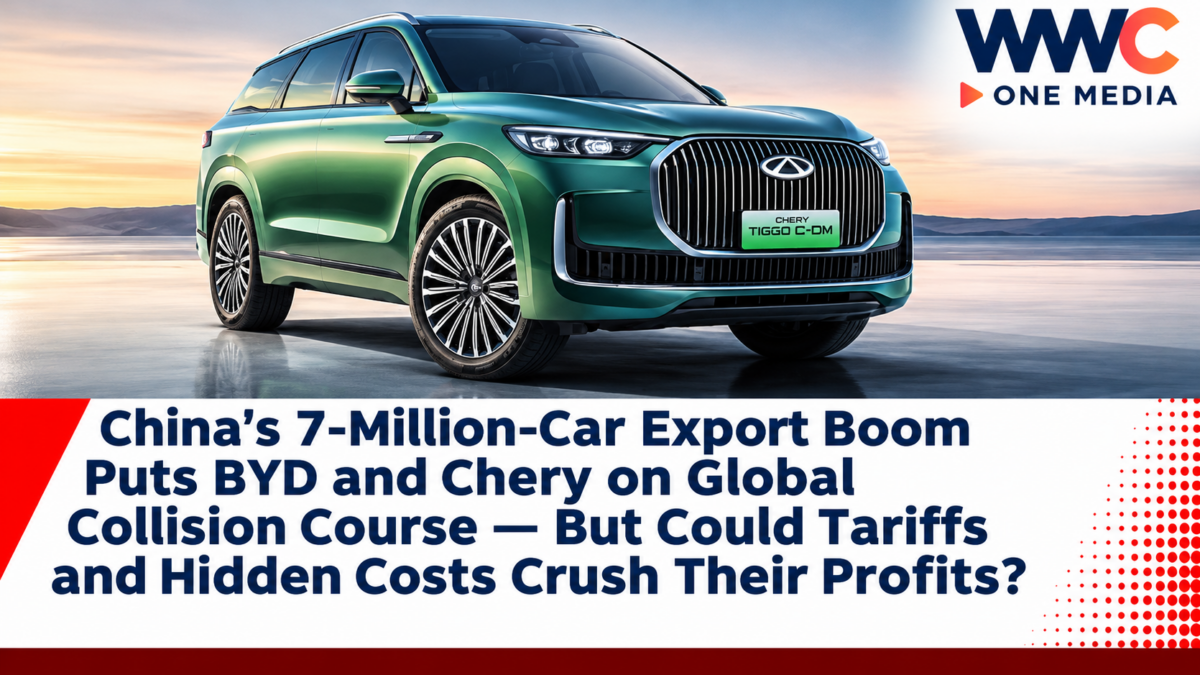
BEIJING / HONG KONG — November 10, 2026 — China’s automobile industry is conquering overseas markets at an extraordinary pace, with manufacturers including BYD and Chery exporting millions of vehicles as they challenge established automotive giants from Japan, Europe and the United States.
But behind the record-breaking shipments lies an increasingly uncomfortable economic reality.
China’s domestic car market is weakening, manufacturers are fighting destructive price wars, and the cost of transporting vehicles to international buyers is climbing.
Meanwhile, governments from Europe to North America are introducing tariffs, import restrictions and additional scrutiny of Chinese-made vehicles.
According to industry figures reported by the Associated Press, China exported more than 7.1 million passenger vehicles during the first nine months of 2026, an increase of more than 70% compared with the same period a year earlier.
September alone recorded approximately 919,000 overseas shipments, up 64% from September 2025.
However, domestic passenger-car sales fell sharply over the same period, exposing the growing dependence of Chinese manufacturers on international demand.
Bloomberg’s analysis of China’s automotive export boom examines the mounting costs and competitive pressures surrounding the international expansion of companies such as BYD and Chery.
The central question is no longer whether China can manufacture and export enormous numbers of vehicles.
It is whether those companies can earn sustainable profits while building overseas factories, paying for expensive shipping, absorbing trade barriers and fighting competitors determined to protect their markets.
China’s Car Exports Surpass 7 Million in Nine Months
China’s automotive industry is undergoing a historic transformation.
For years, international manufacturers viewed China primarily as a vast consumer market where they could sell vehicles to a rapidly expanding middle class.
Today, China has become one of the world’s dominant automotive exporters.
More than 7.1 million passenger vehicles were exported between January and September 2026, according to industry data cited by the Associated Press.
The increase exceeded 70% from the corresponding period in 2025.
Exports in September reached approximately 919,000 units, representing annual growth of 64%.
But the strength of international shipments contrasts sharply with domestic conditions.
Chinese passenger-car retail sales fell approximately 27% in September.
The divergence reflects weaker consumer confidence, reduced purchase incentives and intense competition among domestic manufacturers.
WWC ONE MEDIA previously examined the trend in China Exports Over 7 Million Cars as Domestic Sales Plunge 22% — But Is Its Auto Industry Heading for a Global Trade War?.
The figures reveal a growing dependence on international markets.
Foreign demand is increasingly becoming essential to keeping China’s massive automotive manufacturing system operating.
BYD and Chery Are Leading the Global Expansion
Two of the most important companies in China’s automotive export boom are BYD and Chery.
They represent different but increasingly overlapping business strategies.
BYD has built its reputation around electric vehicles, plug-in hybrids, batteries and vertically integrated manufacturing.
Chery has developed a substantial international business selling conventional gasoline vehicles alongside hybrids and electric models.
Both are expanding their overseas distribution networks.
But Chery has historically held a particularly strong position in total Chinese passenger-car exports.
BYD, meanwhile, has become a major leader in shipments of Chinese-made new-energy vehicles.
The distinction matters because different rankings use different categories.
A manufacturer leading electric-vehicle exports does not necessarily lead total passenger-car exports when conventional gasoline models are included.
In August, Chery exported approximately 193,069 passenger vehicles, while BYD shipped around 183,746, according to China Passenger Car Association figures reported by CnEVPost.
Both manufacturers have continued expanding internationally despite weakening demand at home.
BYD’s Overseas Business Is Now Bigger Than Its Domestic Revenue
One of the strongest signals of China’s automotive transformation came from BYD’s first-half financial results.
The company reported approximately 181.3 billion yuan, or US$27 billion, in overseas revenue during the first six months of 2026.
International revenue accounted for roughly 53% of total sales.
That marked an important milestone: BYD generated more revenue abroad than within Greater China.
According to Bloomberg’s August reporting, overseas revenue grew approximately 34% while revenue from Greater China declined about 31%.
The figures demonstrate why overseas expansion has become essential to BYD’s financial performance.
International markets allow manufacturers to reach new customers and, in some cases, sell vehicles at higher prices than comparable models command in China.
For example, Bloomberg reported that BYD’s Seal U plug-in hybrid SUV was marketed in Germany at prices considerably higher than the corresponding Chinese-market version.
But overseas sticker prices do not automatically represent pure profit.
Manufacturers must account for shipping, tariffs, dealer margins, warranties, taxes and distribution costs.
The profitability advantage depends on the entire cost structure.
China’s Domestic Price War Is Forcing Automakers Abroad
China’s car industry has been struggling with intense competition.
Manufacturers have repeatedly reduced prices to attract customers.
Discounts may temporarily stimulate demand, but they also squeeze profit margins.
Companies with weaker financial resources can find it increasingly difficult to recover research, development and manufacturing expenses.
The problem becomes particularly severe when production capacity expands faster than consumer demand.
Rather than keep factories idle, automakers have strong incentives to pursue overseas orders.
International expansion can help manufacturers maintain production volumes and generate cash flow.
However, the same strategy creates new risks.
If several Chinese companies enter the same foreign market simultaneously, they may eventually begin competing aggressively on price there as well.
That could recreate the profitability problems they are trying to escape.
China Risks Exporting Its Price War to the Rest of the World
The rapid entry of Chinese manufacturers has unsettled established automotive companies.
Brands from Japan, Germany, South Korea and the United States now face competition from Chinese vehicles offering attractive technology and competitive prices.
Chinese manufacturers benefit from large-scale production, established battery supply chains and substantial investment in electric-vehicle technology.
But lower consumer prices do not always mean that every manufacturer is profitable.
Some companies may accept smaller margins to gain market share.
Others may invest heavily in distribution networks before international sales reach sufficient scale.
For established manufacturers, the challenge is maintaining competitiveness without destroying profitability.
For governments, the issue involves protecting domestic employment while preserving consumer access to affordable vehicles.
The growing tension is contributing to trade restrictions and industrial-policy disputes across several regions.
Shipping Costs Threaten China’s Automotive Export Advantage
One of the less visible challenges involves transporting millions of vehicles from Chinese factories to overseas buyers.
Cars require specialized cargo-handling arrangements.
Large roll-on/roll-off vessels, commonly called car carriers, are designed to move vehicles efficiently across oceans.
But China’s extraordinary export growth has strained available shipping capacity.
The Wall Street Journal reported that Chinese vehicle shipments could approach 10 million units in 2026, compared with fewer than 600,000 in 2019.
That represents an enormous increase in demand for shipping services.
Car-carrier charter rates have risen as exporters compete for available vessels.
The Journal reported that large car-carrier daily rates reached approximately $70,000 in June.
Other shipping-market observations have recorded even higher rates for particular vessel types and charter periods.
The exact cost depends on vessel capacity, contract terms, route and market conditions.
Higher freight expenses can reduce the financial advantages of manufacturing vehicles in China.
BYD Is Building Its Own Shipping Fleet
BYD is responding to the shortage by investing in transportation infrastructure.
The company has assembled a fleet of eight dedicated car carriers and plans to expand the number of vessels.
Reporting by Rest of World indicated that BYD intends to grow its fleet to approximately 18 ships by 2029.
Operating dedicated vessels can reduce dependence on external shipping providers and give manufacturers more control over delivery schedules.
It can also help coordinate shipments as sales volumes increase.
But owning ships creates its own costs.
Companies must finance vessel construction or purchases, operate ships, maintain crews and manage fuel expenses.
Shipping capacity also needs to remain sufficiently utilized to justify the investment.
If automotive demand slows, excess vessel capacity could become an expensive burden.
For BYD, the fleet strategy is a long-term investment in global logistics rather than a guarantee of lower costs under every market condition.
Europe Is Tightening Restrictions on Chinese Vehicles
Chinese automakers have made substantial progress in European markets.
Affordable electric and hybrid vehicles have attracted buyers seeking alternatives to established manufacturers.
But European governments have become increasingly concerned about the effect of Chinese imports on domestic producers.
The European Union previously imposed additional tariffs on certain Chinese-made battery-electric vehicles.
In October 2026, the EU also agreed to cap annual imports of Chinese-made hybrid vehicles at 350,000 units, according to Associated Press reporting.
The measure creates additional uncertainty for manufacturers that expanded hybrid shipments after restrictions on battery-electric models.
Import quotas and tariffs can reduce the advantages of exporting finished vehicles directly from China.
Manufacturers may respond by developing local factories, changing product strategies or shifting sales toward other regions.
However, those adjustments require substantial investment and can take years to implement.
China Is Reducing Export Tax Support
Chinese automakers also face changes to domestic tax incentives.
China announced plans to reduce the export value-added-tax rebate for new-energy vehicles from 13% to 9%, effective April 1, 2027.
The reduction could increase effective export costs for manufacturers.
Deutsche Bank analysts estimated that the change could reduce BYD’s net profit by approximately 5,000 yuan per exported vehicle, according to CnEVPost.
That is an analyst estimate, not a guaranteed loss on every vehicle.
The actual impact will depend on export mix, prices, production costs and company responses.
Manufacturers could attempt to raise overseas selling prices, negotiate lower costs or accept reduced margins.
But in highly competitive markets, passing additional costs to consumers may not be easy.
The tax change adds another financial challenge just as overseas expansion becomes more important.
Overseas Factories Offer an Escape From Tariffs
Chinese manufacturers are increasingly investing in production facilities outside China.
BYD has pursued projects in countries including Hungary, Brazil and Turkey.
Other Chinese automakers are expanding production arrangements or partnerships in Europe and emerging markets.
Local production can reduce exposure to certain import tariffs and transportation expenses.
It may also improve access to customers and create local jobs.
But establishing factories involves major capital commitments, regulatory approvals and supply-chain arrangements.
Manufacturers must also train workers, establish quality systems and secure reliable component supplies.
The economics can differ substantially from manufacturing in China.
Labor expenses, energy costs, taxation and factory utilization all affect profitability.
The strategy therefore replaces some export-related risks with investment and execution risks.
Chinese Automakers Are Redesigning Cars for Overseas Buyers
Manufacturers are learning that international expansion requires more than exporting models designed for Chinese consumers.
Reuters reported in May that BYD, Chery, Changan and other companies were developing vehicles tailored to regional preferences.
European buyers, for example, often favor smaller hatchbacks that are less prominent in China’s domestic market.
Other regions may prefer pickup trucks, larger SUVs or vehicles suited to difficult road conditions.
Manufacturers are also adjusting styling, durability and features to meet local expectations.
This approach resembles the strategies used by Japanese manufacturers during earlier periods of international expansion.
Toyota’s Yaris became an important example of a vehicle developed with European preferences in mind.
For Chinese automakers, greater localization could improve customer acceptance.
But designing separate vehicles for different markets can increase development and production complexity.
Successful international growth will require balancing regional customization against economies of scale.
The United States Remains a Difficult Market
Although Chinese automotive brands are expanding internationally, the US remains heavily restricted.
High tariffs and national-security regulations have limited market access for Chinese-connected vehicles.
American automakers have expressed concern about the competitive threat posed by Chinese manufacturers.
Ford CEO Jim Farley has previously characterized the industry’s challenge from China as existential.
The United States has defended its restrictions partly on industrial and national-security grounds.
Critics of protectionism argue that limiting competition can reduce consumer choice and keep vehicle prices higher.
Supporters argue that restrictions protect domestic manufacturing capacity and sensitive technologies.
The result is a fragmented global market in which Chinese automakers encounter very different rules depending on the destination country.
Canada Is Opening a Limited Door to Chinese Electric Vehicles
Canada has adopted a different approach from the United States.
Under a trade arrangement announced earlier in 2026, Canada agreed to allow up to 49,000 Chinese-made electric vehicles annually at a tariff rate of 6.1%.
The arrangement has created new opportunities for companies such as BYD and Chery.
However, the quota is limited and its allocation among manufacturers has been a subject of policy discussion.
Bloomberg previously reported that Canadian officials were considering whether individual companies should face limits on their share of the program.
For Chinese automakers, Canada offers a potentially valuable new market.
For North American manufacturers, the arrangement has raised questions about competition and supply-chain integration.
The impact will depend on actual imports, consumer demand, regulatory requirements and how the quota is administered.
The Philippines Is Becoming an Important Market for BYD
The effects of China’s automotive export boom are increasingly visible in the Philippines.
Chinese brands have expanded their vehicle lineups and dealership networks as Filipino consumers show growing interest in electric and hybrid technology.
BYD is one of the most prominent examples.
WWC ONE MEDIA reported that the company’s Philippine distributor sold 28,399 vehicles during the first eight months of 2026, representing approximately 99% growth from the comparable period a year earlier.
Read the full report: BYD Philippines Nearly Doubles Sales to 28,399 Units — But One Type of Vehicle Is Driving Almost 80% of the Boom.
Plug-in hybrids accounted for approximately 79% of BYD’s Philippine sales during the period.
The figures suggest that consumers are increasingly attracted to vehicles combining electric driving capability with gasoline engines.
The appeal may be particularly strong in areas where charging infrastructure is still developing.
But Philippine distributor sales should not be confused with China’s factory-export statistics.
Vehicle shipments, registrations and retail sales are distinct measures.
Subic Port Is Emerging as an EV Import Gateway
China’s automotive expansion also has implications for Philippine logistics infrastructure.
Subic Port has begun handling shipments of electrified vehicles intended for local distribution.
WWC ONE MEDIA previously examined the development in BYD Cars Land at Subic Port for Philippine Buyers — What This Could Mean for the Country’s EV Market.
The reported shipment included 80 hybrid vehicles and 20 battery-electric vehicles.
Local port authorities have discussed the potential to expand future vehicle handling volumes.
A sustained increase in imported cars could create demand for storage, distribution, inspection and after-sales services.
However, the long-term economic impact will depend on continued vehicle imports and investment in supporting infrastructure.
The Philippines may benefit from wider consumer choice while also facing questions about domestic automotive manufacturing competitiveness.
European Security Concerns Add Another Obstacle
Chinese vehicles are also facing scrutiny over software, connectivity and data security.
Modern cars increasingly use cameras, sensors, location services and internet-connected systems.
These features can improve navigation, safety and convenience.
But they also raise questions about how information is collected, stored and shared.
Some European lawmakers have called for closer scrutiny of Chinese-made connected vehicles.
WWC ONE MEDIA examined the issue in EU Lawmakers Demand Security Probe Into BYD Cars — Could Chinese Electric Vehicles Face Restrictions Across Europe as Spying Fears Intensify?.
The existence of security concerns does not establish that every Chinese connected vehicle engages in espionage or unlawful data collection.
Any allegations should be examined through evidence and appropriate regulatory processes.
Nevertheless, uncertainty about data practices could create additional compliance costs for manufacturers entering foreign markets.
Could China’s Export Boom Undermine Its Own Profits?
The largest financial risk may be that manufacturers expand sales volumes faster than they improve profitability.
International sales can support revenue and factory utilization.
But they also require spending on transportation, distribution, warranty services, marketing and local operations.
Tariffs and reduced export tax rebates create further pressures.
If manufacturers respond by cutting prices, profit margins can narrow even as vehicle shipments rise.
BYD’s international growth illustrates both sides of this equation.
Its overseas revenue has become a major source of growth.
But the company remains exposed to intense competition, substantial investment requirements and changing trade rules.
For Chery, its established international presence offers advantages, but overseas exposure also makes trade barriers and foreign consumer demand increasingly important.
Success will depend on whether automakers can convert international market share into reliable long-term returns.
What Happens Next for BYD, Chery and China’s Auto Industry?
The next phase of China’s automotive expansion will likely be determined by several factors.
Domestic consumer demand must stabilize if manufacturers are to reduce their dependence on overseas markets.
International shipping capacity will need to keep pace with vehicle production.
Manufacturers must also manage changing tariffs and import quotas, particularly in Europe.
The planned reduction in China’s new-energy vehicle export tax rebate in April 2027 will become another test of profitability.
Overseas factories may help manufacturers avoid some trade barriers, but those facilities must operate efficiently to justify the investment.
And consumers in markets such as the Philippines, Brazil and Europe will increasingly judge Chinese brands on reliability, servicing, safety and resale value—not simply purchase price.
The companies that succeed may become lasting global automotive leaders.
Others could struggle if rapid growth fails to generate sufficient earnings.
The Bigger Picture: China’s Auto Revolution Has Entered Its Most Difficult Phase
China’s automotive industry has achieved an extraordinary transformation.
Its manufacturers have developed competitive electric vehicles, established extensive battery supply chains and expanded into markets once dominated by Japanese, European and American companies.
More than seven million passenger-vehicle exports in nine months demonstrate the scale of that achievement.
But China’s export boom is also a response to difficult domestic economic conditions.
Weaker consumer demand and fierce price competition are encouraging manufacturers to seek growth abroad.
That strategy brings additional challenges.
Shipping costs are rising, foreign governments are imposing restrictions and Chinese tax incentives are being reduced.
Meanwhile, the industry’s international expansion requires substantial capital.
For consumers, increased competition could mean more affordable and technologically advanced vehicles.
For established automakers, it creates pressure to improve efficiency and accelerate innovation.
For Chinese manufacturers, however, the challenge is becoming increasingly financial.