SINGAPORE / NEW YORK — November 10, 2026 — Global oil prices extended their dramatic collapse on Tuesday as hopes of a diplomatic breakthrough between the United States and Iran sent international crude benchmarks toward their lowest levels since August, raising the possibility of relief for consumers and businesses battered by months of expensive fuel.
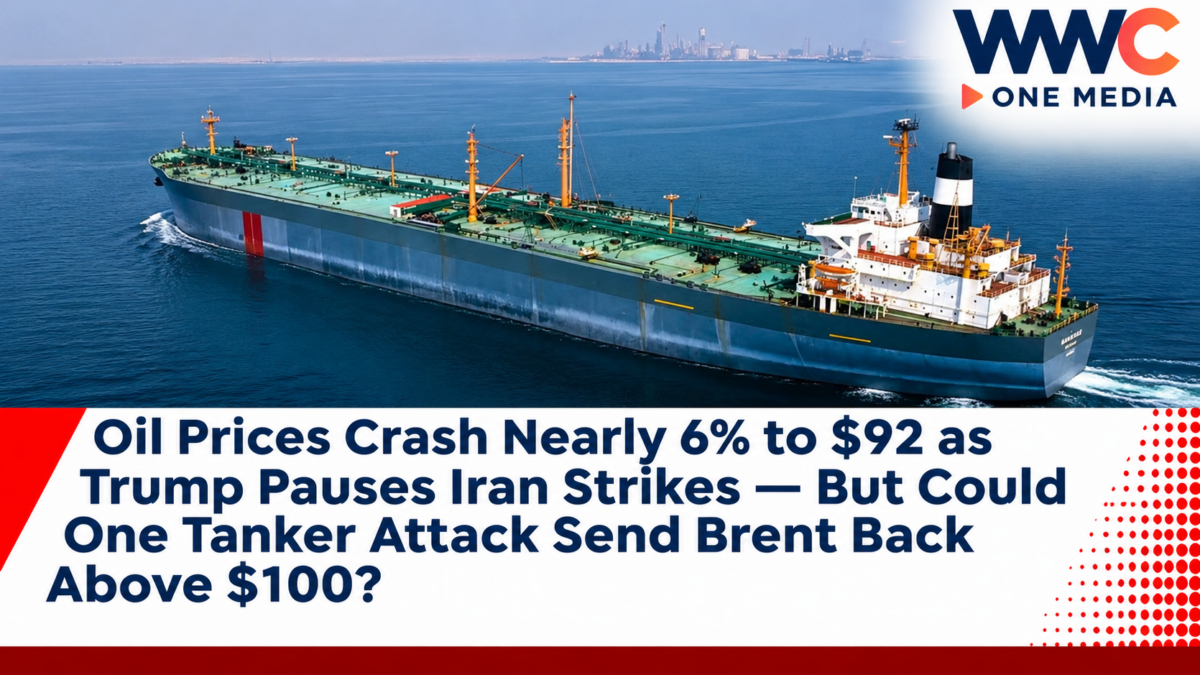
Brent crude, the international oil benchmark, plunged 5.85% to settle at $92.57 a barrel on Monday, November 9, before declining further during Tuesday’s Asian trading session.
US West Texas Intermediate (WTI) crude dropped 4.38% to settle at $86.85 a barrel on Monday.
By Tuesday, Brent was trading near $92, while WTI remained around $86.
The steep selloff followed President Donald Trump’s indication that the United States would avoid additional military strikes against Iran for the time being, reducing fears of another major escalation in the Middle East.
But the sudden improvement in market sentiment contrasts sharply with conditions at sea.
The United States continues enforcing a naval blockade affecting Iran, commercial vessels remain exposed to attacks, and negotiations between Washington and Tehran have yet to produce a final settlement.
With Brent losing approximately 22% from its October peak, could the latest oil-market collapse finally bring lasting fuel-price relief—or will another attack in the Strait of Hormuz send crude soaring again?
Oil Prices Slide Toward Their Lowest Levels Since August
Oil markets experienced another extraordinary trading session on November 9.
According to Reuters, Brent futures fell $5.75 to settle at $92.57 per barrel.
WTI declined $3.98 to $86.85.
The losses extended a prolonged retreat from the six-month highs recorded at the end of October.
Brent had approached $118 per barrel on October 30, when concerns about renewed conflict and supply disruptions were intensifying.
By November 10, the benchmark had fallen approximately 22% from that peak.
Reuters reported that oil prices continued declining during Tuesday’s trading, with Brent quoted at $91.88 and WTI at $86.07 at one point.
These figures represent prices at different observation times, not separate daily closing settlements.
The downturn is particularly significant because crude oil had previously surged during the prolonged conflict involving Iran.
Energy traders are now rapidly reassessing how much of that geopolitical risk should remain reflected in futures prices.
Trump Signals No Immediate New Strikes Against Iran
The immediate catalyst for the selloff was a change in the tone of Washington’s approach to Iran.
President Trump indicated that additional US military action was unnecessary for the moment as diplomatic discussions continued.
He said Washington would refrain from new strikes while evaluating the possibility of an agreement.
The president’s comments followed appeals from regional governments seeking to prevent another escalation.
Qatar has played an important mediating role in the diplomatic efforts.
For oil traders, the remarks reduced the perceived probability of a renewed US military campaign that could further disrupt Middle Eastern petroleum supplies.
But Trump’s position remains conditional.
The White House has not announced that the conflict is over or that all military operations and restrictions have ended.
A reduction in the expected likelihood of escalation is not the same as a completed peace agreement.
This distinction is crucial because oil futures respond not only to current supply conditions but also to expectations about what may happen next.
Iran Peace Hopes Trigger Historic Market Reversal
The latest decline extends an exceptionally volatile period.
Brent lost approximately 16% during the previous week, according to Bloomberg and Reuters.
Depending on the continuous futures series and contract-adjustment method used, that ranked among the sharpest weekly declines since the COVID-19 market turmoil.
The drop accelerated as investors reconsidered the implications of the November 3 US midterm election results and subsequent diplomatic signals.
Market participants increasingly expected Washington to prioritize negotiations rather than further military escalation.
WWC ONE MEDIA previously examined the earlier price collapse in Oil Prices Crash Nearly 8% as Iran Peace Talks Send Brent to $104 — But Could One Failed Deal Trigger a $140-a-Barrel Shock?.
That report tracked a previous wave of selling following renewed diplomatic optimism.
The November 9 decline brought prices substantially lower.
However, the comparison also illustrates the market’s vulnerability to sudden reversals.
Oil prices can rebound rapidly if expectations about future supply change again.
The Strait of Hormuz Remains the Biggest Threat
Despite the drop in crude prices, shipping through the Strait of Hormuz remains dangerous.
The narrow waterway connects major Persian Gulf energy exporters with international markets.
Under normal conditions, approximately one-fifth of global petroleum-liquids consumption moves through the strait.
Disruptions can affect shipments from major oil-producing countries and increase transportation and insurance costs.
The United States continues maintaining its naval blockade, while attacks on commercial vessels have complicated maritime operations.
Reuters reported that security incidents continued near the waterway even as financial markets became more optimistic about negotiations.
The Financial Times also reported recent attacks involving tankers near the Gulf.
This creates an unusual situation.
Oil futures are declining because traders expect less geopolitical disruption, even though the risks to shipping have not disappeared.
WWC ONE MEDIA examined those continuing dangers in Iran Says No Unauthorized Ships Crossed Strait of Hormuz After Navigation Systems Destroyed — New Warning Raises Fears for Global Oil Shipping.
The report covered Iranian claims about maritime restrictions and the condition of navigation infrastructure.
Some details of those incidents remain based on official claims that have not been independently confirmed.
The broader point is that oil-market optimism should not be mistaken for an all-clear signal for commercial shipping.
Physical Oil Supplies Are Also Recovering
Diplomatic optimism is not the only force pushing prices lower.
Physical supply conditions have improved in parts of the global oil market.
Bloomberg reported that producers in the Middle East have been restoring shipments after severe disruptions earlier in the war.
Saudi Arabia and the United Arab Emirates have been increasing flows, while competition for Asian customers has intensified.
Some physical crude prices have weakened relative to benchmark futures.
That matters because physical oil prices reflect the actual commercial conditions facing refiners and other buyers.
When more crude becomes available, buyers may be able to negotiate lower premiums.
However, improvements vary by location and product.
A recovery in crude exports does not necessarily mean that shipments of diesel, gasoline and other refined products have returned to normal.
Nor does increased production automatically resolve risks involving tankers, ports and shipping routes.
OPEC Production Adds Pressure to the Market
Global supply developments are also influencing prices.
Reuters reported that OPEC’s oil production increased in October, with Saudi Arabia, Kuwait and Iraq contributing to higher output.
Additional barrels can reduce pressure on buyers if they reach international markets.
But production and exports are different measures.
A producer may increase output while facing restrictions on shipping, storage or transportation.
For investors, the important issue is how much oil becomes commercially available to consumers.
OPEC and its partners must also evaluate whether changing market conditions justify adjustments to production policy.
If prices remain weak, some producers may have stronger incentives to protect revenues by limiting supply.
Any future output decision would need to be confirmed through an official announcement.
The latest market data demonstrate that traders are considering both diplomatic developments and the underlying balance between oil supply and demand.
Hedge Funds Were Already Reducing Bullish Oil Bets
Financial investors also contributed to the market reversal.
Before the latest price collapse, hedge funds and other speculative traders had been reducing positions that would benefit from higher crude prices.
These changes can intensify market moves when geopolitical expectations shift.
A trader who expects prices to rise may sell futures contracts after deciding that the risks have changed.
If many investors make similar decisions, the selling can amplify a decline.
WWC ONE MEDIA covered the trend in Hedge Funds Slash Bullish Oil Bets Before Crude Crashes 13% After US Midterms — But Could a Failed Iran Peace Deal Send Prices Soaring Again?.
The report examined how speculative positioning changed ahead of the steepest phase of the selloff.
However, changes in hedge-fund positions do not alone determine crude prices.
Actual production, consumption, inventories and transportation conditions remain essential.
Financial positioning can accelerate a market move without explaining every underlying cause.
Lower Oil Prices Could Ease Global Inflation Pressure
A sustained decline in crude prices could provide relief to the global economy.
Petroleum is an important input for transportation, logistics, agriculture and industrial production.
Higher energy expenses can eventually feed into consumer prices.
Conversely, lower oil prices can help reduce some inflationary pressure.
The effect is especially important for countries that import much of their fuel.
Cheaper petroleum can reduce costs for airlines, shipping companies, manufacturers and motorists.
It may also influence how central banks assess future inflation risks.
However, lower energy prices do not guarantee that overall inflation will immediately return to target.
Housing, wages, food prices and other costs can continue rising independently of crude oil.
Furthermore, monetary policymakers generally consider a broad range of economic data rather than respond to one commodity-price movement.
The decline in oil prices is therefore a potentially helpful development, not a complete solution to the world’s inflation problems.
Asian Fuel Markets Are Responding to the Oil Selloff
The change in crude-market sentiment is also affecting refined products.
Singapore is a major trading and bunkering center for Asian energy markets.
Prices of fuel oil used by ships and industrial consumers are influenced by crude availability, refining economics and regional demand.
As Middle Eastern supply concerns have eased, some Asian fuel-oil pricing indicators have weakened.
WWC ONE MEDIA examined those developments in Asia’s Fuel Oil Prices Just Plunged as Iran War Peace Hopes Grow — But Could Expensive Tankers and Another Supply Shock Send Prices Soaring Again?.
The earlier report highlighted how lower commodity prices could coexist with elevated freight costs.
That distinction remains important.
Crude prices, refined-product prices and marine transportation costs do not always move together.
A shipping company may face expensive fuel or insurance even when benchmark crude prices decline.
What Falling Oil Prices Mean for the Philippines
For the Philippines, lower international oil prices could eventually reduce pressure on household budgets and business expenses.
The country imports substantial quantities of petroleum products.
Fuel costs influence transportation, food distribution, industrial operations and electricity generation.
If the international decline persists, it could help reduce the cost of imported petroleum.
That might benefit motorists, public transportation operators, airlines and businesses.
However, Philippine gasoline and diesel prices do not move in perfect synchronization with Brent crude futures.
Local pump prices depend on regional refined-product benchmarks, the peso-dollar exchange rate, taxes, inventories and distribution costs.
A decline in Brent therefore does not guarantee an equivalent percentage reduction at Philippine gasoline stations.
The timing also matters.
Domestic fuel-price adjustments often reflect international trading over previous days rather than a single market quote.
For consumers, sustained lower prices would be more meaningful than a temporary one-day decline.
Could Brent Oil Fall Below $90?
The latest selloff has brought Brent closer to the psychologically important $90-per-barrel level.
Further progress in negotiations could encourage traders to remove more of the geopolitical risk premium.
Continued recovery in Middle Eastern exports could reinforce that pressure.
However, analysts cited by Reuters cautioned that a sustained move below $90 may require clearer evidence of lasting de-escalation.
That includes a credible agreement between Washington and Tehran and greater confidence in shipping security.
Without those developments, traders may remain reluctant to price out the full risk of renewed disruption.
A move below $90 is possible, but it is not guaranteed.
The market’s next direction will depend on both diplomacy and the actual availability of oil.
Could Another Tanker Attack Send Oil Back Above $100?
The opposite scenario also remains possible.
A major attack on commercial shipping, export infrastructure or oil-processing facilities could renew concerns about shortages.
If vessels become unwilling or unable to transit the Strait of Hormuz, transportation costs could rise rapidly.
That could reduce the amount of oil reaching international buyers.
Traders might then rebuild the geopolitical premium that has recently disappeared from futures prices.
Brent returning above $100 is a plausible risk scenario rather than an established forecast.
The scale of any rebound would depend on the seriousness of the disruption, available alternative routes, inventories and government responses.
Financial markets have already demonstrated how quickly oil prices can swing in response to changing expectations.
A failed diplomatic effort could reverse some of the recent decline.
But the size and duration of any future increase cannot be predicted reliably from political statements alone.
What Happens Next for Global Oil Markets?
Investors will be watching several developments.
The first is whether US-Iran negotiations produce a concrete agreement.
The second is whether the United States modifies its naval blockade and whether shipping restrictions ease.
The third is the pace of crude exports from major Persian Gulf producers.
The fourth is how OPEC and its partners respond to lower prices.
The fifth is the condition of tanker traffic through the Strait of Hormuz.
Markets will also assess global demand, particularly from major energy-consuming economies such as China, India and the United States.
For now, oil prices are responding more positively to the possibility of peace than to the continuing risks of conflict.
That balance could change quickly.
The Bigger Picture: Has the Oil War Premium Finally Broken?
The dramatic decline in oil prices represents a major reversal in the global energy market.
Brent has dropped from approximately $118 at the end of October to around $92 during November 10 trading.
The retreat reflects expectations that Washington may avoid further military escalation and pursue a diplomatic solution with Iran.
Improving physical supply conditions and reduced speculative buying have reinforced the selloff.
For consumers and fuel-importing economies, the possibility of sustained lower oil prices is welcome.
But the underlying conflict remains unresolved.
The US naval blockade is still in place.
Commercial shipping remains exposed to attacks.
And no final agreement guarantees that Middle Eastern energy supplies will return to normal.
With global oil prices falling toward $90 as hopes of a US-Iran deal grow, the biggest question is whether the market has finally escaped the war-driven energy crisis—or whether one failed negotiation or tanker attack could send crude back above $100 and unleash another wave of global fuel-price increases.