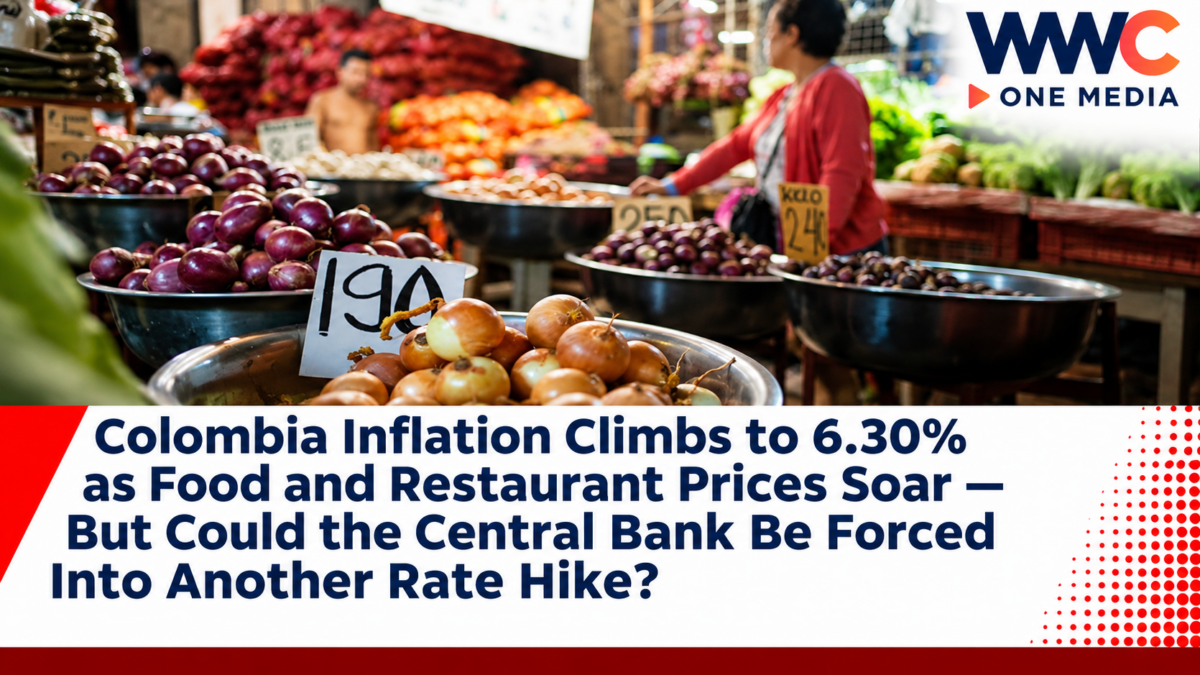
BOGOTÁ, COLOMBIA — November 10, 2026 — Colombia’s inflation rate accelerated to 6.30% in October, extending months of rising consumer prices and intensifying pressure on households already struggling with expensive food, restaurant meals, healthcare and education.
But the latest report delivered an unexpected glimmer of relief for policymakers.
Inflation increased less than economists anticipated, potentially giving Colombia’s central bank more time to evaluate its next move after an aggressive campaign of interest-rate increases.
According to figures released November 9 by Colombia’s National Administrative Department of Statistics (DANE), annual consumer inflation rose only marginally from September’s 6.29%.
Monthly inflation was 0.20%, below the 0.27% median forecast in a Reuters survey.
The result also undershot the 6.38% annual inflation rate expected by economists.
Bloomberg reported that the smaller-than-expected increase could reduce immediate pressure on policymakers to resume raising borrowing costs.
However, Colombia’s inflation problem remains serious.
Consumer prices are increasing at more than twice the central bank’s official 3% target, and several essential spending categories are experiencing substantially faster increases.
Could Colombia’s softer-than-expected inflation report mark the beginning of a lasting recovery—or will persistent price pressures force the central bank to raise interest rates again?
Colombia’s Inflation Reaches 6.30%, Below Market Expectations
Colombia’s official October inflation figures revealed a mixed picture.
Annual consumer inflation edged upward to 6.30%, compared with 6.29% in September.
The increase was only 0.01 percentage point, suggesting that the pace of inflation was stabilizing even though consumer prices continued rising.
During October alone, the consumer price index increased 0.20%.
That was below economists’ expectations for a 0.27% monthly increase.
The figure also represented a slowdown from September’s 0.37% monthly inflation rate.
For the first ten months of 2026, consumer prices increased a cumulative 5.94%.
The latest reading marks the third consecutive month of increasing annual inflation.
However, the October acceleration was much smaller than anticipated.
That distinction is important for investors.
A lower-than-expected inflation reading can reduce pressure for immediate monetary tightening, even when the overall inflation rate remains elevated.
But October’s result does not mean Colombia has achieved price stability.
The country remains a considerable distance from its central bank’s target.
Food, Restaurants and Education Are Driving Household Costs Higher
The inflation figures reveal that several important areas of household spending are experiencing particularly strong price increases.
DANE reported the following annual inflation rates for October:
| Spending category | Annual price increase |
|---|---|
| Restaurants and hotels | 9.39% |
| Education | 7.44% |
| Healthcare | 7.37% |
| Food and nonalcoholic beverages | 7.31% |
| Furniture and household maintenance | 6.60% |
| Overall consumer inflation | 6.30% |
Restaurant and hotel prices showed the strongest annual increase among the major spending categories.
Food prices were another important source of pressure.
The figures help explain why families may continue experiencing financial difficulties even when headline inflation comes in below expectations.
Inflation measures how quickly prices are changing.
A slowdown in inflation does not generally mean that prices have fallen.
Instead, it can mean that prices are increasing more slowly than before.
For Colombian consumers, the distinction matters because the cost of essential services remains substantially higher than a year ago.
Lower-Income Households Are Feeling the Pressure Most
Colombia’s inflation report revealed differences in how rising prices affect households across income groups.
According to DANE, annual inflation reached:
- 6.39% for vulnerable households.
- 6.34% for households classified as poor.
- 6.32% for middle-income households.
- 6.20% for higher-income households.
The figures indicate that lower-income and financially vulnerable families are experiencing somewhat faster increases in the prices of their consumption baskets.
These households often spend a greater proportion of their income on food, housing and essential services.
When those categories become more expensive, families may have less flexibility to adjust their budgets.
They may reduce spending on discretionary purchases or postpone important expenses.
Higher-income households generally have more opportunities to absorb price increases through savings or changes in spending patterns.
However, income-group inflation differences alone do not determine changes in living standards.
Wage growth, employment, household composition and access to support programs also matter.
The latest data nevertheless reinforce concerns about the unequal effects of persistent inflation.
Colombia’s Central Bank Holds Interest Rates at 12.25%
The inflation report comes less than two weeks after Colombia’s central bank decided to pause its monetary tightening campaign.
On October 30, Banco de la República held its benchmark interest rate at 12.25%.
The decision followed earlier increases totaling 300 basis points during 2026.
But policymakers were deeply divided.
Four members of the central bank’s seven-person board supported keeping rates unchanged.
Three favored an additional 25-basis-point increase.
The narrow vote suggests that another increase remains possible if inflation risks intensify.
Governor Leonardo Villar has indicated that the pause should not automatically be interpreted as the end of the tightening cycle.
The central bank’s official statement emphasized that future decisions would depend on inflation, economic activity and fiscal developments.
The November 9 inflation report may strengthen the argument for waiting.
However, it does not guarantee that rates will remain unchanged indefinitely.
Why Colombia’s Interest Rates Remain So High
The central bank has been trying to prevent inflation from becoming entrenched across the economy.
Higher policy rates generally make borrowing more expensive.
That can discourage some consumer spending and business investment, reducing demand-related price pressures.
But the strategy involves economic costs.
Businesses may postpone expansion projects when financing becomes expensive.
Households may find mortgages and other credit products less affordable.
And companies carrying substantial debt may face higher financing expenses.
The central bank must therefore balance inflation control against the risk of slowing economic activity too much.
Similar tensions are emerging elsewhere in Latin America.
WWC ONE MEDIA recently reported on Brazil’s monetary-policy dilemma in Brazil Freezes Interest Rates at 13.75% After Lula’s Election Comeback as Real Plunges 9% — But Could a Bigger Economic Crisis Be Coming?.
Brazil’s circumstances differ from Colombia’s, but both cases demonstrate how persistent inflation can limit central banks’ ability to lower borrowing costs.
Why the October Inflation Surprise Matters to Investors
Financial markets closely monitor whether inflation comes in above or below economists’ forecasts.
A lower reading can influence expectations for future interest-rate decisions.
If investors believe the central bank is less likely to tighten policy, government-bond yields and currency expectations may respond.
But market reactions depend on more than one economic indicator.
Colombia faces additional concerns involving public finances, domestic growth and international financial conditions.
The central bank’s October decision specifically identified fiscal developments as an important factor in the country’s economic outlook.
A favorable inflation surprise may therefore provide temporary relief without resolving wider risks.
WWC ONE MEDIA previously explored the region’s investment prospects in Latin America Has Its Best Investment Tailwinds in Decades — But the Biggest Opportunity May Still Be Hiding in Plain Sight.
That analysis examined how international capital flows, commodity prices and changing financial conditions could influence investment across Latin America.
For Colombia, controlling inflation while preserving economic growth remains essential to attracting long-term capital.
Colombia’s Economy Is Showing Signs of Slower Growth
Banco de la República’s October policy statement indicated that economic activity may have weakened during the third quarter.
The central bank cited evidence of slower private and public consumption.
It also pointed to subdued manufacturing and retail activity.
The slowdown complicated the decision about whether to continue raising interest rates.
Stronger inflation can justify tighter monetary policy.
But weaker economic growth can argue for caution.
Colombia’s economy expanded approximately 3.5% in the second quarter from a year earlier, according to official economic indicators.
However, that figure does not guarantee that growth continued at the same pace in subsequent months.
The central bank’s assessment suggests the economy entered the second half of the year facing a more difficult environment.
For companies, prolonged high borrowing costs can discourage investment.
For households, slower growth can increase uncertainty about wages and employment.
Policymakers therefore face pressure to control inflation without unnecessarily weakening economic activity.
El Niño Could Make Colombia’s Inflation Problem Worse
Weather-related risks remain an important part of the central bank’s outlook.
Colombia is vulnerable to the El Niño climate phenomenon, which can produce drought conditions and disrupt agricultural production.
Lower crop yields or transportation difficulties can affect food supplies and prices.
Changes in rainfall can also influence electricity generation and energy costs.
Colombia relies heavily on hydropower, making water availability economically important.
In its October monetary-policy report, Banco de la República identified El Niño as a potential source of additional inflation pressure.
The risk is particularly significant because food and regulated services have already contributed to rising prices.
A severe weather shock could undermine some of the improvement suggested by October’s lower-than-expected inflation reading.
However, the size and timing of any price impact remain uncertain.
Actual conditions will depend on weather patterns, agricultural output, supply chains and government responses.
Colombia’s Earthquake Recovery Adds Another Economic Challenge
The country’s economic outlook has also been affected by recovery efforts following the destructive earthquake in August.
Disaster recovery can influence government spending, infrastructure investment and local economic activity.
Damaged roads, housing and public facilities may require substantial reconstruction.
The resulting effects can vary across regions and industries.
WWC ONE MEDIA previously examined the humanitarian response in US Expands Colombia Earthquake Aid to $26.5 Million — But the Hardest Part of the Crisis May Be Next.
The report covered emergency assistance and the transition toward reconstruction.
The earthquake should not be presented as the principal cause of October’s inflation reading.
However, its effects form part of the wider economic conditions policymakers must assess.
Reconstruction needs can also complicate fiscal planning when borrowing costs are already elevated.
The Central Bank’s Inflation Forecast Remains Troubling
Despite the lower-than-expected October result, the country’s central bank remains concerned about the longer-term outlook.
Its latest monetary-policy report projects inflation of approximately 7.1% by the end of 2026.
That forecast was revised upward from an earlier estimate of 6.9%.
The bank’s technical staff also projects inflation of about 4.8% at the end of 2027.
Both forecasts remain above the official 3% target.
The central bank expects inflation to move closer to target during 2028.
The projections reflect ongoing risks associated with labor costs, domestic demand, weather and external economic developments.
Importantly, the October inflation data were released after the central bank published its latest quarterly forecast.
The new figures could therefore influence subsequent projections.
But a single better-than-expected month does not establish that the inflation problem has been resolved.
Wage Negotiations Could Become Colombia’s Next Inflation Test
Colombia’s upcoming minimum-wage negotiations represent another important development.
The wage-setting discussions are scheduled to begin November 18.
Workers, employers and government representatives will consider an increase for 2027.
The negotiations are economically sensitive because minimum-wage changes can affect household income and business labor costs.
Higher pay can help workers maintain purchasing power.
However, large wage increases not matched by productivity growth can also raise costs for businesses.
Some companies may respond through pricing, hiring or investment decisions.
The debate is especially important because Colombia’s minimum wage increased substantially for 2026.
Economists are examining whether another large increase could complicate the central bank’s efforts to control inflation.
However, the effect depends on the size of the eventual adjustment and how employers respond.
No final 2027 minimum-wage decision has been announced.
Global Inflation Remains a Concern
Colombia is not alone in confronting persistent price pressures.
Higher energy costs, international conflicts and changes in financial conditions have complicated inflation control across numerous economies.
The United States is also assessing the risk of further monetary tightening.
WWC ONE MEDIA previously examined the international backdrop in US Inflation Hits 3.7% as Gasoline Prices Surge 34% in a Year — But Could the Real Cost-of-Living Crisis Be Far From Over?.
The article explored how higher energy prices and household expenses have influenced inflation expectations.
Global monetary conditions matter to Colombia because international borrowing costs and currency movements can affect domestic financial conditions.
A stronger US dollar, for example, can increase the local-currency cost of some imports.
However, the strength of these effects depends on Colombia’s exchange rate, trade relationships and domestic economic conditions.
What Happens Next for Banco de la República?
Investors will monitor several developments before the central bank’s next monetary-policy decision.
October’s inflation report provides evidence that price increases were less severe than anticipated.
But annual inflation remains more than double the 3% target.
The central bank will also assess domestic growth, wage negotiations and developments in public finances.
Its next scheduled interest-rate decision is December 18, 2026.
Policymakers could decide to maintain the current 12.25% rate if inflation and growth developments support waiting.
Another increase remains possible if price pressures intensify or inflation expectations deteriorate.
The bank has not committed to either outcome.
For consumers and businesses, the immediate priority is whether inflation can slow sufficiently to ease the pressure on household budgets and eventually allow lower financing costs.
The Bigger Picture: Colombia’s Inflation Fight Is Far From Over
Colombia’s October inflation report offers a modest but important improvement relative to market expectations.
Annual inflation rose only marginally to 6.30%.
Monthly price growth slowed to 0.20%.
Both readings came in below economists’ forecasts.
But the underlying economic challenge remains substantial.
Prices in restaurants, education, healthcare and food are rising much faster than the central bank’s target.
Vulnerable households are experiencing especially strong cost-of-living pressure.
Meanwhile, borrowing costs remain high, and the central bank’s Governing Board is divided over whether further tightening is necessary.
Weather risks, wage negotiations and fiscal uncertainty could complicate the outlook.
Colombia has avoided a larger-than-expected inflation shock for now. But with prices still rising at more than twice the official target and interest rates already at 12.25%, the question is whether policymakers can finally bring inflation under control—or whether another painful round of tightening lies ahead.