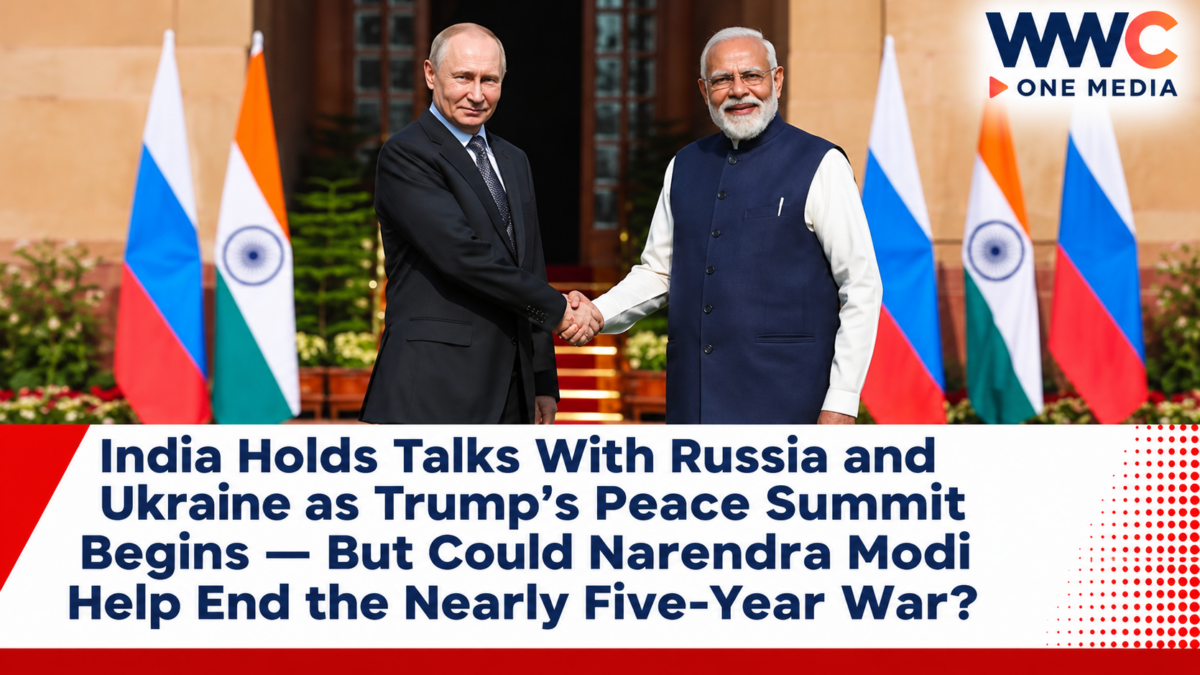
NEW DELHI / ABU DHABI — November 10, 2026 — India has stepped into the diplomatic spotlight ahead of high-stakes US-led peace negotiations between Russia and Ukraine, with Prime Minister Narendra Modi and Foreign Minister S. Jaishankar holding separate discussions with Kyiv and Moscow as Washington launches a renewed effort to end Europe’s deadliest conflict in decades.
The diplomatic push comes as Russian and Ukrainian delegations prepare to meet American negotiators in Abu Dhabi on November 10–11, reopening direct US-mediated negotiations that have been stalled since February.
Modi spoke with Ukrainian President Volodymyr Zelenskyy on Monday, November 9, while Jaishankar separately held talks with Russian Foreign Minister Sergey Lavrov.
The conversations suggest that New Delhi is seeking a more active role in international efforts to stop the fighting, protect commercial shipping and address the devastating economic consequences of the war.
But a difficult question hangs over the negotiations.
With Russia and Ukraine still divided over territory and security guarantees, could India use its relationships with both governments to help deliver a breakthrough that Washington has struggled to achieve?
Modi Speaks With Zelenskyy Ahead of Critical Peace Negotiations
Ukrainian President Volodymyr Zelenskyy confirmed on November 9 that he had spoken with Modi about preparations for the upcoming US-mediated talks.
According to Reuters, Zelenskyy highlighted the Indian leader’s previous calls for an end to the war and emphasized the importance of New Delhi using its diplomatic relationships to support a settlement.
Modi reiterated India’s commitment to helping achieve peace through dialogue and diplomacy.
The discussions occurred just one day before negotiators from Russia, Ukraine and the United States were scheduled to gather in Abu Dhabi.
The timing is significant.
India has maintained diplomatic relations with both Moscow and Kyiv throughout the conflict, avoiding the complete breakdown in relations with Russia experienced by many Western governments.
That position gives New Delhi opportunities for communication across opposing sides.
However, Modi’s conversation with Zelenskyy does not mean India has formally joined the US-led negotiating delegation.
Nor does it establish that the Ukrainian president has accepted any particular peace proposal.
The confirmed development is that both leaders discussed the peace process and India’s potential contribution.
India Also Contacts Russia as Lavrov Speaks With Jaishankar
While Modi was speaking with Zelenskyy, India’s External Affairs Minister S. Jaishankar contacted Russian Foreign Minister Sergey Lavrov.
Jaishankar publicly confirmed that their discussion focused on the Ukraine conflict and ongoing diplomatic initiatives.
Russia’s Foreign Ministry also acknowledged the conversation, referring to bilateral cooperation and international issues.
The back-to-back contacts highlight India’s effort to remain engaged with both governments rather than relying solely on Washington’s diplomatic initiative.
New Delhi has maintained a longstanding strategic relationship with Moscow, covering defense cooperation, energy and other areas.
At the same time, India has repeatedly affirmed support for diplomacy and peaceful conflict resolution.
Its position is distinctive because it maintains significant relationships with Russia, Ukraine, Europe and the United States.
This could make India useful in supporting specific confidence-building measures even if it does not become the principal mediator in a comprehensive peace agreement.
WWC ONE MEDIA previously examined Modi’s diplomatic position in India’s Modi Emerges as a Potential Diplomatic Bridge Between Russia and Iran.
That report explored how India’s relationships with competing international powers create opportunities for diplomatic engagement.
India Offers to Help Restore Black Sea Grain Shipments
One of the most important developments concerns maritime trade.
Zelenskyy said India was prepared to help mediate arrangements for grain export corridors in the Black Sea.
Shipping disruptions have become a serious concern because Ukraine is a major agricultural exporter.
Russian military operations and maritime insecurity have complicated grain exports, affecting international trade and food supply routes.
For India, the issue extends beyond the conflict itself.
Food-price instability and disrupted shipping can affect developing economies that depend on agricultural imports.
An arrangement protecting commercial vessels and grain shipments could potentially reduce some of those risks.
India has also previously discussed broader shipping safety and energy transportation with Russia and Ukraine.
Bloomberg reported in October that Jaishankar described New Delhi’s involvement as expanding beyond general appeals for peace into practical issues such as Black Sea shipping safety.
The proposed grain-corridor role is therefore consistent with India’s previously stated diplomatic priorities.
However, no new maritime agreement had been confirmed ahead of the November 10–11 talks.
India’s willingness to assist should not be reported as evidence that Russia and Ukraine have accepted a final shipping arrangement.
Trump Launches New US-Led Peace Talks in Abu Dhabi
The Indian diplomatic contacts coincide with a renewed American effort to negotiate an end to Russia’s full-scale invasion of Ukraine.
US President Donald Trump’s administration is bringing Russian and Ukrainian representatives together in Abu Dhabi on November 10 and 11.
The talks are expected to address several major issues, including a possible end to hostilities, post-war security guarantees, humanitarian measures and de-escalation.
US Special Envoy Steve Witkoff and presidential adviser Jared Kushner are expected to represent Washington.
Reuters reported that the negotiations would be the first US-mediated direct discussions between Moscow and Kyiv since February.
The new round follows months of diplomatic contacts involving the United States, Russia, Ukraine and European governments.
WWC ONE MEDIA covered the announcement in US to Bring Russia and Ukraine Back to the Table in Abu Dhabi — But Can Trump’s New Peace Push Finally Break the Deadlock?.
The renewed negotiations represent an important diplomatic opportunity.
But a scheduled meeting is not the same as a negotiated ceasefire.
The parties remain far apart on several issues that have repeatedly prevented earlier talks from producing a settlement.
The Biggest Obstacle: Who Controls Ukrainian Territory?
The territorial dispute remains one of the central barriers to peace.
Russia continues demanding that Ukraine surrender control of the entire Donbas region, including territory that Russian forces have not captured.
Ukraine rejects proposals requiring it to relinquish territory still controlled by its military.
President Zelenskyy has emphasized that decisions affecting Ukrainian territory must respect the country’s sovereignty and involve legitimate Ukrainian decision-making.
Washington has suggested that compromises may be possible as part of a broader settlement.
But no territorial agreement has been confirmed.
Security guarantees represent another major challenge.
Ukraine wants commitments that would help deter renewed Russian military aggression after a ceasefire.
Moscow, meanwhile, continues pressing its own demands concerning European security arrangements and NATO.
The sides have not publicly agreed on how those competing objectives could be reconciled.
India’s ability to assist may therefore be greater on narrower humanitarian and commercial matters than on the central territorial dispute.
Europe Fears Being Excluded From a Major Peace Settlement
The negotiations are also exposing tensions between Washington and European governments.
European leaders have expressed concern that a broad agreement involving Russia and the United States could affect NATO and the continent’s security structure without adequate European participation.
According to Reuters and the Associated Press, American envoys have been consulting European and NATO representatives about potential security guarantees for Ukraine.
Moscow has resisted direct European involvement in the main negotiations.
European officials argue that decisions affecting their security cannot be made without their participation.
The dispute is particularly important because European countries would likely have major responsibilities in supporting any long-term settlement.
WWC ONE MEDIA examined the disagreement in Europe Defies Trump and Putin, Demands End to Ukraine War Before Russia Gets New Security Deal.
India’s involvement adds another diplomatic voice, but it does not resolve disagreements over the roles of Ukraine, Europe and Russia in determining the future security order.
Russia Continues Attacking Ukraine Despite Peace Diplomacy
The negotiations are unfolding while fighting continues.
The Associated Press reported fresh Russian attacks against Ukrainian infrastructure and civilian targets ahead of the Abu Dhabi discussions.
Ukrainian strikes have also targeted Russian industrial and energy facilities.
The continued fighting highlights the difficulty of negotiating peace while both armies remain engaged in active military operations.
For Ukraine, protection of civilian infrastructure is a major concern as winter approaches.
Repeated attacks on electricity systems can disrupt heating, water supplies and essential services.
Kyiv has sought stronger protections for energy facilities and other critical infrastructure.
But previous attempts to reduce attacks have failed to produce a durable halt in hostilities.
WWC ONE MEDIA recently examined the humanitarian consequences in Russia Fires 36 Ballistic Missiles at Ukraine, Cripples Kyiv’s Power Grid and Damages Major Bridge.
The continuing attacks make it harder to build confidence between the negotiating parties.
They also increase pressure on diplomatic intermediaries to produce concrete humanitarian results.
Why India’s Relationship With Russia Matters
India’s longstanding partnership with Russia gives Modi access to diplomatic channels that could support discussions involving Moscow.
Russia remains an important partner for India in defense and energy.
New Delhi has also continued engaging with Western governments, including the United States, on strategic and economic matters.
This balancing approach has sometimes attracted criticism from governments seeking a stronger international response to Russia’s invasion.
India, meanwhile, has maintained that diplomacy is necessary to achieve a sustainable settlement.
New Delhi’s relationships may provide useful opportunities for communication, but they do not guarantee leverage over Russia’s decisions.
The Kremlin’s willingness to modify its territorial or security demands will depend on its own strategic calculations.
Similarly, Ukraine’s acceptance of any agreement will depend on whether Kyiv believes its sovereignty, security and long-term national interests are protected.
Can Modi Become an Effective Peace Mediator?
India’s involvement has three potential advantages.
First, New Delhi maintains working diplomatic relationships with both Russia and Ukraine.
Second, its position allows it to communicate with governments that have sharply different views of the conflict.
Third, India has expressed interest in practical humanitarian and commercial arrangements, particularly involving shipping and food security.
But there are important limitations.
India is not currently confirmed as a formal participant in the trilateral US-Russia-Ukraine negotiations.
Nor has it been appointed the principal mediator for a final political settlement.
Its role is better described as a potential supporting diplomatic partner.
That distinction matters because ending the war would require agreement on issues far more difficult than arranging bilateral conversations.
Territory, military deployments, sanctions, reconstruction and international guarantees all remain deeply contested.
India may be able to contribute to specific agreements without being able to resolve the entire conflict.
What Happens Next in Abu Dhabi?
The November 10–11 negotiations will test whether the United States can narrow the differences between Moscow and Kyiv.
Important developments to monitor include whether the parties agree on humanitarian measures, establish a further negotiating timetable or produce commitments to reduce attacks on civilian infrastructure.
Progress on Black Sea shipping could provide one area where India’s engagement becomes relevant.
But no breakthrough should be assumed before the participating governments announce specific agreements.
US Secretary of State Marco Rubio has cautioned that the peace process remains difficult, even as Trump has expressed optimism about the possibility of a broader settlement.
A lasting agreement would require more than diplomatic momentum.
It would need terms acceptable to the parties, practical implementation arrangements and credible protections against renewed conflict.
The Bigger Picture: Could India Help Break the Ukraine Peace Deadlock?
India’s latest conversations with Russia and Ukraine mark another step in New Delhi’s increasingly active engagement with efforts to end the war.
Modi’s discussion with Zelenskyy, combined with Jaishankar’s call to Lavrov, demonstrates that India is seeking to remain relevant as Washington organizes a new round of negotiations.
New Delhi’s proposed involvement in Black Sea grain corridors could offer a practical opportunity to support humanitarian and commercial stability.
Yet the fundamental obstacles remain formidable.
Russia and Ukraine disagree over territory, security guarantees and the conditions necessary to stop the fighting.
European governments are demanding an appropriate role in determining their future security.
And despite renewed diplomacy, military operations continue.
India’s contribution could be valuable, particularly if it helps secure limited agreements that build confidence between the parties.
But no evidence yet establishes that Modi can deliver the comprehensive settlement that has eluded negotiators for years.
With the United States bringing Russia and Ukraine back to the negotiating table and India opening conversations with both sides, the diplomatic opportunity is real. But can Narendra Modi help turn competing demands into a workable peace—or will the latest round of talks become another failed attempt to end the war?