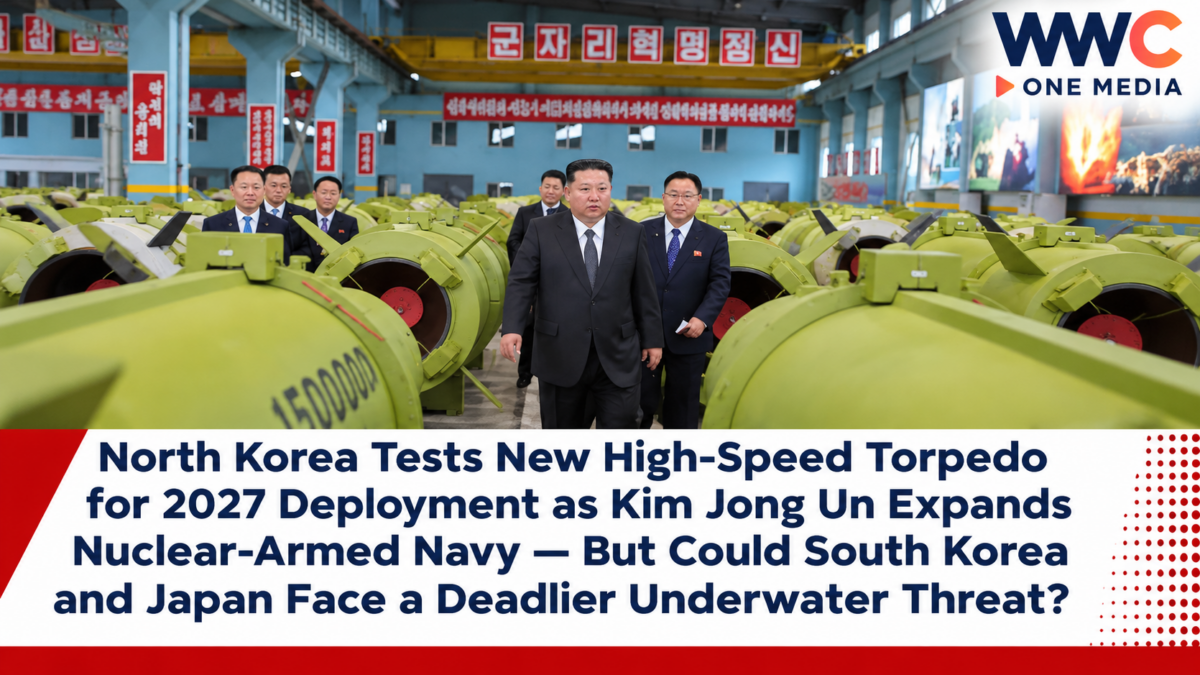
SEOUL, SOUTH KOREA — November 10, 2026 — North Korea has announced another significant step in its military modernization campaign, claiming to have successfully tested a new high-speed torpedo system that it intends to deploy with its navy in early 2027.
The announcement, reported Tuesday by the state-run Korean Central News Agency (KCNA), comes as North Korean leader Kim Jong Un accelerates the development of advanced underwater weapons, larger warships and naval capabilities intended to strengthen the country’s military deterrence.
According to the North Korean government, the latest weapons test took place on Monday, November 9, in the East Sea, also known internationally as the Sea of Japan.
The test was reportedly conducted jointly by the Academy of Defense Sciences, the Missile Administration and the Torpedo Weapon Research Bureau.
North Korean authorities claimed the operation demonstrated the effectiveness of the newly developed weapon.
However, the regime did not disclose the torpedo’s speed, range, payload, guidance technology or launching platform.
That lack of transparency leaves important questions unanswered about the weapon’s actual battlefield capabilities.
As Pyongyang prepares to deploy new underwater weapons and expand its surface fleet, could the Korean Peninsula be entering a more dangerous phase of naval competition?
North Korea Plans to Deploy New Torpedo in Early 2027
North Korea’s announcement outlined an unusually specific deployment timetable for its latest high-speed torpedo.
According to KCNA, the weapon is scheduled to enter service with the North Korean Navy beginning in early 2027.
The stated deployment goal suggests that Pyongyang wants to move beyond experimental development toward operational use.
But an announced timetable does not establish that the system is ready for large-scale deployment.
Independent military analysts would need additional evidence—including test data, operational assessments and reliable technical information—to evaluate the weapon’s readiness.
KCNA described the latest firing as part of routine weapons research intended to improve the technological sophistication of North Korea’s military systems.
South Korean broadcaster KBS World reported that Seoul’s Joint Chiefs of Staff was closely monitoring the North’s continuing weapons development.
The South Korean military has not publicly confirmed the performance figures or technical specifications of the new torpedo.
The distinction matters because North Korea frequently announces successful weapons tests without releasing information sufficient for independent evaluation.
A Second Torpedo Test in Less Than a Month
The November 9 test follows another high-profile underwater weapons demonstration in October.
On October 15, North Korea said it tested a new precision-guided torpedo known as Zam-2.0.
Pyongyang claimed the weapon incorporated artificial intelligence technology for target detection and guidance.
State media also said the system used technologies developed through more than 180 tests conducted over five years, including work on propulsion efficiency.
The announcement attracted international attention because it suggested that North Korea was experimenting with more sophisticated methods of locating and attacking maritime targets.
However, the precise role played by artificial intelligence remains unclear.
The Associated Press reported in October that military specialists questioned whether the technology could actually identify targets autonomously, rather than merely improve existing guidance functions.
North Korea has not released enough independently verifiable technical evidence to resolve those questions.
Specialist publication NK News reported on November 10 that the latest high-speed torpedo test was the second publicly announced demonstration of the weapon within approximately one month.
It also noted that North Korea had not published photographs of the new system.
It remains uncertain whether the November test involved the same configuration previously described as Zam-2.0 or an updated version.
Why High-Speed Torpedoes Could Change Naval Warfare
Torpedoes are underwater weapons designed to strike ships or submarines.
Unlike conventional missiles that generally travel through the air, torpedoes approach their targets through water, creating different detection and defensive challenges.
Some advanced torpedo systems use acoustic guidance or other sensors to track targets.
Others employ specialized propulsion technologies to increase underwater speed.
For a navy attempting to challenge a technologically superior opponent, underwater weapons can offer an important asymmetric capability.
That means a military may seek to counter more expensive enemy platforms through comparatively smaller, specialized systems.
North Korea could potentially use improved torpedoes to complicate the operations of South Korean, Japanese or American naval vessels.
But the actual threat would depend on the weapon’s independently verified range, speed, accuracy, reliability and ability to operate against modern countermeasures.
A fast torpedo is not automatically an unstoppable weapon.
Modern naval forces use multiple layers of protection, including acoustic sensors, electronic systems, decoys and tactical procedures intended to reduce underwater threats.
Without more evidence, it would be premature to conclude that North Korea’s latest system can defeat those defenses.
Kim Jong Un Is Building a Larger and More Powerful Navy
The latest torpedo announcement is part of a broader naval modernization campaign.
In June 2026, North Korea commissioned the approximately 5,000-ton Choe Hyon destroyer in the Yellow Sea.
A second 5,000-ton destroyer, the Kang Kon, entered service in September, according to reporting by Yonhap.
These vessels represent a significant expansion of North Korea’s surface-combatant ambitions.
During the commissioning of the Choe Hyon, Kim Jong Un described the modernization of the navy as an important part of the country’s strategic military development.
He also indicated that efforts to equip the navy with nuclear weapons were advancing.
Those statements should be understood as North Korean government claims about its military program, not independent confirmation that every planned system is operational.
Nevertheless, the simultaneous development of new warships, submarine-launched missiles and underwater weapons points to a coordinated effort to strengthen maritime capabilities.
For South Korea and its allies, that raises questions about how quickly Pyongyang might narrow some of its longstanding disadvantages at sea.
North Korea’s Massive New Warship Draws International Attention
The naval buildup continued into November.
Reuters reported on November 3 that Kim Jong Un had inspected shipbuilding activities at the Nampho Shipyard and ordered improvements to construction capacity and operational efficiency.
North Korean state media released images of a large vessel under construction.
Analysts cited by Reuters assessed that the ship appeared to be a warship of approximately 10,000 tons, potentially capable of carrying a substantial number of missiles.
That estimate was based on analysis of available imagery, not official confirmation of the completed vessel’s displacement or capabilities.
The government also reportedly intends to increase its production of major surface warships.
The expansion could eventually provide North Korea with more platforms capable of carrying missiles and other advanced weapons.
However, building large warships does not automatically produce an effective blue-water navy.
Sustained naval operations require trained crews, dependable maintenance, logistics, surveillance systems and the ability to coordinate weapons and sensors.
North Korea’s ability to integrate those elements remains an important question for regional defense planners.
Submarine-Launched Missiles Add Another Security Concern
North Korea has also been developing submarine-based strike capabilities.
In October, Pyongyang reported firing two types of strategic cruise missiles from what South Korean reporting described as a presumed 3,000-ton submarine.
Submarine-launched weapons can complicate an adversary’s defensive planning because underwater launch platforms may be more difficult to locate than fixed land-based sites.
Their military effectiveness depends on the quality of the submarines, crew training, communications, sensors and weapons.
North Korea has long maintained a substantial submarine fleet, although much of it consists of older or smaller vessels.
More advanced underwater weapons could enhance some of those platforms’ potential combat roles if successfully integrated.
But the existence of new torpedo technology does not prove that every North Korean submarine can deploy it.
KCNA has not identified the launching platform for the November 9 test.
That omission prevents a reliable assessment of which ships or submarines might eventually carry the new weapon.
South Korea Monitors Pyongyang’s Growing Weapons Arsenal
South Korea has been monitoring North Korea’s accelerating weapons development.
KBS World reported that the South Korean Joint Chiefs of Staff was closely following the latest torpedo announcement.
Seoul’s military maintains extensive surveillance and defensive capabilities designed to monitor North Korean activity.
Its security relationship with the United States also remains central to deterrence on the Korean Peninsula.
However, North Korea’s expanding weapons arsenal creates additional operational questions.
Naval commanders must assess not only ballistic missiles and surface ships but also submarines, underwater weapons and increasingly sophisticated targeting systems.
The military implications extend beyond a single torpedo test.
A coordinated force employing multiple weapons from different platforms could present more complicated detection and defense challenges than an isolated attack.
Nevertheless, no independently confirmed evidence from the November 9 test establishes that North Korea is preparing an imminent strike against South Korea, Japan or the United States.
The announcement concerns weapons development and planned deployment, not a declaration of war.
Could Japan Face a Growing Maritime Security Challenge?
Japan is also watching developments on the Korean Peninsula closely.
North Korea’s missile and nuclear programs have long been important concerns for Tokyo.
The country’s naval modernization introduces an additional dimension.
Japan depends heavily on maritime transportation for energy, raw materials and international trade.
Security planners therefore pay close attention to military activity in surrounding waters.
A more capable North Korean underwater force could increase the complexity of regional maritime surveillance.
However, the available information does not establish that the new torpedo has the range or operational capability to threaten specific Japanese ports, shipping routes or military facilities.
Japan also maintains substantial anti-submarine warfare capabilities and a close defense partnership with the United States.
The strategic concern is therefore not that North Korea has suddenly achieved naval superiority.
It is that continued weapons development could gradually increase the number and sophistication of threats that regional militaries must monitor.
The United States Faces a More Complicated North Korean Deterrence Problem
Washington has repeatedly expressed concern about North Korea’s expanding nuclear and missile capabilities.
A Congressional Research Service assessment updated in October 2026 described the continuing development of North Korean systems capable of threatening US interests and allies.
The assessment covered strategic missiles and other weapons intended to strengthen Pyongyang’s military deterrent.
The addition of more capable naval weapons could complicate future military planning.
At the same time, diplomatic efforts have remained difficult.
Reuters reported on November 4 that North Korea had conducted another series of missile launches during a period of heightened tensions.
The launches followed public disagreements involving Pyongyang and Washington.
North Korean officials have continued demanding changes to what they describe as hostile US policies.
The expanding weapons program may strengthen Pyongyang’s negotiating position from its own perspective.
But increasing military capabilities can also intensify distrust, encourage additional defensive measures and make diplomatic engagement more complicated.
Rising Maritime Tensions Across the Indo-Pacific
North Korea’s naval modernization is unfolding against a wider background of military competition across East Asia.
China, the United States, Japan, South Korea and other regional governments are devoting increasing attention to maritime security.
The strategic environment includes territorial disputes, military exercises, submarine operations and the protection of vital communications infrastructure.
These are separate security issues, and North Korea’s latest torpedo test should not automatically be linked to unrelated maritime confrontations.
Nevertheless, the regional pattern helps explain why governments closely monitor new underwater capabilities.
WWC ONE MEDIA previously examined maritime tensions near the Philippines in Teodoro Blasts Beijing Over Batanes Claims as Chinese Research Ship Standoff Raises Alarm.
That dispute concerns Philippine sovereignty and Chinese maritime activity, not North Korea’s weapons program.
Another report, Philippines Accuses Chinese Research Vessel of Spoofing Location Near Batanes Cable Corridor, examined allegations involving a vessel operating near critical undersea communications infrastructure.
The incident highlights why monitoring activities beneath and around strategic waterways has become increasingly important.
WWC ONE MEDIA also covered the Philippine Coast Guard’s deployment of its largest vessel to challenge a Chinese research ship near Batanes.
Taken together, these separate developments illustrate the growing attention that Indo-Pacific governments are placing on maritime awareness, security and defense.
Could Artificial Intelligence Become the Next Naval Arms Race?
North Korea’s claims about AI-equipped torpedoes have attracted attention because artificial intelligence is becoming increasingly relevant to modern defense technology.
Possible military applications include sensor processing, navigation assistance, target classification and decision-support systems.
For underwater weapons, advanced algorithms could potentially improve the interpretation of acoustic information and other sensor data.
However, the term artificial intelligence is broad.
A weapon described as AI-enabled might use relatively limited automated functions rather than the advanced autonomous decision-making capabilities sometimes suggested by sensational headlines.
North Korea has not provided sufficient technical documentation to establish the sophistication of its claimed AI guidance systems.
The Associated Press reported in October that specialists remained skeptical about the extent of Pyongyang’s technological achievement.
The more important question is whether North Korea can translate laboratory demonstrations and controlled tests into dependable systems that operate effectively under real-world conditions.
Why Early 2027 Matters
North Korea’s announcement of an early-2027 deployment timetable introduces a near-term milestone for regional military observers.
The timeline suggests Pyongyang intends to accelerate the integration of new torpedoes into its navy.
However, several questions remain unresolved.
The regime has not disclosed which vessels will receive the weapon, how many units it expects to produce or whether additional testing will be required.
It has also withheld independently verifiable information about the weapon’s range, speed and operational performance.
Even if the first units enter service in early 2027, full operational deployment could take considerably longer.
New military systems often require extensive training, maintenance preparation and integration with existing platforms.
As a result, the announcement should be treated as a stated deployment objective rather than proof that a fully mature weapons capability is already available.
The Bigger Picture: Kim Jong Un’s Navy Is Changing — But How Dangerous Will It Become?
North Korea’s latest torpedo announcement reinforces the determination of Kim Jong Un’s government to modernize its armed forces.
Pyongyang is pursuing more capable underwater weapons, larger surface warships, submarine-based strike options and advanced missile systems.
Those developments could alter regional defense calculations if the announced capabilities are successfully developed and deployed.
But significant uncertainties remain.
The November 9 torpedo test has not been independently validated, the weapon’s specifications have not been disclosed and North Korea’s actual deployment capacity remains unknown.
Military power ultimately depends on more than ambitious announcements.
Reliability, production capacity, training and operational integration will determine whether the new systems meaningfully strengthen Pyongyang’s navy.
For South Korea, Japan and the United States, the challenge will be monitoring these developments while maintaining credible defenses and avoiding unnecessary escalation.
With North Korea targeting early 2027 for deployment of its newest high-speed torpedo, the question is no longer simply whether Kim Jong Un wants a more powerful navy—but whether his military can turn its ambitious underwater weapons program into a genuine challenge for US and allied naval forces.