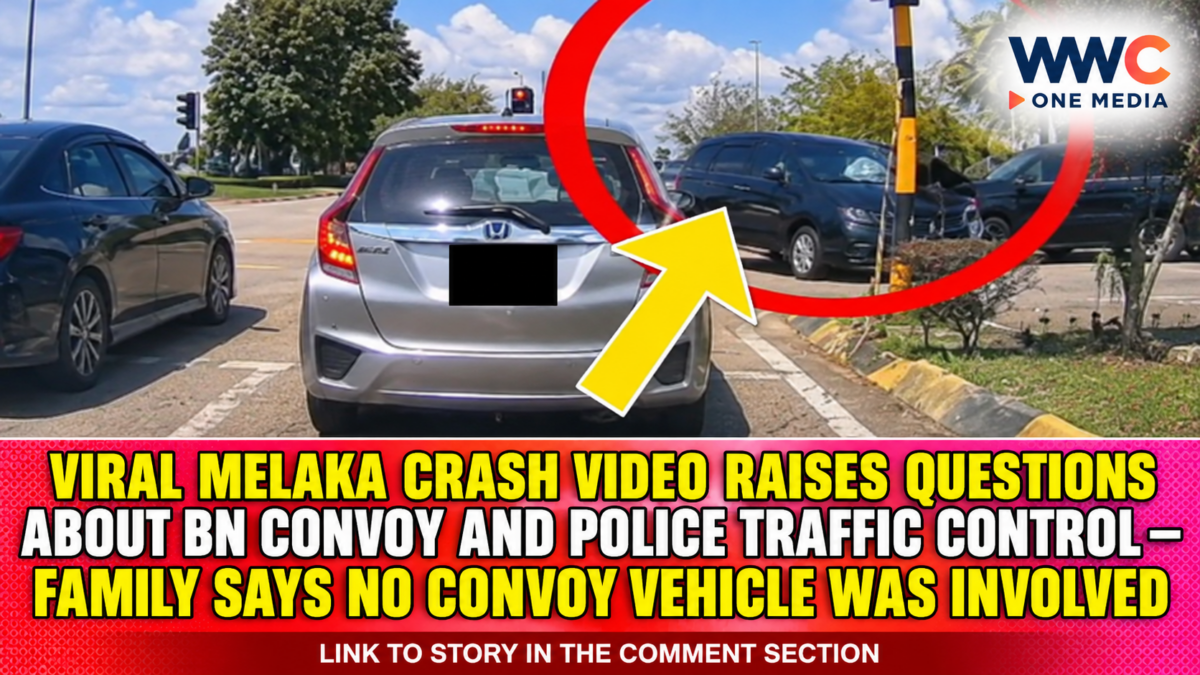
A viral dashcam video showing two cars colliding at a traffic-light junction in Melaka has sparked questions about whether police gave a Barisan Nasional (BN) campaign convoy priority during the state election period.
The footage, recorded at a junction along the Alor Gajah–Melaka Tengah–Jasin (AMJ) highway, shows one vehicle turning right while another travels straight ahead before the two collide. The impact sends the vehicles veering towards traffic in an adjacent lane.
The controversy began after social media users alleged that traffic police had stopped other motorists to allow a convoy carrying BN campaign stickers to pass through the junction.
However, an important clarification emerged the following day: a person identifying themselves as a relative of one of the families involved disputed claims that the convoy caused the crash or that any convoy vehicle was involved in the collision.
That distinction is crucial. The video has prompted legitimate questions about traffic management, but it does not by itself establish that the convoy caused the accident, that police instructions led to the collision, or that anyone involved received unlawful preferential treatment. Malay Mail+1
Viral Dashcam Footage Shows Two Cars Colliding at Melaka Junction as BN Convoy Priority Claims Spread
The video, which circulated on Threads, shows a car turning right at a traffic-light junction while another vehicle travels straight ahead. The two cars collide, with the impact sending them veering towards vehicles in a neighbouring lane.
The incident happened at a junction along the Alor Gajah–Melaka Tengah–Jasin (AMJ) highway during campaigning for the Melaka state election.
The footage prompted questions about whether traffic police had temporarily stopped other road users to allow a BN convoy through. Vehicles bearing BN campaign stickers were reportedly seen in the convoy, leading social media users to question who was travelling in it and why it appeared to receive priority.
The original post also called for an explanation from Melaka BN chairman Datuk Seri Ab Rauf Yusoh about the convoy’s movements and the basis for any traffic arrangements.
Malay Mail reported on November 8 that it could not independently verify the video or the claims accompanying it. At the time of publication, it had not received an immediate response from police or BN representatives. Malay Mail+1
Family Member Disputes Claims Linking Ab Rauf’s Convoy to the Crash
A significant clarification emerged on November 9, when a Threads user identifying themselves as a relative of one of the families involved disputed claims that Ab Rauf’s convoy had caused the accident or was involved in the collision.
The individual said their family was travelling from Sungai Rambai towards Bandar Melaka in a black Toyota Vios that was badly damaged in the crash.
They insisted that the vehicles involved were ordinary members of the public and that neither Ab Rauf nor his convoy was involved in the accident.
The statement directly challenged the version circulating online, which had linked the collision to the passage of the BN convoy.
This distinction matters: the presence of a convoy in the surrounding traffic footage does not establish that one of its vehicles collided with the two cars. BBC PORTAL+1
What the Dashcam Video Does — and Does Not — Prove
The footage has raised two separate questions that should not be confused.
The first concerns the cause of the collision. The video shows two vehicles moving through the junction and colliding, but the available reporting does not establish which driver was legally responsible. Determining fault would require a proper assessment of the traffic signals, vehicle movements, road conditions and other evidence.
The second concerns traffic management. Social media users questioned whether officers had stopped motorists to allow the convoy to pass and whether the arrangement was justified.
Even if police temporarily controlled traffic for a convoy, that alone would not establish misconduct. The reason for the control, the instructions given to drivers and whether the junction was managed safely would need to be examined.
As of the reports available for this incident, there was no publicly confirmed police finding establishing that officers’ traffic instructions caused the crash or that BN received improper preferential treatment.
Previous Melaka VIP Convoy Controversy Adds Context
The latest debate has revived memories of a separate incident in Melaka in December 2025, when a video appeared to show an ambulance waiting while police escorted a convoy of 18 buses carrying a Chinese tourism and investment delegation.
Melaka police chief Datuk Dzulkhairi Mukhtar said officers had controlled traffic at the Jalan Taming Sari junction because the convoy was passing through. He maintained that the ambulance was not responding to an emergency because its siren was not activated.
The police explanation was challenged by members of the public, including a state executive councillor who stressed that emergency ambulances should receive priority.
The police subsequently said the siren heard in the footage belonged to a police vehicle rather than the ambulance. The controversy was investigated as a separate matter involving allegations of inaccurate information circulated online. FMT+2
That earlier case does not prove that police acted improperly in the latest incident. However, it helps explain why another video involving a convoy and traffic control has attracted strong public attention.
Why Police Traffic Control During Political Campaigns Matters
Political convoys are a familiar feature of election campaigns, allowing candidates and party leaders to travel between constituencies, rallies and public events.
Police may be required to manage traffic around certain movements, particularly when security or public safety requires temporary road control. But such arrangements should be proportionate, clearly managed and designed to minimise disruption to ordinary motorists.
The public has a legitimate interest in understanding why traffic is stopped, who authorised the arrangements and whether the same safety standards apply to everyone.
This is particularly important during an election campaign, when political parties and public officials are under heightened scrutiny.
WWC ONE MEDIA has previously reported on political tensions surrounding Malaysia’s election alliances in Malaysia’s Perikatan Nasional Suspended After Bersatu Complaint as Coalition Faces Deregistration Threat.
The publication has also examined the wider political calculations ahead of Malaysia’s next general election in UMNO Wants GE16 Sooner After Johor and Negeri Sembilan Gains — But Zahid Says It Will Stay in Anwar’s Government Until the End.
Road enforcement is another important part of the public-safety debate. In a separate report, WWC ONE MEDIA covered a Johor operation that caught more than 1,000 foreign motorists for various road-related offences in Johor Traffic Crackdown Catches More Than 1,000 Foreigners — Singaporeans Among Those Flagged.
These reports concern different incidents, but they highlight the importance of accountability, consistent enforcement and public confidence in the authorities.
The Questions That Still Need Answers
The family member’s clarification has helped correct an important part of the viral narrative: the available report says the two cars involved in the collision belonged to members of the public, not Ab Rauf’s convoy.
However, questions about traffic management remain separate from the question of who was involved in the crash.
A full explanation would help establish whether police temporarily stopped traffic, what instructions were given at the junction, whether the convoy received authorised assistance and whether the traffic arrangements were conducted safely.
The available reporting does not provide a confirmed police investigation outcome on those specific questions.
For now, the incident is a reminder of how quickly dashcam footage can trigger political controversy — and why viral claims must be checked against verified information before conclusions are drawn.