NEW YORK — November 10, 2026 — America’s 2026 midterm elections produced more than a political earthquake. They also triggered a massive wave of speculative trading, as millions of dollars flowed into prediction markets while voters delivered a sweeping victory to the Democratic Party.
Platforms such as Kalshi and Polymarket saw trading activity surge as election results emerged on November 3, with investors wagering on control of Congress, individual Senate races and unexpected gubernatorial upsets.
According to CNBC’s November 9 analysis, election-related contract volume more than tripled from the final week of October to election week.
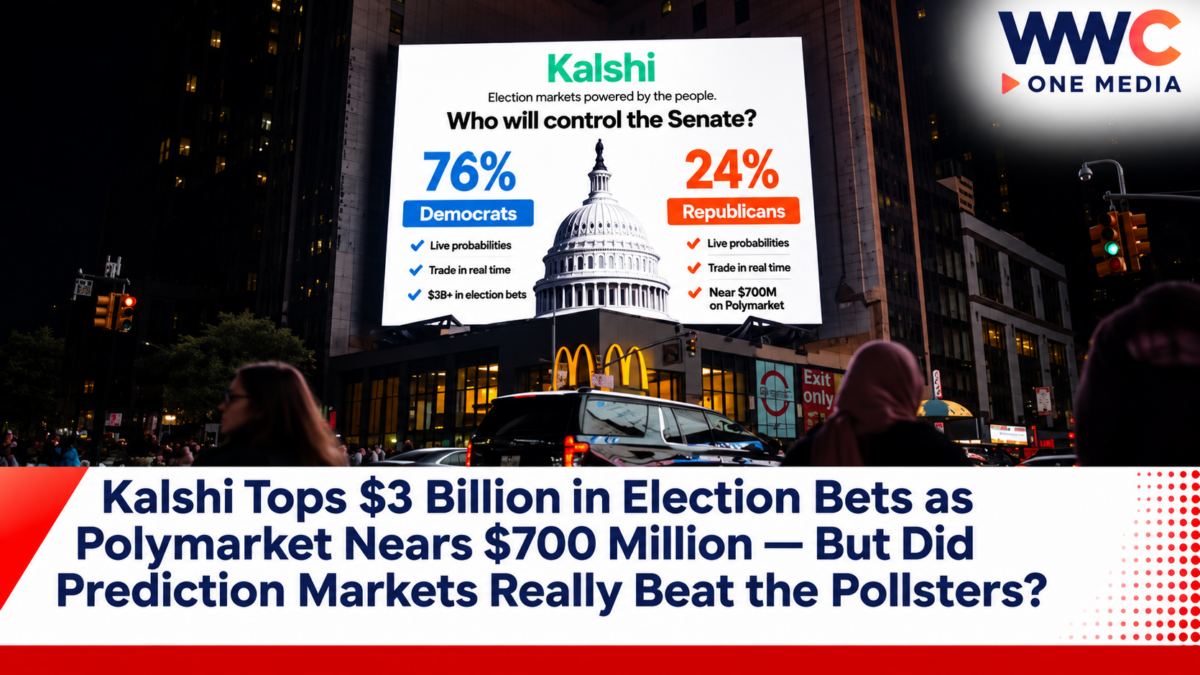
Kalshi reported more than $3 billion in cumulative midterm contract volume, including markets involving mayoral elections, while Polymarket reported nearly $700 million in midterm trading across its two exchanges during election week.
The figures demonstrate the enormous commercial appeal of a financial product that allows people to trade on the outcomes of political events.
But the numbers also raise an uncomfortable question.
If billions of dollars are flowing into contracts predicting who will control the US government, are these markets becoming a valuable forecasting tool—or an increasingly influential form of political speculation?
The debate has intensified after prediction markets correctly favored most eventual winners but failed to anticipate some major election surprises.
One of the most dramatic examples occurred in Texas, where Republican Governor Greg Abbott lost to Democrat Gina Hinojosa despite having entered election night as the market favorite.
And even as platforms celebrate their forecasting success, lawmakers are demanding greater scrutiny of their operations.
Election Night Turns Into a Massive Trading Event
On November 3, Americans were not the only participants watching election results unfold.
Traders around the world were following the changing prices of event contracts on prediction-market platforms.
A prediction-market contract generally pays according to whether a specified outcome occurs.
For example, a contract tied to Democratic control of the House may increase in value as traders become more confident that Democrats will win.
The market price can be interpreted as an implied probability, although trading fees, liquidity and market structure can affect the relationship.
As results began arriving from Indiana before 7 p.m. Eastern time, CNBC found that trading activity increased sharply.
Contract prices moved increasingly toward Democrats as their electoral strength became apparent.
By the end of the night, Democrats had secured a major victory, winning control of both chambers of Congress.
The outcome demonstrated how quickly prediction-market prices can react to incoming information.
But reacting to election results is different from predicting them accurately beforehand.
Kalshi Reports More Than $3 Billion in Midterm Contract Volume
Kalshi emerged as one of the largest beneficiaries of the election-trading boom.
The platform reported more than $3 billion in cumulative trading volume on contracts tied to the 2026 midterms, including mayoral races.
That represents the total reported volume over the relevant contract lifetimes, not money traded exclusively on November 3.
It is also not company revenue.
Trading volume measures contract activity, and contracts may change hands multiple times.
Consequently, a platform can report billions of dollars in cumulative volume without receiving an equivalent amount in new customer deposits.
The distinction matters because headline trading figures can substantially exaggerate a platform’s economic earnings when interpreted incorrectly.
Kalshi generates revenue through its business model, including applicable transaction fees.
The full reported value of contracts is not retained by the company as profit.
Polymarket Records Nearly $700 Million in Midterm Trading
Polymarket also experienced substantial activity during election week.
According to CNBC, the platform’s two exchanges reported nearly $700 million in midterm contract trading during the period.
The figure is significant but should be compared carefully with Kalshi’s totals.
The platforms’ reporting periods, market coverage and contract definitions are not necessarily identical.
A separate November 3 Washington Post analysis found nearly $1.9 billion in combined midterm trading had already occurred by late November 2.
Other researchers using more narrowly defined sets of contracts have reported different totals.
Those differences do not automatically mean one report is incorrect.
They may reflect whether analysts include local elections, multiple exchanges, historical transactions, bundled contracts and other categories.
For readers, the takeaway is that political event trading has become a multibillion-dollar activity, even though no single volume estimate captures every transaction under identical rules.
Prediction Markets Correctly Favored Most Winners
One of CNBC’s most important findings involved forecasting accuracy.
The network analyzed election contracts on Kalshi and Polymarket and found that more than 87% of markets had assigned at least a 90% probability to the eventual winner approximately 24 hours before election night.
That suggests traders were often confident about the correct outcome.
But the statistic has limitations.
Many congressional races were not especially competitive.
A market assigning a 98% probability to a candidate widely expected to win a safe district is less impressive than correctly anticipating a close upset.
A high overall success rate can therefore conceal errors in races where accurate forecasting is more difficult.
Prediction markets can also respond to conventional polling, campaign information and professional election forecasts.
They should not automatically be credited with independently discovering every outcome.
Texas Governor’s Race Exposes the Limits of Betting Odds
Texas provided one of the clearest warnings about prediction-market confidence.
Incumbent Republican Governor Greg Abbott entered the election as the favorite on major prediction platforms.
But Democratic challenger Gina Hinojosa ultimately won.
According to CNBC, more than $1 million in trading occurred after 8 p.m. on November 3 in a Kalshi contract involving Abbott’s reelection.
The election result contradicted the expectation held by many traders before voting ended.
That does not mean everyone who traded the market lost money.
Some may have bought contracts favoring Hinojosa, hedged earlier positions or sold their contracts before settlement.
But the result showed that market probabilities can be substantially wrong.
As previously covered by WWC ONE MEDIA, Texas’s electoral reversal was one of the most consequential developments of the 2026 midterms.
Related WWC ONE MEDIA coverage: Ted Cruz’s Texas Nightmare Comes True as Democrats Oust Greg Abbott and Win Senate Seat — But Could the GOP’s Historic Defeat Endanger His 2028 Ambitions?
Texas illustrates the fundamental uncertainty surrounding election forecasting.
A market showing a 70% probability of victory still implies that defeat is possible.
Democrats’ Congressional Victory Generates Heavy Trading
The battle for control of Congress was another major source of prediction-market activity.
Shortly after 11 p.m. on election night, more than $1.4 million was traded on a Kalshi market involving Republicans’ failure to retain control of the House of Representatives.
As additional results came in, the probability of Democratic control increased.
The eventual results gave Democrats control of both the House and Senate for the incoming Congress.
WWC ONE MEDIA previously examined the scale of the political shift and its consequences for President Donald Trump’s remaining two years in office.
Related WWC ONE MEDIA coverage: Democrats Capture Both Houses of Congress in Sweeping Midterm Victory — Trump Faces Major Political Setback With Two Years Left in Office
The incoming Democratic majority is expected to change congressional oversight, spending negotiations and the administration’s legislative prospects.
But prediction-market prices did not determine those outcomes.
Voters did.
Contract settlements must ultimately rely on the applicable market rules and authoritative election results.
Did Kalshi and Polymarket Actually Beat Traditional Polls?
Prediction-market operators promoted their forecasting records following the election.
Kalshi CEO Tarek Mansour and Polymarket CEO Shayne Coplan highlighted their platforms’ successful calls.
But independent researchers offered a more cautious interpretation.
Wake Forest University economist Koleman Strumpf told CNBC that prediction markets performed well without clearly surpassing the best traditional forecasts.
Political forecaster Nate Silver also challenged claims that market pricing independently outperformed established forecasting models.
His argument was that market probabilities often moved toward probabilities already published by professional forecasters.
This creates an important question about information sources.
Prediction markets may aggregate the judgments of people who have money at stake.
But those traders can use the same polling, turnout models, campaign reports and public information available to everyone else.
Their predictions are therefore not necessarily independent of traditional election research.
A strong market forecast may be useful, but it should not be treated as a replacement for polling or verified election results.
Small Trades Can Sometimes Move Political Odds
The reliability debate extends beyond mistakes in forecasting.
Before the elections, a CNBC investigation examined how relatively small trades could influence displayed probabilities in certain political contracts.
Researchers found that a large proportion of active congressional markets had limited liquidity, making prices vulnerable to substantial movements from comparatively small transactions.
As previously reported by WWC ONE MEDIA, the analysis raised concerns that market prices could change sharply without an equivalent change in actual voter sentiment.
Related WWC ONE MEDIA coverage: Election Betting Under Fire as 88% of Prediction Markets Prove Easy to Move — But Could Traders Be Shaping Democracy Before Votes Are Counted?
That earlier report also examined the 2026 Los Angeles mayoral primary, where a prominent candidate received favorable market odds but failed to advance.
Such discrepancies illustrate the difference between a financial market’s expectations and the actual preferences expressed by voters.
However, evidence that prices can move sharply is not, by itself, proof that traders committed illegal manipulation or changed an election outcome.
Combo Contracts Make Volume Figures Harder to Compare
Another issue is the way some prediction-market platforms report trading activity.
Certain products allow participants to combine multiple outcomes into one contract.
These resemble parlays commonly found in sports betting.
A contract might depend on several events all occurring.
Its notional value can be much larger than the amount of money a trader initially risks.
As previously reported by WWC ONE MEDIA, these structures can make reported trading volume appear especially large.
Related WWC ONE MEDIA coverage: Prediction Markets Are Posting Explosive Trading Volumes — But Combo Contracts Are Making the Boom Look Even Bigger
CNBC’s November 9 analysis of weekly election activity excluded combination markets from the specific dataset used to compare trading across weeks.
That makes its week-to-week findings more useful, but they should not automatically be compared with every platform’s headline cumulative total.
For investors and readers, volume definitions are crucial.
Trading activity, customer deposits, payouts, fees and company revenue represent different financial measures.
Sports Contracts Still Dominate Prediction Markets
Despite the attention surrounding the midterms, sports contracts remain the dominant source of prediction-market trading.
A Legal Sports Report analysis found that Kalshi processed more than $1.1 billion in election trading during a 10-day period surrounding the midterms.
During the same interval, the platform processed approximately $25.3 billion in parlay-style contracts and another $6.1 billion in non-parlay sports contracts.
The comparison indicates that election trading, while substantial, represented a relatively small part of the platform’s overall activity.
The market’s commercial growth is therefore tied closely to the expansion of event trading beyond politics.
This distinction matters because much of the regulatory controversy concerns sports contracts rather than election forecasting alone.
Democrats Could Intensify Regulation After the Midterms
The prediction-market industry also faces a more difficult political environment.
Following the Democratic victories, lawmakers began calling for closer scrutiny of event contracts.
Senator Adam Schiff criticized the Commodity Futures Trading Commission over its approach to sports-related contracts.
The dispute involves federal regulation, state gambling laws and tribal sovereignty.
Some lawmakers argue that sports event contracts function like gambling products and should not bypass established state regulatory frameworks.
Prediction-market companies argue that their products are financial derivatives falling under federal oversight.
The CFTC has issued guidance supporting broad access to certain event-contract markets, but legal disputes remain active.
A Democratic-controlled Congress could pursue hearings, new rules or legislation.
However, increased political scrutiny does not automatically mean that Kalshi or Polymarket will be banned.
Any regulatory changes will depend on the relevant legal process.
Coinbase’s Prediction-Market Expansion Shows the Business Opportunity
The sector’s growth is attracting traditional financial companies and cryptocurrency platforms.
Coinbase, for example, has identified prediction markets as one of its developing business lines.
During its third-quarter 2026 financial reporting, Coinbase said prediction-market activity had reached more than $200 million in annualized revenue.
That represents an annualized business run rate rather than revenue earned in one quarter.
As WWC ONE MEDIA previously reported, Coinbase sees prediction markets as part of a broader effort to diversify beyond conventional cryptocurrency trading.
Related WWC ONE MEDIA coverage: Coinbase Returns to Profit as Prediction Markets Top $200 Million in Annualized Revenue — But Can Its New Businesses Outrun the Crypto Slump?
The strategy illustrates why prediction markets are attracting investment.
Platforms can offer contracts tied to politics, economics, financial markets and other events.
But each category raises separate regulatory, consumer-protection and market-integrity questions.
For companies seeking growth, expanding contract availability may increase trading activity.
It can also increase legal and operational risk.
The Industry Faces Questions About Insider Information
Political prediction markets also raise concerns about who may have access to information that other traders do not.
Campaign staff, government officials, consultants and other insiders may know details about political activity before those facts become public.
Critics argue that event contracts could create opportunities to profit from confidential information.
The Washington Post reported that lawmakers have proposed stronger restrictions on certain election-related trades.
Supporters of prediction markets argue that prices can help aggregate information from diverse sources.
But information aggregation becomes more complicated when market participants may have unequal access to nonpublic facts.
Platforms must establish rules and enforcement systems capable of addressing improper activity.
The existence of unusual trading does not automatically prove misconduct.
Specific allegations require transaction records, investigations and appropriate legal findings.
What the 2026 Election Revealed About Prediction Markets
The midterms demonstrated three important realities.
First, prediction markets can attract enormous trading activity around major political events.
Second, they can respond quickly as new election information becomes available.
Third, they can still make significant errors, especially in unexpected outcomes and highly competitive races.
The industry’s proponents view market prices as useful probabilities informed by financially motivated participants.
Critics worry that large trades, thin liquidity and aggressive promotion can create a misleading impression of certainty.
Neither position should be accepted without examining the underlying data.
A strong forecasting record should be assessed across different types of races and compared with appropriate polling models.
Volume should be reported using consistent definitions.
And election outcomes must be determined by official processes rather than market expectations.
The Bigger Picture: Is Democracy Becoming a Financial Trading Product?
The 2026 midterms marked a significant moment for America’s prediction-market industry.
Billions of dollars in election-related contracts changed hands across the leading platforms.
Many markets correctly anticipated the Democratic takeover of Congress.
But the Texas gubernatorial upset demonstrated that traders can be wrong—even when significant sums of money are involved.
Meanwhile, the industry’s commercial success has brought increasing scrutiny of financial risk, political influence and regulatory oversight.
The question is no longer simply whether prediction markets can forecast elections.
It is how those markets should operate when their contracts concern democratic outcomes, government decisions and events with serious consequences for the public.
Prediction markets may provide useful information about expectations. But they are not votes, polls, official forecasts or guarantees.
And as Kalshi and Polymarket celebrate a multibillion-dollar midterm trading boom while lawmakers prepare tougher questions, one challenge remains: Will prediction markets become trusted tools for understanding political uncertainty—or could their biggest election-night success trigger the regulatory reckoning that threatens their explosive growth?