Malaysia’s authorities are examining allegations that elements of The Weeknd’s recent concerts in Kuala Lumpur may have crossed religious and cultural sensitivities, after a giant golden female robot sculpture and performers dressed in red hooded robes triggered heated debate online.
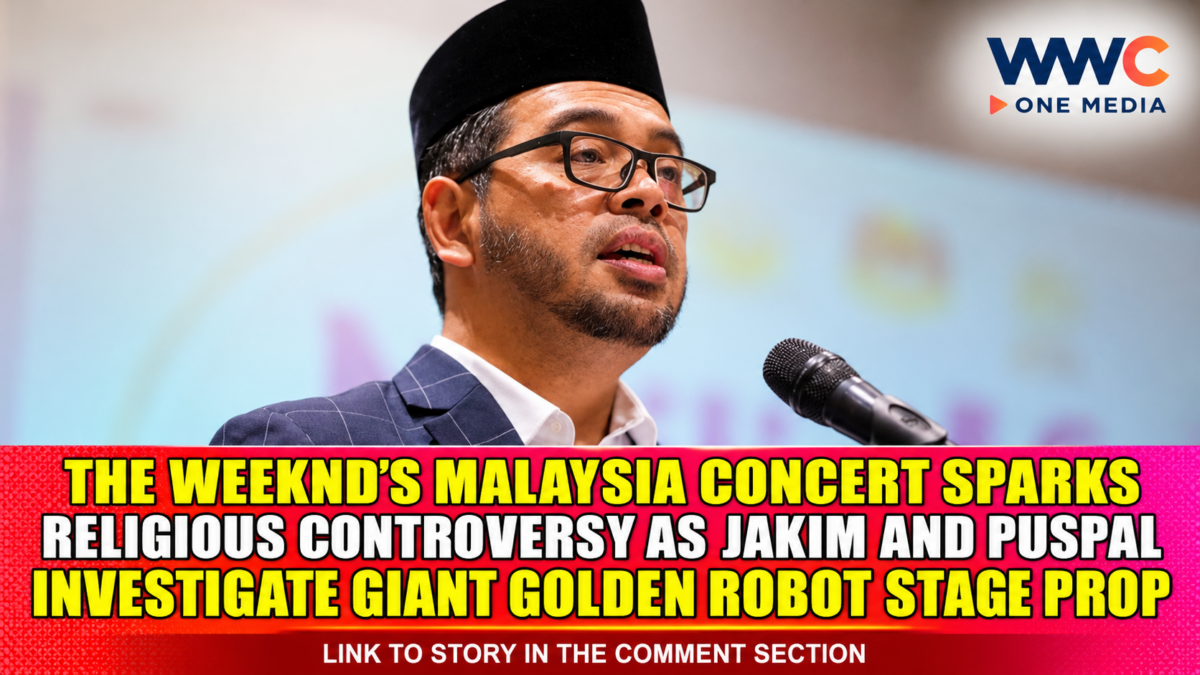
Religious Affairs Minister Senator Dr Zulkifli Hasan said the Malaysian Islamic Development Department (JAKIM) is working with the Central Agency Committee for Applications for Filming and Performances by Foreign Artistes (PUSPAL) to verify the claims and determine whether the concerts complied with the conditions imposed on the performances.
The minister warned that firm action would be taken if investigators establish that any rules were breached. However, he stressed that enforcement would be based on verified facts and applicable law.
The controversy centres on The Weeknd’s After Hours Til Dawn tour, which held two performances at the National Stadium in Bukit Jalil on November 4 and 5, 2026. The shows featured elaborate stage visuals, including a towering golden female robot sculpture that became the focus of criticism from some Malaysian social media users. Malay Mail+2
Giant Golden Robot Statue Triggers Backlash
The most controversial visual was a large golden female robot sculpture positioned prominently on the concert stage.
The sculpture was designed by Japanese artist Hajime Sorayama, whose work is widely recognised for its futuristic, metallic humanoid figures and exploration of the relationship between humans, technology and machines.
However, some viewers interpreted the sculpture and other stage elements as resembling an idol or object of worship.
The debate intensified after videos circulated showing dancers wearing red hooded robes performing around the sculpture. Critics questioned whether the combination of the statue, costumes, lighting and choreography carried religious or ritualistic symbolism.
Other viewers defended the performance as theatrical stage design and artistic expression, arguing that a futuristic sculpture should not automatically be interpreted as a religious object.
At this stage, the allegations remain under examination. Authorities have not announced a finding that the performance contained actual worship practices or that the organisers violated Malaysian regulations. Kosmo Online+2
The Weeknd’s Malaysia Concert Under JAKIM Investigation After Giant Golden Robot Sparks Religious Controversy
The Weeknd’s two concerts in Malaysia have triggered a major debate over artistic freedom, religious sensitivities and the rules governing international performances after a giant golden female robot sculpture and red-robed dancers became the centre of a growing controversy.
Malaysian authorities are now examining allegations that certain elements of the Canadian superstar’s performances could be interpreted as resembling religious worship or ritualistic practices.
Minister in the Prime Minister’s Department (Religious Affairs) Senator Dr Zulkifli Hasan confirmed on November 9 that the Malaysian Islamic Development Department (JAKIM) is working with the Central Agency Committee for Applications for Filming and Performances by Foreign Artistes (PUSPAL) to verify the allegations and determine whether the concerts complied with their approved conditions.
He warned that firm action would be taken if investigators establish that regulations were violated, stressing that any enforcement must be based on verified facts and applicable law.
The controversy follows The Weeknd’s After Hours Til Dawn tour performances at the National Stadium in Bukit Jalil on November 4 and 5, 2026. The concerts featured elaborate stage productions that attracted international attention, but one particular visual has since sparked heated discussion across Malaysia. Malay Mail+2
Giant Golden Robot Sculpture Triggers Religious Sensitivity Debate
The main focus of the controversy is a towering golden female robot sculpture positioned prominently on the concert stage.
The artwork was designed by Japanese artist Hajime Sorayama, who is internationally recognised for his futuristic metallic humanoid sculptures and illustrations.
The sculpture, reportedly measuring approximately 12 metres (40 feet), formed part of the tour’s elaborate visual production.
However, some Malaysian viewers questioned its appearance and the way it was incorporated into the performance. Their concerns intensified after videos circulated showing dancers wearing red hooded robes moving around the giant sculpture.
Critics argued that the combination of the statue, costumes, choreography and dramatic lighting could resemble religious or ritualistic symbolism.
Others defended the production, describing the sculpture as a futuristic artwork rather than an object intended for worship. They argued that artistic symbolism should not automatically be interpreted as a religious statement.
The disagreement has become particularly sensitive because the issue involves the interpretation of religious imagery in a country where public performances must take cultural and religious considerations into account.
Importantly, the allegations have not yet been established as fact. Authorities have not announced that the concert involved actual worship practices or that its organisers violated Malaysian regulations. Kosmo Online+2
JAKIM and PUSPAL Are Checking Whether Concert Rules Were Violated
Zulkifli said JAKIM’s Research Division is working directly with PUSPAL’s secretariat to establish whether the allegations are accurate and whether the performances complied with the conditions imposed on the concerts.
PUSPAL is the Malaysian government committee responsible for overseeing applications and guidelines involving foreign film productions and performances by international artistes.
Its role is particularly important because foreign performers and their organisers must comply with the applicable approval requirements when staging events in Malaysia.
The minister emphasised that artistic performances should not create confusion involving religious beliefs, morality or religious sensitivities.
He also reiterated that Islam prohibits the worship of anything other than Allah.
However, the minister did not announce a ban on The Weeknd, a cancellation of future performances or a confirmed violation by the organisers.
Instead, the authorities are verifying the claims before determining whether further action is justified. Malay Mail+2
PAS Youth Questioned the Giant Statue and Red-Robed Dancers
The controversy gained momentum after PAS Youth raised concerns about the concert’s stage presentation.
Its chief, Sukri Omar, questioned the giant golden sculpture and a dance sequence involving female performers dressed in red hooded robes.
He alleged that the production appeared to draw inspiration from a fictional civilisation in which machines were worshipped as gods.
The criticism prompted further discussion about whether the visual presentation could normalise imagery that some members of the Muslim community consider incompatible with Islamic beliefs.
The criticism was not universally accepted. Other social media users argued that the production should be understood within the context of science-fiction-inspired stage design and the artistic themes of The Weeknd’s tour.
The disagreement illustrates how the same visual presentation can produce very different interpretations depending on cultural, religious and artistic perspectives. FMT+2
Malaysia’s Federal Territories Mufti Also Issues a Statement
The controversy has also attracted attention from the Federal Territories Mufti Department.
In a statement dated November 9, Mufti Ahmad Fauwaz Fadzil discussed the concert from an Islamic perspective, highlighting concerns about imagery and performances that could be interpreted as ritualistic or as glorifying something other than Allah.
The statement referred to the approximately 40-foot golden female robot sculpture, red hooded performers, dramatic lighting, lasers and pyrotechnics.
It stressed the importance of protecting religious beliefs while recognising that artistic expression should be assessed carefully and based on the actual elements presented.
The statement represents the religious position expressed by the Federal Territories Mufti Department. It should not be confused with the outcome of JAKIM and PUSPAL’s separate verification process. Jabatan Mufti Wilayah Persekutuan+1
The Controversy Raises Bigger Questions About International Concerts in Malaysia
The dispute could have implications beyond The Weeknd’s performances.
Malaysia regularly welcomes international musicians, performers and large-scale entertainment productions. These events involve promoters, production companies, venue operators and foreign artists who must navigate local regulations and cultural expectations.
A controversy involving stage imagery could therefore encourage organisers to review their productions more carefully before bringing international tours into the country.
A similar issue involving cultural and religious sensitivities emerged recently in Malaysia when HYROX Malaysia faced criticism over promotional material identifying Carlsberg as a beer partner for its Kuala Lumpur fitness competition.
The organiser apologised and said it should have paid greater attention to Malaysia’s religious beliefs and cultural values. Carlsberg subsequently clarified that it was not commercially involved in the Malaysian event.
WWC ONE MEDIA covered the dispute in HYROX Malaysia Apologises After Carlsberg Sponsorship Backlash as Sports Ministry Warns Kuala Lumpur Race Could Lose Approval.
The situation involving The Weeknd is different, but both cases demonstrate the importance of understanding local expectations when organising international events.
Other Countries Also Scrutinise What Happens on Concert Stages
Malaysia is not the only country where live performances have faced scrutiny over artistic content and regulatory requirements.
In China, singer Na Ying received a rare exemption after performing an unapproved tribute song during a concert in Chengdu. The incident renewed discussion about how strictly performers must follow approved set lists and entertainment regulations.
WWC ONE MEDIA previously examined the case in China Gives Na Ying Rare Exemption After Unapproved Tribute Song at Concert.
Meanwhile, Singapore has also faced debates about the boundaries of artistic expression and public-order requirements involving international performers.
Its approach to foreign political symbols and public performances was examined in Singapore’s Art World Hits a New Red Line as Gaza-Related Expression Puts Artists Under the Spotlight.
These cases involve different laws and circumstances, but they highlight a common challenge for international entertainment companies: a production designed for a global audience may encounter different cultural and regulatory expectations in each country.
The Weeknd’s Concert Production Has a Larger Artistic Background
The golden robot sculpture is not an isolated stage decoration created specifically for Malaysia.
Hajime Sorayama has spent decades developing futuristic metallic figures that explore the relationship between humans, machines, technology and the human body.
His signature chrome and gold humanoid designs have appeared in exhibitions, commercial collaborations and popular culture.
The sculpture’s appearance in The Weeknd’s tour production reflects the artist’s broader visual direction, which combines futuristic imagery, dramatic theatrical elements and dystopian themes.
The Weeknd, whose real name is Abel Tesfaye, has built much of his musical identity around cinematic storytelling, dark visual concepts and elaborate live productions.
His After Hours Til Dawn tour combines music, large-scale installations, lighting effects and theatrical performances to create an experience extending beyond a conventional concert.
This artistic background provides context for the production, although it does not determine whether every element complies with the regulations of the country hosting the event.
WWC ONE MEDIA previously reported on another major international concert controversy in Janet Jackson’s Infamous 2004 Super Bowl Wardrobe Malfunction as New Claims Reopen One of Pop Music’s Biggest Scandals.
What Happens Next for The Weeknd and the Concert Organisers?
The immediate question is whether JAKIM and PUSPAL will find evidence that the Bukit Jalil performances breached any conditions or applicable regulations.
If violations are established, the authorities have indicated that appropriate action will be taken under Malaysian law.
However, no final finding has been announced, and the allegations should not be treated as proof of wrongdoing by The Weeknd or the concert organisers.
The investigation could also influence how future international concerts are reviewed, particularly when their productions include elaborate sculptures, religious-looking imagery, costumes or theatrical choreography.
For now, the controversy has developed into a wider national conversation about the balance between artistic freedom, cultural identity and religious sensitivities.
The Weeknd’s concerts were intended to bring an international music spectacle to Malaysian fans. Instead, the giant golden robot has become the centre of a debate that could influence how future global tours approach performances in Malaysia.