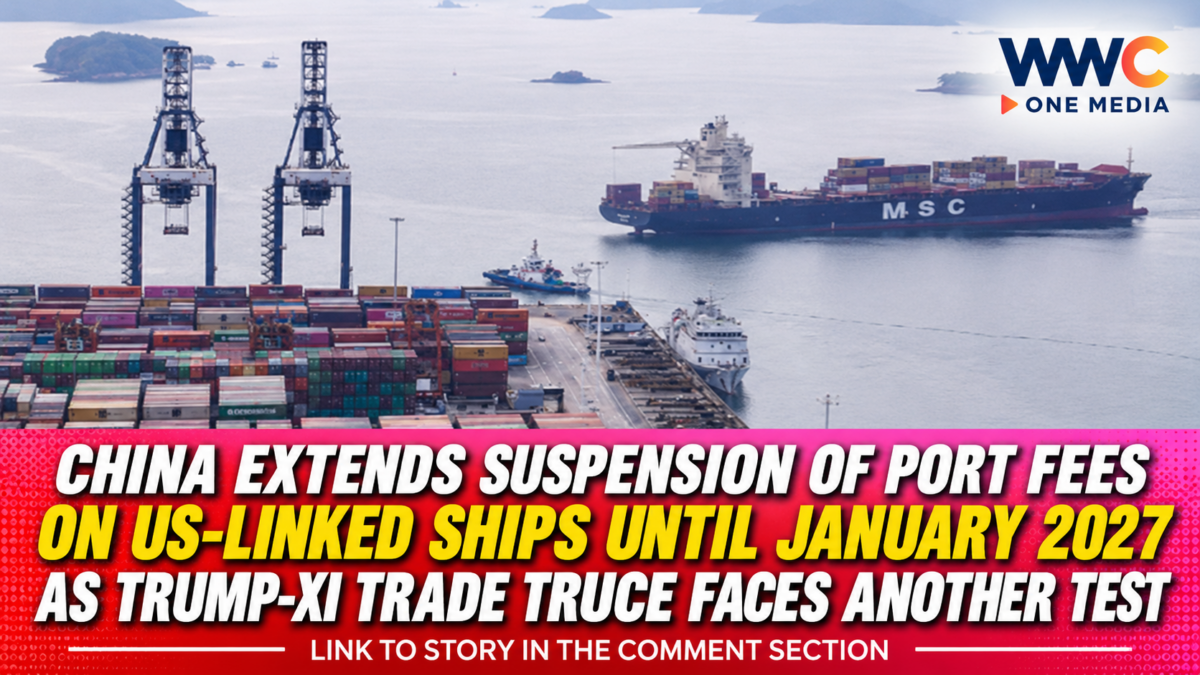
China has extended its suspension of special port fees on vessels linked to the United States until January 10, 2027, giving the world’s two largest economies another two months to prevent their maritime dispute from escalating into a fresh trade confrontation.
The decision, announced by China’s Ministry of Transport on Monday, November 9, 2026, also extends the suspension of Beijing’s investigation into the security of shipping and shipbuilding supply chains.
The move comes as Washington and Beijing continue working to preserve a fragile trade agreement covering tariffs, shipping, critical minerals and other strategic economic interests.
For international shipping companies, importers and exporters, the extension provides temporary relief from additional port charges that could have increased transportation expenses and disrupted global supply chains.
But the decision does not resolve the underlying disagreement over China’s dominance of the global shipbuilding industry or America’s efforts to rebuild its domestic maritime capabilities.
Instead, it gives both governments more time to negotiate before another important deadline arrives in January.
China Extends Port Fee Suspension Until January 10, 2027
China’s Ministry of Transport confirmed that special port fees on US-linked vessels will remain suspended until January 10, 2027.
The government will also continue suspending its investigation into the impact of US measures on the security and development interests of China’s shipping, shipbuilding and related industrial supply chains.
According to the ministry, the extension was approved by the State Council and implements the outcomes of the eighth round of China-US economic and trade consultations.
The suspension covers three measures introduced by China in 2025:
- The announcement imposing special port fees on US ships.
- The implementation measures governing the collection of those fees.
- The investigation into the security of shipping and shipbuilding supply chains.
China originally announced the suspension on November 10, 2025, following an agreement reached during economic and trade discussions with the United States in Kuala Lumpur, Malaysia.
The arrangement was part of a broader effort to prevent retaliatory maritime measures from escalating alongside the two countries’ tariff dispute. en.chinadiplomacy.org.cn+1
The United States Is Also Extending Its Suspension of Port Fees on Chinese Ships
China’s decision is particularly significant because Washington has also extended its own suspension of maritime fees targeting Chinese-linked vessels.
The US Trade Representative proposed extending the pause on Section 301 maritime measures through January 9, 2027.
The measures target vessels owned or operated by Chinese entities and ships built in China that call at US ports.
The United States introduced the measures following a Section 301 investigation into China’s maritime, logistics and shipbuilding sectors.
The original suspension was scheduled to expire in November 2026. However, the US decision to extend it by approximately two months prevents the immediate return of additional charges.
China’s extension to January 10 effectively keeps the two countries’ reciprocal maritime fee suspensions aligned, although their respective deadlines differ by one day.
The parallel decisions are important because imposing additional fees on vessels associated with the other country could have created new costs for shipping operators and companies dependent on international freight.
The latest developments suggest that both governments currently prefer to maintain the temporary arrangement rather than immediately restart the maritime dispute. S&P Global+2
Why Did the US and China Introduce Special Port Fees?
The maritime dispute originated from Washington’s concerns about China’s growing dominance of global shipbuilding, shipping and logistics.
In April 2024, the US Trade Representative launched a Section 301 investigation into China’s practices in these industries following a petition from American labour organisations.
Washington argued that Chinese government support, industrial policies and market practices had weakened American competitiveness and created significant dependencies in industries considered important to national security and economic resilience.
The investigation concluded that China’s policies and practices were unreasonable and burdened US commerce.
The Trump administration subsequently introduced port-fee measures designed to make Chinese-linked vessels more expensive to operate in American ports.
China responded with its own special port fees targeting US-linked vessels.
The confrontation threatened to affect international shipping companies even when their cargoes were not directly connected to the political dispute.
That was one reason the maritime measures became part of the wider US-China trade negotiations.
How Much Could Shipping Companies Have Paid?
The original US measures included different fee structures depending on a vessel’s ownership, operator and country of construction.
Under the revised framework, fees included:
- US$50 per net ton per voyage for vessels owned or operated by Chinese entities.
- US$18 per net ton or US$120 per container discharged, whichever was higher, for certain Chinese-built vessels operated by non-Chinese companies.
These charges were substantially less aggressive than the original proposals, which had contemplated fees reaching as much as US$1.5 million per port call for certain Chinese-built vessels.
The financial impact could have been considerable for shipping operators making repeated calls at American ports.
The consequences would not necessarily have stopped with vessel owners. Shipping companies could have passed additional costs to exporters, importers and ultimately consumers through higher freight rates.
S&P Global reported that the potential charges had generated concern among American coal exporters, particularly because of their dependence on international shipping capacity.
The additional expenses could have made US exports less competitive in overseas markets. S&P Global+1
American Businesses Want the Port Fee Suspension to Continue
The possibility of reinstating maritime fees has attracted opposition from American business and shipping organisations.
According to Supply Chain Dive, more than 250 industry stakeholders signed a letter urging the US Trade Representative to permanently suspend the Section 301 vessel fees.
The organisations included the National Retail Federation, National Association of Manufacturers, World Shipping Council and US Dairy Export Council.
Their concern is that additional charges could increase transportation costs and create uncertainty for companies that have little control over which vessels shipping lines use.
The organisations also questioned whether port fees alone could meaningfully rebuild America’s shipbuilding industry.
China has a significant advantage in global commercial shipbuilding capacity, while the United States continues facing limitations involving shipyards, skilled labour and production capacity.
For American businesses, the immediate priority is maintaining reliable shipping services without introducing additional costs that could weaken their international competitiveness. Supply Chain Dive+1
China and America Are Trying to Prevent Another Trade War
The port fee extension is part of a much broader effort to maintain the fragile economic understanding between Washington and Beijing.
The two countries have spent years imposing tariffs, restricting technology transfers and introducing countermeasures affecting strategic industries.
The trade truce reached in 2025 helped reduce some of the immediate pressure, but disagreements over market access, industrial policy, critical minerals and agricultural trade remain unresolved.
The extension of the maritime fee suspension therefore represents another temporary step towards keeping negotiations alive.
WWC ONE MEDIA previously examined the wider agreement in US-China Trade Truce Extended — But the Bigger Deal Is Still Out of Reach.
The report explains why the two governments continue negotiating despite disagreements over tariffs, agricultural purchases, rare-earth supplies and technology restrictions.
Another analysis, US and China Extend Trade Truce to January as Trump-Xi Summit Opens Door to Bigger Deal, examines how the temporary arrangement gives both countries additional time to pursue a broader economic agreement.
The maritime fee extension fits into that same strategy: avoid another immediate confrontation while negotiations continue.
Rare Earths and Critical Minerals Add Pressure to the Negotiations
Shipping fees are not the only source of tension between Washington and Beijing.
Critical minerals and rare-earth materials remain among the most important economic issues in the relationship.
China dominates significant parts of the global rare-earth processing and manufacturing supply chain. These materials are essential for electric vehicles, electronics, renewable-energy equipment, advanced manufacturing and defence technologies.
The United States wants more reliable access to these strategic resources and greater independence from Chinese supply chains.
Beijing, meanwhile, has used export controls and licensing requirements as part of its approach to managing sensitive materials and technology.
Recent discussions between American and Chinese officials have also highlighted concerns about agricultural purchases and the implementation of previous trade commitments.
WWC ONE MEDIA recently covered the pressure facing the agreement in Trump’s China Trade Deal Faces New Crisis as Bessent and Greer Demand Action on Rare Earths and US Farm Purchases.
These disputes demonstrate why the maritime agreement should not be viewed as an isolated shipping decision. It is part of a much larger negotiation involving trade, technology, industrial competitiveness and economic security.
Could the Extension Benefit Global Shipping and Asian Exporters?
The decision could provide temporary stability for international shipping companies operating between Asia and the United States.
China is a major manufacturing and export centre, while American ports handle enormous volumes of imported consumer goods, industrial materials and other cargo.
If the additional port fees had returned, shipping operators could have faced difficult decisions involving vessel deployment, cargo allocation and freight pricing.
Some companies might have attempted to use alternative vessels or adjust shipping schedules to avoid the additional charges.
However, changing vessel assignments is not always straightforward. Shipping lines operate complex global networks, and the availability of suitable vessels depends on routes, capacity, contracts and port requirements.
Asian exporters could also benefit from greater predictability because additional maritime costs can affect the competitiveness of products entering the American market.
The extension does not guarantee lower freight rates, but it removes one potential source of additional cost during the suspension period.
January 2027 Could Become the Next Major Trade Deadline
The latest extension gives Washington and Beijing until January 2027 to make further progress.
The United States will need to decide whether to continue suspending its maritime measures or allow them to take effect.
China will face a similar decision regarding its special port fees and shipping supply-chain investigation.
If the two governments fail to reach a broader understanding, the possibility of renewed maritime charges could return.
That would create uncertainty for shipping operators already dealing with fluctuating fuel prices, geopolitical tensions and changing international trade policies.
The challenge for both countries is that the underlying problems remain unresolved.
Washington wants to strengthen domestic shipbuilding and reduce dependence on Chinese maritime capacity.
Beijing wants to protect its shipping and shipbuilding industries from what it considers unfair restrictions.
Neither side has abandoned those objectives.
The January deadline will therefore be an important test of whether the current suspension can evolve into a longer-term agreement.
What the China-US Port Fee Extension Means for the World
China’s decision to extend the suspension of special port fees on US-linked ships is a significant development for international trade.
It prevents the immediate return of retaliatory maritime charges and gives shipping companies another two months of relative certainty.
The matching US extension also suggests that both governments are still interested in maintaining the economic truce, even as disagreements over shipbuilding, critical minerals and industrial policy continue.
But the latest announcement is not a permanent settlement.
The maritime dispute remains unresolved, and the wider US-China relationship is still vulnerable to renewed tensions.
For businesses, the priority is predictable shipping costs and reliable access to international markets.
For governments, the challenge is finding a way to protect strategic industries without disrupting the global trade networks on which their economies depend.
China and the United States have bought themselves another two months. But when January 2027 arrives, will both sides finally reach a lasting maritime agreement—or will the return of port fees trigger another costly confrontation between the world’s two biggest economies?