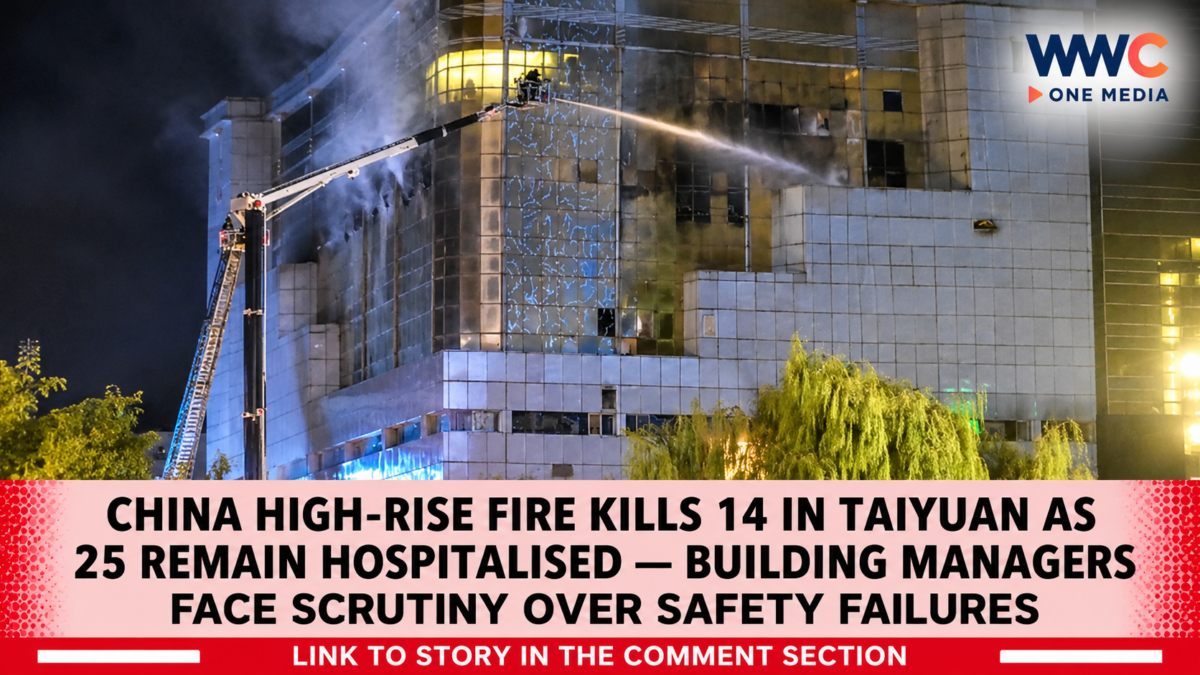
A devastating fire at a 40-storey mixed-use residential building in northern China has killed at least 14 people and left 25 others hospitalised, including nine in serious condition, as authorities investigate how the blaze spread through the high-rise property.
The fire erupted on Sunday evening, November 8, in Taiyuan, the capital of Shanxi province. Thick smoke poured from the building as firefighters used cranes and other equipment to battle the flames, which spread from a lower section of the complex towards its upper floors.
The tragedy has raised fresh concerns about fire safety in China’s densely populated buildings, particularly properties combining residential apartments, hotels, short-term accommodation and commercial businesses.
In a significant development, local authorities have also taken control measures against management personnel associated with the building’s owner and property-management company. The company’s previous record of fire-protection and workplace-safety deficiencies has added another dimension to the investigation.
The cause of the fire has not yet been officially established.
Fire Erupts in 40-Storey Building in Downtown Taiyuan
The blaze broke out at approximately 4:59pm on November 8 at the Haosheng International Apartment building in the Liuxiang area of Taiyuan’s Yingze district.
The property is a mixed-use complex containing residential accommodation, hotels, short-term rental apartments, small businesses and children’s tutoring facilities.
According to reports from Reuters and Chinese state media, the fire appeared to begin around the fourth floor of a lower annex before spreading towards the eighth and ninth floors, where a hotel is located.
Videos verified by Reuters showed thick smoke billowing from the 40-storey structure while firefighters positioned on cranes worked to extinguish the flames.
The fire was brought under control at approximately 7pm, about two hours after it began. Rescue operations were completed by around 8:30pm.
The rapid spread of smoke and flames through a building with multiple types of occupants created a challenging emergency for firefighters and rescue personnel. Reuters+1
Death Toll Rises to 14 as 25 People Remain Hospitalised
The death toll increased as authorities continued confirming casualties following the rescue operation.
Initially, 38 people were taken to hospital, with five deaths reported on Sunday night. By Monday, November 9, authorities had confirmed that at least 14 people had died.
A further 25 people remained hospitalised, including nine whose injuries were classified as serious.
The figures reflect the latest reported official casualty update available in the initial coverage of the disaster. Authorities have not publicly released the identities of all the victims.
Emergency medical teams continued treating survivors while officials coordinated assistance for affected families.
The number of people killed makes the Taiyuan incident one of the most serious recent residential building fires reported in the city. AsiaOne+2
Building Management Comes Under Investigation
One of the most important developments following the tragedy concerns the building’s management.
Caixin Global reported on November 10 that the property’s management company had previously been fined for fire-protection deficiencies and workplace-safety failures.
Authorities have also taken control measures against personnel from the building’s ownership unit and the head of its property-management company.
These developments have intensified questions about whether safety violations, maintenance problems or weaknesses in building management contributed to the disaster.
However, investigators have not yet established that the previous violations caused Sunday’s fire.
The distinction is important: a history of safety deficiencies raises legitimate concerns, but the precise cause of the blaze and any responsibility for the deaths must be established through the investigation.
Authorities have said the findings will be handled in accordance with the law. Caixin Global+1
Why the Building’s Mixed-Use Design Raises Safety Questions
The Haosheng International Apartment was not simply a residential tower.
Its combination of apartments, hotels, short-term rentals, businesses and educational facilities meant that different groups of people could have been inside the building when the fire broke out.
This type of mixed-use development can create complicated evacuation challenges.
Hotel guests may be unfamiliar with emergency exits. Short-term renters may not know the building’s layout. Commercial occupants and residents may also have different evacuation procedures and levels of familiarity with safety equipment.
When a fire spreads through a shared structure, smoke can move into corridors, stairwells and other common areas, potentially affecting people far from the original ignition point.
Investigators will need to determine how the building’s fire-protection systems performed, whether emergency exits remained accessible and whether occupants received adequate warnings.
They will also need to examine whether the building’s design and management arrangements complied with applicable safety requirements.
At this stage, authorities have not publicly established which specific safety systems failed, if any.
China Faces Renewed Scrutiny Over High-Rise Fire Safety
The Taiyuan tragedy comes amid continuing concerns about fire safety in China’s residential and commercial buildings.
The country has experienced several deadly fires in recent years, prompting authorities to strengthen inspections and review safety standards.
One of the most devastating recent examples was the November 2025 fire at Wang Fuk Court in Hong Kong, which killed 168 people and triggered an extensive investigation into construction materials, renovation practices and fire-protection systems.
That disaster exposed how building maintenance, combustible materials and inadequate safety arrangements can combine to produce catastrophic consequences.
WWC ONE MEDIA previously examined the continuing legal and safety fallout in 259 New Charges After Hong Kong’s Deadliest Fire — What Went Wrong at Wang Fuk Court?.
Although the Hong Kong disaster and the Taiyuan fire involve different buildings and circumstances, both have renewed attention on the importance of fire-resistant materials, properly maintained alarms, accessible escape routes and effective emergency planning.
A Previous Fire-Safety Campaign Faces Another Test
China launched a nationwide campaign to address fire hazards in high-rise buildings following the deadly Hong Kong disaster.
The campaign placed greater emphasis on identifying fire risks, inspecting building systems and improving safety management.
The Taiyuan incident now raises questions about how effectively such measures are being implemented, especially in older or mixed-use properties.
A building can contain modern facilities and still present serious risks if safety equipment is poorly maintained, evacuation procedures are inadequate or property managers fail to address known deficiencies.
The investigation will therefore be important not only for determining what happened in Taiyuan but also for identifying whether similar risks exist in other buildings.
What Investigators Must Establish
Authorities face several critical questions as the investigation continues.
Where exactly did the fire start?
Initial reports indicate that the blaze began around the fourth floor of a lower annex. Investigators must establish the precise point of origin and what ignited the fire.
Why did the flames spread towards the hotel floors?
The movement of fire and smoke through the building will be central to understanding how occupants became trapped or exposed.
Were fire alarms, sprinklers and emergency exits functioning properly?
Investigators will need to examine the building’s fire-protection systems, maintenance records and evacuation arrangements.
Did previous safety violations contribute to the disaster?
The reported history of fire-protection deficiencies at the management company makes this a particularly important question. Authorities must determine whether any outstanding safety problems were connected to the incident.
Until these questions are answered, it would be premature to attribute the fire to a specific electrical fault, construction defect or management failure.
Why the Taiyuan Fire Matters Beyond China
The tragedy is a reminder that high-rise fire safety is a major public-safety issue across Asia, where densely populated cities rely heavily on apartment towers and mixed-use developments.
Singapore, for example, has also experienced residential fires that required evacuations and hospital treatment for affected occupants.
WWC ONE MEDIA has reported on a Pasir Ris HDB fire that sent two people to hospital after smoke engulfed an eighth-floor flat.
Another incident in Bukit Panjang forced around 100 residents to evacuate after a fire broke out inside a ninth-floor flat. Details are available in the report on the Bukit Panjang HDB fire.
These incidents differ significantly in scale and circumstances from the Taiyuan disaster, but they illustrate how a fire inside one unit can quickly become an emergency affecting an entire residential block.
The importance of fire prevention is also reflected in Singapore’s emergency-response guidance, which regularly warns residents about overloaded electrical outlets, unattended appliances and obstructed escape routes.
For building owners and property managers, the broader lesson is that fire safety cannot depend on emergency response alone. Prevention, inspections, maintenance and evacuation planning must work together.
The Investigation Could Expose Deeper Building-Safety Problems
The death of 14 people in Taiyuan has placed the building’s management arrangements and fire-protection history under intense scrutiny.
The reported previous fines involving the management company make the investigation especially significant. Authorities must now determine whether those deficiencies were corrected and whether any outstanding problems contributed to the disaster.
For the families of the victims, the immediate priority is accountability and support for those affected.
For survivors, the focus remains on medical treatment and recovery.
For China’s authorities, the challenge is to establish exactly how the fire started, why it spread and whether preventable safety failures played a role.
The blaze was extinguished within approximately two hours, but the consequences will extend far beyond the emergency response.
With 14 people dead, 25 still receiving hospital treatment and the building’s management facing scrutiny over previous safety deficiencies, will the Taiyuan investigation uncover the failures behind one of northern China’s deadliest recent high-rise fires?