Three in four Singaporean parents believe private tuition is necessary for their children to succeed academically, even as most admit they want to reduce the pressure placed on their children.
A new survey released on November 9, 2026, by education advocacy group EveryChild.SG has exposed a growing contradiction in Singapore’s education system: parents want their children to enjoy a less stressful childhood, but many fear that reducing tuition and examination preparation could leave them at a disadvantage.
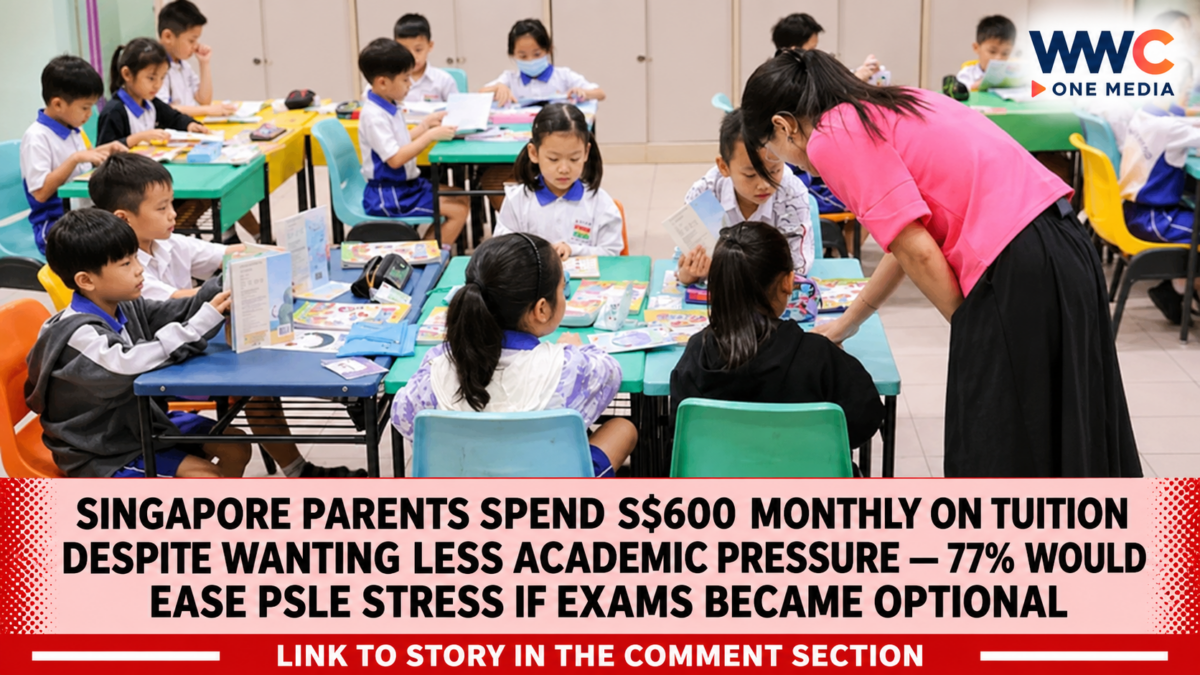
The survey found that families spent a median of S$600 monthly per child on tuition outside primary school. Meanwhile, 72 per cent of parents said they wanted to put less academic pressure on their children but worried that their children could lose out in the Primary School Leaving Examination (PSLE).
Even more significantly, 77 per cent said they would ease that pressure if children were guaranteed places in secondary schools through a system that made the PSLE optional.
The findings highlight the difficult choices facing families in Singapore, where academic achievement remains closely associated with future educational opportunities, despite years of efforts to promote holistic development and reduce examination stress.
The research was conducted by market research firm NielsenIQ and involved 4,007 Singapore citizens and permanent residents. It included 2,002 parents aged 25 to 65 whose children currently attend, or had attended within the previous five years, a local primary school, alongside 2,005 young adults aged 18 to 30 who had attended local primary schools. AsiaOne+1
Three in Four Parents Believe Tuition Is Necessary to Succeed
The survey revealed how deeply private tuition has become embedded in Singapore’s education culture.
Approximately 75 per cent of parents said tuition outside school was necessary for children to do well academically.
For many families, additional lessons are no longer viewed simply as optional support for students struggling with particular subjects. They are increasingly seen as an important way to remain competitive and prepare for major examinations.
However, the financial burden differs significantly depending on household income.
Families earning S$5,000 or less monthly spent a median of S$300 per primary school child on tuition.
Households earning between S$5,000 and S$15,000 spent S$600, while those earning between S$15,000 and S$20,000 spent S$1,000.
These differences demonstrate how access to additional academic support can depend heavily on a family’s financial circumstances.
For parents with limited resources, reducing tuition may feel like a difficult decision when they believe other children are receiving extra preparation.
The result is a competitive environment in which families may continue paying for tuition even when they question whether their children are already spending too much time studying. AsiaOne+1
72% Want Less Academic Pressure but Fear Their Children Will Fall Behind
One of the most revealing findings was the gap between what parents want for their children and what they feel compelled to do.
Although 72 per cent wanted to reduce academic pressure, many feared that stepping back from tuition or examination preparation could put their children at a disadvantage.
This concern is particularly significant because the PSLE remains an important transition point between primary and secondary education.
Parents must consider secondary school choices, admission requirements and their children’s examination performance, creating anxiety over whether reducing preparation could affect future opportunities.
The survey also found that 77 per cent of parents would ease academic pressure if their children were guaranteed secondary school places through a system that made the PSLE optional.
The findings suggest that many families are not necessarily opposed to reducing examination pressure. Instead, they want reassurance that their children will not lose opportunities if they choose a less competitive approach to education. AsiaOne+1
Parents Support a Through-Train System to Reduce Examination Stress
The survey also examined support for a proposed alternative to the current primary-to-secondary school transition.
Around 80 per cent of respondents believed a through-train system would make learning more enjoyable, while 79 per cent felt it could reduce examination pressure.
EveryChild.SG has previously proposed allowing approximately 80 to 90 per cent of pupils to progress directly into an associated secondary school without sitting the PSLE.
Students seeking admission to selective schools could still choose to take the examination.
The proposal aims to reduce the pressure surrounding the Primary 6 examination while preserving opportunities for students who want to compete for places in more selective institutions.
However, this remains an advocacy proposal, not an announced government policy.
There are also questions about how such a system would affect school admissions, educational standards and competition for popular secondary schools.
The idea is gaining attention because parents appear open to structural changes that could give children more time to develop their interests and abilities without making a single examination the centre of their primary school experience. AsiaOne+1
Large Class Sizes Are Another Reason Parents Turn to Tuition
The survey identified another concern affecting families: whether teachers have enough time to provide individual attention in classrooms.
Approximately 66 per cent of respondents felt that classes were too large for teachers to give every child sufficient attention.
Meanwhile, 73 per cent of parents believed large class sizes contributed to the perceived need for private tuition.
This suggests that some families see tuition as a way to compensate for limitations in classroom support.
When children struggle to understand lessons or need more time to master particular subjects, parents may turn to private tutors for additional explanations and practice.
However, the findings also raise broader questions about classroom resources, teacher workloads and whether schools can provide sufficient individual support without families having to pay for additional lessons.
WWC ONE MEDIA previously examined Singapore’s efforts to address classroom pressures in Singapore Will Test Smaller Classes in 6 Schools From 2027 — But MOE Says Teachers Could End Up Teaching More.
The planned pilot highlights the importance of examining not only class sizes but also how teachers’ responsibilities, staffing and classroom arrangements affect students’ learning experiences.
Separate IPS Study Shows Tuition Spending Has Continued to Rise
The EveryChild.SG findings come after another major education study released by Singapore’s Institute of Policy Studies (IPS) in September 2026.
That separate survey involved 1,500 Singaporean and permanent resident parents with children attending local primary schools.
It found that average monthly tuition expenditure had increased to S$677 in 2026, compared with S$318 in 2016.
Average monthly enrichment spending also increased to S$355 from S$125 over the same period.
The IPS study found that nearly nine in 10 parents believed children spent too much time on tuition and enrichment activities.
Yet 70.2 per cent said they would spend more on these activities if they had the financial resources.
Another significant finding was that 87.9 per cent of parents reported experiencing stress about their children’s education, compared with 73.1 per cent in 2016.
The proportion reporting arguments with their spouses over their children’s education also increased, from 42.8 per cent to 59.7 per cent.
These findings reveal that education-related pressure extends beyond students’ examination preparation. It can affect household finances, relationships and parents’ emotional well-being.
The two surveys should not be treated as a direct comparison because they involved different samples, questions and research periods. Nevertheless, both point to persistent concerns about tuition, competition and parental anxiety. CNA+2
Parents Increasingly Value Happiness and Holistic Development
Despite their concerns about academic performance, Singaporean parents are also showing greater interest in their children’s overall development.
The IPS study found that 90.2 per cent of parents continued to rate Singapore’s education system highly, broadly unchanged from 90.3 per cent in 2016.
At the same time, more parents supported allowing children to make mistakes and learn from them. The proportion agreeing with this view increased from 62.2 per cent in 2016 to 79 per cent in 2026.
When choosing primary schools, parents placed strong importance on teachers who supported children’s social and emotional development.
For secondary schools, character, values, discipline and the child’s own preferences were among the factors receiving high levels of support.
However, academic considerations remain influential.
The IPS study found that 85.9 per cent of parents considered the PSLE an important checkpoint, while 75.8 per cent preferred secondary school admission based on PSLE results.
This illustrates why reducing academic pressure is difficult: parents may support a more balanced education system while continuing to rely on examination results when making decisions about their children’s future.
WWC ONE MEDIA previously explored this changing attitude in Singapore Parents Opt Out of Education Arms Race, Put Children’s Well-Being Ahead of Grades.
The experiences of parents who have chosen to prioritise happiness, personal interests and learning at a child’s own pace demonstrate that alternatives to constant academic competition are possible, even when social pressure remains strong. CNA+2
Singapore’s Education Ministry Faces a Difficult Balancing Act
The debate over tuition and the PSLE comes as the Ministry of Education continues reviewing how Singapore’s education system can become less competitive without weakening educational standards.
The ministry’s Education Conversations, which began in April 2026 and are expected to continue into 2027, include discussions about the PSLE, Direct School Admission and secondary school choices.
Second Minister for Education David Neo has acknowledged concerns that the transition from primary to secondary school can be a particularly stressful period for children and families.
One challenge is that removing one source of competition may simply move the pressure somewhere else.
For example, making the PSLE optional could increase competition for Primary 1 admission, specialised programmes or other secondary school opportunities.
The government must therefore consider whether reforms would genuinely reduce pressure or merely create new ways for families to compete.
WWC ONE MEDIA covered the policy debate in MOE to Examine PSLE, DSA and School Choice Pressures in Singapore.
The ministry’s discussions reflect a wider question about how to ensure that children have access to meaningful educational opportunities without making families feel that every decision could determine their future.
Could Singapore’s Tuition Culture Finally Change?
The latest survey exposes a difficult reality for Singaporean families.
Many parents want their children to have more time to play, explore personal interests and enjoy their childhood. Yet the fear of falling behind continues to influence decisions about tuition, enrichment and examination preparation.
The financial figures also show that academic competition can place different levels of pressure on households depending on their income.
For some families, S$300 in monthly tuition is already a significant expense. For others, spending S$1,000 or more may be considered necessary to provide additional academic support.
The bigger challenge is creating an education environment in which parents feel confident that reducing tuition does not automatically mean sacrificing their children’s future opportunities.
Singapore has already introduced changes to examinations, subject-based learning and school admissions. But the latest findings suggest that changing policies alone may not be enough to transform parental expectations.
Ultimately, the question is whether Singapore can build an education system in which children are encouraged to succeed without feeling that every examination, activity and school placement is another competition they cannot afford to lose.
Until parents feel confident that their children can thrive without constant academic preparation, the tuition race may continue — even among families who desperately want it to slow down.