MANILA, PHILIPPINES — November 8, 2026 — When thousands of Filipinos take to the streets to demand accountability, most arrive with a message, not a weapon.
Yet the line between a peaceful demonstration and a violent confrontation can become dangerously thin when frustration, mistrust, fear and clashes with authorities converge.
That troubling reality is back in focus after ABS-CBN News published an explainer examining why public protests sometimes turn violent, revisiting the confrontation between demonstrators and police near Mendiola during the massive anti-corruption rallies of September 21, 2025.
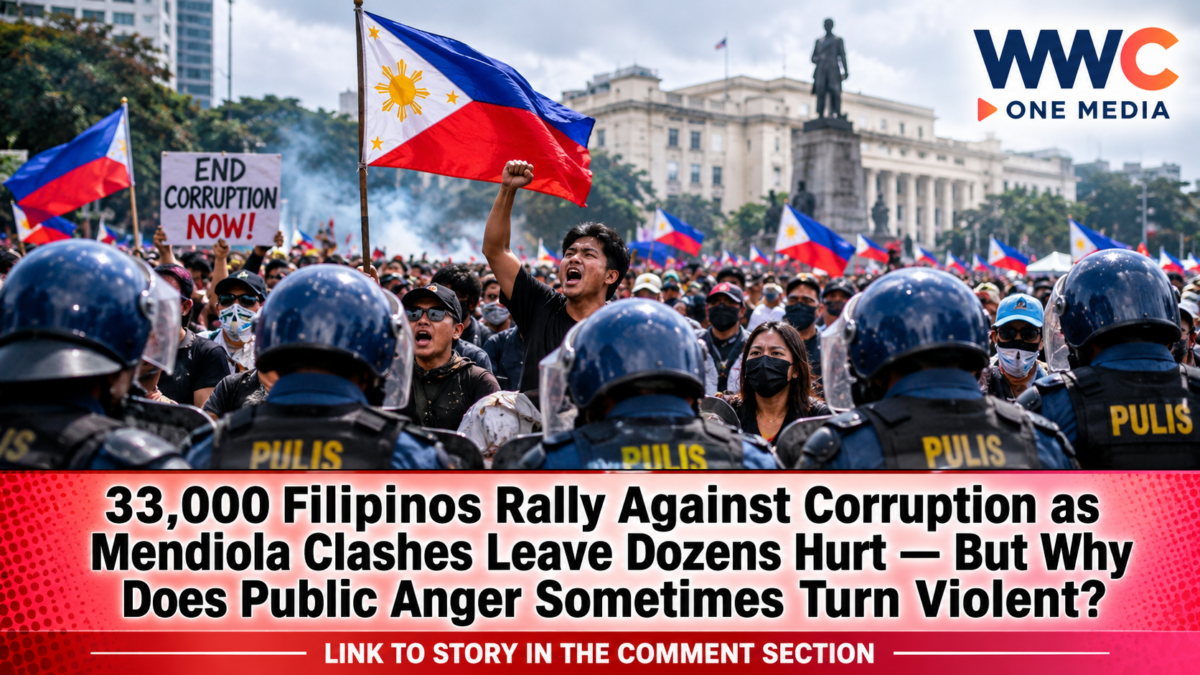
The incident unfolded while tens of thousands of Filipinos were protesting alleged corruption involving government flood-control projects.
Most participants joined peaceful demonstrations. But separate confrontations near the presidential palace escalated into attacks involving rocks, bottles and incendiary objects, according to authorities and eyewitness reporting.
The Associated Press reported that police arrested 49 individuals and that approximately 70 law-enforcement personnel were injured.
The violence became a disturbing counterpoint to the larger demonstrations demanding government accountability.
But research into crowd behavior suggests that protests rarely can be understood by looking only at their most dramatic moments.
Public anger may emerge from longstanding economic pressures, perceived injustice, distrust in institutions and frustration over problems that citizens believe have not been addressed.
What happens after people gather can depend on a complicated interaction between demonstrators, organizers, police and the broader political environment.
The central question is no longer simply why people become angry enough to protest. It is why some demonstrations remain peaceful while others spiral into confrontation—and whether the next violent clash can be prevented.
September 21, 2025: How Anti-Corruption Protests Turned Violent
The protests took place as public outrage intensified over allegations of corruption in Philippine flood-control projects.
Across Metro Manila, demonstrators demanded accountability from politicians, government officials and contractors implicated in alleged irregularities.
Major peaceful assemblies were held at Luneta and the EDSA People Power Monument.
The Associated Press reported that more than 33,000 people participated in those gatherings.
But near Mendiola, a smaller group clashed with police guarding routes toward Malacañang.
According to the Philippine National Police, individuals threw rocks and other objects at officers.
Authorities also reported that tires and a container vehicle were set on fire.
Police deployed riot-control measures to contain the disturbance.
Reuters footage showed burning tires, protesters throwing objects, police formations and individuals being detained.
Some law-enforcement personnel and other people were injured.
However, the violence around Mendiola should not be attributed to all participants in the broader anti-corruption movement.
The overwhelming majority of demonstrators at the major rally sites were reported to have assembled peacefully.
This distinction matters because a confrontation involving a relatively small group can dominate national headlines and overshadow the demands of thousands of peaceful participants.
Why Public Anger Can Build Before a Protest Begins
Protests are often the visible expression of frustrations that have accumulated over months or years.
People may become angry when they believe public institutions are failing to address problems affecting their lives.
These problems can include rising living costs, unemployment, inadequate public services, corruption and unequal treatment.
In the Philippines, allegations involving flood-control projects have been especially sensitive.
Citizens who experience repeated flooding may question why substantial public funds have not produced adequate protection.
When residents believe their concerns are repeatedly ignored, dissatisfaction can deepen.
That does not mean people experiencing hardship will inevitably become violent.
Most grievances do not result in violence, and many protest movements are deliberately committed to peaceful action.
But sustained perceptions of injustice can help explain why some issues generate unusually intense public reactions.
The distinction is between understanding the origins of anger and assuming that anger makes harmful actions acceptable.
The first is essential to responsible analysis.
The second would be misleading.
The Psychology of Protest: Why Crowds Do Not All Behave the Same Way
Modern research challenges the assumption that people automatically lose their judgment when they enter a crowd.
In a 2026 review published in the Annual Review of Psychology, social psychologist John Drury examined research on crowd behavior and collective identity.
The research emphasizes that participants often interpret events through shared beliefs and understandings of what their group is trying to achieve.
In other words, a crowd is not necessarily a collection of people behaving without reason.
Participants may have specific objectives, internal expectations and ideas about which actions are acceptable.
Crowd behavior can also change when the situation changes.
For example, people who initially expect a peaceful demonstration may react differently if they believe they are being treated unfairly.
Police responses, actions by particular participants and the spread of information can all influence how a confrontation develops.
But these relationships are not automatic.
A strong police presence does not necessarily cause violence.
Neither does an angry crowd inevitably become destructive.
The outcome depends on the circumstances, the actions of particular individuals and how the participants respond to one another.
How a Peaceful Demonstration Can Escalate
Research published in March 2026 in Integrative Psychological and Behavioral Science explored how anger and changing interpretations of events can contribute to protest escalation.
The analysis suggests that participants may initially view confrontation as a way to pressure authorities into responding to grievances.
If they conclude that their demands are being dismissed or that they are being treated illegitimately, some may reassess the situation and become more confrontational.
That process can involve several developments.
First, public frustration produces a willingness to demonstrate.
Second, protesters gather and establish expectations about how the event will unfold.
Third, a triggering incident—such as a disputed arrest, an attempted breach of a barrier or the throwing of an object—changes the atmosphere.
Fourth, some participants and police may respond to those events in ways that heighten tension.
Finally, a confrontation can spread beyond the people originally involved.
This is a possible pathway, not a universal explanation for riots.
The Mendiola incidents require assessment using evidence from the actual confrontation rather than assuming every research mechanism occurred there.
Police Actions Can Influence Whether Tension Escalates
Police have a responsibility to protect both public order and citizens exercising their constitutional rights.
How those responsibilities are carried out can affect whether a protest remains peaceful.
Researchers have examined approaches that emphasize dialogue, clear communication and proportionate responses to unlawful conduct.
Such approaches seek to avoid treating an entire gathering as hostile because of the actions of a few participants.
A 2025 study of protest management in Columbus, Ohio, examined a model emphasizing communication, de-escalation and graduated tactical responses.
The researchers reported that legitimacy-focused policing could help contain confrontation and encourage self-regulation within protest crowds.
That does not mean officers should ignore assaults or threats.
Rather, it suggests that policing strategies can seek to isolate specific harmful conduct while allowing lawful participants to continue demonstrating.
During the September 2025 demonstrations, Philippine officials said police had been instructed to exercise maximum tolerance.
President Ferdinand Marcos Jr.’s administration also emphasized that individuals responsible for violence would be held accountable.
Whether particular police actions during an incident were lawful and proportionate must be evaluated using the specific evidence, not generalized assumptions.
The Philippine Constitution Protects Peaceful Protests
Article III, Section 4 of the 1987 Philippine Constitution protects freedom of speech, expression and peaceful assembly.
This protection includes the right to petition government authorities for the redress of grievances.
The law recognizes that demonstrations are an important part of democratic participation.
Batas Pambansa Blg. 880, or the Public Assembly Act of 1985, provides rules governing public assemblies and law-enforcement responsibilities.
It defines maximum tolerance as the highest degree of restraint that authorities should exercise during public assemblies or their dispersal.
The statute also addresses permits and identifies circumstances in which a permit is not required.
The constitutional protection of peaceful assembly does not provide blanket immunity for assaults, arson or other criminal acts.
At the same time, authorities must not automatically treat an entire peaceful gathering as unlawful because specific individuals commit offenses.
Both principles are important.
The public has the right to demand accountability.
Police also have the responsibility to protect people from harm.
The challenge is enforcing those responsibilities fairly.
September 2026: Another Protest Tests Police Restraint in Taguig
The debate over protest rights and police response continued in September 2026.
Demonstrators gathered outside the Grand Hyatt Manila in Taguig to protest the proposed Pax Silica initiative during a forum attended by President Marcos.
The demonstration became confrontational, with injuries reported among police officers and activists.
The PNP reiterated its commitment to protecting peaceful assembly while warning against violence.
As previously reported by WWC ONE MEDIA, the incident highlighted competing concerns over public expression, crowd control and lawful police intervention.
Related WWC ONE MEDIA coverage: PNP Says the Right to Protest Will Be Protected—But What Happened in Taguig Shows Where Police Draw the Line
The Taguig protest was separate from the September 2025 Mendiola confrontation.
However, both incidents renewed debate over how authorities should handle demonstrations involving strong political disagreement.
They also demonstrate why specific responsibility for violence must be established rather than attributed collectively to all protesters.
Malacañang Says Protesters Should Use Lawful Channels
Following the Taguig confrontation, Palace Press Officer Claire Castro urged critics of Pax Silica to express their concerns through lawful channels.
The government acknowledged the right to question policy decisions but maintained that violence would not resolve the dispute.
As WWC ONE MEDIA reported, the administration’s response raised questions about whether official dialogue and public consultation were sufficient to address the protesters’ concerns.
Related WWC ONE MEDIA coverage: Palace Says Violent Protests Won’t Stop Pax Silica Debate—But Critics Are Demanding Answers the Government Still Has to Address
The issue illustrates an important challenge.
Governments can encourage peaceful dialogue, but those channels must be accessible and capable of responding meaningfully to legitimate concerns.
At the same time, participants remain responsible for their own conduct.
Frustration with government policy does not remove the obligation to respect other people’s safety.
Not Every Protest Becomes Violent: Cebu Offers a Different Example
The September 21, 2026 Martial Law anniversary demonstration in Cebu City offers a useful contrast.
Progressive groups marched to raise concerns about rising prices, wages, corruption, human rights and government accountability.
Police estimated that approximately 100 people participated.
The event concluded without a major reported violent incident.
According to reporting covered by WWC ONE MEDIA, tension briefly arose when police carrying anti-riot shields positioned themselves near demonstrators.
Organizers objected to the deployment.
Police officials subsequently ordered the personnel to withdraw while maintaining security monitoring.
The demonstration continued without major disruption.
Related WWC ONE MEDIA coverage: Rising Prices, Power and Fuel Costs Take Center Stage at Cebu Martial Law Rally
The Cebu incident does not prove that changing police positions will always prevent conflict.
It does, however, provide an example of authorities and demonstrators adjusting their actions during a tense situation without a major confrontation developing.
That distinction is important when evaluating claims that protests naturally turn violent.
Most do not.
Hagonoy Residents Show How Protest Can Remain Peaceful Despite Deep Anger
Another example comes from Hagonoy, Bulacan.
On September 20, 2025, residents organized a demonstration drawing attention to recurring flooding and allegations involving flood-control spending.
Participants walked through floodwaters as a symbolic expression of the conditions they said their communities continued to experience.
Their protest was designed to make a visible statement about government accountability.
As WWC ONE MEDIA previously reported, the event brought together residents frustrated by persistent flooding and alleged problems involving public infrastructure projects.
Related WWC ONE MEDIA coverage: Hagonoy Residents Wade Through Nearly 4 Feet of Floodwater to Protest—But Their Real Message Goes Beyond the Flood
The protest illustrates how citizens can communicate intense frustration through symbolic and collective action.
Its message was closely connected to experiences of flooding.
But the demonstration itself should not be confused with the separate violent confrontation near Mendiola the following day.
These examples show that shared political grievances can produce very different forms of collective action.
Can Corruption Scandals Intensify Social Unrest?
Allegations of corruption can create particularly strong public reactions because they involve questions about fairness, public resources and institutional trust.
Citizens may believe that money intended for infrastructure, health care or other public services has not been used properly.
Such allegations can become especially inflammatory when they concern essential services or public safety.
Flood-control spending provides a clear example.
Communities exposed to repeated disasters may see alleged project irregularities not merely as financial misconduct but as a threat to their livelihoods and safety.
However, anger over corruption does not establish the guilt of any particular official or contractor.
Specific criminal allegations must be investigated and adjudicated according to the law.
Nor does the existence of corruption allegations explain the actions of every individual at a demonstration.
Protests involve participants with different motivations and varying degrees of commitment to peaceful action.
Responsible reporting must distinguish the legitimate issues being raised from particular acts of violence.
Why Violent Clashes Can Undermine a Movement’s Message
Violence can dramatically change how a protest is perceived.
A gathering intended to highlight corruption may instead become associated with injuries, arrests and damaged property.
News coverage may focus on immediate security concerns rather than the underlying public demands.
Political leaders may also use incidents of violence to justify additional restrictions or condemn the protest movement more broadly.
That does not mean the original grievances disappear.
Nor does it mean that all demonstrators share responsibility for the conduct of a few individuals.
But the shift in public attention can affect how effectively a movement communicates its objectives.
For organizers, maintaining clear expectations and peaceful coordination can help protect participants and preserve the focus of a demonstration.
For police, responding proportionately to specific threats can help avoid unnecessary escalation.
For journalists, accurately distinguishing peaceful participants, alleged offenders and police actions is essential.
Can Better Communication Prevent the Next Confrontation?
There is no guaranteed formula for preventing every violent protest incident.
But research and practical experience identify several considerations that may help reduce risk.
Clear communication between organizers and police can reduce uncertainty about routes, barriers and permitted activities.
Visible and proportionate policing can help participants understand what authorities are trying to protect.
Organizers can establish expectations about peaceful conduct and identify ways to respond to confrontations.
Police can distinguish between specific people allegedly committing harmful acts and the wider peaceful crowd.
Authorities can also provide opportunities for grievances to be heard through credible institutional processes.
None of these measures removes the possibility of violence.
But they can reduce misunderstandings and create opportunities to address tension before it becomes a larger confrontation.
The most important lesson is that protest management involves more than security deployment.
It also involves legitimacy, communication, accountability and public trust.
The Bigger Picture: Anger Is a Warning Sign, Not an Excuse for Violence
The September 2025 anti-corruption protests revealed two different realities.
Thousands of Filipinos gathered peacefully to demand answers about alleged misuse of public funds.
At the same time, a separate confrontation near Mendiola resulted in injuries, arrests and damage.
Both developments matter.
The peaceful demonstrators were exercising an important democratic right.
The violence required investigation and an appropriate law-enforcement response.
ABS-CBN’s November 8 retrospective highlights why understanding the circumstances surrounding public anger is important.
Research suggests that collective frustration can deepen when citizens perceive institutions as unresponsive or unfair.
It also indicates that crowd dynamics and interactions with authorities can influence whether tension escalates.
But those findings should not be used to excuse attacks or assume that every protest follows the same pattern.
The strongest conclusion is that explaining violence and justifying violence are fundamentally different things.
For the Philippine government, the challenge is responding credibly to public grievances while respecting constitutional freedoms.
For law-enforcement agencies, it is maintaining order without treating peaceful demonstrators as criminals.
For protest organizers, it is protecting participants and preserving the legitimacy of their message.
And for the public, it is recognizing that democratic accountability requires both the freedom to speak and respect for the rights and safety of others.
As corruption allegations, economic pressures and public frustration continue to shape political debate, one question remains: Will Philippine institutions address the grievances that drive people into the streets—or could another confrontation once again overshadow thousands of citizens demanding change peacefully?